One of the common arguments offered during the NBA lockout was that David Stern and the owners had to initiate the lockout in an effort to make the league better. Citing the success of the NFL, these advocates predicted that the NBA would be more successful economically, more important culturally, and just a better game if it adopted the rules and policies of the NFL. Such arguments have not died down with the end of the lockout or with the start of the NBA season.
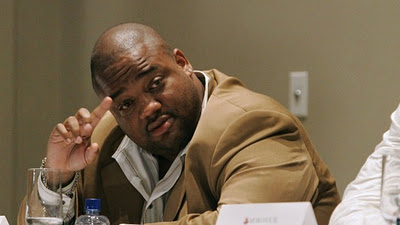
Embodying this logic is Jason Whitlock’s recent column, “NFL is model for American success.” Whitlock argues that NFL is a model of success not just for the NBA, but the nation. With a salary cap, revenue sharing, a requirement that players attend at least three years of colleges, its amateur draft design, its “emphasis on teams over individuals while making room for superstars” and “a free-agent system that allows franchises to retain their marquee players”, the NFL offers “the perfect blend of capitalism and socialism.” He remarks further:
One hundred years from now, when scholars analyze the rise and fall of our dynasty, the NFL might be considered America’s greatest invention, the cultural and economic force that should’ve been our guide to 200 more years of global domination.
If only Pete Rozelle had been our president rather than the architect of the modern-day national pastime, Americans would understand the value of restraints on capitalism, revenue sharing and a system that strengthens the poor.
There is so much wrong with the argument and the analysis that it is hard to know where to start. The idea that the NFL’s age restriction leads to a better or more successful system, even in absence of any sort of evidence, is reflective of Whitlock’s propensity to sell myths as fact. The ample success of NBA players, whether those who skipped college or those who were “one-and-done” ballers, runs counter to the rhetoric offered by Whitlock.
Likewise, the premise that NFL is superior because it emphasizes teams over individuals, which has led to increased fan interest, erases the overall popularity of NBA stars throughout the world. Whereas LeBron James, Kobe Bryant, and Michael Jordan are transnational icons, whose talents generated profits for the NBA and its corporate partners, the same cannot be said for the NFL. Think about it, can you name an NFL player that captures the global imagination?
When Michael Jordan was playing, he was one of the most recognizable people in the world; Kobe Bryant’s visits to Asia lead to mass hysteria. Would any NFL player – past or present – elicit such reactions? Despite the fact that the NBA erases these global realities from its economic picture, the NBA global success is very much a result of its emphasis on individual stars over teams.
Likewise, the ascendance of dynasties within the NBA – Bulls, Lakers, Spurs, Celtics –, which has certainly enhanced the NBA’s brand, is reflective of the structure of the NBA. In many regards, the NBA system is superior even though David Stern and the owners seem intent on slowly undermining what has been successful for the league in so many ways.
What is most striking, however, is Whitlock’s celebration of the NFL as an ideal model for the entire nation. Should the NBA and the nation at large emulate the model provided by the NFL given that: 21 former NFL players recently sued the NFL for not protecting players against the harms of concussions. In the lawsuit, they “accuse the NFL of deliberately omitting or concealing years of evidence linking concussions to long-term neurological problems.”
Is the NFL the ideal business and social model, given that: according to a 2006 Study in the St. Petersburg Times, for every year an NFL player spends it the league, it takes 3 years off his life expectancy. In other words, given that the average career of an NFL player is 4 years, his life expectancy will be 55 (as opposed to 75, the national average for American males). Put succinctly by Greg Doyle, “The NFL is killing its players, literally leading them to an early grave — and now the NFL is trying to kill them even faster. That’s a fact, people.” While some may call this rhetoric incendiary and hyperbolic, consider that in 2010, almost 280 players spent time on injured reserve, with 14 suffering head injuries, 13 experiencing neck injuries, and one dealing with spine injury.
The NBA is where injuries happen. While still early to measure the playoff implications, or more importantly any long-term impacts on a particular player’s health, the NBA lockout, the shortened preseason, and the tight packed schedule are having an immediate impact on the health of the league’s players and the quality of its games.
Players like Eddy Curry or Jerome James are easy fodder for fans and NBA analysts, but as the recent retirement of Brandon Roy reminds us, many NBA players risk their careers in attempting to get back on the court as soon as possible so their team can make a playoff run. Speaking on the long-term impact that Roy’s ill-fated return from during the 2010 playoffs had on his career, New York Times’ Rob Mahoney makes this salient point:
Few figures in the basketball narrative are treasured as highly as the Willis Reed archetype, and Roy has taken to the role of hobbling star time and time again.
The image of Reed hobbling onto the court during the 1970 playoffs is stuff of legend. As is the sight of a flu-ridden Michael Jordan willing his team to victory during the 1997 NBA finals. Both of these moments made Sports Illustrated’s top-10 Playing With Pain Moments, and Reed’s valiant return was chosen as the greatest all-time.
Until the 2011-12 season finds its heroic or Reed or Jordan moment, this money grab masking as an NBA season is only spurring higher health care costs and declining fan interest.
Take TNT’s Thursday night game that pit the Heat against the Hawks. The game ultimately ended after 3 OT periods, although the game was anything but thrilling. With LeBron James and Dwayne Wade sitting out, the most compelling match-up was Chris Bosh v. Ivan Johnson. The NBA isn’t where amazing happens, since much of amazing is sitting on the bench wearing street clothes.
The impact of injuries is evident as one scans ESPN’s rumor tab, which is a long list of injuries. No more reports on potential trades or trends in the league – just a medical report. Of course, you don’t have to bother with “rumor tab” when you can just go to CBS Sports Basketball injuries. I did just that, looking at the page on the evening of January 5, 2012. The number of players out for a single game, doubtful, questionable and probable is pretty astounding. Each of the following players are out for their team’s next game:
As part of its efforts to expand its market share, and make inroads with basketball players in America’s inner cities, Under Armour recently launched its “Are you from here?” campaign.
Pairing commercials with exhibition basketball games in various American cities, Under Armour embraced a grassroots marketing strategy: “While established brands are able to market globally with ease, Under Armour is building from the ground up using unique grassroots schemes to become a player in the ultra competitive world of basketball endorsement,” writes Peter Walsh in Slam Magazine. Walsh goes on to add, “With this strategy, Under Armour is hopeful that they will be able to build relationships with younger players and fans to build for the future as their popularity continues to grow.” Featuring Kemba Walker, Brandon Jennings, and Derrick Williams, these commercials theoretically introduce the future generation of consumers to the future of the NBA. While the NBA lockout limited the exposure and visibility of these commercials, now that the season is in full swing and the campaign is getting a second life, it is worth noting the interesting representations of race, class, and basketball simmering in these ads.
These commercials reify the dominant narrative that most NBA players grew-up in inner-city communities. While this fiction continues to hold sway, in reality a majority of NBA players spent their formative years in suburban and outer-burban neighborhoods. It is more convenient and potentially lucrative to portray NBA players emanating “straight-out-of Compton,” Chicago’s Southside, Coney Island, Oakland, or Harlem. To wit Under Armour’s commercials are laced with shots of metal fences, graffiti and other signifiers of urban life play upon the hegemonic visual signifiers of blackness, urbanity, and the NBA.
The commercial featuring Kemba Walker for example features him saying, I “grew up in the projects” a place “where every kid dreams about winning.” Likewise, the one featuring Brandon Jennings, with countless visual representations of Compton and the urban streets of Los Angeles, has him saying, the “streets are filled with chance and choice and always one move from losing it all.” According to Kemba Walker, “We’re just trying to show our faces in the communities man, we hood guys.”
Imagining America’s inner-cities as spaces of violence and opportunity, as space of despair and play, these commercial erase the complex experiences of urban America. Historian Robin D.G. Kelley in discussion of media representation of street ball elucidates the harmful messages delivered here. Commercials such as “Are you from here?” “romanticize the crumbling urban spaces in which African American youth play.” Such “representations… are quite remarkable; marked by chain-link fences, concrete playgrounds, bent and rusted nettles hoops, graffiti-scrawled walls, and empty buildings, they have created a world where young black males do nothing but play.”
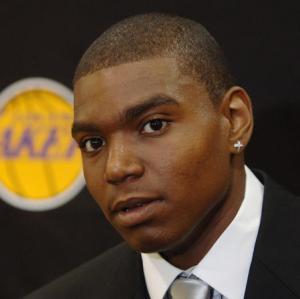
Lakers center Andrew Bynum has become persona non grata within the Los Angeles media. Bynum has become the source of media condemn and criticism, most of which has nothing to do with basketball, minus the manufactured panic over the Lakers’ non-struggles, and hand-wringing over whether Bynum is a viable trade asset in a deal for Dwight Howard.
T.J. Simers, in “Lakers need one more big man, fewer Chicken Littles,” feeds this panic over the Lakers in typical and clichéd demonization of Andrew Bynum. Depicting him as a “big baby,” unreliable and injury-prone, Simers is skeptical about Bynum’s worth to the Lakers:
“If the Lakers are going to be successful, they need Bynum playing shoulder-to-shoulder with Gasol and Kobe, making it the Big Three. That would mean Bynum stepping forward as a professional,”
Simers piles it on further
“I have my doubts. I was in his corner before he went punk in the playoffs, the big baby walking off the court while removing his jersey.”
The infantilization of Bynum while seemingly without much basis is especially troubling given the history of representing black men as immature boys. This column, however, doesn’t limit itself to the basketball arena offering cheap shots that would make any number of NBA “enforcers” proud. He follows-up his discussion of the basketball issues with the following:
Then he became the walking embodiment of the entitled athlete, twice in a span of two months having his car photographed parked in a handicap spot. Obviously he doesn’t care about the rules, civility or what others think. How many times did he park wherever he wanted without being caught?
The criminalization of black athletes is nothing new and Simers deploys this common deployed narrative with ease. According to sociologist Jonathan Markovitz, “The bodies of African American athletes from a variety of sports have been at the center of a number of mass media spectacles in recent years, most notably involving Mike Tyson and O.J. Simpson, but NBA players have been particularly likely to occupy center stage in American racial discourse.”
The film does provide exceptional moments, such as when Stokely Carmichael interviews his mother about their family’s struggles during Stokely’s childhood. Best of all is an impromptu speech given by Angela Davis about White repressive violence and Black self-defense. As David Leonard wrote in another review of the film, “Humanizing the movement and focusing on the interpersonal dynamics in a core theme of the film.”
However, as a historical text, I found the film disappointing. Undoubtedly, the movie was limited by the footage available; and it even opens with the following statement, “This film…does not presume to tell the whole story of the Black Power Movement, but to show how it was perceived by some Swedish filmmakers.” Thus, its creators deserve credit for recognizing Mixape’s shortcomings. Yet, although the documentary’s weaknesses can be forgiven, they unfortunately limit the film’s use as a teaching tool.
At times Mixtape presents an inaccurate chronology, like when it introduces the Black Panthers in its 1969 section, even though the organization was formed in 1966. In addition, the latter section of the film, on 1970-1975, becomes increasingly unfocused as the film shifts to concentrate on Black ghetto life and drug usage. The narrative further breaks down when the War on Drugs is discussed, which did not begin in earnest until the 1980’s. While the introduction and promotion of drugs like heroin, and later crack cocaine, certainly deserves a place in the story of Black Power, here it undermines the films coherence.
Moreover, the section on the 1970’s leaves out other notable developments such as the proliferation of Black cultural nationalism in the form of fashion, food, entertainment and culture. Also left out is Black Power’s increasing presence in electoral politics such as the Black Panthers’ bid for offices in Oakland and the Black Political Conventions of the early 70’s. Other topics that could have been address were the proliferation of Black Studies and Black Power’s impact in education, as well as the issues of masculinity and gender within the movement. Unfortunately, Mixtape ends up perpetuating the erroneous notion that the Black Power Movement was effectively over by 1971, save the Angela Davis trial.
Therefore, Mixtape would not be best for 100 or 200 level students, or as an introductory source on the Black Power Movement. Certain sections might be useful, but other films like Eyes on the Prize: Power!, Eyes on the Prize: A Nation of Law?,Negroes with Guns, and Scarred Justice are better suited for introductory purposes. However, for advanced students and scholars of the period, the film provides invaluable imagery of the 1960’s and 70’s Black Freedom Struggle.
Marc A. Robinson is a PhD candidate in the American Studies Program and teaches in the Critical Culture, Gender and Race Studies Department at Washington State University. His dissertation is on the Black Student Union and Black Power in the late 1960’s. Follow him @MarcARobinson1.
With FLOTUS and Rhianna targeted, 2011 ends with more racist and sexist language
Within the span of about 10 days, a little-known congressional representative and an even lesser known magazine emerged into the public by deliberately disrespecting two of the most popular black women in the world: the first lady of the United States Michelle Obama, and mega-pop-star Rihanna. Each of these instances are distinctly despicable in that they attempt to degrade women’s bodies generally by reaffirming a societal gaze that assigns value to a woman’s humanity based almost exclusively on the size and shape of her body. What may be more sinister here though is the deployment of this tragically common assault at two exceptionally popular and powerful black women with one unfortunate outcome being the fact that the ‘representative’ and the ‘magazine’ enhanced their ‘brands’ via an assortment of name checks in the media-sphere. Sadly we will have to (yet again) mention those (brand) names here.
During a recent Christmas bazaar at St. Aidan’s Episcopal Church in Hartford, Wisconsin, Rep Jim Sensenbrenner (R – WI) criticized Michelle Obama’s campaign against obesity given the size of her lower posterior.. Daniel Bice, in “Sensenbrenner apologizes to first lady over ‘big butt’ remark,” described the incident in the following way:
Perhaps Sensenbrenner – who was accompanied by an aide – assumed it was safe to crack wise about the first lady’s posterior in such a heavily Republican area. But, as the old saying goes, this is what happens when you assume.
Ann Marsh-Meigs, a church member who heard Sensenbrenner’s remarks, said he took several swipes at the first lady on Dec. 10. . . .“He then talked about how different first ladies have had different projects – Laura Bush and literacy – and he named two or three others,” Marsh-Meigs said in an interview last week. “And then he said, ‘And Michelle Obama, her project is obesity. And look at her big butt.’”
“That’s basically what he said,” she continued. “It was a combination of her work on obesity and her shape.”
When confronted by a woman in attendance, who sought to highlight Mrs. Obama’s wonderful qualities, Rep Sensenbrenner responded by noting that “Michelle should practice what she preaches – ‘she lectures us on eating right while she has a large posterior herself.’”
History reveals that the unmasking and over-sexualization of black bodies is a longstanding practice central to American popular culture. As Bobo (1995) states: “Representations of black women in mainstream media constitute a venerable tradition of distorted and limited imagery” (p. 33). Rather than constituting black women as “specific victims of the lust of [white] brutes,” dominant representations have posited black women as sexually deviant, aggressive, domineering or wretched victims – as mammies or jezebels (Hansberry, 1960).
Black women’s bodies have historically garnered negative attention in the public sphere; the black female form has posed as both a threat and a cheap, yet addictive, commodity within American culture. Within the realm of popular culture Janet Jackson’s breasts, like Jennifer López’s and Beyonce’s behinds, have elicited incredibly prurient commentary highlighting both the exotic determination and demonization of female bodies of color. This history endures through these comments that rely on the fragmentation of Michelle Obama’s body.
Colorlines recently published a 90 second video summarizing the year in race, an amazing feet given what has happened over the year. Statistical measurement define 2011, in many ways:
45 percent of the 131,000 homeless veterans in America are African-American
26 percent of African American families earn less than $15,000
1 in 9 African Americans live in neighborhoods where 40%+ of its residents live in poverty
Black women earn 68 cents for every dollar earned by men; for Latinas this number is 59 centers
16.2 percent of African Americans are unemployed
17.5 percent of black males are unemployed; 41 percent of black teenagers are without a job
11.4 percent of Latinos are unemployed; 21.3% of Alaska Natives and 19.3% of members of Midwest indigenous communities are unemployed
In 2011, blacks and Latino were twice as likely to face home foreclosures
“Between January and June of 2011, the United States carried out more than 46,000 deportations of the parents of U.S.-citizen children”
Yet, meaning of this year transcends these numbers. We have seen ample intrusions of blatant racism into the public square. I recently wrote about this, arguing:
In Two-Faced Racism, Leslie Picca and Joe Feagin explore the ways in which racial performances are carried in both the frontstage (integrated and multiracial public spaces) and the backstage (those private/semi-private all-white spaces where race talk and racist ideas reveal themselves in profound ways). Their research found that the backstage offers whites a place to “perform, practice, learn, reinforce, and maintain racist views of and inclinations toward people of color. These views and inclinations play a central role in generating and maintaining the overt and covert racial discrimination that is still commonplace in major institutions of this society” (27-28).
Increasingly, however, the frontstage is replacing the backstage whereupon whites are publicly performing, learning, reinforcing and maintaining their racist views toward people of color. Evident in college students donning blackface and then putting pictures online, evident in Gene Marks, Newt Ginrich, Donald Trump and their reactionary pals lamenting the laziness of black youth, evident in the usage of the N-word, evident in white-only movie screenings and white-only swimming pools, the lines between the frontstage and the backstage are blurring before our eyes. In other words, the frontstage is now the backstage, leaving me to wonder what sorts of ideologies, stereotypes and racial talk is transpiring in backstage. Or maybe, in a “post-racial America,” widespread racism has returned (did it ever leave?) to the frontstage thereby illustrating the importance of challenging and resisting in each and every location.
From Rep. Doug Lamborn referring to President Obama as a “tar baby” and Brent Bonzell describing President Obama as “a skinny, ghetto crackhead” to Fox’s headline for President Obama’s birthday party –“Obama’s Hip-Hop BBQ Didn’t Create Jobs” and Eric Bolling “criticizing” President Obama for “chugging 40’s in IRE while tornadoes ravage MO,” there have been ample examples of the ways in which public expressions of racism have defined the 2011 political sphere. The racism and sexism directed at Michelle Obama (just one example) and the astounding types of political commercials (just one example) are also evident of the ways in which violent rhetoric has dominated the public square.
Not surprisingly, Rush Limbaugh (calling President Obama a “oreo cookie” and Michelle Obama as “uppity”), Ann Coulter (“our blacks are better than theirs”), Pat Buchannan (“Blacks bought a lot of propaganda of the liberal plantation”), amongst others, all illustrate the ways in which racist language and ideologies define the nature of political discourse during 2011. Beyond the ample instances of racism, it is important to see beyond the starling ease that racism operates within the public square to look at the ways race plays out within the deployed narratives and ideologies. Take Pat Buchannan, who reminisced for Jim Crow during 2011: “Back then, black and white lived apart, went to different schools and churches, played on different playgrounds, and went to different restaurants, bars, theaters, and soda fountains. But we shared a country and a culture. We were one nation. We were Americans.” In language and the vision for America, race defined the past year (and the years before).
The last year has also seen quite a bit of recycling. From the Moynihan Report and culture of poverty, to bootstraps ideology and efforts to blame the poor, 2011 has seen a comeback (not that these racist narratives ever went away) of these troubling ideas. Two of the most illustrative examples were Newt Gingrich and Gene Marks. Gingrich, who has made a career of race baiting (calling President Obama a “food stamp president” and one defined by a “‘Kenyan, anti-colonial worldview’”), recently offered policy prescriptions to deal with black unemployment: teach black youth the value of work. He stated:
Really poor children in really poor neighborhoods have no habits of working. And have nobody around them who works. They have no habit of ‘I do this and you give me cash’-unless it’s illegal. What if you paid them part time in the afternoon, to sit at the clerical office and greet people when they came in? What if you paid them to work as the assistant librarian. What if they were the assistant janitor, and carried a mop?
Deploying longstanding stereotypes about black laziness and criminality, all while crafting economic policy based on bootstrapism, Ginrich shows how 2011 has been so much about sampling and redeploying the racist ideologies of yesteryear. Gene Marks, whose article prompted widespread condemnation because of its paternalistic tone and acceptance of widespread stereotypes, is equally reflective of this trend.
I am not a poor black kid. I am a middle aged white guy who comes from a middle class white background. So life was easier for me. But that doesn’t mean that the prospects are impossible for those kids from the inner city. It doesn’t mean that there are no opportunities for them. I believe that everyone in this country has a chance to succeed. Still. In 2011. Even a poor black kid in West Philadelphia.
The prosecution and sentencing of, and the struggle for justice for, Kelly Williams-Bolar is emblematic of many issues surrounding race in 2011. From the criminalization of people of color and the demonization of women of color, to educational inequalities and the generation of kids behind left behind, her case teaches us much about the continued struggle for civil rights in 2nd decade of the twenty-first century. Jamilah King described the case in the following way:
Just in case you haven’t seen this story blow up on your social network this week: Kelley Williams-Bolar is headed to an Ohio jail. The mother of two was sentenced this week to 10 days in jail, three years of probation, and 80 hours of community service. Her crime? Sending her two daughters to an out-of-district school. . . .It’s an infuriating case, especially for anyone who’s even remotely familiar with educational inequity in this country. America still hasn’t made good on its half-century promise to desegregate its public schools, and academic achievement can almost always be measured by zip code.
The demonization of women of color extended into the realm of popular culture as well.
2011 was also the year of The Help, a film that recycled the hegemonic Hollywood trope of “white love” (h/t Elon James White) and racial redemption all while sanitizing the black freedom struggle. Yet, it was also a year defined by the many powerful responses to this film; these effort resisted and challenged the film’s (mis)representation of black women’s work, segregation, social justice, and countless other issues. From the Association of Black Woman Historians’ powerful statement to the many articles from black scholars – Dutchess Harris, Rebecca Wanzo, Mecca Jamilah Sullivan, Martha Southgate, Mark Anthony Neal, Aishah Shahidah Simmons, Melissa Harris-Perry, and Honorée Fanonne Jeffers – many voices have challenged the narrative and representations offered by The Help, refusing to accept the cultural politics of the mainstream. Yet, 2011 has also seen the release of Pariah, a film that explores the experience of a young black lesbian struggling for acceptance within her family and society at large. Whereas The Help represents blackness as accessory, as the help, Pariah reminds audiences of the power and beauty of black identity, highlighting heterogeneity, diversity, and humanity.
2011 has seen ample moments of resistance, a refusal to accept and tolerate racism, sexism, and homophobia. It has been a year of “speaking truth to power” and refusing the dominant narrative. Following the airing of ABC’s 20/20 special entitled “Children of the Plains,” a group of Native American students from South Dakota produced their own video that refused the images and messages offered in the show: “I know what you probably think of us…we saw the special too. Maybe you saw a picture, or read an article. But we want you to know, we’re more than that…we have so much more than poverty.” Then there were the students from Ohio University, who launched the “We are a culture not a costume” campaign to protest the racist stereotypes and racist images so prominent during Halloween. Youth in California and Alabama fought vigorously to change the tide against anti-immigrant racism. Hotel workers in New York protested Dominique Strauss-Kahn and the victimization of Nafissatou Diallo. And so much more.
The power of new media as a space of resistance has been on full-display, whether the consciousness raising happening on twitter and Facebook, or the ways in which Jay Smooth, Jasiri X, Issa Rae, Amie Breeze Harper, Ariana Proehl. Scholars like Alondra Nelson, Koritha Mitchell, Nicole Fleetwood, Danielle McGwire, Kellie Jones, Evie Shockey, and Manning Marable (who we lost this year) have also published important works that advance the study of race, gender, and sexuality in both history and our current moment. In the face of erasure, dehumanization, and persistent inequalities, scholars and artists (see Lisa Thompson’s discussion of black women in theater), activists and organizers, and people from community big and small have met the racism and injustice with force. There has been so much to challenge in 2011 yet the many instances of injustice have not killed our “freedom dreams.” While these dreams will be deferred until 2012, the struggle will continue.




 Dr. David J Leonard