My latest @NewBlackMan: Dehumanized and Dismissed: Bananas, the NHL, and the Rhetorics of White Racism

Dehumanized and Dismissed:

Bananas, the NHL, and the Rhetorics of White Racism

by David J. Leonard | NewBlackMan

During a recent exhibition game between the Philadelphia Flyers and the Detroit Red Wings, the larger history of racism within NHL and society at large showed its ugly head. Held in London Ontario, a fan (or multiple fans) threw not one but two bananas at Wayne Simmonds. One of the flying bananas in fact reached the ice as Simmonds, one of 28 blacks playing in the NHL, skated in on the goalie during a shoot-out. “I don’t know if it had anything to do with the fact I’m black. I certainly hope not,” Simmonds noted. “When you’re black, you kind of expect (racist) things. You learn to deal with it. I guess it’s something I obviously have to deal with – being a black player playing a predominantly white sport.”

Others connected to the sport were not so willing (despite their having greater power and privilege) to reflect on the racial realities and hostilities of the NHL in this moment or elsewhere. While describing it as a “stupid and ignorant action,” Commissioner Gary Bettman made clear that incident was “in no way representative of our fans or the people of London, Ontario.” Maxine Talbot, a teammate of Simmonds, summarily dismissed the incident as “isolated” that said little about the state of hockey: “It’s not like there’s a problem with racism in our league. It’s one person!”

Dismissing it as an aberration and the work of some ignorant fans, the response fails to see the broader history of the NHL, not to mention the larger racial issues at work. While Bettman and others sought to isolate the incidence as the work of a single person who isn’t representative of hockey culture or society at large, others pointed to the persistence of racism within the NHL. Kevin Weeks, who had a banana thrown at him during the 2002 Stanley Cup Playoffs, noted his lack of surprise that Simmonds was subjected to such racism: “I’m not surprised. We have some people that still have their heads in the sand and some people that don’t necessarily want to evolve and aren’t necessarily all that comfortable with the fact that the game is evolving.”

Weeks is not alone here, with Glen McCurde, vice-president of membership service for Hockey Canada, contextualizing Simmonds’ experience within a larger tension that has resulted from the growing diversity of the NHL and Canada at large: “We recognize there’s a changing face of the population in Canada and hockey needs to change too. We need to change too. We need to ensure our programs are welcoming of all Canadians.” Yet, this instance (among others) illustrates that both hockey and Canada itself are imagined through and protected of whiteness. According to Peter Donnelly, the history of hockey is where “the sport has been comfortable in its whiteness. Reflecting on the larger history of racism in the NHL, Weeks, McCurdie, and Donnelly situate this moment within a broader milieu of racism.

The incident itself, the broader history of the NHL, and the frequent practice of fans throwing bananas at black soccer players within the European leagues (or the hurling of other racial epithets), however, was unconvincing to many of the commenters that appeared below the ESPN article. Focusing on the over sensitivity of African Americans, the lack of evidence of racial animus, and otherwise denying the importance of this incident through their insertion of “jokes” the collective reaction can be best described as both denial and dismal. In many ways the reaction to the sight of a fan throwing a banana at a black athlete mirror the type of responses that followed the reports about ASU fans donning blackface during a football game. These moments, as with other instances of everyday instances of racism, have not led to sustained dialogues about the persistence of racial violence within the public square or even efforts to eradicate the daily penetrations of racial hostilities, but instead efforts to isolate, deny, and dismiss, constructing these instances as minor issues at worst, one that has very little impact on society.

Such a callous and simplistic understanding of racism is on full display with Thomas Chatterton Williams’ The Atlantic piece, “Racism Without Racists?” Writing about Oprah Winfrey and other middle-class (or upper-middle class) African Americans who have spoke out against daily confrontations of individual prejudices and systemic racism, Williams seems to dismiss the significance of these moments, reducing them to trivial and minor moments of inconvenience. “The looming problem in black America is not that Oprah Winfrey can’t go to Hermès after hours or that Dr. Alexander is being overlooked. The point of real concern, it seems to me, ought to be the significant and growing class divide within the black community itself–the widening gap in opportunity and access that separates blacks who have educations and resources from those who do not. Offering a very narrow construction of racism that erases the connections and interdependence of racism,” Williams continues with his argument:

If we are fortunate enough to find ourselves in or near that first category, it is our ethical obligation not to forget the sacrifice it took for us to get there. Beyond that, though, it’s difficult to see what advantage can be gained trying to prove a negative or lamenting what cannot be known. And this much is certain: In a world where there’s racism, whether with or without racists, living well–as all of the people under consideration here are clearly doing–is, and always will be, the best and only revenge.

What is striking about his discussion here is the concerted efforts to isolate the micro-aggressions, the white racial frames that emanate throughout society, and the consequences of everyday racism. Individualize racism doesn’t exists in a vacuum but instead illustrates a larger history and ideological framework. A fan throwing a banana at a black player isn’t merely an affront to the player, an example of individualized racism, but a window into a larger history of racism inside and outside of hockey. It reflects the nature of white supremacy; it embodies the ways in which racism dehumanizes blackness and imagines black bodies as both pathological and savage.

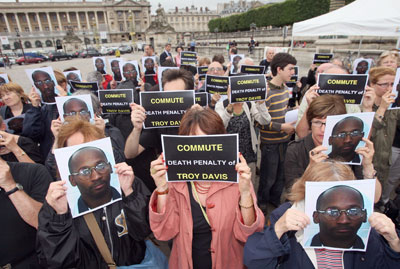
To deny the importance of the systematic dehumanization of blackness, given its consequences, evidence by the state-sponsored murder of Troy Davis and the persistence of the war on drugs, is troubling. The everyday racism of white supremacy whether it be with fans throwing bananas, college students donning blackface or attending ghetto parties, or the dissemination of racist jokes and epithets, is violent itself; yet, at another level, the constant intrusion of dehumanizing rhetorics, representations, and behaviors contributes to a process where both equality and full citizenship for people of color remain a dream deferred.


Post Script

In recent days, Wayne Simmonds has found himself under the spotlight again following accusations from Sean Avery that he used a “homophobic slur during the first period of the bitter preseason contest.”  Although the NHL was unable to confirm Avery’s accusation   (“since there are conflicting accounts of what transpired on the ice, we have been unable to substantiate with the necessary degree of certainty what was said and by whom. […] In light of this, we are unable at this time to take any disciplinary action with respect to last night’s events”) irrespective of Avery’s claims, video evidence showing Simmonds “hurling the epithet toward Avery” or Simmonds non-denial to the media, the incident should give us pause.  As Mark Anthony Neal noted on twitter (and thanks to @IyaOmotinuwe for raising this issue), it is the ultimate irony here.  Just as a tossed banana must be understood with a larger history and process of dehumanization, so does the language of homophobia.  Homophobic slurs perpetuate the denied humanity and rights afforded to members of the GLBT community.  In a statement to the NHL, Mike Thompson, acting president of GLAAD, made this clear:

Hate speech and anti-gay slurs have no place on the ice rink. The word that Simmonds used is the same word that is hurled at LGBT youth on the playground and in our schools, creating a climate of intolerance and hostility. He should not only apologize for this anti-gay outburst, but the Philadelphia Flyers and the NHL have a responsibility to take action and educate their fans about why this word is unacceptable.

A further irony and complication comes from the fact that Avery himself has been accused of racism, and more specifically that he uses racial slurs /epithets while on the ice (Alex Forlov, who made one accusation, subsequently backtracked).  All of this points to the larger issue of dehumanizing language and actions, all of which must thought of in relationship to large systems and ideologies that circumscribes equality and inclusion for all

via NewBlackMan: Dehumanized and Dismissed: Bananas, the NHL, and the Rhetorics of White Racism.

NewBlackMan: Could Dr. King Watch Big Time College Sports?

Could Dr. King Watch Big Time College Sports? Race Beyond Shame

by David Leonard and C. Richard King | NewBlackMan

In “Shame of College Sports,” legendary American historian Taylor Branch turns his college sports in this month’s The Atlantic. Focusing on the profits generated through college sports, the lack of power available to student-athletes, and the absurdity to claims of amateurism and student-athletes, Branch exposes the exploitation and hypocrisy that is as much part of the NCAA experience as March Madness and Bowl Games. Almost hoping to disarm critics who often scoff at ‘slavery analogies,’ Brand avoids that comparison instead embracing one that centers on colonialism.

Slavery analogies should be used carefully. College athletes are not slaves. Yet to survey the scene—corporations and universities enriching themselves on the backs of uncompensated young men, whose status as “student-athletes” deprives them of the right to due process guaranteed by the Constitution—is to catch an unmistakable whiff of the plantation. Perhaps a more apt metaphor is colonialism: college sports, as overseen by the NCAA, is a system imposed by well-meaning paternalists and rationalized with hoary sentiments about caring for the well-being of the colonized. But it is, nonetheless, unjust. The NCAA, in its zealous defense of bogus principles, sometimes destroys the dreams of innocent young athletes.

Providing readers with an amazing history, including the origins of the term student-athlete (as part of a systematic effort to avoid paying workers’ compensation claims for injured football players) and illustrating the methods used by NCAA and its partner schools to maintain the illusion of amateur sports all while raking in the dough, Branch surprisingly avoids the issue of race. The colonial analogy notwithstanding, there is virtually no discussion of the racial implications in this system, the larger history of the NCAA in relationship to race, and the ways in which white racial frames help to justify an acceptance of such a system.

Branch seems to point to the racial implications here in a section entitled, ““The Plantation Mentality,” where he quotes Sonny Vaccaro:

“Ninety percent of the NCAA revenue is produced by 1 percent of the athletes,” Sonny Vaccaro says. “Go to the skill positions”—the stars. “Ninety percent African Americans.” The NCAA made its money off those kids, and so did he. They were not all bad people, the NCAA officials, but they were blind, Vaccaro believes. “Their organization is a fraud.”

The reference to the “Plantation mentality” and the explicit acknowledgement that the bulk of profits are generated within sports that in recent years have been dominated by African American athletes generates surprisingly little discussion of the radicalized political economy of college athletics today. Over a decade ago, D. Stanley Eitzen observed

These rules reek with injustice. Athletes can make money for others, but not for themselves. Their coaches have agents, as many students engaged in other extracurricular activities, but the athletes cannot. Athletes are forbidden to engage in advertising, but their coaches are permitted to endorse products for generous compensation. Corporate advertisements are displayed in the arenas where they play, but with no payoff to the athletes. The shoes and equipment worn by the athletes bear very visible corporate logos, for which the schools are compensated handsomely. The athletes make public appearances for their schools and their photographs are used to publicize the athletic department and sell tickets, but they cannot benefit. The schools sell memorabilia and paraphernalia that incorporate the athletes’ likenesses, yet only the schools pocket the royalties. The athletes cannot receive gifts, but coaches and other athletic department personnel receive the free use of automobiles, country club memberships, housing subsidies, etc.

To our minds, then, Branch clearly misses an opportunity to reflect on the ways in which the system is built around generating profits through the labor of young African American men. Those profits – the billions of dollars earned through television contracts, merchandizing, video game deals, concessions, booster donations, ticket sales – find there way into the hands of overwhelming white constituency, coaches and athletic directors, in support of a largely white establishment.

Continue reading @ NewBlackMan: Could Dr. King Watch Big Time College Sports?.

Latest piece from @NewBlackMan: “Shut Up and Play:” Racism, Sexism and “Unattractive” Realities of American Culture


“Shut Up and Play:” Racism, Sexism and “Unattractive” Realities of American Culture

by David J. Leonard | NewBlackMan

My anger and frustration following yesterday’s tennis match has nothing to do with the match itself. While pulling for Serena Williams and disappointed by her defeat, the surprising loss did little to damper my spirits. What has inspired my ire has been the media’s yet again troubling treatment of Serena Williams.

Following the match and in response to her confrontation with the match umpire (see here for details and video), commentators have taken her to task, deploying racialized and gendered criticism. Described as “petulant,” going “bonkers,” as “a stereotypical Ugly American” and as someone whose “ego” led to a “tirade” the media tone has rendered what appeared to be a tame and minor confrontation into a spectacle that rehashes longstanding stereotypes about black women as childish, emotional, lacking self-control, and otherwise angry. In other instances, Williams has been demonized for her “outburst” and “menacing behavior,” for “losing her cool” during an “Ugly US Open meltdown” and the “the menacing tone of her remarks.” Mary Carillo referred to Serena’s behavior as that of an “ass clown.”

The references to her tone and demeanor as menacing, given the ways in which white supremacist discourse has pathologized and rendered African American as cultural, physical, and economic menaces are particularly revealing. “Racial logic has advanced a link between the legibility of black bodies, and a racial being,” argues Delia Douglas in “To be Young, Gifted, Black and Female: A Meditation on the Cultural Politics at Play in Representations of Venus and Serena Williams.” Noting, “that black bodies have historically been designated as the site and source of pathology,” Douglas makes clear that “behaviour and habits are seen as symptomatic of these racial distinctions.”

The hyperbolic and racially and gendered rhetoric is encapsulated by a column from George Vecesey in The New York Times

As she stormed at the chair umpire during a changeover, Williams was reverting to her vicious outburst at a line official that caused her to be disqualified at match point in a semifinal in 2009, the last time Williams was here.” “But at what point does comportment, sportsmanship, become part of the measure of a great champion?” “The tantrum early in the second set caused many in the crowd to boo the decision, delaying the next point. Stosur kept her cool, and Williams never showed a trace of those couple of hard hits. She could have gone out with dignity on an evening when she did not have her best game. Instead, she called the chair umpire a hater, and later professed not to remember a word of it.

Irrespective of the exaggerating and demonizing rhetoric, Serena Williams’ confrontation of the umpire was tame; while angry with a suspect call and unwilling to capitulate to authority merely because of custom, she was clearly composed, calm, and collective; there was no “outburst;” she did not “lose her cool” nor was anything about her behavior “menacing.”

Even the USTA has concluded that the “controversy” was much ado about nothing, fining Williams $2,000 dollars. Explaining the fine, it announced:

US Open Tournament Referee Brian Earley has fined Serena Williams $2,000 following the code violation issued for verbal abuse during the women’s singles final. This fine is consistent with similar offenses at Grand Slam events. As with all fines at the US Open, the monies levied are provided to the Grand Slam Development Fund which develops tennis programs around the world.

After independently reviewing the incident which served as the basis for the code violation, and taking into account the level of fine imposed by the US Open referee, the Grand Slam Committee Director has determined that Ms. Williams’ conduct, while verbally abusive, does not rise to the level of a major offense under the Grand Slam Code of Conduct.

Noting the existence of “similar offenses” during the course of all Grand Slam events, the USTA acknowledges the banality of the behavior from Serena Williams.

Williams has been positioned as yet another black athlete who may have the athletic talent, but lacks the mental toughness and commitment needed to excel on the biggest stages. More significantly, the post-match commentaries reveal the powerful ways that race and gender operate within American culture. Her blackness and femininity, especially in the context of the white world of tennis, overdetermines her positioning within a sporting context. This moment illustrates the profound impact of both race and gender on Serena Williams, a fact often erased by both popular and academic discourses. According to Delia Douglas, “The failure to consider the ways in which sport is both an engendering and racializing institution has lead to myriad distortions, as well as the marginalization and oversimplification of black women’s experiences in sport.” As such, her stardom, her success, and the specifics of the incident does not insulate her from criticism and condemnation, but in fact contributes to the acceptability in fans and commentators alike symbolically shouting and yelling, “Shut up and play.”

Continue reading @ NewBlackMan: “Shut Up and Play:” Racism, Sexism and “Unattractive” Realities of American Culture.

NewBlackMan: “Our Justice System at Its Worst”: Date Set for Troy Davis Execution

“Our Justice System at Its Worst”:

Date Set for Troy Davis Execution

by David J. Leonard | NewBlackMan (#TooMuchDoubt)

This week, Georgia announced its plans to carry out the execution of Troy Davis. While there remains time to thwart this miscarrying of justice, the planned execution should give pause to us all.

In absence of forensic evidence or a murder weapon, an all-white jury convicted Davis of the 1989 murder of a police officer in Savannah. The basis of the conviction was the witness testimony of nine individuals (7 eyewitnesses and 2 “jailhouse snitches”), many of who have subsequently spoken about police pressure. In fact, since his conviction, all but two of the prosecution’s non-police witnesses have recanted or contradicted their own testimonies, leaving the conviction in doubt. At the same time, 9 individuals have signed affidavits implicating another individual who happens to be one of the two witnesses who have not reversed on original testimony. Notwithstanding these significant doubts raised during the appeals process, one that has never allowed for his defense team to fully explore the recanting witness testimony, Davis’ conviction has remained, resulting in the issuing of his death warrant yesterday.

As part of its announced plan to stop the execution of Davis, the NAACP described the injustice in the following way: “This is our justice system at its very worst, and we are alive to witness it. There is just too much doubt.” Calling for people to take action to save Troy Davis’ life, his case points to larger racial issues that demand action as well.

His conviction and the decision to proceed with his execution should give pause given the research on race and witness identification. According to the Innocence Project, 75% of wrongful convictions overturned by DNA were the result of witness misidentification. “While eyewitness testimony can be persuasive evidence before a judge or jury, 30 years of strong social science research has proven that eyewitness identification is often unreliable” reports the Innocence Project. “Research shows that the human mind is not like a tape recorder; we neither record events exactly as we see them, nor recall them like a tape that has been rewound. Instead, witness memory is like any other evidence at a crime scene; it must be preserved carefully and retrieved methodically, or it can be contaminated.”

One of the sources of contamination is clearly race and the myriad of assumptions that result from an institutionalized system of stereotyping. In “Cross-Racial Identification Errors in Criminal Cases,” Sheri Lynn Johnson highlights the unreliable nature of “eye-witness” testimony, a fact that is exacerbated in cross-racial situations. Evidence from actual cases and in research studies elucidate the ways in which race and the larger social meanings attached to blackness play a significant role within the process of witness identification. In a study conducted with white students at University of Illinois and black students at Howard University, researchers showed them pictures of 10 white and 10 black individuals for a second and half; then, they were are asked to recall the pictures from a series of other photos. According to Elizabeth F. Loftus, in Eyewitness Testimony:

[T] he subjects were clearly better able to identify members of their own race. This study was later duplicated with the addition of Asian students. Again [African Americans] had greater difficulty recognizing faces of whites and Asians. Interestingly, however, whites and Asians had relatively little problem in identifying members of each other’s race – though both had trouble identifying [African Americans]. (from review of book)

The psychological obstacles facing witnesses along with the ways in which race further complicates the process is well documented. Yet, we continue to rely on witness testimony within the criminal justice system. The power of the white racial frame illustrates the reasonable doubt inherent in eyewitness testimony. In a society where black is akin to criminal, so much so that within the dominant imagination there exist a distinct category, the “criminalblackman” (Russell, 1998, p. 3), it is crucial to reflect on what is at stake with Troy Davis: his life and so many others.

The planned execution of Troy Davis also points to a larger question of the racial application of the death penalty within the United States. According to David Dow, 35 years into the return of the death penalty “It remains as racist and as random as ever.” Referencing the often-cited Baldus Study, which “found that black defendants were 1.7 times more likely to receive the death penalty than white defendants and that murderers of white victims were 4.3 times more likely to be sentenced to death than those who killed blacks,” Dow highlights the racist application of the death penalty. Cases involving an alleged black perpetrator and a white victim are far more likely to result in the death penalty. Although, “nationwide, blacks and whites are victims of homicide in roughly equal numbers . . . 80 percent of those executed had murdered white people.”

PLEASE CONTINUE READING @ NewBlackMan: “Our Justice System at Its Worst”: Date Set for Troy Davis Execution.

Lewis Gordon: The Problem With Affirmative Action | Truthout

The Problem With Affirmative Action

Monday 15 August 2011

by: Lewis R. Gordon, Truthout | Op-Ed

(Photo: _Davo_)

Henry Louis Gates Jr., the famed African-American literary scholar and director of the Du Bois Institute at Harvard University, recently reflected the following in an interview on National Public Radio: If it weren’t for affirmative action, he would not have been admitted to Yale University, regardless of how high his credentials were and he would not have had the opportunities to demonstrate his talent over the past four decades.(1)

Gates’ admission reflects a fundamental problem with affirmative action. It works. I had the opportunity to reflect on that out loud in a discussion at the Race and Higher Education conference in Grahamstown last month when I asked: “Are there no mediocre white people in South Africa? Is every white person hired, every white person offered admission to institutions of learning, an excellent candidate?”

My rhetorical question was premised upon what Gates and many other highly achieved blacks know and that is the myth of white supremacy is the subtext of the “qualifications” narrative that accompanies debates on affirmative action.

When I was tenured at Brown University, the process required evaluations of my work from five referees. Expected performance was a published monograph, several articles, satisfactory teaching, service and signs of international recognition. My dossier had the following: three monographs (one of which won a book award for outstanding work on human rights in North America), an edited book, a co-edited book, 40 articles (several of which had gone in reprint in international volumes), two teaching awards and service that included heading a committee that recruited 23 scholars of color to the university. The process for my promotion and tenure was dragged out because of continued requests for more referees. The number grew to 17.

There was a comparable white candidate in the philosophy department. He also supposedly worked in existentialism, one of my areas of expertise. His dossier? A contract for his dissertation and a few articles. His case was successful. His contracted dissertation was published several years later. He has since then not published a second book. He is now a full professor at that institution. Over the years, I have only met one person in his field who knew of and spoke well of his work. That person was a classmate of his in graduate school.

Was affirmative action necessary for my promotion and tenure? Yes. But as should be evident in this example and no doubt Gates’ and many others, there is another truth. Was investment in white supremacy necessary for less than stellar whites to be promoted? Yes.

Affirmative action, which brought people of color to the table to learn first-hand about the level of performance of their white predecessors and contemporaries, stimulated a reflection on standards in many institutions. As more people of color began to meet inflated standards, what were being concealed were the low standards available to the whites who preceded them (and no doubt many who continue to join them as presumed agents of excellence).

To continue reading click here: The Problem With Affirmative Action | Truthout.