NewBlackMan: A Prayer for Sophie


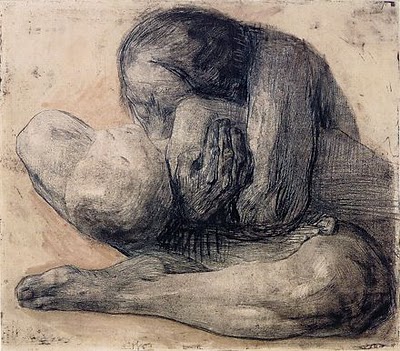
“Woman with Dead Child” by Kathe Kollwitz

**

A Prayer for Sophie

by David J. Leonard | NewBlackMan

Five years ago, on October 2, 2006, our family experienced one of life’s great joys, the birth of our second child, Sophie Nicole Leonard. We had spent the months leading up to her birth excitingly waiting for her to join our family. I can still remember painting her room or getting all of the baby stuff ready; the vivid image of our oldest daughter shouting to her unborn sister “the eggs are coming down and they taste really good,” as my partner ate her breakfast, remains encased in my mind.

Our joy and excitement would quickly turn into devastating agony, with our daughter ultimately succumbing to an infection, dying in the early morning of October 3rd. In an instant, we had lost our child, a tragedy that was beyond our imagination, even though its occurrence is too common throughout the world. Every detail of that day sits with me: getting dropped off at the hospital; how sick my wife looked when I entered the room; the sights and sounds when Sophie entered the world. More vivid and painful are the memories of where I was sitting when she went into cardiac arrest, the clothes I was wearing, the hospital smell, and the sounds of “code blue.” To this day, I still cannot see a helicopter without thinking about the 60+ mile trip I took in the dark, so close to my dying daughter yet unable to help or hold her. I cannot shake these memories nor can I shake those moments alone in a sterile and quiet hospital at 3AM where I obsessively watched the various monitors as evidence of her continued life. Just closing my eyes now, I can still see myself in the waiting room – waiting for things to turn around, waiting for my wife to arrive, waiting for the pain to stop; waiting . . . waiting, only to see her die in front of us, holding her one time before we drove those 60 long miles home.

While it has been five years, these memories remain strong. They remain with me. So does the number of people who told me, “It’s not suppose to happen.” While understanding people’s efforts to ease our pain by noting disbelief and shock since it wasn’t suppose to happen to “us,” the idea that we (and not others) were suppose to be immune to the tragedy of losing our daughter is one that sticks with me. It isn’t suppose to happen to anyone, but it happens all too often within the United States and globally.

For every 1,000 live births, 4.5 babies die in the United States. While relatively uncommon in the United States, the U.S. accounts for the second largest amount of neonatal deaths (that includes child deaths within the first 27 days of life) in the industrialized world. Compared to other countries around the world, the United States ranks with Croatia, United Arab Emirates, and Qatar, and lags behind Cuba, Slovakia, all of Western Europe and Scandinavia. The situation is even worse when as we look at racial inequality, especially as we look at the first year of life. African American children are 2.5 times more likely to die before their first birthday than white children.

Continue reading NewBlackMan: A Prayer for Sophie.

“We Are the 99 Percent”

Below is two images from the “we are the 99%” movement. Powerful illustrating of injustices and inequalities; interesting frames; interesting who is included and who isn’t included

2nd October 2011

Photo with 8 notes

2nd October 2011

I AM the 99%

I am 53 years old and have worked since I was 13 (paying into Social Security AND Medicare). I have lost 2 401Ks and a pension. I lost my home in 2007 due to mortgage fraud. I am ONE paycheck away from homelessness. I pay more in taxes than GE, Exxon and Bank of America combined. My plan for retirement is WORK UNTIL I DIE.

You can read more via We Are the 99 Percent.

Malcolm Gladwell on Bruce Ratner and the Barclays Center – Grantland

Ten years ago, a New York real estate developer named Bruce Ratner fell in love with a building site at the corner of Atlantic and Flatbush Avenues in Brooklyn. It was 22 acres, big by New York standards, and within walking distance of four of the most charming, recently gentrified neighborhoods in Brooklyn — Park Slope, Boerum Hill, Clinton Hill, and Fort Greene. A third of the site was above a railway yard, where the commuter trains from Long Island empty into Brooklyn, and that corner also happened to be where the 2, 3, 4, 5, D, N, R, B, Q, A, and C subway lines all magically converge. From Atlantic Yards — as it came to be known — almost all of midtown and downtown Manhattan, not to mention a huge swath of Long Island, was no more than a 20-minute train ride away. Ratner had found one of the choicest pieces of undeveloped real estate in the Northeast.

But there was a problem. Only the portion of the site above the rail yard was vacant. The rest was occupied by an assortment of tenements, warehouses, and brownstones. To buy out each of those landlords and evict every one of their tenants would take years and millions of dollars, if it were possible at all. Ratner needed New York State to use its powers of “eminent domain” to condemn the existing buildings for him. But how could he do that? The most generous reading of what is possible under eminent domain came from the Supreme Court’s ruling in the Kelo v. New London case. There the court held that it was permissible to seize private property in the name of economic development. But Kelo involved a chronically depressed city clearing out a few houses so that Pfizer could expand a research and development facility. Brooklyn wasn’t New London. And Ratner wasn’t Pfizer: All he wanted was to build luxury apartment buildings. In any case, the Court’s opinion in Kelo was treacherous ground. Think about it: What the Court said was that the government can take your property from you and give it to someone else simply if it believes that someone else will make better use of it. The backlash to Kelo was such that many state legislatures passed laws making their condemnation procedures tougher, not easier. Ratner wanted no part of that controversy. He wanted an airtight condemnation, and for that it was far safer to rely on the traditional definition of eminent domain, which said that the state could only seize private property for a “public use.” And what does that mean? The best definition is from a famous opinion written by former Justice Sandra Day O’Connor:

Our cases have generally identified three categories of takings that comply with the public use requirement. … Two are relatively straightforward and uncontroversial. First, the sovereign may transfer private property to public ownership — such as for a road, a hospital, or a military base. See, e.g., Old Dominion Land Co. v. United States, 269 U. S. 55 (1925); Rindge Co. v. County of Los Angeles, 262 U. S. 700 (1923). Second, the sovereign may transfer private property to private parties, often common carriers, who make the property available for the public’s use — such as with a railroad, a public utility, or a stadium.

A stadium. The italics are mine — or rather, they are Ratner’s. At a certain point, as he gazed longingly at the corner of Atlantic and Flatbush, a light bulb went off inside his head. And he bought the New Jersey Nets.

Earlier this year, NBA commissioner David Stern was interviewed by Bloomberg News. Stern was expounding on his favorite theme — that the business of basketball was in economic peril and that the players needed to take a pay cut — when he was asked about the New Jersey Nets. Ratner had just sold the franchise to a wealthy Russian businessman after arranging to move the team to Brooklyn. “Is it a contradiction to say that the current model does not work,” Stern was asked, “and yet franchises are being bought for huge sums by billionaires like Mikhail Prokhorov?”

“Stop there,” Stern replied. “… the previous ownership lost several hundred million dollars on that transaction.”

This is the argument that Stern has made again and again since the labor negotiations began. On Halloween, he and the owners will dress up like Oliver Twist and parade up and down Park Avenue, caps in hand, while their limousines idle discreetly on a side street. And at this point, even players seem like they believe him. If and when the lockout ends, they will almost certainly agree to take a smaller share of league revenues.

Continue reading at Grantland

My latest @NewBlackMan: Dehumanized and Dismissed: Bananas, the NHL, and the Rhetorics of White Racism

Dehumanized and Dismissed:

Bananas, the NHL, and the Rhetorics of White Racism

by David J. Leonard | NewBlackMan

During a recent exhibition game between the Philadelphia Flyers and the Detroit Red Wings, the larger history of racism within NHL and society at large showed its ugly head. Held in London Ontario, a fan (or multiple fans) threw not one but two bananas at Wayne Simmonds. One of the flying bananas in fact reached the ice as Simmonds, one of 28 blacks playing in the NHL, skated in on the goalie during a shoot-out. “I don’t know if it had anything to do with the fact I’m black. I certainly hope not,” Simmonds noted. “When you’re black, you kind of expect (racist) things. You learn to deal with it. I guess it’s something I obviously have to deal with – being a black player playing a predominantly white sport.”

Others connected to the sport were not so willing (despite their having greater power and privilege) to reflect on the racial realities and hostilities of the NHL in this moment or elsewhere. While describing it as a “stupid and ignorant action,” Commissioner Gary Bettman made clear that incident was “in no way representative of our fans or the people of London, Ontario.” Maxine Talbot, a teammate of Simmonds, summarily dismissed the incident as “isolated” that said little about the state of hockey: “It’s not like there’s a problem with racism in our league. It’s one person!”

Dismissing it as an aberration and the work of some ignorant fans, the response fails to see the broader history of the NHL, not to mention the larger racial issues at work. While Bettman and others sought to isolate the incidence as the work of a single person who isn’t representative of hockey culture or society at large, others pointed to the persistence of racism within the NHL. Kevin Weeks, who had a banana thrown at him during the 2002 Stanley Cup Playoffs, noted his lack of surprise that Simmonds was subjected to such racism: “I’m not surprised. We have some people that still have their heads in the sand and some people that don’t necessarily want to evolve and aren’t necessarily all that comfortable with the fact that the game is evolving.”

Weeks is not alone here, with Glen McCurde, vice-president of membership service for Hockey Canada, contextualizing Simmonds’ experience within a larger tension that has resulted from the growing diversity of the NHL and Canada at large: “We recognize there’s a changing face of the population in Canada and hockey needs to change too. We need to change too. We need to ensure our programs are welcoming of all Canadians.” Yet, this instance (among others) illustrates that both hockey and Canada itself are imagined through and protected of whiteness. According to Peter Donnelly, the history of hockey is where “the sport has been comfortable in its whiteness. Reflecting on the larger history of racism in the NHL, Weeks, McCurdie, and Donnelly situate this moment within a broader milieu of racism.

The incident itself, the broader history of the NHL, and the frequent practice of fans throwing bananas at black soccer players within the European leagues (or the hurling of other racial epithets), however, was unconvincing to many of the commenters that appeared below the ESPN article. Focusing on the over sensitivity of African Americans, the lack of evidence of racial animus, and otherwise denying the importance of this incident through their insertion of “jokes” the collective reaction can be best described as both denial and dismal. In many ways the reaction to the sight of a fan throwing a banana at a black athlete mirror the type of responses that followed the reports about ASU fans donning blackface during a football game. These moments, as with other instances of everyday instances of racism, have not led to sustained dialogues about the persistence of racial violence within the public square or even efforts to eradicate the daily penetrations of racial hostilities, but instead efforts to isolate, deny, and dismiss, constructing these instances as minor issues at worst, one that has very little impact on society.

Such a callous and simplistic understanding of racism is on full display with Thomas Chatterton Williams’ The Atlantic piece, “Racism Without Racists?” Writing about Oprah Winfrey and other middle-class (or upper-middle class) African Americans who have spoke out against daily confrontations of individual prejudices and systemic racism, Williams seems to dismiss the significance of these moments, reducing them to trivial and minor moments of inconvenience. “The looming problem in black America is not that Oprah Winfrey can’t go to Hermès after hours or that Dr. Alexander is being overlooked. The point of real concern, it seems to me, ought to be the significant and growing class divide within the black community itself–the widening gap in opportunity and access that separates blacks who have educations and resources from those who do not. Offering a very narrow construction of racism that erases the connections and interdependence of racism,” Williams continues with his argument:

If we are fortunate enough to find ourselves in or near that first category, it is our ethical obligation not to forget the sacrifice it took for us to get there. Beyond that, though, it’s difficult to see what advantage can be gained trying to prove a negative or lamenting what cannot be known. And this much is certain: In a world where there’s racism, whether with or without racists, living well–as all of the people under consideration here are clearly doing–is, and always will be, the best and only revenge.

What is striking about his discussion here is the concerted efforts to isolate the micro-aggressions, the white racial frames that emanate throughout society, and the consequences of everyday racism. Individualize racism doesn’t exists in a vacuum but instead illustrates a larger history and ideological framework. A fan throwing a banana at a black player isn’t merely an affront to the player, an example of individualized racism, but a window into a larger history of racism inside and outside of hockey. It reflects the nature of white supremacy; it embodies the ways in which racism dehumanizes blackness and imagines black bodies as both pathological and savage.

To deny the importance of the systematic dehumanization of blackness, given its consequences, evidence by the state-sponsored murder of Troy Davis and the persistence of the war on drugs, is troubling. The everyday racism of white supremacy whether it be with fans throwing bananas, college students donning blackface or attending ghetto parties, or the dissemination of racist jokes and epithets, is violent itself; yet, at another level, the constant intrusion of dehumanizing rhetorics, representations, and behaviors contributes to a process where both equality and full citizenship for people of color remain a dream deferred.


Post Script

In recent days, Wayne Simmonds has found himself under the spotlight again following accusations from Sean Avery that he used a “homophobic slur during the first period of the bitter preseason contest.”  Although the NHL was unable to confirm Avery’s accusation   (“since there are conflicting accounts of what transpired on the ice, we have been unable to substantiate with the necessary degree of certainty what was said and by whom. […] In light of this, we are unable at this time to take any disciplinary action with respect to last night’s events”) irrespective of Avery’s claims, video evidence showing Simmonds “hurling the epithet toward Avery” or Simmonds non-denial to the media, the incident should give us pause.  As Mark Anthony Neal noted on twitter (and thanks to @IyaOmotinuwe for raising this issue), it is the ultimate irony here.  Just as a tossed banana must be understood with a larger history and process of dehumanization, so does the language of homophobia.  Homophobic slurs perpetuate the denied humanity and rights afforded to members of the GLBT community.  In a statement to the NHL, Mike Thompson, acting president of GLAAD, made this clear:

Hate speech and anti-gay slurs have no place on the ice rink. The word that Simmonds used is the same word that is hurled at LGBT youth on the playground and in our schools, creating a climate of intolerance and hostility. He should not only apologize for this anti-gay outburst, but the Philadelphia Flyers and the NHL have a responsibility to take action and educate their fans about why this word is unacceptable.

A further irony and complication comes from the fact that Avery himself has been accused of racism, and more specifically that he uses racial slurs /epithets while on the ice (Alex Forlov, who made one accusation, subsequently backtracked).  All of this points to the larger issue of dehumanizing language and actions, all of which must thought of in relationship to large systems and ideologies that circumscribes equality and inclusion for all

via NewBlackMan: Dehumanized and Dismissed: Bananas, the NHL, and the Rhetorics of White Racism.
NewBlackMan: What I Learned This Summer (or What I Already Knew): The Uncompassionate Conservative Movement

What I Learned This Summer (or What I Already Knew):

The Uncompassionate Conservative Movement

by David J. Leonard | NewBlackMan

Kids have made their way back to school, with many writing and reporting about what they did last summer. I thought I would do something similar, writing about what I have learned about “conservatives” in the last few weeks.

Lesson (1) At a recent Republican Debate, audience members made their support for state-sponsored executions clear. What I learned is that they think it is a beautiful thing that Texas executes so many people; the mere mention of execution resulted in cheers and ovations. They must think that being part of a group of nations (including China, Iran, North Korea and Yemen) that carries out a great number of the world’s execution is worthy of applause. I guess some find pride in the fact that Texas executed more people in 2010 (17) than Bangladesh and Somalia and as many as Syria (one less than Libya and about 10 behind Saudi Arabia). While I am appalled by the barbaric practice of state-sponsored murder, I am equally disgusted by the reaction that I witnessed that day. I would guess many of them are unhappy with the U.S. Supreme Court, who issued a stay of execution for Duane Buck, who was convicted of double murder in 1985. According to Tim Murphy:

In order to “secure a capital punishment conviction in Texas they needed to prove “future dangerousness”—that is, provide compelling evidence that Buck posed a serious threat to society if he were ever to walk free. They did so in part with the testimony of a psychologist, Dr. Walter Quijano, who testified that Buck’s race (he’s African American) made him more likely to commit crimes in the future. (Quijano answered in the affirmative to the question of whether “the race factor, [being] black, increases the future dangerousness for various complicated reasons.”)

Governor Perry’s death penalty record (particularly questions raised about his execution of an innocent man) and the applause given for executions give me pause. It is yet another reminder of the hypocrisy in the term “compassionate conservative.”

Lesson (2) The members of the Republican Party think a person without insurance in need of health care should be left to die because “choices have consequences.” Danielle Belton, from The Black Snob, describes the situation in the following way:

The most startling moment was during a hypothetical question posed by Wolf Blitzer about a 30-something, once healthy uninsured guy who didn’t buy insurance when he could afford it, but got really sick and might die. Should we let him die? While Ron Paul was trying to give his “go to a church for help if you’re uninsured and dying of an illness answer” (more on that later), the crowd got a little restless and cheered for letting the dude die.

On top of the last debate where folks cheered Gov. Rick Perry’s death penalty rate in Texas — even when some of those folks killed were likely innocent — has demonstrated a bloodlust among the conservative, “pro-lifer” crowd. Once again proving, the best thing you can do as a human being with these folks is stay a fetus as long as possible.

I guess executions (of some people) are good and allowing some people to die is also fine. These first two “lessons” were just from this month, followed-up on lessons learned throughout the summer

Continue reading at NewBlackMan: What I Learned This Summer (or What I Already Knew): The Uncompassionate Conservative Movement.

NewBlackMan: Could Dr. King Watch Big Time College Sports?

Could Dr. King Watch Big Time College Sports? Race Beyond Shame

by David Leonard and C. Richard King | NewBlackMan

In “Shame of College Sports,” legendary American historian Taylor Branch turns his college sports in this month’s The Atlantic. Focusing on the profits generated through college sports, the lack of power available to student-athletes, and the absurdity to claims of amateurism and student-athletes, Branch exposes the exploitation and hypocrisy that is as much part of the NCAA experience as March Madness and Bowl Games. Almost hoping to disarm critics who often scoff at ‘slavery analogies,’ Brand avoids that comparison instead embracing one that centers on colonialism.

Slavery analogies should be used carefully. College athletes are not slaves. Yet to survey the scene—corporations and universities enriching themselves on the backs of uncompensated young men, whose status as “student-athletes” deprives them of the right to due process guaranteed by the Constitution—is to catch an unmistakable whiff of the plantation. Perhaps a more apt metaphor is colonialism: college sports, as overseen by the NCAA, is a system imposed by well-meaning paternalists and rationalized with hoary sentiments about caring for the well-being of the colonized. But it is, nonetheless, unjust. The NCAA, in its zealous defense of bogus principles, sometimes destroys the dreams of innocent young athletes.

Providing readers with an amazing history, including the origins of the term student-athlete (as part of a systematic effort to avoid paying workers’ compensation claims for injured football players) and illustrating the methods used by NCAA and its partner schools to maintain the illusion of amateur sports all while raking in the dough, Branch surprisingly avoids the issue of race. The colonial analogy notwithstanding, there is virtually no discussion of the racial implications in this system, the larger history of the NCAA in relationship to race, and the ways in which white racial frames help to justify an acceptance of such a system.

Branch seems to point to the racial implications here in a section entitled, ““The Plantation Mentality,” where he quotes Sonny Vaccaro:

“Ninety percent of the NCAA revenue is produced by 1 percent of the athletes,” Sonny Vaccaro says. “Go to the skill positions”—the stars. “Ninety percent African Americans.” The NCAA made its money off those kids, and so did he. They were not all bad people, the NCAA officials, but they were blind, Vaccaro believes. “Their organization is a fraud.”

The reference to the “Plantation mentality” and the explicit acknowledgement that the bulk of profits are generated within sports that in recent years have been dominated by African American athletes generates surprisingly little discussion of the radicalized political economy of college athletics today. Over a decade ago, D. Stanley Eitzen observed

These rules reek with injustice. Athletes can make money for others, but not for themselves. Their coaches have agents, as many students engaged in other extracurricular activities, but the athletes cannot. Athletes are forbidden to engage in advertising, but their coaches are permitted to endorse products for generous compensation. Corporate advertisements are displayed in the arenas where they play, but with no payoff to the athletes. The shoes and equipment worn by the athletes bear very visible corporate logos, for which the schools are compensated handsomely. The athletes make public appearances for their schools and their photographs are used to publicize the athletic department and sell tickets, but they cannot benefit. The schools sell memorabilia and paraphernalia that incorporate the athletes’ likenesses, yet only the schools pocket the royalties. The athletes cannot receive gifts, but coaches and other athletic department personnel receive the free use of automobiles, country club memberships, housing subsidies, etc.

To our minds, then, Branch clearly misses an opportunity to reflect on the ways in which the system is built around generating profits through the labor of young African American men. Those profits – the billions of dollars earned through television contracts, merchandizing, video game deals, concessions, booster donations, ticket sales – find there way into the hands of overwhelming white constituency, coaches and athletic directors, in support of a largely white establishment.

Continue reading @ NewBlackMan: Could Dr. King Watch Big Time College Sports?.

My newest piece @NewBlackMan: Elmo and the “Beloved Community”: The Conservative Right’s Assault on Sesame Street

Elmo and the “Beloved Community”:

The Conservative Right’s Assault on Sesame Street

by David J. Leonard | NewBlackMan

Over the summer, Ben Shapiro, while making an appearance on Fox News’ Hannity, “jokingly” announced his desire to “cap” the characters of Sesame Street. He followed this up with more “serious” criticisms, denouncing America’s favorite kid’s show because of its “soft bigotry of low expectations,” its promotion of “gender neutral language,” and its advocacy to “give boys dolls and girls fire trucks.” The other members of Hannity’s “great all-American” panel similarly spoke about the downgrading of America’s moral fabric, seemingly linking the messages of Sesame Street to the cultural wars. The Huffington Post describes his criticism of Sesame Street in the following way:

Chief amongst Shapiro’s alleged liberal offenders is Sesame Street, the Jim Henson-created educational show carried on PBS, the public network with few conservative fans or defenders.

Citing interviews with one of the show’s creators, early episodes of the show featuring hippies and racial reconciliation and, more recently, incidents such as 2009’s “Pox News” controversy, Shapiro writes that “Sesame Street tried to tackle divorce, tackled ‘peaceful conflict resolution’ in the aftermath of 9/11 and had Neil Patrick Harris on the show playing the subtly-named ‘fairy shoeperson.'”

Patrick Harris, to Shapiro’s chagrin, is gay. And, even scarier, Cookie Monster says cookies are only a sometimes food now; the venerable sweets machine has added fruits and vegetables to his diet, indicating a major liberal plot.

On Martin Bashir’s show on MSNBC, Shapiro similarly denounced children’s television for promoting “a self-esteem ethos, the idea that, to paraphrase Barney ‘everyone is special’; an unearned self-esteem.”

The attacks on Sesame Street (and by extension the liberal media and big government intrusion in family matters) are nothing new. A 1992 column in The Economist similarly denounced Sesame Street as a liberal assault on American values:

The problem comes when the sensible tolerance and respect of “Sesame Street” are mutated into something less appealing. First, it becomes a kind of hypertolerance (which argues, for example, that the canon of black female authors is as rich as that of white male authors); which is merely silly. Second, it becomes an intolerance of those who do not practice this hyper-tolerance (so that anyone who argues that a canon of authors who happen to be white and male is better than the one picked by sex and skin color is a racist sexist); which is pernicious. It is the intolerance that has come to be called “political correctness”—or PC (Sesame Street, the acceptable face 1992, A30).

The criticisms that “multiculturalism” or “tolerance” represents a vehicle for the “intolerance” for dominant values (white, Christian, middle-class) that have purportedly been central to America’s historic greatness are common to the broader culture. Equally troubling to those critics of Sesame Street is not only tax-payer support for a program that is neither intended for white-middle class audiences (Shapiro notes the history behind Sesame Street), but in their mind devalues whiteness for the sake of multiculturalism agenda.

To understand this criticism and to comprehend the right’s denunciation of Sesame Street mandates an examination of this larger history and the ways in which Sesame Street has built upon the civil rights movements and those concerned with justice, equality, and fairness. In 1979, The New York Times identified the primary focus of Sesame Street as the “4-year-old inner-city black youngster.” Jennifer Mandel, in “The Production of a Beloved Community: Sesame Street’s Answer to America’s Inequalities,” argues that while the original intended audience for the show was “disadvantaged urban youth” who suffered because of “the limited availability of preschool education” the appeal and impact of the show transcended any particular demographic. While addressing structural inequalities and countering the systemic failures in America’s educational television was part of the show’s mission, it more masterfully offered a utopic vision of America and the broader world.

continue reading at NewBlackMan: Elmo and the “Beloved Community”: The Conservative Right’s Assault on Sesame Street.