“I am Troy Davis” – Jasiri X

From Description on YouTube

Jasiri X uses Pete Rock’s classic beat, “They Reminisce Over You” to shed light on the case of Troy Davis.

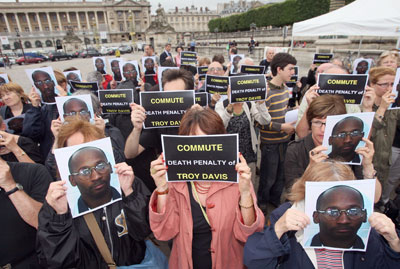
The state of Georgia plans to execute Troy Davis on September 21, 2011. There is still serious doubt as to Troy Davis’ guilt, and by putting him to death Georgia runs the risk of killing an innocent man. Please call on the board to save Troy Davis’ life.The fact is, no physical evidence connected Davis to the murder. Seven of the original nine witnesses have recanted, with many saying their testimony was a result of law enforcement pressure. Of the remaining witnesses, one is highly suspect and the other could be the actual culprit in the officer’s murder.Now, despite these and other facts, the state of Georgia has taken the final steps toward Davis’ execution — and only the Georgia Board of Pardons and Parole stands between Davis and the lethal injection chamber.

Take action by going to:

http://www.naacp.org/pages/too-much-doubt

http://www.colorofchange.org/campaign/save-troy-davis-life/

http://blog.amnestyusa.org/deathpenalty/dont-let-georgia-kill-troy-davis/

Sign a petition,

Send a tweet, post on facebook, or organize an event.

NewBlackMan: “I Am Troy Davis” (video)

Grassroots International Rally to Stop the Execution of Troy Davis September 20th!!!

We are calling on All Activists, Artists, Grassroots, Secular, Non-secular and Every Day People to Organize and Take to Streets in Solidarity to Stop the scheduled execution of Troy Anthony Davis AN INNOCENT MAN who is scheduled to die on September 21st at 7pm in the State of Georgia!

STOP THE EXECUTION! FREE TROY DAVIS!

On March 28, 2011, the US Supreme Court failed to take up the appeal of Troy Anthony Davis, the Savannah, Ga. man whose scheduled execution has been halted three times in the past because of the growing evidence and public belief in his innocence.

Chatham County Superior Court Judge Penny Freesemann signed the death warrant for Davis on Tuesday Sept. 6th, marking the fourth time since 2007 that the state has a scheduled an execution for Davis. The U.S. Supreme Court cleared the way for the execution in March by rejecting an appeal by Davis.

Department of Corrections Commissioner Brian Owens has set 7 p.m. at the Georgia Diagnostic and Classification Prison in Jackson to carry out the sentence.

Meanwhile, the state Board of Pardons and Paroles has scheduled a 9 a.m. Sept. 19 clemency hearing to allow Davis’ attorneys one final attempt to delay or commute the sentence, board spokesman Steven Hayes said Wednesday.

Troy Davis is an African American on death row in Georgia. Davis was convicted in the 1989 killing of a police officer despite what Amnesty International calls “overwhelming doubts about his guilt.” No physical forensic evidence was presented at Davis’ trial, and 7 of the 9 non-police witnesses have recanted their testimony, with at least two saying they were pressured by police to finger Davis as the killer.

WHAT YOU CAN DO:

1. Organize Rallies in you area

2. Set up teach-ins

3. Sign the Amnesty USA petition, asking the GA Board of Pardons & Parole to grant Troy clemency, and forward it to others :

http://takeaction.amnestyusa.org/siteapps/advocacy/ActionItem.aspx?c=6oJCLQPA…

4. Set up vigils

5. Call Georgia Governor Nathan Deal’s office and ask him to grant Troy Clemency (404)656-1776

6. Call Georgia Board of Pardon and Paroles ask them to grant Troy Clemency (404) 656-5651

Who are some of the supporters:

Well known individual such as Jimmy Carter, Archbishop Desmond

Tutu,singer Harry Belafonte, actress Susan Sarandon, Congressman John Lewis, and author and activist Angela Davis, to name a few—have voiced support for Troy.

For more info on the case of Troy Anthony Davis go to http://troyanthonydavis.org/

via NewBlackMan: “I Am Troy Davis” (video).

Latest piece from @NewBlackMan: “Shut Up and Play:” Racism, Sexism and “Unattractive” Realities of American Culture


“Shut Up and Play:” Racism, Sexism and “Unattractive” Realities of American Culture

by David J. Leonard | NewBlackMan

My anger and frustration following yesterday’s tennis match has nothing to do with the match itself. While pulling for Serena Williams and disappointed by her defeat, the surprising loss did little to damper my spirits. What has inspired my ire has been the media’s yet again troubling treatment of Serena Williams.

Following the match and in response to her confrontation with the match umpire (see here for details and video), commentators have taken her to task, deploying racialized and gendered criticism. Described as “petulant,” going “bonkers,” as “a stereotypical Ugly American” and as someone whose “ego” led to a “tirade” the media tone has rendered what appeared to be a tame and minor confrontation into a spectacle that rehashes longstanding stereotypes about black women as childish, emotional, lacking self-control, and otherwise angry. In other instances, Williams has been demonized for her “outburst” and “menacing behavior,” for “losing her cool” during an “Ugly US Open meltdown” and the “the menacing tone of her remarks.” Mary Carillo referred to Serena’s behavior as that of an “ass clown.”

The references to her tone and demeanor as menacing, given the ways in which white supremacist discourse has pathologized and rendered African American as cultural, physical, and economic menaces are particularly revealing. “Racial logic has advanced a link between the legibility of black bodies, and a racial being,” argues Delia Douglas in “To be Young, Gifted, Black and Female: A Meditation on the Cultural Politics at Play in Representations of Venus and Serena Williams.” Noting, “that black bodies have historically been designated as the site and source of pathology,” Douglas makes clear that “behaviour and habits are seen as symptomatic of these racial distinctions.”

The hyperbolic and racially and gendered rhetoric is encapsulated by a column from George Vecesey in The New York Times

As she stormed at the chair umpire during a changeover, Williams was reverting to her vicious outburst at a line official that caused her to be disqualified at match point in a semifinal in 2009, the last time Williams was here.” “But at what point does comportment, sportsmanship, become part of the measure of a great champion?” “The tantrum early in the second set caused many in the crowd to boo the decision, delaying the next point. Stosur kept her cool, and Williams never showed a trace of those couple of hard hits. She could have gone out with dignity on an evening when she did not have her best game. Instead, she called the chair umpire a hater, and later professed not to remember a word of it.

Irrespective of the exaggerating and demonizing rhetoric, Serena Williams’ confrontation of the umpire was tame; while angry with a suspect call and unwilling to capitulate to authority merely because of custom, she was clearly composed, calm, and collective; there was no “outburst;” she did not “lose her cool” nor was anything about her behavior “menacing.”

Even the USTA has concluded that the “controversy” was much ado about nothing, fining Williams $2,000 dollars. Explaining the fine, it announced:

US Open Tournament Referee Brian Earley has fined Serena Williams $2,000 following the code violation issued for verbal abuse during the women’s singles final. This fine is consistent with similar offenses at Grand Slam events. As with all fines at the US Open, the monies levied are provided to the Grand Slam Development Fund which develops tennis programs around the world.

After independently reviewing the incident which served as the basis for the code violation, and taking into account the level of fine imposed by the US Open referee, the Grand Slam Committee Director has determined that Ms. Williams’ conduct, while verbally abusive, does not rise to the level of a major offense under the Grand Slam Code of Conduct.

Noting the existence of “similar offenses” during the course of all Grand Slam events, the USTA acknowledges the banality of the behavior from Serena Williams.

Williams has been positioned as yet another black athlete who may have the athletic talent, but lacks the mental toughness and commitment needed to excel on the biggest stages. More significantly, the post-match commentaries reveal the powerful ways that race and gender operate within American culture. Her blackness and femininity, especially in the context of the white world of tennis, overdetermines her positioning within a sporting context. This moment illustrates the profound impact of both race and gender on Serena Williams, a fact often erased by both popular and academic discourses. According to Delia Douglas, “The failure to consider the ways in which sport is both an engendering and racializing institution has lead to myriad distortions, as well as the marginalization and oversimplification of black women’s experiences in sport.” As such, her stardom, her success, and the specifics of the incident does not insulate her from criticism and condemnation, but in fact contributes to the acceptability in fans and commentators alike symbolically shouting and yelling, “Shut up and play.”

Continue reading @ NewBlackMan: “Shut Up and Play:” Racism, Sexism and “Unattractive” Realities of American Culture.

Newest piece from @NewBlackMan: Party Like It’s 1899: Arizona Football and Blackface Fans

Party Like It’s 1899: Arizona Football and Blackface Fans

by David J. Leonard | NewBlackMan

To celebrate their new football uniforms, Arizona State University officials encouraged students to come to their Friday game against University of Missouri wearing all black. Four students decided to use this moment as an opportunity to party like it was 1899 by donning blackface. The media reaction, thus far, has been muted, not surprising given the persistent intrusion of minstrelsy into contemporary popular culture and the overall dismissal of most behavior from white college students as harmless revelry. Yet, this instance point to several larger issues at work.

The practice of white students donning blackface is not an isolated incident but reflects a larger trend within America’s college’s and universities. While usually taking place at parties, outside the view of the public at large, the minstrel tradition is alive and well. Tim Wise, in “Majoring in Minstrelsy: White Students, Blackface and the Failure of Mainstream Multiculturalism,” notes that during the 2006-2007 school year there were 15 publicly known instances of racial mockery. He describes this practice in the following way:

Given the almost monthly reports that white college students at one or another campus have yet again displayed a form of racist ignorance so stupefying as to boggle the imagination. For some, it means dressing up in blackface. For others, a good time means throwing a “ghetto party,” in which they don gold chains, afro wigs, and strut around with 40 ounce bottles of malt liquor, mocking low-income black folks. For still others, hoping to spread around the insults a bit, fun is spelled, “Tacos and Tequila,” during which bashes students dress up as maids, landscapers, or pregnant teenagers so as to make fun of Latino/as.

At the core of any of these instances is a sense of power and a perceived right to mock and degrade irrespective of its impact; it may also potential reflect ignorance about the larger history and meaning of blackface. In either instance, we see white privilege in action. “It’s certainly true that most whites are unaware of the way that blackface has been used historically to denigrate the intellect and humanity of blacks,” writes Tim Wise. “And most probably know little about the history of how ghetto communities were created by government and economic elites, to the detriment of those who live there. Yet, at some level, most of those engaged in these activities had to know they were treading on offensive ground.”

Whereas in the more commonplace practice of “ghetto parties” or other racial mocking parties the ignorance argument makes less sense given the efforts gone to limit outside exposure, it is easy to see how a lack of knowledge about the meaning and history of blackface might have led these students to attend nationally-televised football game in blackface. Ignorance, however, is no excuse.

The ability to be ignorant, to be unaware of the history and consequences of a person’s action, to simply do as one pleases is a quintessential element of privilege. It reflects a level of power to be either unaware or unconcerned with the potential offense; the ability to ignore and dismiss history is a privilege, one that the state of Arizona promotes through its very policies. “One thing we know about racism is that much of it is learned. We also know that young people must also learn racial sensitivity. In both cases, Arizona State University appears to have failed the test,” writes Boyce Watkins. “Students are a reflection of those who teach them, and it’s interesting that these four white women made the plan to wear black face, went out and bought the makeup, told their friends about their plan, put on the makeup and went to the game, without anyone even taking a second to realize that what they were doing would be incredibly offensive to millions of people.” Watkins’ assessment seems particularly important given we are not talking about Arizona, the epicenter of the anti-ethnic studies movement.

In 2010, on the heals of its decision to institutionalize racial profiling, the legislature followed-up with its ban on ethnic studies classes “designed primarily for students of particular ethnic groups, advocate ethnic solidarity or promote resentment of a race or a class of people.” It is hard not to make a connection here, as well as the larger history of Arizona and race.

Whether arguing that blackface at ASU football game reflects ignorance about the larger history of racism and the potential offense many might take from the sight of 4 white college students reenacting a racist tradition of minstrelsy; or that their decision is a conscious push-back against what they perceive as political correctness run amuck, the larger context is crucial. Ignorance of this larger history or disregard for its meaning is “Decrying the ghetto party as ‘modern-day minstrelsy’ is surely an expression of righteous indignation, but it is only the beginning of the story rather than the end,” noted Jared Sexton in a 2007 piece that I co-wrote for Colorlines. “The persistent challenge is to understand why the perverse pleasure of cross-racial caricature and its disavowed currents of mockery, ridicule, envy and hatred are so powerfully attractive to its participants—participants who, as a rule, rely on the dynamics of racial segregation that have produced the ghetto for the very form and substance of the most public and the most intimate aspects of their social lives.”

In other words, the sight of these four students in blackface is a reminder of the consequences of persistent racial segregation, the cost of a hegemonic multiculturalism that avoids issues of inequality and racism, the manifestation of white privilege, and most importantly, in the context of Arizona, evidence of the importance of ethnic studies as a curricular intervention.   It demonstrates the necessity of ethnic studies because those are spaces where the history of and meaning within the tradition of minstrelsy is learned.  That is the opportunity to rectify that ignorance or unlearn the acceptance of these practices. 

Jay Smooth, in “How To Tell People They Sound Racist,” distinguishes between “what they did and what they are conversations,” calling upon people to avoid the traps that results from the common practice of debating whether or not someone is racist.  Whereas the “what they are” conversations focuses on motives and intent of an individual, “the what they did conversation focuses strictly on a person’s words and actions, and explaining why what they did and what they said was unacceptable.”   Hopefully, we can use this moment to not only to point out the unacceptability of blackface in any context (“what they did conversation”) but to also reflect on its roots and the broader implications at work here.  We need to have “the it’s bigger than this incident” and “it ain’t just about these four students” conversations so that we can maybe stop having THESE conversations so often. 

via NewBlackMan: Party Like It’s 1899: Arizona Football and Blackface Fans.

NewBlackMan: “Our Justice System at Its Worst”: Date Set for Troy Davis Execution

“Our Justice System at Its Worst”:

Date Set for Troy Davis Execution

by David J. Leonard | NewBlackMan (#TooMuchDoubt)

This week, Georgia announced its plans to carry out the execution of Troy Davis. While there remains time to thwart this miscarrying of justice, the planned execution should give pause to us all.

In absence of forensic evidence or a murder weapon, an all-white jury convicted Davis of the 1989 murder of a police officer in Savannah. The basis of the conviction was the witness testimony of nine individuals (7 eyewitnesses and 2 “jailhouse snitches”), many of who have subsequently spoken about police pressure. In fact, since his conviction, all but two of the prosecution’s non-police witnesses have recanted or contradicted their own testimonies, leaving the conviction in doubt. At the same time, 9 individuals have signed affidavits implicating another individual who happens to be one of the two witnesses who have not reversed on original testimony. Notwithstanding these significant doubts raised during the appeals process, one that has never allowed for his defense team to fully explore the recanting witness testimony, Davis’ conviction has remained, resulting in the issuing of his death warrant yesterday.

As part of its announced plan to stop the execution of Davis, the NAACP described the injustice in the following way: “This is our justice system at its very worst, and we are alive to witness it. There is just too much doubt.” Calling for people to take action to save Troy Davis’ life, his case points to larger racial issues that demand action as well.

His conviction and the decision to proceed with his execution should give pause given the research on race and witness identification. According to the Innocence Project, 75% of wrongful convictions overturned by DNA were the result of witness misidentification. “While eyewitness testimony can be persuasive evidence before a judge or jury, 30 years of strong social science research has proven that eyewitness identification is often unreliable” reports the Innocence Project. “Research shows that the human mind is not like a tape recorder; we neither record events exactly as we see them, nor recall them like a tape that has been rewound. Instead, witness memory is like any other evidence at a crime scene; it must be preserved carefully and retrieved methodically, or it can be contaminated.”

One of the sources of contamination is clearly race and the myriad of assumptions that result from an institutionalized system of stereotyping. In “Cross-Racial Identification Errors in Criminal Cases,” Sheri Lynn Johnson highlights the unreliable nature of “eye-witness” testimony, a fact that is exacerbated in cross-racial situations. Evidence from actual cases and in research studies elucidate the ways in which race and the larger social meanings attached to blackness play a significant role within the process of witness identification. In a study conducted with white students at University of Illinois and black students at Howard University, researchers showed them pictures of 10 white and 10 black individuals for a second and half; then, they were are asked to recall the pictures from a series of other photos. According to Elizabeth F. Loftus, in Eyewitness Testimony:

[T] he subjects were clearly better able to identify members of their own race. This study was later duplicated with the addition of Asian students. Again [African Americans] had greater difficulty recognizing faces of whites and Asians. Interestingly, however, whites and Asians had relatively little problem in identifying members of each other’s race – though both had trouble identifying [African Americans]. (from review of book)

The psychological obstacles facing witnesses along with the ways in which race further complicates the process is well documented. Yet, we continue to rely on witness testimony within the criminal justice system. The power of the white racial frame illustrates the reasonable doubt inherent in eyewitness testimony. In a society where black is akin to criminal, so much so that within the dominant imagination there exist a distinct category, the “criminalblackman” (Russell, 1998, p. 3), it is crucial to reflect on what is at stake with Troy Davis: his life and so many others.

The planned execution of Troy Davis also points to a larger question of the racial application of the death penalty within the United States. According to David Dow, 35 years into the return of the death penalty “It remains as racist and as random as ever.” Referencing the often-cited Baldus Study, which “found that black defendants were 1.7 times more likely to receive the death penalty than white defendants and that murderers of white victims were 4.3 times more likely to be sentenced to death than those who killed blacks,” Dow highlights the racist application of the death penalty. Cases involving an alleged black perpetrator and a white victim are far more likely to result in the death penalty. Although, “nationwide, blacks and whites are victims of homicide in roughly equal numbers . . . 80 percent of those executed had murdered white people.”

PLEASE CONTINUE READING @ NewBlackMan: “Our Justice System at Its Worst”: Date Set for Troy Davis Execution.

New post from @NewBlackMan- Campus PD: Criminalizing Higher Education?


Campus PD: Criminalizing Higher Education?
by David J. Leonard | NewBlackMan

In what was obviously a slow night television night, I found myself searching for something to watch.  After perusing up and down the onscreen schedule, I came across Campus PD (I was somewhat familiar with show having read about their filming in Pullman, WA, where I live), a show that “takes viewers along for the ride with officers on duty to capture firsthand all the mayhem and excitement they take on night after night when student fun spirals out of control.” The show is described in the following way:

From policing parties and security issues, to keeping the peace at sports events and arresting possible suspects, ride with the “Campus PD” as they tackle the ongoing challenge of keeping students safe. Depicting university life from the perspective of the law enforcement professionals who police them, this ground-breaking new series presents a real-life account of these modern-day campus heroes. As they gear up for a shift, these courageous cops know they’re in for a few surprises!

The series heads to five college towns across the country including Tallahassee, FL, San Marcos, TX, Cincinnati, OH, Chico, CA, and Greenville, NC. It takes viewers deep inside the internal lives of the law enforcement professionals policing a town of fun-loving college kids. It isn’t easy, but these dedicated officers love their jobs, and wouldn’t have it any other way.


The emphasis on “fun,” “keeping student’s safe” “fun-loving college kids,” parties, and “binge drinking COEDS” is instructive, demonstrating how a show about criminal misconduct goes to great extents to decriminalize its primarily white, middle-class, “participants” and in doing so criminalizes the Other once again.


The show might as well be called “Warning PD.”  In the three episodes I watched on television, and countless clips online (which don’t necessarily show the encounters from start to finish leaving it hard to see the final resolution), I have only seen a handful of actual arrests.  For the most part, the show brings to life several excessively permissive campus police forces, who tolerate abuse, disrespect, and a culture of chaos.  In many instances, college students are given countless warnings, and only after failing to comply with instructions, are they forced to deal with the repercussions of their actions with a ticket or an arrest.


Another common theme within these initial episodes I watched from start to finish was a belief from the students they were unjustly being persecuted by the police.  Students would often note that, “they were not doing” anything wrong, or that they were simply engaged in “harmless fun” only to be harassed by campus police.  Given the ways in which harassment, racial profiling, and pre-text stops so often define the experiences of youth of color, it is a troubling re-imagination of policing in America.  Worse yet, Campus PD does a good job in showing why many college students view police as unfairly harassing them.


In two different episodes (as in the book Dorm Room Dealers), students respond to the presence of police by telling them to go “police” and investigate some real criminals.  That is, they were wasting their time with the happenings of college students since they were harmless, as opposed to those who “lived over there.”  In both instances, “over there” was clearly the neighborhood inhabited by poor people of color.  This assumption (one that is reinforced by the show) that the “real criminals” exist elsewhere reflects the power of American racial and class logic.


According to a study from the Journal of Alcohol and Drug Education, 95 percent of respondents imagined an African American when asked about drug users.  In other words, blackness operates interchangeably with criminality, especially in relationship to the urban poor.  Better said, “to be a man of color of a certain economic class and milieu is equivalent in the public eye to being a criminal.” (John Edgar Wideman, p. 195)


The consequences of the permissive policing and a culture that imagines college students engaged in criminal activity as just having fun (as opposed to the “real criminals”), is evident in the lack of attention directed at the criminal misconduct taking place at America’s colleges and universities.


According to a 2007 study reported in USA Today, over half of America’s college student regularly abuse alcohol and drugs.

The study found that college students have higher rates of alcohol or drug addiction than the general public: 22.9% of students meet the medical definition for alcohol or drug abuse or dependence — a compulsive use of a substance despite negative consequences — compared with 8.5% of all people 12 and older.


Increasingly, along with the traditionally seen drug and alcohol abuse, college students are abusing prescription drugs like Adderall, termed “smart drugs” by many college students.  “For many middle and upper-middle class young people in New York,” notes Lala Straussner. “Adderall is much more acceptable than using methamphetamine (more common on West Coast) or crack cocaine, although the brain doesn’t know the difference.” Yet, the ubiquity and acceptance of “smart drugs” is simply the perceived function or the consequences of these drugs but the ways in which crack and meth are both racialized and connected to distinct class identities.  Prescription drugs, on the other hand, are linked to those in college, who are said to have a future, illustrating criminality and criminals are identities are constructed as elsewhere and not within college communities.


While shows like Campus PD illustrate the ubiquity of instances of public intoxication, cases of drunk-driving, and physical assaults, other issues plague college communities.  As such, it does little to elucidate the problem of sexual violence (20-25% of women in college will experience rape or an attempted rape), prescription drug abuse, and even drug dealing.  The erasure of these systemic problems reflects a culture that imagines college as a space of parties, fun, and adolescent behavior rather than criminal activity.


This type of narrative is evident in the recent drug busts at San Diego Sate University and Columbia University.  In 2008, after a several month investigation, authorities arrested 75 students (96 people in total), confiscating drugs worth a total of approximately $100,000 worth of drugs.  Among the 20 students arrested for distribution and sales was a criminal justice major, who when arrested was in possession of two guns and 500 grams of cocaine.   San Diego County Dist. Atty. Bonnie Dumanis made clear that their investigation demonstrated “how accessible and pervasive illegal drugs continue to be on our college campuses and how common it is for students to be selling to other students.” This was certainly true with Columbia University, where 5 students were arrested as part of “Operation Ivy League,” “a five-month undercover sting, during which police purchased $11,000 worth of drugs from the students out of Columbia fraternity houses and dorms.”


While the media rendered this incidence and that at SDSU as a shocking spectacle, it is clear that the situation at these schools is a national phenomenon.   This should actually be surprising given how drug markets are as segregated as the rest of America.  According to A. Rafik Mohamed and Erik D. Fritsvold, authors of Dorm Room Dealers, who spent 6-years examining drug distribution at a Southern California Private school, not only do students sell to other students, but do in a reckless manner, which in their mind highlight a sense of entitlement based on the students’ middle-class white identities.  Phillip Smith describes their findings in “Dorm Room Dealers: A Peek into the Drug World of the White and Upwardly Mobile”:

Mohamed and Fritsvold show repeatedly the reckless abandon with which their subjects went about their business: Dope deals over the phone with uncoded messages, driving around high with pounds of pot in the car, doing drug transactions visible from the street, selling to strangers, smuggling hundreds of pills across the Mexican border. These campus dealers lacked even the basics of drug dealer security measures, yet they flew under the radar of the drug warriors.

Even when the rare encounter with police occurred, these well-connected students skated. In one instance, a dealer got too wasted and attacked someone’s car. He persuaded a police officer to take him home in handcuffs to get cash to pay for the damages. The cop ignored the scales, the pot, the evidence of drug dealing, and happily took a hundred dollar bill for his efforts. In another instance, a beach front dealer was the victim of an armed robbery. He had no qualms about calling the police, who once again couldn’t see the evidence of dealing staring them in the face and who managed to catch the robbers. The dealer wisely didn’t claim the pounds of pot police recovered and didn’t face any consequences.


A former Columbia student highlights a similar culture there, adding more evidence to the arguments offered in Dorm Room Dealers.

But, in fact, the prestigious institution on Manhattan’s Upper West Side has long been “ripe” for drug trafficking, a knowledgeable 2009 Columbia graduate told The Daily Beast. “I think the permissive environment of Public Safety”—as Columbia’s campus police force is known—“makes it a no-brainer proposition,” said this former student, who described himself as a recreational drug user who dabbled in selling. “I always felt safe.”


The culture and climate of Columbia in terms of public concern and policing, as opposed to the levels of surveillance found a few miles away in Harlem, tells an important story about how race and class operate in contemporary America.  Campus PD offers a similarly distorted glimpse a crime as well.


Media accounts of these two recent drug operations and shows like Campus PD have done little to shine a spotlight on the double standards that exist between the primarily white middle-class student population and poor youth of color when it comes to policing and incarceration.  With the situation at Columbia, one student has plead guilty thus far; although charged with the most serious crimes, he was sentenced to 6-months in prison in July.  In a city where 46,500 people were arrested for marijuana possession in 2009, with 87% of these people being black and Latino, the inequality is quite clear.


San Diego saw a similar outcome, with many of those arrested pleading guilty only to face probation and entrance into a drug diversion programs, leading some people to question why police are spending so much time and energy conducting investigations against college students that do not result in incarcerations.   When considering the media coverage, popular representations of college campuses, levels of policing and unzealous prosecution, it is no wonder that while African Americans constitute 13% of all monthly drug users, they represent 38% of these arrested for drug possession, 55% of convictions and 74% of prison sentences; it is as argued by Michelle Alexander, the new Jim Crow, ostensibly cordoning off America’s college and universities from policing and prosecution.  The criminalization of black and brown youth and the decriminalization of white America, particularly its middle-class college-bound constituency, have material consequences.


Evident in a show like Campus PD and the various examples provided here is the ways in which  “what it means to be criminal in our collective consciousness to what it means to be black.”  In other words, “the term black criminal is nearly redundant . . . . To be a black man is to be thought of as a criminal, and to be a black criminal is to be despicable – a social pariah” (Alexander 2010, p. 193).   No wonder so many students yell at cops to go focus on the “real criminals”; that is the message they have learned all too well.

***
Originally posted at NewBlackMan

Mark Anthony Neal @NewBlackMan: “I Arrived the Day Fred Hampton Died”: If Jay Z Met Fred Hampton


“I Arrived the Day Fred Hampton Died”: If Jay Z Met Fred Hampton

by Mark Anthony Neal | NewBlackMan

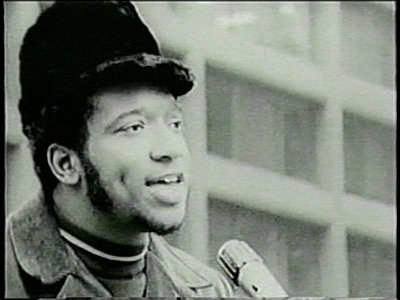
In the early morning of December 4, 1969, before dawn, the Chicago Police Department in conjunction with the Federal Bureau of Investigation—The FBI—riddled the residence of Black Panther Party leaders Fred Hampton and Mark Clark, killing them both. Hampton, who was sleeping in the back of the house with his pregnant girlfriend was unable to defend himself (he had been drugged by an informant), leading poet and Third World Press founder Haki Madhubuti (then Don L. Lee) to describe the incident as a “One Sided Shootout.” On that same day, Shawn Corey Carter—the maverick hip-hop mogul and artist—was born in the Bedford-Stuyvesant section of Brooklyn, NY. I can’t help but wonder what might have happened if these two—icons for two distinct generation of Black youth—might have ever had the chance to meet.

For those familiar with the legacy of Fred Hampton, simply known as Chairman Fred for many, Jay Z might seem the very antithesis of what Hampton represented. At the time of his assassination, Hampton was being prepared for national leadership within The Black Panther Party, which was decimated by incarceration (Huey P. Newton and Bobby Seale) and exile (Eldridge Cleaver). Hampton was 21-years-old, five years younger than Martin Luther King, Jr. was when he led the Montgomery Bus Boycott and the same age of Malcolm Little when he was when he began the prison sentence that transformed him into Malcolm X. Hampton was no ordinary young Black man.

Specifically the Black Panther Party was targeted by FBI director J. Edgar Hoover’s counter-intelligence program, known by the acronym COINTELPRO. The year before Hampton’s death, Hoover publically announced that the Black Panther Party was the “greatest threat to the internal security of the country.” Part of the FBI’s strategy was to kill off the local leadership of the Black Panther Party, before it could ascend to national leadership. In that vein Hoover targeted the Black Panther Party’s breakfast program, because it was one of the most tangible ways the organization impacted their communities.

According to historian Craig Ciccione, author of the forthcoming If I Die Before I Wake: The Assassination of Fred Hampton, “The threat was on the local level because on the local level the organizing was most effective.” Ciccone suggests that killing off local leadership could be achieved on a much quieter level—he notes that virtually none of the Panthers killed in the late 1960s were part of the national leadership.

Of those local leaders, Fred Hampton was perhaps the most significant—The FBI created a file on Hampton when he was just an 18-year-old high school student, who would shortly become leader of the Illinois Chapter of the Black Panther Party. Fred Hampton was a compelling figure because of his skills as an organizer—he was instrumental in the creation of the Rainbow Coalition (a term later appropriated by Jesse Jackson) which included the Black Panther Party, young White activist known as The Young Patriots and The Young Lords, a national organization of Puerto Rican activists co-founded by Felipe Luciano, who was also a member of the original Last Poets.

Combined with his accomplished skills as an orator and his willingness to organize beyond the Black community, Hampton was the prototype for the next generation of Black activist, a possibility that was literally killed in the early hours of December 4, 1969.

One of the tragedies of Fred Hampton’s death is that his presence would not be felt in the Marcy Houses that Jay Z came of age in, or in any of the like communities across this country were young Black Americans lacked examples of political agency and activism that were in sync with their lives at the dawn of 1980s. The period, best known as the Reagan era, was marked by the child murders in Atlanta, the explosion of crack cocaine in Black communities, the emergence of AIDS and the collapse of the kinds of social and cultural infrastructures that helped Black Americans survive segregation and racial violence throughout the 20th Century.

Hip-Hop initially filled that void and though early hip-hop was little more than the “party and bullshit” that seems so normative today, it ability to allow young Black Americans a voice and alternative ways to view the world may have been it most potent political achievement. For example, Chuck D would have been Chuck D regardless of Hip-Hop, but how many young Blacks became politically engaged because Chuck D had Hip-Hop. Indeed as Jay Z details throughout his memoir Decoded (written with Dream Hampton), the possibilities that Hip-hop offered were compelling enough to take him from the street life.

The easy part of this story is to suggest that Jay Z, as emblematic of a Black generational ethos, has squandered Hip-Hop’s political potential on the spoils of crass materialism, middle-management wealth and a politics of pragmatism (as embodied by his man Obama). The feel good move is to imagine a 61-year-old Hampton and a 41-year-old Carter sitting down in conversation with Sonia Sanchez to discuss the legacy of the Black Panther Party on Hip-Hop and Carter’s funding of the Fred Hampton and Shirley Chisholm Institute for Black Leadership Development (which by the way Mr. Carter, need not be a dream). Unfortunately the history of Black political engagement is not as simple as one of those Staples “easy” buttons.

Continue reading at NewBlackMan: “I Arrived the Day Fred Hampton Died”: If Jay Z Met Fred Hampton.