NewBlackMan (in Exile): Kevin Durant and the Myth of Michael Jordan’s America

Kevin Durant and the Myth of Michael Jordan’s America

by David J. Leonard | NewBlackMan

With game #3 in the NBA finals set for tonight, and the series in question, one thing not in question is that the league has finally found its Michael Jordan for the twenty-first century. While others have fallen short for a number of reasons, it seems that Kevin Durant is on the precipice of following in Air Jordan’s footsteps.

Although the NBA lockout marked the end of this search, given the league’s focus on team rivalries over superstars, it now clear that Kevin Durant has taken the mantle. Irrespective of who ultimately wins the series, Kevin Durant has already been declared the winner of America’s next best commodifiable baller. His reign is not so much about basketball but the narrative, the embedded racial meaning, his appeal in “red state America,” and the representational possibilities available with Durant. Clearly LeBron James’ basketball resume is on the same level; in fact, with multiple MVP awards, endless skill, and an ability to dominate each and every game at both ends of the floor, LB6 has game that is once in generation. The same cannot be said for KD35, whose skills are unimpeachable yet his power and resonance rests with the story and ideological confirmation he provides the league and countless fans.

Since MJ’s retirement, the league, its marketing partners, and fans alike have pinned for someone to fill his AIR Jordans. Each anointed as the next Michael Jordan, Penny Hardaway, Grant Hill, Vince Carter, and Harold Miner (“Baby Jordan”) all failed to deliver because of injuries, limited production, or a combination of both. Each in their own right was imagined as a player who could fill the shoes, whose talents, charisma, and athleticism would propel the NBA during its post-Jordan era. None of them met these expectations resulting in an NBA in continued search for a twenty-first century basketball God.

Kobe Bryant and LeBron James each took the mantle of the next Jordan to places none of the other NMJ (next Michael Jordan) had reached. Kobe, because of his talents, the ways in which he patterned his game and demeanor after Jordan, his quest for rings, and most importantly his competitiveness, all elevated the comparisons, leading many to argue that he was the NMJ. Yet because of Eagle County, Colorado, because of his conflicts with Shaquille O’Neal and the ultimate demise of the Lakers Dynasty, and because he is said to have demanded to get out of Los Angeles, Kobe has fallen short in other’s quest to find the next Michael Jordan. Like Kobe, LeBron James has delivered on the court, dazzling fans with his passing skills, his athleticism, and his ability to make his teammates better. Worse than struggling to secure a title, LeBron James fell short in the MJ sweepstakes when he decided to take his talents to South Beach. Simply exercising his rights of free agency meant that James was no longer eligible for Jordan status within the national imagination.

While possessing the skills, charisma, and baller potential, the two most promising players to lead the NBA, to build upon the global popularity established by Jordan, have fallen short not because of any basketball deficiency, but their inability (or our inability) to fill some mythical shoes. The quest to find the Next Michael Jordan, thus, has nothing to do with basketball but rather is part of an effort to find a player who reinforces popular narratives about the American Dream, the protestant work ethnic, and post-racialness.

Continue reading @ NewBlackMan (in Exile): Kevin Durant and the Myth of Michael Jordan’s America.


NewBlackMan in Exile: Brittney Griner, Women Athletes and the Erotic Gaze

Brittney Griner,
Women Athletes and the Erotic Gaze


by David J. Leonard | NewBlackMan (in Exile)

With the 40th anniversary of the Title IX, and the recent announcement that for the first time in history American female athletes will outnumber their male teammates at the Olympics, it would be easy to claim victory in the fight against sexism within the world of sports. Dave Zirin, in a recent column about Title IX and Serena Williams, reflected on the importance of this legislation:

There is arguably no piece of progressive legislation that’s touched more people’s lives than Title IX, which allowed young women equal opportunity in education and sports. According to the Women’s Sports Foundation, one in thirty-five high school girls played sports forty years ago; one in three do today. Before Title IX, fewer than 16,000 women participated in college sports; today that number exceeds 200,000. All stereotypes about women being too “emotional” to handle sports were answered when the gyms were unlocked, and they arrived in droves. It is a reform that has improved the quality of life for tens of millions of women around the country.

While certainly a landmark piece of legislation that literally and symbolically transformed sporting landscapes throughout the United States more so in the suburbs, Zirin also elucidates the persistence of sexism within sports culture, evident in inequity in pay, coaching disparities, differential treatment from the press, and the intransigent power of stereotypes. Recognizing an incomplete transformation and the need for persistent agitation as to fully realize justice and equality, Zirin depicts sports as a place where dreams remained deferred.

The reasons for Zirin’s muted or skeptical celebration have been on full display this evening with the treatment of Brittney Griner by “sports fans” on Twitter. Illustrating the ways that race, gender, and sexuality constrain and contain, the ways that racism, sexism, and homophobia exists as prism/prison of sporting consumption, and the ways that new media operates as a technology of surveillance and demonization, the treatment of Griner highlights the dreams yet fulfilled in Title IX. What should have been a celebration of her greatness and that of other female athletes is yet another moment of rampant sexism, homophobia and racism. Here are but a few of the tweets that echoed within the twitter world during the ESPYS:


·      And the best male athlete goes to… Britney Griner


·      Britney Griner should have won best male athlete…


·      If Britney Griner‘s straight then I’m an Angels fan.


·      Watchin the #espys……ummmmm Britney Griner sounds like a man……wow!!


·      The Heat win “BestTeam” category really? They should sign Britney Griner then they’d really be a scary team


·      Britney Griner is a man


·      The ESPYs made me cry tonight. Not because of Eric LeGrand or Pat Summit. But because of Britney Griner. That woman frightens me endlessly.


·      Britney griner screaming like a dude lol


·      Britney Griner has to be a dude


·      Britney Griner is a Dude her voice deeper than mine


·      Britney griner looks and sounds like a dude #BestMaleAthlete


·      I would rather have Britney Griner win best male athlete than Lebron. Because she’s WAY more of a man than he will ever be


·      Britney griner… Do your balls grow hair? #nodoubt


·      Cup check in britney griner please


·      I wonder if Britney griner is packing more downstairs than the #bieledong@BeingBielema


·      No one on this planet can tell me that Britney Griner is not a homosexual male. I won’t believe it. #ESPYS


·      Britney Griner’s voice scares me


·      Britney Griner…you just won best FEMALE college athlete, at least go to the ESPY’S dressed like a GIRL! Smh.


·      Are we sure that Britney Griner is really a girl??


·      If Britney Griner wins female athlete of the year at the Espys tonight I’m gonna throw a fit. She’s not even a female


Clearly, the 2012 ESPYS were another moment to mock and ridicule and to otherwise dehumanize Britney Griner. Demonizing her as “unattractive,” questioning her worthiness or the appropriateness of her receiving an award for “best female athlete,” and imaging her as a scary and disgusting Other, the Tweets are yet another reminder of how sports culture remains a space hostile to women, especially those who don’t fulfill male sexual fantasies.  In an effort to fully contextualize these tweets, I thought I would repost piece I wrote for Slam earlier in the year.


Continue reading NewBlackMan in Exile: Brittney Griner, Women Athletes and the Erotic Gaze.

The Invisible War: A Film on Rape, Women and Combat (A Review)

June 23, 2012

By

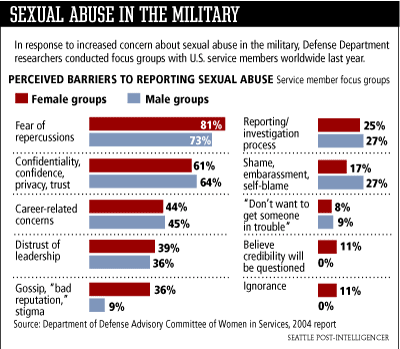
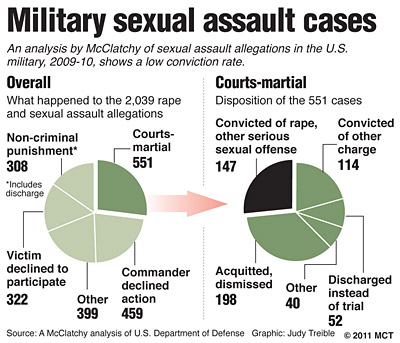
Horrifying . . . devastating . . . infuriating . . . saddening.  These are the emotions I felt as I watched The Invisible War, a new film, written and directed by Kirby Dick, which opened nationally yesterday.  To be sure, The Invisible War isn’t your typical war story.  It’s a gripping docu-film that focuses on the “powerfully emotional stories of rape victims” within the U.S. military, and their “struggles to rebuild their lives and fight for justice.”  Shining a spotlight on a world largely defined by masculinity, combat, force, sex, and concealment, this film unveils the following:

  • 20% of women are assaulted while in the military
  • Only 8% of the assailants are prosecuted, with only 2% facing conviction
  • 80% of the victims do not report
  • 25% of women do not report rape because the person responsible for receiving the report is oft times also the rapist
  • 1% of men in the military, totaling 20,000, are victims of rape
  • 15% of incoming military recruits acknowledge that they have attempted or committed a rape prior to entering the service
  • 40% of homeless female veterans are victims of rape
  • Of the 3,223 cases that are actually prosecuted, only 175 of the assailants would serve jail time (all numbers are from the film or related press)
  • “The Veterans Administration spends approximately $10,880 on healthcare costs per military sexual assault survivor. Adjusting for inflation, this means that in 2011 alone, the VA spent almost $900 million on sexual assault‐related healthcare expenditures” (press packet).

The Invisible War paints a picture of injustice and sexism, and a culture of sexual violence that has reached epidemic proportions.  However, it does more than offer disheartening and infuriating statistics.  It provides a story, a story about women and men—those who are celebrated as heroes, who receive standing ovations at parades, whose service is lionized and celebrated over and over again—who have been raped while serving in the U.S. military.  Irrespective of yellow ribbons and holidays, it is a story that illuminates rape culture and the ways that victims are multiply victimized within a culture of warfare, camouflage (or cover-up), and sexual violence.

The filmmakers interview roughly 70 survivors of military rape, women and men, who in the face of victimization by their assailants, their military community, and countless others, have decided to fight back.  We learn the stories of women like Kori Cioca who was raped and physically beaten while serving in the U.S. Coast Guard.  We hear how her assailant, who was also her commanding officer, didn’t just rape her, but also broke her jaw during the attack.  And, we learn how Cioca was reminded (over and over again) that her punishment for “lying” would be a court-martial, when attempting to report the assault to those in command.

The Invisible War elucidates a culture of rape and victimization as well as the continual cultivation of revictimization, wherein the military instigates an “in-house” society of violence—among comrades.  Some victims were even charged with adultery due to the assailant being married!  Moreover, of the five women from Marine Barracks Washington interviewed in the film, four were investigated and punished after reporting incidences of rape.  They were told to “suck it up,” unfairly disciplined professionally, threatened with prosecution, and demonized publicly.  And perhaps worse of all, they were often forced to face their assailants every step of the way.

From suicide attempts to physical pain, the film documents several consequences of rape, to include but not limited to rising costs, exacerbated by an “in-house” rape culture.  We see this with Cioca.  The physical pain resulting from her assault is endless.  Because of her broken jaw, Cioca continues to live on a liquid diet, she cannot go outside when it is cold because of pain, and probably most dispiriting, Cioca’s assault remains with her both physically and emotionally.  In fact, she often wakes up screaming.  The dual agony of severe discomfort and traumatic recollection are unceasing.  Unfortunately, this reality has been largely ignored by the VA, which refused to cover all of her medical expenses.

The power of The Invisible War rests with the elevation of the voices and experiences of the soldiers themselves and their families.  The consequences of sexual violence can be felt in the physical and emotional anguish expressed throughout the production.  However, though the film gives voice to victims of rape (and their families) within the military, therefore breaking the silence perpetuated by a complicit media, it misses a critical opportunity to expand the discussion to explore the effects and entwinement of militarism, patriarchy and misogyny in our broader socio-political context.  At times, The Invisible War seems to even downplay how patriarchy and American institutions/ideology(ies) actually sanction and give life to rape culture(s).  In short, in trying to spotlight the injustice facing men and women in the military, and the systematic camouflaging (pun intended) at each level in the chain of command, The Invisible War misses the opportunity to make some pretty significant connections.

A more efficient grasping of sexual violence within the military requires looking at its deployment of gendered language as well as the ways in which women are objectified within and without military culture.  It also demands that we look at “base women,” the relationship between U.S. operations overseas and prostitution, as well as the ways that sexism infects U.S. policies.  In addition, a more critical reading of sexual violence pushes us to explore the treatment of women within the U.S. military, particularly those serving in countries currently occupied by the U.S.
Continue reading @ The Invisible War: A Film on Rape, Women and Combat (A Review) | The Feminist Wire.

Adidas and the Truth About ‘Slavery Sneakers’ – News & Views – EBONY

Adidas and the Truth About ‘Slavery Sneakers’

David Leonard

Adidas’ planned release of its “JS Roundhouse Mids” shoes has been put on hold, but the rightful outrage continues.

The sight of “slave shoes”—sneakers with shackles and chains—prompted widespread indignation and outrage. “The attempt to commercialize and make popular more than 200 years of human degradation, where Blacks were considered three-fifths human by our Constitution is offensive, appalling and insensitive. Removing the chains from our ankles and placing them on our shoes is no progress,” writes Jesse Jackson. “For Adidas to promote the athleticism and contributions of a variety of African-American sports legends … and then allow such a degrading symbol of African-American history to pass through its corporate channels and move toward actual production and advertisement, is insensitive and corporately irresponsible.”

The shoes are yet another reminder of the efforts to sanitize and erase slavery from public consciousness. Whether in the efforts to whitewash history through denying or minimizing the history of slavery, or turning slavery into sources of profit and pleasure, the shoes speak to an effort to reimagine slavery within White America. Whereas the history of slavery is one of violence, bloodshed, and survival in the face of brutality, these shoes disrespect the memories and atrocities at the heart of this country. In turning its symbols – shackles and chains – into something of trendy desire and pleasure, these shoes and its designers not only spit on this history but seek to cash in on the pain and suffering of many people.

The marketing of the shoes also disturbingly capitalize on incidences of shoe violence and media sensationalism. According to the Philadelphia Inquirer, “On Adidas’ Facebook page, the company calls the shoe ‘so hot you [will need to] lock your kicks to your ankles.’” Like those pundits, politicians, and media who sold fear by citing kids being murdered for their shoes, Adidas sees an opportunity in exaggerated stories of death. By telling its consumers that “yes others will desperately want your shoes but not to worry, they are on lockdown,” the company is selling consumers a footwear version of LoJack. As with the politicians and media pundits before them, Adidas is continuing a tradition of peddling and proofing off of racial fears and stereotypes.

As the history of shoe production has been one of exploitation, abuse and “slave-like” conditions, there is sickening irony in these shoes. Do the shackles and chains attached to the shoes mirror those that have been found on children’s feet? Does it symbolically reflect the sweatshop conditions endured by those who produce shoes and apparel throughout the globe?

Continue reading @ Adidas and the Truth About ‘Slavery Sneakers’ – News & Views – EBONY.

REBIRTH OF GEEK: The NBA’s Nerd Swag Reigns – Entertainment & Culture – EBONY

REBIRTH OF GEEK:

The NBA’s Nerd Swag Reigns

David Leonard

With Kevin Durant and the Oklahoma City Thunder making a serious run for the title this year, interestingly talk has once again turned to his stylistic choices. With debate shows like Around the Horn and First Take, not too mention various content starved sports writers, pining for anything to debate, much has been made about Durant’s clothing choices. Watching Durant, along with Russell Westbrook, LeBron James, and Dwyane Wade at live post-game press conferences has become the NBA’s version of the red carpet. Part shock and awe, part celebration of the players’ purported back turning on hip-hop styles, and part curiosity, no piece of clothing has been left unremarked upon, making me wonder if Joan Rivers has a future on ESPN.

Noting how players wear “gingham and plaid and velvet, bow ties and sweater vests, suspenders, and thick black glasses they don’t need,” Wesley Morris celebrates their stylistic stances against racial stereotypes. It ain’t just an outfit, it’s an effort to stomp out racial bigotry: “Their colors conflict. Their patterns clash. Clothes that once stood as an open invitation to bullies looking for something to hang on the back of a bathroom door are what James now wears to rap alongside Lil Wayne. Clothes that once signified whiteness, squareness, suburbanness, sissyness, in the minds of some NBA players no longer do.”

Similarly, Sean Gregory identifies his clothing choices as a window into his broader appeal and demeanor: “In Durant, African-Americans are blessed with an ideal front man: a seemingly humble superstar” evidence by his “refusal to play the part of ego-driven hoops celeb” as well as clearly his propensity to wear glasses rather than chains, a backpack rather than headphones, and sweater in lie a hoodie. If you didn’t know that plaid and mismatched colors was a sign of humility and a lack of ego, now you know.

Commenting about the popularity of non-prescription glasses from NBA stars, Dave Hyde furthered the links between “nerds” and the sort of “style” embraced by several NBA stars: “That’s just it. No one’s sure what the statement these frameless glasses are other than, well, Urkel-R-Us. . . . .But wear the non-glass glasses? You don’t need to understand fashion to recognize a nerdy idea when it hits you right between the eyes.”

The efforts to celebrate “nerd style” are wrapped up in larger questions of identity. For several commentators, it is punctuates an expanded definition of Blackness (in the tradition of Touré’s post-Blackness theories) available in contemporary America. Under this logic our changing world allows for Allen Iverson and Kevin Durant, Kanye West and Little Wayne, Brittney Griner and Nicki Manaj, Michelle Obama and Cory Booker to exist under a larger umbrella of blackness. According to Touré, “I see [Black irony] in NBA star Kevin Durant’s penchant for nerd chic, wearing glasses and a schoolboy backpack and thereby taking the air out of the Black male imperative to be masculine, tough, and cool.”

Continue reading @ REBIRTH OF GEEK: The NBA’s Nerd Swag Reigns – Entertainment & Culture – EBONY.

NewBlackMan (in Exile): Playing Dead: The Trayvoning Meme & the Mocking of Black Death

Playing Dead:

The Trayvoning Meme & the Mocking of Black Death

by Lisa Guerrero and David J. Leonard | NewBlackMan

The more things change, the more they stay the same. While new media and social networking is “transforming” our society, in certain ways, bringing people closer together, if only seemingly so, its “newness” seems only relative to its potential as a new frontier in which to deploy and recycle the same old narratives and tropes, to continue a history of injustices that define the American experience. As the technologies of communication appear new, the technologies of oppression are anything but. However, as we see with “Trayvoning,” the trend that has White youth posting pictures of themselves as if they were part of the Trayvon crime scene, the marriage of communication innovation with racist stagnation does constitute something new, though not improved, in the history of the system of racism in the United States.

“’Trayvoning’ is when you get a hoodie, Skittles and Arizona iced tea, and pose like you’ve been shot in the chest.” The Facebook page instructs participants in go through the following steps:

1. Get hoodie

2. Get skittles

3. Get Arizona

4. Wear hoodie

5. Go to Florida

6. Get shot 🙂

Trayvon Martin was a 17-year-old African American male who was unarmed and got shot by a raciest [sic] Mexican American.

During Step 7, participants are instructed to post their pictures on the Internet, which has led to widespread circulation of these disgusting and dehumanizing images.

In response to reports about “Trayvoning,” Jasiri X asked on Twitter: “Trayvoning? Really? Why is our pain, suffering & death, always mocked for laughs?” This question gets to the heart of not only the efforts to recreate and disseminate representations of the Trayvon case, but it is also a means to communicate pleasure in the murder of Trayvon. “Trayvoning” recasts and performs injustice by turning someone’s pain and suffering into a spectacle of white pleasure that further denies the humanity of black people. This is reflected not just in “Trayvoning” but with the Orlando businessman who has sought to capitalize by selling Trayvon shooting targets, the media that continues to criminalize and blame Trayvon, and those who have disparaged, mocked (see here for picture of someone who donned blackface), and made light of a dead young man.

The disregard for Black life, and the disparagement of Black death is nothing new; the pleasure and joy garnered from Black suffering and dreams deferred has been central to White supremacy throughout United States history. Evident in minstrel shows, the history of lynching, and jokes about racial profiling or the war on drugs, whites have always found joy in the violence experienced by African Americans.

The history of American public discourse is one marred with both the erasure of black and suffering, and efforts to find happiness and pleasure in the suffering of the OTHER. We saw this during Hurricane Katrina where the sight of African Americans wading through water in search of food or medicine, or stranded families clinging to life on roof tops elicited reactions of shock and horror as well as pleasure and joy at the knowledge that could never happen to White America. Dylan Rodriguez describes Katrina as a “scene of white popular enjoyment, wherein the purging/drowning of black people provided an opportunity for white Americana to revel in its entitlement to remain relatively indifferent to this nearby theater of breathtaking devastation.”

Such joy isn’t simply an outgrowth of the denied humanity of Black people or the refusal to witness and see Black pain, but it is also a celebration of, or at least the solidification of, White humanity, White power, and the protective armor that whiteness provides each and every day. This is the story of race in America, from lynchings to Katrina, from slavery to Trayvon Martin.

But the examples of racialized disregard that have surrounded Trayvon Martin’s death, most recently exemplified in the commodification and “meme-ification” of the tragedy by various White people. This marks a startling new mechanization of racism wherein there has been a complete evacuation of humanity…on both sides, that of people of color and other marginalized groups, the dehumanization of which is, sadly, no longer surprising, but also that of dominant groups who willfully participate in acts of oppression like “Trayvoning” whose humanity becomes increasingly and insidiously taken over by consumption and performance. The joy historically, as well as contemporaneously, taken by many Whites in the violence against and suffering of African Americans has become nearly indistinguishable from the joy of consuming.

Continue reading @ NewBlackMan (in Exile): Playing Dead: The Trayvoning Meme & the Mocking of Black Death.

Why Shouldn’t Diddy’s Son Get a Scholarship? – Entertainment & Culture – EBONY

Why Shouldn’t Diddy’s Son Get a Scholarship?

By David Leonard

The announcement that Justin Combs, son of Sean “Diddy” Combs, would take his talents – on the field and in the classroom – to UCLA has prompted widespread debate (err haterism). Despite excelling on the football field and with his academics, some have questioned whether he deserves or should be given a scholarship, especially in our current economic climate. More than the issue of the cost of collegiate athletics and rising tuition costs, the “controversy” surrounding his scholarship to UCLA comes from a belief that Combs is not entitled to an athletic scholarship because of his father’s wealth.

A blog post – “Should rich kids be ineligible for college scholarships?,” gives voice to those who have questioned the decision from UCLA and the Combs family:

Justin shouldn’t keep this money: Here’s the bottom line, says Dennis Romero at LA Weekly: “The son of a guy worth nearly half a billion dollars” doesn’t need a free ride to college, especially to “a school where student tuition and fees have nearly tripled in the last 10 years.” I mean, this is a kid who poses in front of “a $300,000-plus Maybach,” likely the car his dad got him on his 16th birthday. Now that’s “a free ride that could pay for half dozen full-ride scholarships to UCLA.”

The mere fact that this subject to debate on CNN or that CBS affiliate in Los Angeles sent a reporter to ask students their opinion is troubling and points to some larger issues at work. Justin Combs earned a scholarship; UCLA decided that his football skills and his academic preparedness were worthy of an athletic scholarship. That should be the end of the discussion yet for those who see his Diddy’s mogul status, his MTV Sweet 16 bash, his car, or his father’s stock portfolio as reasons to deny an earned, merit-based, scholarship, let me say a few things.

First off, the scholarship is “compensation” for his athletic labor; it is payment for not only his hard work but also a skill set that has proven to be valuable. It is compensation for the job of being a student-athlete, one that not only includes practice, games, media sessions, film sessions, workouts, travel, physical and mental wear and tear, and public appearances, along with being a college athlete. It is remuneration for the millions of dollars generated by collegiate football and basketball players, whose talents the NCAA, its partner institutions, and the sports media have converted into a billion dollar industry. While an exploitative relationship, this is still the “wage.” Unless the sons and daughters of America’s 1-percent are going to be asked to forgo wages at their various jobs, there is little one should say to Justin Combs.

Second, the idea that budgets or student fees are being impacted by athletic scholarships is without basis. Beyond the reality that state monies are not used for athletic scholarships, the efforts to link Combs to the budget is faux outrage. Where is the outrage over excessive salaries for coaches? High-price administrators? High cost tuition has nothing to do with scholarship athletes, or “overpaid professors” but an overall divestment in higher education. It reflects an unwillingness to invest public monies, to raise the necessary tax dollars, to maintain great universities. Blaming student-athletes and condemning Justin Combs is nothing more than a rhetorical weapon of mass distraction, one that so often cites hip-hop as the source of societal ills.

Additionally, if one is going to “mean’s test” scholarships, wouldn’t that ostensibly eliminate all merit-based scholarships? Does that mean all scholarships will be allocated based on need or just when involving the sons and daughters of hip-hop moguls?

For those who don’t think Combs deserves an athletic scholarship, are you willing to take the same position for a student who earns academic scholarship? If athletic excellence doesn’t matter for a student of wealth, should artistic or academic excellence matter either?

Continue reading @ Why Shouldn’t Diddy’s Son Get a Scholarship? – Entertainment & Culture – EBONY.