Dr. David J. Leonard: Whiteness Matters

Whiteness Matters

Between the racist comments, the constant use of the race denial card (this country’s most frequently used “race card”), and the absurd claims of White victimhood, our conversations about race need to change. The failed responses, at a rhetorical and a policy level in the aftermath of Katrina and post-Trayvon highlights a persistent failure to account for American racism. As Richard Wright reminded us decades ago, “There isn’t any Negro problem; there is only a white problem.” In other words, there isn’t a race card, but the injustices of persistent racism, one that not only erects obstacles but also provides unearned advantages for White America. Whiteness matters and it is time to account for American racism.

Sure, we got teary during The Blind Side and Antoine Fisher; we maybe even gave money to KONY2012 and after Hurricane Katrina; we maybe even donned a hoodie to protest the murder of Trayvon Martin. Sympathy and apologies are in great supply. As James Baldwin once said, “People can cry much easier than they can change.” I don’t even doubt there are individuals out there who are genuinely concerned about racism and injustice; I don’t doubt that there are many Whites that marched with Dr. King and whose “best friends” might be Black. None of this matters if African Americans continue to die at the hands of guns held by security guards and police officers all without justice

During the last few months, I have heard over and over again: “we are all Trayvon Martin.” Yet we are not Trayvon Martin – and we never could be. White America is never suspicious. Is it White America who is stopped and frisked in cities like New York? Can you imagine if Whites in Salt Lake City were stopped daily in search of guns, even though only .2% of those stops would result in finding a weapon? We can already hear the outrage!

Is it White America who must show their papers when stopped in places Arizona? Is it White America who endures “driving while black,” “shopping while black,” or “walking while black.” Driving or shopping while White is not an issue insomuch as Whites are able to engage in the practices without being seen as problem. White America can walk to the store without fear of being hunted down. White America can count on justice and a nation grieving at the loss of White life. We aren’t Trayvon Martin, we are George Zimmerman; we aren’t Rekia Boyd or Marisa Alexander: we are presumed innocent until proven innocent. We are seen as victims worthy of protection and mourning. The cover of People Magazine features three victims of Aurora and not the many victims of extrajudicial violence and the daily realities of guv violence.

I want you to close your eyes for a second, and imagine that your son or daughter, sister or brother, granddaughter or grandson, ventured to the corner store for some Skittles and tea but never returned? Can you imagine if Peter or Jan were gunned down right around the corner from your house and the police didn’t notify you right away? Can you imagine if little Cindy or Bobby sat in the morgue for days as you searched to find out what happened them? Can you even imagine the police letting the perpetrator go or the news media remaining silent? Can you even fathom learning about background and drug tests on your child? Can you imagine the news media demonizing your child, blaming your child for his own death?

Can you imagine the outcry if seven White youths had been gunned down by police and security guards in a matter of months? What about more than 110 in 6 months? Can you imagine the extensive political interest, the media stories that would saturate the airwaves? If the recent coverage of shooting in Aurora is any indication, there would be little else on the national media landscape. Can you imagine Fox News or any number of newspapers reporting about a school suspension for one of the victims or doctoring pictures in an attempt to make these victims less sympathetic? Can you imagine a person holding up a sign calling these victims “thugs” and “hoodlums.” Can you imagine pundits blaming White youth for wearing “thug wear” or citing THC in their system as explanation for why our sons and daughters are gunned down with unfathomable frequency. Just think about the media frenzy, the concern from politicians, and the national horror every time a school shooting happens in Suburbia or every time a White woman goes missing … can you imagine if women routinely went missing from your community and the news and police department simply couldn’t be bothered?

Continue reading @ Dr. David J. Leonard: Whiteness Matters.

NewBlackMan (in Exile): Olympic Inequalities

Olympic Inequalities

by David J. Leonard | HuffPost Sports

In a recent blog post on The Huffington Post, Kelli Goff dared to ask the unthinkable: “Why Are Some Olympic Sports Whiter Than Others?” Noting the obvious and seeking to understand the absence of people of color from many Olympic sports, Goff attempts to answer why Gabby Douglas, Lia Neal, Jordan Burroughs, Ibtihaj Muhammad, Justin Lester, John Orozco, and Cullen Jones are unusual in the white world of sports. While noting class, environment, differential opportunities (I explore this aspect here), and countless other factors, Goff stays clear of racism:

Before the eye rolling begins, this is not a column about rampant racism in sports. But it is an attempt to understand why some sports end up predominated by one racial group versus others, and the long-term social and cultural implications of such segregation on the field, court, or gymnastics mat.

Despite her attempt to push the conversation away from racism in sports (and beyond), there has been ample resistance from readers. The truth is hard to hear. The reason why America’s Olympic team is overwhelmingly white, the reason why there are so few athletes of color within many Olympics sports, is the persistent impact of racism, segregation, and institutional violence.

Embodying class inequalities, a history of discrimination, and the realities of residential segregation, many Olympic sports are dominated by whites because the spaces, the neighborhoods, the schools and the very institutions that produce those recreational and elite athletes are racially segregated. Whether swimming, diving, or gymnastics, the pipeline to the Olympics is one where youth of color find difficult entry, if not outright exclusion.

We see the consequences of inequality and segregation as it relates to our high school sports, our recreation, leisure, and play. Research has shown that people of color and particularly lower-income communities have fewer opportunities for physical activity. For example, several studies published within the American Journal of Preventive Medicine (AJPM) found “that unsafe neighborhoods, poor design and a lack of open spaces and well constructed parks make it difficult for children and families in low-income and minority communities to be physically active.”

Likewise, citing the study from Trust for America’s Health (TFAH) and the Robert Wood Johnson Foundation (RWJF) entitled “F as in Fat: How Obesity Threatens America’s Future 2010” Angela Glover Blackwell focuses on the structural impediments to a healthy lifestyle that includes exercise. “As the report illustrates, where we live, learn, work and play has absolutely everything to do with how we live. Low-income families of color are too often disconnected from the very amenities conducive to leading healthier lives, such as clean air, safe parks, grocery stores with fresh fruits and vegetables, and affordable, reliable transportation options that offer access to those parks and supermarkets.” Communities of color, and America’s poor, are disconnected from the very facilities and resources necessary to become a great champion. Access to pools, coaches, gyms, and healthy foods, remains a dream deferred for communities of color, meaning the dreams of an Olympic birth are all too distant as well.

Continue reading @ NewBlackMan (in Exile): Olympic Inequalities.

Beyond Bikinis: Women’s Nine New Rules to Land a Sports Illustrated Cover

Beyond Bikinis: Women’s Nine New Rules to Land a Sports Illustrated Cover

by Charles Modiano

On July 31, 2012
Cross-Post from POPSspot

Before today’s big Olympic victory, the US Women’s Gymnastics Team already won their media gold medal by landing on the cover of Sports Illustrated (SI) [1]. Does this represent a new SI era after a well-celebrated 40th anniversary of Title IX or merely SI’s yearly one-and-done women’s cover quota?

Under Terry McDonell — current Sports Illustrated Group boss — SI’s depiction of women has never been worse. SI is a prime case study in the Title IX paradox: The 1972 legislation has helped bring sports participation of women to historic highs, but related sports media coverage has dropped to all-time lows.

Criticism of SI and women is not new: A 2012 study[2], “Where are The Female Athletes in Sports Illustrated?” updates a 30-year chorus of studies from 1979[3], 1988[4], 1991[5], 1994[6], 1996[7], 1997[8], 2002[9], 2003[10], 2008[11], 2009[12], 2010[13], videos [14], and you get the point.  According to must-see documentary “Not Just A Game”[15] and TV studies[16], ESPN The Mag and Sports Center are not much better[17].

Sports Illustrated’s newest low can be traced directly to McDonell’s 2002 arrival as SI’s Editor in Chief. He arrived with much-needed tech-savvy, but also an editorial history dominated by Men’s magazines. His previous two stops at the tabloid US Weekly and Men’s Journal would noticeably influence SI’s direction.

Last year, The Atlantic’s Eleanor Barkhorn kindly treated readers with the nine ways a woman could land an SI cover. In this year’s remix, her special spirit is applied to McDonnell’s 10-year tenure.  Under the new rules, breaking the cover barrier is less about “what you play” than “who you are”.


RULE #1: BE A SWIMSUIT MODEL

The Problem: Skin trumps skill. ”Bikinis or Nothing” isn’t just a swimsuit cover slogan, it’s a cover policy.  With this month’s Olympic Cover, the score is now tied. Since 2002, ten covers have been devoted to swimsuits models, and ten depicted as actual athletes (*excludes shared covers or “commemorative” issues not mailed to subscribers[18]).

Before McDonell: SI was heavily criticized in the 1990’s, but still had more than twice as many (non-swimsuit) covers of women. With just the slightest reinvestment of swimsuit profits back into women’s sports, SI could easily exceed its 1950′s average of five covers per year.

Big Picture: McDonell counts on “naked women” to move copies, and SI’s swimsuit issue– a multi-media cash cow — sold more copies in 2011 than all other issues in the first five months combined [19]. While these profits have always deafened SI to past well-documented criticisms of sexism, the absence of female athlete alternatives only intensifies that impact which is well-summarized at “Beauty Redefined”:

“SI Swimsuit Issue profits from a philosophy of constructing men as active, women as passive; men as subjects, women as objects; men as actors, women as receivers; men as the lookers and women as the looked-at; and I argue, men as consumers and women as the “to-be-consumed”


RULE #2: BE AMERICAN

The Problem: Country even trumps champion. While last year’s “one and done” solo cover went to USA Soccer goalie Hope Solo, The Japanese Women’s World Cup Champions and heroics of Homare Sawa were “Do You Believe in Miracles?” material.

With their supreme underdog status, incredible grace, and context of Japan’s devastating earthquake and tsunami, they also should have been SI’s 2011 easy choice for “Sports Person(s) of the Year”. But they were just sooooooooo – Japanese.

Before McDonell: Roberto Duran (7), Bjorn Borg (5), and Steffi Graf (3) all received  multiple covers for their brilliance.

Big Picture:  Unless wearing an American uniform, SI doesn’t care much for foreigners anymore – women or men. The greatest victim has been Roger Federer whose legendary tennis career produced one solo cover and several Sportsperson of Year snubs. Boxing sensation Manny Pacquiao?: Nothing. Same goes for soccer phenoms Lionel Messi and Marta, and the golfing brilliance of  Annika Sorenstam and Yani Tseng.


RULE #3: HAIR MATTERS

The Problem: Hair trumps heart. Long is good, blond is better, flowing is preferred, and bleach is a legal performance enhancer.   Rule #3 can trump rule #2 but not rule #4. At least Maria Sharapova won a Grand Slam title unlike previous Russian cover tennis princess Anna Kournikova whose 2000 cover predated McDonnell.

“But Women Can’t Sell!”: In 2004[20], Sharapova was a top-seller who  even doubled single-copy sales of  Derek Jeter and Kevin Garnett.

…Is it because blondes have more fun?…

Big Picture: Softball great Jennie Finch was covered in a mini-skirt, and skiing sensation Lindsey Vonn’s derriere was bent up high. Unlike the standard tuck position, Vonn is smiling with head cocked sideways, and seems to have forgotten her helmet. Oops.

In “Sex Sells Sex, but Not Women’s Sports”, sports media scholar Mary Jo Kane writes:

“A major consequence of the media’s tendency to sexualize women’s athletic accomplishments is the reinforcement of their status as second-class citizen in one of the most powerful economic, social and political institutions on the planet. In doing so, media images that emphasize femininity/sexuality actually suppress interest in, not to mention respect for, women’s sports.”


RULE #4: BE WHITE


The Problem: White trumps right. In a sports era dominated by African-American women, only Serena Williams has been featured by herself[21] – besides Beyonce. SI ignores women of color today as it once did Black men before 1968 [22].

Venus Williams’ seven grand slam titles?:  Not grand enough. Venus and Serena on a cover together, or Laila Ali’s fists?: No storylines there. The hoops dominance of Candace Parker and Brittany Griner in college, or Lisa Leslie and Sheryl Swoopes in the WNBA-Olympics? Not dominant enough. Historic women’s hoops win streaks of UCONN (90-games) or Olympics (35 and counting)? Not long enough.

Before McDonell: In the previous 10 years, SI featured a young Serena, a young Venus, Michelle Kwan, Marion Jones, Jamila Wideman, the Women’s Olympic Basketball team, Gail Devers, Jackie Joyner-Kersee, and Kristi Yamaguchi.

…Is it because black women are too angry?…


     July 12, 2010                   July 19, 2010

Big Picture: All Serena did to receive a 2003 cover was win four consecutive Grand Slams. After 13 Slam wins, another came in 2010 entitled: “Love Her, Hate Her”.  Why would SI “hate her”?: For berating an official? Should John McEnroe burn in hell? Or at least not profit from it? Let’s debate.

Just how big is the gender-race compound bias facing women of color? Just one week later, SI issued an IPad cover entitled “An Appreciation“[23]  for George Steinbrenner – a man who turned boorish behavior into an Olympic sport when not collecting two felonies. Why can’t SI just “love” Serena?

Serena’s first-ever outburst in 2009 received a US Open record fine – more than the combined total of McEnroe’s first 20 tantrums. The Crunk Feminist Collective summarizes the broader issue that stretches from mass media to mass incarceration:

“White anger is entertaining; Black anger must be contained”.


RULE #5: BE “GIRLY”


The Problem: America’s best two female athletes the last two years went coverless. Abby Wambach doesn’t quite fit SI’s definition of “feminine enough”, Brittney Griner definitely doesn’t, and both violate previous rules.

Before McDonell: SI’s Sexist-Heterosexist-Eurocentric femininity box is not new, and past rule-breaking sports legends like Martina Navratilova and Jackie-Joyner Kersee did not get the attention they warranted — but they still received three covers each from SI.

Big Picture: Concerned citizen Sarah Thomas wants SI to shatter all “artificial barriers” and “corporate beauty standards” by putting Sarah RoblesHolley Mangold, and the U. S. Women’s Weightlifting Olympic team on SI’s cover. In her Change.org petition she writes:

 ”Sports Illustrated would be making a strong statement confirming their commitment to their true mandate; celebrating the achievements of great athletes… And maybe, just maybe, young girls who don’t resemble swimsuit models either can be inspired by these women’s stories to be physically active, have positive self esteem, and even – who knows? – nurture dreams of future Olympic success.”


RULE #6: GET A MAN!
(especially if you play hoops)


The Problem: Diana Taurasi and Maya Moore each led the UConn Huskies to multiple championships, but can’t land a regular edition cover without male validation. Pat Summitt too! Shared covers would be a great thing if they served as additions and not replacements for solo covers (commemorative issues don’t count[18]).

Under McDonnell, a regular SI issue has never been solely devoted to college, WNBA, or Olympic basketball (also see rule #4). Diana Taurasi stated last week:

“I think it’s funny. We’re a team that’s won four [Olympic] gold medals in a row and yet we’re still fighting for respect in our own country. I think it’s a little sad.” 

“But Women Can’t Sell!”: The 2003 and 2008 shared college basketball previews (CBP) both had great success[24], and the 2003 Taurasi-Okafor cover was clearly the highest seller of nine CBP issues studied.

Big Picture: Griner still can’t crack a 5-part multi-cover college preview, and sports media scholar Michael Messner sheds light in “No Hype for Women’s Hoops”:

“When big games are shown on TV, people tune in: … The 2010 women’s title game between Connecticut and Stanford attracted 3.5 million TV viewers, up 32 percent from the previous year. Despite this increasing fan interest, though, viewers of sports news and highlights shows still experience what novelist Tillie Olsen called “unnatural silences” about women’s basketball.”


RULE #7: BEAT A MAN!

The Problem: Danica Patrick is the only woman to land more than one positive SI solo cover under McDonnell, but competing against men is not the easiest path to emulate.

“But Women Can’t Sell!”: Patrick’s 2005 cover outsold the previous seven issues including Tiger Woods, Steve Nash, Randy Moss, Shaq, the NFL Draft, and every single baseball and basketball issue that year (non-previews).

Big Picture: If Tim Tebow can receive six college covers without having to compete against the very best men in his sport (i.e. NFL), women should not have to either.


RULE #8: GO FOR THE GOLD!


The Problem: With this month’s Olympic cover preview, Rule #8 has just been cautiously reinstated. In 2008, SI completely ignored women for the first Olympic year in SI’s history[25] despite dominance by US Olympic hoop team, gymnast Shawn Johnson, and swimmer Natalie Coughlin.  SI is not alone.

“But Women Can’t Sell!”: Sales of the 2004 Women’s Olympic team not only edged out Michael Phelps from previous week, but also outpaced 2004 covers by men named Brady, Vick, Clemens, Griffey, Kobe, Armstrong, and Mickelson.

Big Picture: In 2008, those four separate Olympic covers went to Michael Phelps, Michael Phelps, Michael Phelps, and Michael Phelps. The Women’s Foundation helps explain why:

Researchshows that the primary factor in determining what sports getcovered in newspapers is the sports interests of the sports editor. Many sports editors grew up in a time and culture in which theabilities of women to play sports were devalued.


RULE #9: STRIP FOR SI!

Jennie Finch - Sports Illustrated Swimsuit 2005Danica Patrick - Sports Illustrated Swimsuit 2009Lindsey Vonn - Sports Illustrated Swimsuit 2010

The Problem: The significant majority of woman athletes with solo covers have also posed for swimsuit pictures within its pages[26]. While each athlete certainly has that right, a disturbing pattern has emerged: Williams, Finch, Patrick, and Vonn were all rewarded covers within a few months after posing for the swimsuit issue.

Vonn reflected on her 6-month old swimsuit photo shoot: “Back then I had no idea I was going to be on the cover of the regular SI”. By now, all SI cover aspiring women get the unspoken deal: “If you really want the cover – it really helps to get uncovered.”

Before McDonell: In different decades, Marion Jones, Michelle Kwan, Florence Griffith Joyner, Chris Evert, and Peggy Fleming all made covers without posing in bikinis for SI.

Big Picture:  In”Does Sexy Mean Selling Out“, Laura Pappano clarifies:

“Much of the [right to be sexy] debate is a distraction to the fundamental challenge of getting to a more fair place… Seeking real equity for female athletes means learning to appreciate female athletes’ performances on their own.”

This debate has also distracted from SI’s reality that one’s “right” has morphed closer to “requirement”, and individual choice into institutional force. The full scope of Sports Illustrated’s sexism and McDonnell’s mantra becomes clear:

Objectification of women isn’t a swimsuit thing — it’s the only thing.

Terry McDonell President of Sports Illustrated Group Mark Ford and Editor of Sports Illustrated Group Terry McDonnell attend the SI Swimsuit Launch Party hosted By Pranna at Pranna Restaurant on February 15, 2011 in New York City.

Mark Ford (SI Group President) and Terry McDonell (Editor of SI Sports Group)
At 2011 Sports Illustrated Launch Party

CONTINUE READING AT POPSPOT

NewBlackMan (in Exile): Covering the #Fail: The NBA, Sports Reporting & the United Hater Nation

Sunday, June 10, 2012

Covering the #Fail: The NBA, Sports Reporting & the United Hater Nation

by David J. Leonard | NewBlackMan

I have lost that lovin’ feeling. Already a recovering baseball, football, and college sports fan, I am slowly starting to hate the NBA. Don’t get me wrong – I love the game; there is nothing like a crisp bounce pass, a thunderous dunk, an ankle-breaking crossover, a fadeaway jumper, and a last second shot. Nothing compares to the beauty of the NBA game, or its excitement, competitiveness, and unpredictability. No other sport can compare when it comes to artistry and memorable moments: MJ’s jumper over Bryon Russell, Magic’s baby hook, Reggie’s 8 points in 9 seconds, Kobe’s alley-oop to Shaq, Robert Horry/Derek Fisher, and that is just a few playoff moments. Just think: Iverson’s crossover, Duncan’s bank shot, the Dream shake. Shaq’s rim tattlers, Ray Allen’s jumper, Gervin’s finger roll, and MJ/Kobe’s baseline jumper. The sight of LeBron James or Kevin Durant getting in the zone is not simply greatness personified but pure beauty. Perfection, beauty, and timeless are the words I would use to describe the NBA yet I have lost that lovin’ feeling.

My waning love isn’t about the hypocrisy of a league that sells its products through hip-hop at the same time it disparages and regulates its presence. It isn’t about an overzealous commissioner who vetoes trades for basketball reasons or even the league’s racial and class politics. It isn’t about greedy owners and the treatment of players. I have long come to grips with my discomfort, remaining a fan in spite of these troubling realities for the love of the game. Yet, that love doesn’t feel eternal.

The last week of the playoffs has highlighted my growing unease with basketball, which has nothing to do with the players, the league, or even basketball. I am starting to hate watching the NBA (and sports in general) because of the media, fans, and the cultural politics of blame. Upon the conclusion of several playoff games, commentators and fans alike immediately took to their respective platforms to blame players for a loss, to disparage, mock, and otherwise ridicule these great athletes. It is not just the glee the results from THEIR loss, but the pleasure in denigrating and disrespecting another person’s hard work and artistry that is killing my love softly and slowly, especially during the playoffs.

The Pacers’ victory over the Heat didn’t produce praise for Indiana’s squad or celebration of a clutch performance from David West or Roy Hibbert but endless statements from the UHN – United Hater Nation. Blaming LeBron, D-Wade, Spoelstra, Riley, and the role players, the post-game banter focused on player failures, player shortcomings, and worse yet the inadequacies of the players – “he isn’t clutch; he is mentally weak; he is selfish; he is to blame for the loss.” What happened to who is responsible for the win? What happened to celebration and acknowledgment of the greatness of players evident in the victory? In victory and loss, the politics of blame imagines players as robots deserving condemnation when they don’t perform as expected.

Even James’ historic performance in Game 6 of the Eastern Conference Finals did not silence every critic with questions raised as to whether he could play at the level in a 4th quarter with the score tied, or whether or not he had the mental toughness to make that last 2nd shot. I am surprise he wasn’t criticized for not having 25 assists along with his 45 points. Where is the love?

The postgame commentary following game 2 (and likely game 4) between the Lakers and Thunder was no different in terms of the blame game, although it included death threats directed at Steve Blake. With debates about who was responsible for the Lakers inability to close and secure in those games (Kobe, Pau, Bynum, Coach Brown, role players; Jim Buss??) few even acknowledged the execution from the Thunder. The Thunder won that game and would ultimately win 4 games. The Thunder execution when it counted was amazing, especially for the young and untested team from OKC. That continued into the Spurs series. Yet, in many instances, the exceptional play of the Thunder and all its players hasn’t been the focus from the media and fans on social media given the dominance of the culture of blame, uber criticism, and the haters that dominate the NBA landscape.

Continue reading @ NewBlackMan (in Exile): Covering the #Fail: The NBA, Sports Reporting & the United Hater Nation.

NewBlackMan (in Exile): “Even Sugar Got Free…”: Black Athletes and the Contradictions of Free Agency

“Even Sugar Got Free…” *:

Black Athletes and the Contradictions of Free Agency

by David J. Leonard | NewBlackMan (in Exile)

One of the common narrative frames of the 2012 playoffs was how the Oklahoma City Thunder did things the “right way.” Ignoring the team’s move from Seattle, a fact that left Sonics fans with a bitter taste in their mouth, Thunder mania stemmed from the fact that the bulk of their roster was made-up of draft picks and players who arrived via trade. Embodying a “rags-to-riches” ideology, one that celebrates individuals and institutions that supposedly pull themselves up by their bootstraps (or draft-picks), the celebration of the Thunder makes perfects sense given our national imagination about sports. In praising the Thunder for choosing to trade several players to acquire endless draft picks (a fact that surely also had to do with the pending sale of the team and dumping salary), fans and media pundits reimagined the Thunder as creating their own destiny.

This celebratory tone was amplified during the 2012 finals, which pitted the Thunder against the Heat, an organization imagined as everything wrong with sports. “The fact that we equate the Heat with evil and the Thunder with good reveals one big truth: sports fans and media hate it when a player chooses where he plays, and love it when a player has no choice over where he plays,” writes Nicholas Schwartz. “Writers and fans simply approve when a player has absolutely no choice over where he can play — like the Oklahoma City players dealt through trades — and disapprove when a player has a choice in which uniform he puts on. The criticism of the Heat ‘model’ for winning reveals that sports fans simply don’t want athletes to have any power over the course of their careers.”

What is clear from this “logic” and the celebration of the Thunder is that fans and media alike don’t like free agency. Worse yet, they don’t approve of players, particularly young African American men, determining their own future. In wake of LeBron James’ decision to take his talents to South Beach, William Rhoden noted the oppositional nature of free agency for the black athlete: “There are many lessons contained in the James free-agency drama. The first is controlling the game, not allowing the game to control you. Here is James, a 25-year-old African-American man with a high school diploma, commanding a global stage.” The response that he should “shut up and play” where he is told to play reflects the hegemony of white racial framing. The message is clear: professional basketball players are lucky enough to earn millions of dollars for playing a game, and that the least they can be is grateful, appreciated and loyal to their fans and city.

The contempt for player movement within the NBA has been on full display in recent years. The condemnation directed at LeBron James both typified this mentality all while perpetuating the idea that free agency is destroying the league. On The Bleacher Report, Asher Chancey named James the #1 worst traitor in sports history (the Sonics/Thunders’ owners are no where on the list). “By holding a prime-time news conference to announce to the world that the City of Cleveland was losing one the best athletes in professional sports, LeBron showed all the qualities we suspect our favorite athletes possess but hope they do not,” he notes. “LeBron showed the entire world that he has an enormous ego, he cares about himself first and all others second, and that the game of basketball is just that to him, a game.”

In other words, in holding a nationally held press conference that millions of people chose to watch, by raising money for the Boys and Girl’s Club, and in exercising his rights under free agency, he was denigrated (and dehumanized) as a traitor. He was said to be worse than owners who moved their teams to other cities or franchises that fire its workers because of a lockout.

Telling, no?

With jerseys burning in the background and fans ranting in virtual spaces, Dan Gilbert made clear his feelings about James and the enterprise of free agency:

Continue reading @ NewBlackMan (in Exile): “Even Sugar Got Free…”: Black Athletes and the Contradictions of Free Agency.

NewBlackMan (in Exile): Serena Williams: “Ain’t I a Champion?”

Serena Williams: “Ain’t I a Champion?”

by David J. Leonard | NewBlackMan (in Exile)

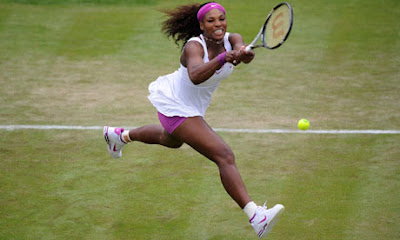
On Saturday, Serena Williams captured her 5th Wimbledon title (later in the day, she and Venus would secure a double’s title as well). Since 1999, the Williams sisters have captured 10 titles at the all-England club. Yet, for each of them, this success has not come without trials and tribulations. Over the last few years, Serena has suffered countless injures, including a blood clot in her lungs. Battling insomnia, depression, physical ailments, and the tragedy of her sister’s murder, Serena has overcome obstacles far more challenging than a Sharapova backhand. “I definitely have not been happy,” Williams announced in 2011. “Especially when I had that second surgery (on my foot), I was definitely depressed. I cried all the time. I was miserable to be around.” In other words, Serena Williams has secured greatness on and off the court, thriving in spite of tremendous hardship.

Within a culture that thrives on stories of redemption, that celebrates resilience and determination, the career of Serena Williams reads like a Hollywood screenplay. Yet, her career has been one marred by the politics of hate, the politics of racism and sexism. Last year I wrote about the treatment she has faced from fans and media alike:

What is striking about the comments and several of the commentaries as well, is the demonization of Serena Williams. Focusing on her body (reinforced by the many pictures that sexualize Williams), her attitude, and her shortcomings as a player, the responses pathologize Williams. “The Williams sisters have been criticized for lacking ‘commitment’ by refusing to conform to the Spartan training regime of professional tennis, restricting their playing schedules, having too many ‘off-court interests’ in acting, music, product endorsements, fashion and interior design, and their Jehovah’s Witness religion” (McKay and Johnson).…

“The Williams sisters also have been subjected to the carping critical gaze that both structures and is a key discursive theme of ‘pornographic eroticism’,” writes James McKay and Helen Johnson. Similarly, Delia Douglas argues, a “particular version of blackness” is advanced within the representations of the Williams sisters. We see the “essentialist logic of racial difference, which has long sought to mark the black body as inherently different from other bodies. Characterizations of their style of play rely on ‘a very ancient grammar’ of black physicality to explain their athletic success”

This monumental victory also didn’t lead to a celebration, a coronation of the greatest player of her generation (and maybe in history), but instead more of the same. The story of redemption and the beauty of her game isn’t the story found throughout the cyber world, from twitter to the comment section of various sports websites.

Her victory prompted tweets referring to her by the “N Word” and several more about her body and sexuality. Reflecting an atmosphere of racist and sexist violence, of dehumanizing rhetoric, tweets referring to her as a gorilla flowed throughout cyberspace with great frequency (some of the below appeared over the last week).

  • ·      Today a giant gorilla escaped the zoo and won the womens title at Wimbledon… oh that was Serena Williams? My mistake.
  • ·      Serena Williams is a gorilla
  • ·      Watching tennis and listening to dad talk about how Serena Williams looks like gorilla from the mist
  • ·      I don’t see how in the hell men find Serena Williams attractive?! She looks like a male gorilla in a dress, just saying!
  • ·      You might as well just bang a gorilla if you’re going to bang Serena Williams
  • ·      Earlier this week I said that all female tennis players were good looking. I was clearly mistaken: The Gorilla aka Serena Williams.
  • ·      serena williams looks like a gorilla
  • ·      Serena Williams is half man, half gorilla! I’m sure of it.
  • ·      Serena Williams look like a man with tits, its only when she wears weave she looks female tbh, what a HENCH BOLD GORILLA!
  • ·      Serena Williams is a gorilla in a skirt playing tennis #Wimbledon
  • ·      My god Serena Williams is ugly! She’s built like a silver backed gorilla
  • ·      I would hate to come across Serena Williams in a dark alley #nightmare#gorilla#notracist
  • ·      Serena williams is one of the ugliest human beings i’ve ever seen #Gorilla
  • YouTube posts offered similar responses to her victory:
  • ·      A man? look at her body, more like a silver back gorilla. I can easily imagine her charging through the jungle breaking trees while flexing those muscles. Doesn’t help that her nose looks like a gorillas as well. I keep expecting to see her zoo handlers to chain her up after the match before she can escape.
  • ·      Monkey business
  • ·      i ddnt know apes wer allowed in women tennis O_O

It would be a mistake to dismiss these comments as the work of trolls or extremists whose racism and sexism put them outside the mainstream.  Just as the Obamas, just as Dr. Christian Head, just as Mario Balotelli was depicted as King Kong in a recent cartoon, and just as just as soccer andhockey players from throughout the Diaspora face banana peels and monkey chants, the racism raining down on Serena’s victory parade highlights the nature of white supremacy.  It embodies the ways that white supremacy demonizes and imagines blackness as subhuman, as savagery.

Continue reading @ NewBlackMan (in Exile): Serena Williams: “Ain’t I a Champion?”.

Jeremy Lin and the NBA’s Race Problem – Entertainment & Culture – EBONY

Jeremy Lin and the NBA’s Race Problem

David Leonard

We interrupt this regularly scheduled Jeremy Lin update to bring your breaking news about Jeremy Lin: he is taking his talents to South Texas. The unfolding drama that amazingly pushed Dwight Howard’s fate to out of the limelight has finally come to end, although without fireworks.

Some have taken the opportunity to blame Carmelo Anthony or JR Smith for Lin’s departure. Carmelo Anthony, when asked about The Lin Situation over the weekend, offered the following: “At this point there’s a lot going on. I stay away from that part right now. I would love to see him back, but I think he has to do what’s best for him right now…It’s not up to me. It’s up to the [Knicks] organization to say they want to match that ridiculous contract that’s out there.”

And then the media spun “ridiculous” as if Carmelo was arguing that Lin’s offer was undeserved. When I read these comments, it didn’t feel like a sign of disrespect, or one where Anthony was saying that Lin didn’t warranted the contract, but rather that it was (L)insane, amazing, and out-of-the ordinary. Like saying “that dunk was ridiculous” or “that performance was sick.” Six months ago, did you think Lin would command 25 million dollars? Did you foresee earning as much as Russell Westbrook or millions more than Steve Nash.

Ridiculous!

When not blaming Melo and Smith, fans and commentators have directed their attention at the Knicks and owner James Dolan. To place all the focus on the Knicks decision is to deny Lin his choice and his agency. According to Frank Isola, “Dolan felt betrayed by Lin for going back to Houston to rework the contract. After all, the Knicks acquired Lin in December after he was released by both Golden State and Houston.” Some have linked this sense of betrayal to Lin’s Asianness, as if Dolan only felt “betrayed” because HE gave Lin – the “overlooked Asian American baller” a chance otherwise unavailable to him.

From start until now, Linsanity has been wrapped in racial narratives that pitted him against Black players. Is it a surprise that as some within the organization reportedly felt he was getting a big head or being ungrateful? Linansity emerged because he could be imagined as the anti-Black NBA star. Yet with reports of him not wanting to play at 85%, his flashy clothing at the ESPYS, and his demands to get paid more, he no longer fits this bill.

And compared to LeBron James, Deron Williams, Dwight Howard, Carmelo Anthony, and Ray Allen, Lin has gotten a pass. Yes, some have criticized him, questioning his worth and his value, questioning his loyalty. But this doesn’t stack up with the derision and contempt directed at Black NBA players. Many in the media have come to Lin’s defense. Dan Devine made a point to explain that “This wasn’t an act of treason,” but rather this is ” how free agency works.”

Yet the loudest media voices weren’t speaking up for Howard or Williams when they expressed their desire to head to NY, or when fans took to Twitter and into the streets to metaphorically and literally burn Ray Allen’s Celtics jersey. Nor did they come to the defense of James when Dan Gilbert described James’ decision as a “shocking act of disloyalty from our home grown ‘chosen one’ sends the exact opposite lesson of what we would want our children to learn.”

If we believe reports that the Knicks decision wasn’t driven by money or even for basketball reasons, but instead Dolan’s ego or his feeling that Lin should have been more grateful since “how often does an Asian American kid go from Harvard to MSG,” it is fair to say race matters. But this is the NBA, where race matters, and where Black players face the daggers of American media racism daily. The constant backlash against these stars, particularly Black ones, who determine their own fate is clear: professional basketball players are lucky enough to earn millions of dollars for playing a game, and the least they can be is grateful, appreciative and loyal.

As Charles Moriano brilliantly stated, the media constantly tells NBA players “get-back-in-your-place-you-spoiled-ungrateful-fill-in-the-racial-code-word-blank.” For Jeremy Lin, the “code words” may be different, but the foundation of race is unquestionable.

via Jeremy Lin and the NBA’s Race Problem – Entertainment & Culture – EBONY.