Shoes, Diplomas, and the American Dream – The Conversation – The Chronicle of Higher Education

(Christian Petersen/Getty Images for Nike, via ABC News)

Shoes, Diplomas, and the American Dream

September 7, 2012, 12:26 pm

By David J. Leonard

The media is abuzz with reports of Nike’s fall release of the LeBron X. Not surprisingly, the widespread commentary doesn’t focus on production conditions or even the technological components of the shoe, but instead on the cost of the shoes. According to The Wall Street Journal, the LeBron X would retail for a whopping $315 dollars; subsequent reports noted that Nike would market the model with all the hi-tech bells and whistles for only $290, with a basic model costing around $180. Pushing the boundaries of what constitutes a shoe (not just laces and “leather”), the LeBron X will include Nike’s + technology, which allows athletes to measure vertical leap, activity, and otherwise assess basketball progress.

Rumors of a $315 shoe led commentators to wax sociological, using the moment to lament the values and cultural priorities of the nation. More specifically, these sociological impersonators lamented the warped values of the poor, of inner-city residents, and of youth—blacks—who would probably flock to stores to purchase the shoes. “The lust for expensive LeBron X sneaker signals a bigger problem,” writes Daryl E. Owens, a columnist at the Orlando Sentinel. Whether linking it to warped priorities or reviving memories of black youths murdering each other for expensive shoes in the 90s (and more recently), Owens points to the dangers of consumption from certain communities: “For too many, the problem is a malignant mutated strain of conspicuous consumption, crossed with hardship and low self-esteem.” Greg Doyel of CBS Sports also objected that “LeBron is trading on the most vulnerable part of his fan base: their self-image.”

Imagining black youth as lacking values, self-esteem, and agency, Doyel and company see the shoes—and not poverty, job and housing discrimination, the prison-industrial complex, divestment in public education, etc.—as the destructive influence on the future of this generation. In other words, the allure of these shoes, and the desire to get one’s hands on them at any cost, is the explanation for persistent inequality. Painting a picture of black youth rioting and killing for these shoes, of a community lacking values, these commentators play on the worst kind of stereotypes and misinformation.

Yet it seems clear that Nike does have a message to market. The company is selling high-school and college athletes the prospect of not just a career but also a future. As with higher education as a whole, this is a message directed at the middle-class—at suburban whites rather than blacks. The LeBron X provides the electronic wizardry for student athletes to better their game. These shoes are imagined as yet another device or investment in a path toward the American dream. Akin to private coaches, the best equipment, nutritionists, private traveling teams, and other financial burdens, the shoes are yet another example of how sports achievement is tied to consumption and investment, to privilege. Akin to spending hundreds of thousands of dollars for a degree from an elite college, tens of thousands on private high schools or preschools because they are pipelines to the American dream. The shoe itself—and the reaction—is a metaphor for what is happening to higher education.

Continue reading @ Shoes, Diplomas, and the American Dream – The Conversation – The Chronicle of Higher Education.
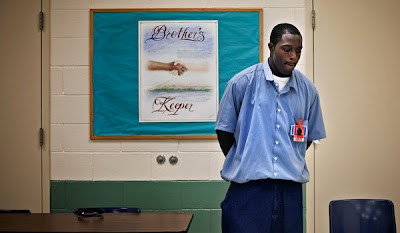
NewBlackMan (in Exile): Real Consequences: The War on Drugs, the New Jim Crow and the Story of Jonathan Hargett

Sean Proctor for The New York Times

Real Consequences:

The War on Drugs, the New Jim Crow and the Story of Jonathan Hargett

by David J. Leonard | NewBlackMan (in Exile)

Most basketball fans have never heard of Jonathan Hargett. A basketball legend with immense potential, Hargett never fulfilled this promise. In a recent piece, The New York Times sought to explain this unfulfilled potential, chronicling his story as not just tragic but a cautionary tale.

Pete Thamel’s story is one that begins and ends with the basketball court. It replicates the popular narrative of the African American baller whose immense talents and endless potential were derailed by pathological behavior, a lack of discipline, and a system that did little to curtail these bad behaviors. In an effort to highlight this tragic story, Thamel imagines the tragedy through his greatness on the court, seemingly reducing Hargett’s story to one of talent left to rot in the fields.

Noting how Amar’e Stoudamire, Kevin Durant, and Carmelo Anthony have noted his greatness, Thamel uses their assessment to not only authenticate the wasted potential but to make clear the American Dream that could have been; yet, his life is more nightmare and according to “‘What Happened to Him?’” that isn’t because of a lack of talent or opportunity:

His signature move was his ability to freeze an opponent with a crossover dribble, then blow past him toward the basket, lobbing the ball off the backboard and catching it and dunking it with one hand. It became known simply as a Hargett.

“Especially when you’re talking about memories and things like that from high school basketball and A.A.U. basketball, he’s definitely one of the names that comes up,” Anthony said. “What happened to him?”

The answer is jarring and sadly predictable. Hargett, who turns 30 this weekend, is an inmate at the medium-security Indian Creek Correctional Center here, serving the final months of a nearly five-year sentence for drug possession with intent to sell.

Thamel’s answer is rife with simplicity and stereotypes. We are told over and over again that Hargett ended up in prison rather than the NBA simply because of his own demons and the failures of those around him to save him. Having lost his father, who died of pneumonia, Hargett grew up with his mom and 6 siblings.

Hargett’s mother, Nancy, worked multiple jobs to help support her six children. With his mother often working and no father figure around, Hargett began to form bad habits. Lancaster said that after Hargett’s ninth-grade year, he began showing up late to practice, and Lancaster noticed an entourage beginning to form around him.

In other words, the death of his father, the failures of his mother, and the influences of the street derailed Hargett’s greatness on the court. Lacking the necessary discipline, focus, and ability to see beyond the present, Hargett spent more time smoking marijuana than honing his craft. He eventually became addicted to marijuana, leading him on a path to prison rather than the NBA. For Thamel, Hargett’s own personal failures and demons are only part of the answer as to “why” or “what happened” to Hargett, as the other part of the story rests with the culture of sports.

A story about agents, handlers, and others who saw Hargett as a dollar sign, as an amazing talent who could line their pockets in the long run, Thamel (and others) treat Hargett as an expose about the pitfalls and dangers of contemporary sports. At its core, it really frames the narrative along these lines (in the words of Hargett himself): “The moral of this whole story is to help someone not to make the same mistakes.” In other words, the story that is offered here is one that imagines him as someone who made bad choices because of a lack of discipline and values (“culture of poverty”). Worse, his own failures are exacerbated by a system that never held him accountable. His fate wasn’t simply the result of his own failings but that of a system based in the exploitation and abuse of vulnerable young men like Hargett, whose talent insulates from the necessary discipline. These personal and institutional failings end with his incarceration.

Continue reading @ NewBlackMan (in Exile): Real Consequences: The War on Drugs, the New Jim Crow and the Story of Jonathan Hargett.

Sexual Harassment in a Culture of Misogyny | The Feminist Wire

Sexual Harassment in a Culture of Misogyny

By David J. Leonard

At least once year, the media highlights the issue of sexual harassment within the sport world. Often focusing on an athlete harassing a member of the media or someone within the organization, the narrative plays upon sensationalism, often depicting sexual harassment as the result of the confluence of highly sexualized male athletes, products of the über-masculine world of words, with an increasingly integrated sports world. In other words, the media coverage often reduces sexual harassment to tawdry tales involving athletes, seemingly leaving readers to believe that had women remained outside of these “male spaces,” sexual harassment would decline proportionally. Erasing power, legitimizing male privilege, all while denying the frequency of sexual harassment at every level of sporting culture and society at large, the media discourse surrounding sexual harassment often fails in documenting this societal evil.

At the start of the 2011 NBA season (and at its conclusion with a settlement), one story received ample coverage without much analysis and discussion. A former employee of the Golden State Warriors filed a lawsuit against Monta Ellis and the team for alleged sexual harassment. The AP Story described the lawsuit and the allegations as follows:

A former Golden State Warriors employee filed a sexual harassment lawsuit against star guard Monta Ellis on Wednesday, alleging Ellis sent her unwanted texts that included a photo of his genitals. In her lawsuit, which also names the team, Erika Ross Smith alleges Ellis began sending her several dozen explicit messages, sometimes several times a day, starting in November 2010 through January while she worked for the team’s community relations department.The messages included lines such as, “I want to be with you,” and “Hey Sexy,” and periodically asked her what she was wearing or doing, according to the lawsuit.

Sensationalistic, a series of headlines without much analysis, context, and examination, the spectacle here did little to address to problem of sexual harassment within the NBA and throughout society. The allegations against Ellis and the Warriors are not the only instance of reported sexual harassment. One week prior, Warren Glover, a former NBA security official, alleged that he was fired from his position with the NBA, one that he had held for ten years, because of his efforts to expose sexual harassment in the league office:

A former N.B.A. security official says that he repeatedly warned his superiors that women in the office were being sexually harassed or discriminated against, but that his concerns were ignored and that he was ultimately fired for his actions on the women’s behalf. He is suing the league for lost wages and damages.

These two instances, as well as the 2007 case involving Isiah Thomas, contribute to a narrative of the NBA as having a sexual harassment problem. Reinforcing the image of sport as a space of heightened sexism, where sexual harassment is rampant because of sport (macho) culture, the media discourse isolates the injustices, thereby comforting the rest of society. In other words, rather than using these moments to confront sexism and sexual harassment found in the NBA and society at large, such discourse isolates it to sports/NBA culture, thereby reinforcing a pacifying narrative of hypersexual black ballers (the Glover case works a bit different) preying on women.

Continue reading @ Sexual Harassment in a Culture of Misogyny | The Feminist Wire.

Olympic swimmers help erase the historic ‘swimming color line’ | theGrio

Olympic swimmers help erase the historic ‘swimming color line’


Lia Neal competes in the Women’s 200 yard Individual Medley heats on day one of the AT&T Short Course National Championships at McCorkle Aquatic Pavillion on December 2, 2010 in Columbus, Ohio. (Photo by Chris McGrath/Getty Images)

As Lia Neal, Cullen Jones, and Anthony Irvin compete in the the 2012 Olympic Games, they are not simply battling the best in the world; they are helping to close the book on a sad chapter in American history. With each start, each stroke, and each flip-turn, the trio of African-American swimmers are putting the historic (and occasionally more recent) exclusion of African-Americans from America’s pools further behind us. Their presence on this year’s Olympic team and their place among the larger history of black Olympic swimmers (they join Maritza Correia, who won a silver medal in 2004) reminds us of a larger history of racism and exclusion.

Indeed, to witness three black Olympians competing as swimmers represents the continued struggle against the longstanding efforts to keep pools white.

“Sports reflect a larger quandary in the land of opportunity, that so many sports have been resistant to inclusion for all races,” writes William C. Rhoden. And for decades, African-Americans were denied access to swimming pools and other municipal activities: and not only in the south. In Pittsburgh at the turn of the 20th century, whites attacked blacks in the name of swimming segregation.

Richard Allietta describes the level of violence and harassment directed at African-Americans within a segregated swimming culture: “As a youngster in Bellaire, Ohio in the early 1950′s, we would go to the public swimming pool on Mondays, ‘colored day,’ and sit in the observer stands and jeer at the colored swimmers.” Similarly, Ted Gaskins’ memories of his childhood in New Mexico, as described to American RadioWorks, illustrates the longstanding connections between American racism and swimming:

During my early childhood days in Alamogordo, New Mexico, in the early-to-mid 1950s, my grandparents owned and operated the local municipal swimming pool. This was before filtering systems were required and the pool had to be treated with chlorine and other chemicals to maintain the cleanliness of the water. It was also drained once a week and refilled with fresh water.

The sign on the outside of the pool read: “hours 10am to 6 pm Tuesday— Sat. Colored: Sunday from 1 pm – 5 pm.’

After 5:00 on Sunday, my grandfather would drain the pool (125,000 gallons of water) — and on Monday everyone would grab buckets of liquid chlorine and scrub the entire pool.

I asked my grandfather why we did this, and he said that the colored people were unclean and this would kill any bacteria that they would bring in. I also would ask my grandmother if I could go swimming on Sunday, and she would always tell me no, because that was the time when the “colored folks” could swim and I wasn’t allowed to swim with them. This went on till 1957 and at that time the state required the new filtering system and my grandparents closed the pool because of the cost of the new equipment. This was an accepted practice during my early childhood.

Reflecting entrenched ideologies, many white residents resisted efforts to integrate pools in the northern and western U.S. during the 1940s and early 1950s. As these municipal pools, which were largely constructed during the Progressive Era (yes, government creating jobs), began to integrate, many whites fled to suburban and private pools, resulting in systemic divestment from the urban spaces.

Continue reading @ Olympic swimmers help erase the historic ‘swimming color line’ | theGrio.

NewBlackMan (in Exile): Baseball’s “Puppy Mill”?: ‘Pelotero’ and the Dominican Connection

Baseball’s “Puppy Mill”?: ‘Pelotero’ and the Dominican Connection

by David J. Leonard | NewBlackMan (in Exile)

Sports films are a staple within American culture. From the Hollywood imagination to documentaries, there has been a longstanding interest in sporting cultures. Offering a window into fundamental American tropes and ideologies – meritocracy; bootstraps; rages to riches; the American Dream – sports films fill the insatiable desire for stories of perseverance, redemption, and possibility. Pelotero, a new documentary narrated by John Leguizamo, enters into this larger cultural landscape, highlighting the dreams and nightmares of global baseball.

Pelotero sets out to answer a simple yet immensely complex question: how can a country the size of the Dominican Republic, with only 2% of the population of the United States, produce so many professional baseball players? In 2010, 86 of MLB’s 833 players come from the Dominican Republic; almost 25% of the 7,000 minor league players hailed from this nation of 9.7 million people. The film’s directors, Ross Finkel, Jon Paley, and Trevor Martin describe their goal as follows:

The central question behind Pelotero was a simple one: Why are Dominicans so good at baseball? The tiny island nation is consistently overrepresented in the Major Leagues, and as America’s pastime continues to globalize, every year brings a fresh crop of young Dominican Peloteros to the top levels of the game. We had a romantic image of these players’ humble beginnings etched in our minds; poor kids chasing rolled up socks through dusty streets as motorbikes whizzed by. However, that vision of street ball felt disconnected to another romantic idea of Dominican baseball; Big Papi, Sammy Sosa, or Robinson Cano slowly trotting around the bases under the bright lights and cheering fans of a big league ballpark. How does one lead to the other? And what is the story in between the two?

Eschewing cultural arguments, those that emphasize role models and “the single-minded pursuit of baseball” and theories that harken Social Darwinism, Pelotero highlights the social, political and economic contexts that funnel Dominican youth into the professional ranks.

With only two offices throughout the world, one in New York City and the other in Dominican Republic, it is clear that Major League Baseball has focused its efforts on developing future players. The desperation and poverty facing those in the Dominican Republic and throughout the Caribbean and Latin America has produced conditions ripe for American corporations taking advantage of this potential labor force, ultimately exploiting workers (players) inside and outside the United States. The establishment of “schools” – baseball’s sweatshops that produce its raw materials – has exacerbated this process.

Beyond filling the League with talented ball players, Major League Baseball teams use the “third world” because the “raw materials” (the players) are cheap. Dick Balderson, a vice-president of the Colorado Rockies, called this process a “boatload mentality.” The idea behind this approach is to sign a “boatload” of Latin players for less money, knowing that if only a couple make it to the big leagues, teams will still profit from the relationship. “Instead of signing four [American] guys at $25,000 each, you sign 20 [Dominican] guys for $5,000 each.” The desperation and poverty facing those in Latin America is facilitating this “single-minded” pursuit of sports, creating a situation where professional baseball teams are able exploit this labor force.

Charles S. Farrell, who is the former director of Jesse Jackson’s Rainbow Sports, described the dangerous predicament facing youth in the Dominican Republic:

Baseball is mainly the sport of the poor in the Dominican Republic, and viewed by so many as a way to escape poverty. Mothers and fathers put a glove on boys as soon as they can walk in order to pursue the dream of la vida buena.

But with every dream there are dream merchants, those who promise to pave a path to glory and riches for a price. The buscónes, as they are known, latch onto prospects at an early age, giving them advice and consul on how best to pursue the dream. Some are genuine in their mission; others simply hook into a potential meal ticket. Either way, good or bad, the buscónes have become a part of the Dominican baseball scene.

Pelotero highlights the consequences of the overdevelopment of the institutions of baseball alongside the underdevelopment of society at large (thanks in part to the polices of the IMF and World Bank). It elucidates how everyone from scouts to the teams themselves take advantage of the limited economic opportunities, the manipulated (unfree) marketplace, and the imported American Dream to get young 13 and 14 year olds to work hard so that maybe their parents can have a better life. Reduced to commodity, the efforts to sell a dream, a future, and most powerfully freedom/independence (signing day is July 2) to the players and their families are crucial in maintaining this exploitative system. One respondent in the film describes the ways that baseball views these young men: “It’s like when you harvest the land, you put seed on the land, you water it, you clear, and then when it grows, you sell it.”

Continue reading @ NewBlackMan (in Exile): Baseball’s “Puppy Mill”?: ‘Pelotero’ and the Dominican Connection.

The Criminalization of Mental Illness in Black America | Urban Cusp

The Criminalization of Mental Illness in Black America

By David J. Leonard

It was a normal night in 2009 at Delonte West’s house. Tired from a long day, West retreated to his room to get some rest. As usual, he took a dose of Seroquel, medication he uses for his bipolar disorder. “Sadness is a normal human emotion,” explains West. “And there’s a mechanism that kicks in and lets you know it’s time to stop being sad. With bipolar, that mechanism is out, so you don’t even know when you’re sad.” Despite certain side effects, Seroquel helps to regulate these mechanisms.

Shortly after falling asleep, West was awoken and told that his friends were downstairs messing around with some guns in the house. Despite feeling the effects of the medication, West decided that the best course of action was to remove the guns from his home, transporting them to a house nearby. He described the situation to Slam Magazine in the following way:

A few of my cats had found some stuff in the studio and they were living the whole gangsta life thing- guns in the air and this and that. And I said, ‘Oh my God. What the fu*k are y’all doin’ in here? Y’all got to go. Momma ain’t on that. Kids are running around upstairs. It’s time to go.’

Gassed up from the commotion, West decided it would be prudent for him to relocate the guns to an empty house he owned nearby. So, with his other vehicles blocked in by guests’ cars, and expecting it to be a short trip, he haphazardly loaded up his Can-Am and placed the weapons in a Velcro-type of bag – “not a desperado, hardcase, gun-shooting-out-the-side type case” -and set off.

Unfortunately, while responsibly moving the guns, he found himself unable to shake his groggy feeling. Realizing the terrible predicament he faced, he sought out a police officer, only to find himself under arrest and ultimately in jail. While clearly a result of his Bipolar Disorder and his need to medicate, West would be punished by the criminal justice system (1-year house arrest), by the media (in terms of ridicule and a narrative that consistently imagined him as criminal), and with a 10-game suspension from the NBA. Named as a member of The Bleacher Report’s “all thug team” and also a member of a list of players who “could double as gang members,” and often described as a “thug” and a “gangsta” in comment sections, Delonte West highlights the ways the criminality and mental health becomes within the black body.

His difficulties and troubles are rarely linked to his disease, instead positioned as yet another criminal baller. Moreover, even acknowledgment about his Bipolar Disorder provides little cover or context given the stigmas directed at black males. Knowledge of medical conditions, instead, are used as further evidence of his criminality and danger. “West wouldn’t be the first person to be picked on for having a mental health condition, and certainly not the first to be picked up for the same,” notes Sam Eifling. “But it’s worth noting that, despite harming precisely no one, West likely became another example of the criminalization of mental illness in America. Now he’s stigmatized as not just sick, but criminal.” Ain’t that a truth known all too well by a disproportionate number of African Americans.

Continue reading @ The Criminalization of Mental Illness in Black America | Urban Cusp.

BIGGER THAN PENN STATE: Does Our Culture Neglect Child Abuse Victims? – News & Views – EBONY

BIGGER THAN PENN STATE: Does Our Culture Neglect Child Abuse Victims?

By David J. Leonard


Amid all the self-righteousness and demands for accountability, justice and changes are the realities that speak to a societal disregard for the injustice of child abuse. Clearly, Penn State, a culture of hero worship, and most specifically those who turned their back on Jerry Sandusky’s victims in the name of bowl victories and football tradition, are complicit. Dollars and wins were deemed more important than the safety of children, an indictment of many.

We can all point to the various enablers within Penn State – administration, the Board of Trustees, Joe Paterno and countless others. Yet, the NCAA and the sports media, which not only promote a culture of football, a “victory culture,” and a “win by any means necessary” are also complicit here. They provided the incentive, the financial remunerations, and the institutional support that gave rise to this tragedy. Did what the NCAA did today make kids any safer; did it change the culture of college sports; did it adjust societal priorities; did it change the ways we define heroes. The plague of child abuse necessitates systemic action, including budgetary support for the prevention of child abuse; it requires financial commitment that actually puts kids first, that cares for those who have faced the unthinkable injustice for child abuse. As the NCAA wags its finger at Penn State and as ESPN and others in the sports media congratulate them, I am left to wonder who will hold the American political structure accountable for making kids more vulnerable.

For the first time in 18 years, the budgetary support for the Victims of Child Abuse Act was cut to ZERO for the 2013 budget. Monies that supported the victims of child abuse, that served almost 300,000 abused children in 2011, are gone, unless Congress restores them. According to the National Children’s Alliance, the cutting of funding for the Victims of Child Abuse Act will result in among other things:

  • Fewer abused children will receive services in every jurisdiction;
  • CACs will not receive the technical assistance and training they need to do their work effectively;
  • Prosecutors would not receive the training and technical assistance they need to get successful prosecutions, hold offenders accountable, and keep our communities safer;

If we as a society are truly concerned about child abuse, lets put our money where our mouth is. Instead of purchasing tickets for one game, instead of donating to our favorite athletic program, instead of donating to politicians who vote against the interest of children, instead of forking over $$ for the latest game gear, lets make our priorities clear with some investment in those actually promoting justice.

Continue reading @ BIGGER THAN PENN STATE: Does Our Culture Neglect Child Abuse Victims? – News & Views – EBONY.