NewBlackMan (in Exile): Olympic Inequalities

Olympic Inequalities

by David J. Leonard | HuffPost Sports

In a recent blog post on The Huffington Post, Kelli Goff dared to ask the unthinkable: “Why Are Some Olympic Sports Whiter Than Others?” Noting the obvious and seeking to understand the absence of people of color from many Olympic sports, Goff attempts to answer why Gabby Douglas, Lia Neal, Jordan Burroughs, Ibtihaj Muhammad, Justin Lester, John Orozco, and Cullen Jones are unusual in the white world of sports. While noting class, environment, differential opportunities (I explore this aspect here), and countless other factors, Goff stays clear of racism:

Before the eye rolling begins, this is not a column about rampant racism in sports. But it is an attempt to understand why some sports end up predominated by one racial group versus others, and the long-term social and cultural implications of such segregation on the field, court, or gymnastics mat.

Despite her attempt to push the conversation away from racism in sports (and beyond), there has been ample resistance from readers. The truth is hard to hear. The reason why America’s Olympic team is overwhelmingly white, the reason why there are so few athletes of color within many Olympics sports, is the persistent impact of racism, segregation, and institutional violence.

Embodying class inequalities, a history of discrimination, and the realities of residential segregation, many Olympic sports are dominated by whites because the spaces, the neighborhoods, the schools and the very institutions that produce those recreational and elite athletes are racially segregated. Whether swimming, diving, or gymnastics, the pipeline to the Olympics is one where youth of color find difficult entry, if not outright exclusion.

We see the consequences of inequality and segregation as it relates to our high school sports, our recreation, leisure, and play. Research has shown that people of color and particularly lower-income communities have fewer opportunities for physical activity. For example, several studies published within the American Journal of Preventive Medicine (AJPM) found “that unsafe neighborhoods, poor design and a lack of open spaces and well constructed parks make it difficult for children and families in low-income and minority communities to be physically active.”

Likewise, citing the study from Trust for America’s Health (TFAH) and the Robert Wood Johnson Foundation (RWJF) entitled “F as in Fat: How Obesity Threatens America’s Future 2010” Angela Glover Blackwell focuses on the structural impediments to a healthy lifestyle that includes exercise. “As the report illustrates, where we live, learn, work and play has absolutely everything to do with how we live. Low-income families of color are too often disconnected from the very amenities conducive to leading healthier lives, such as clean air, safe parks, grocery stores with fresh fruits and vegetables, and affordable, reliable transportation options that offer access to those parks and supermarkets.” Communities of color, and America’s poor, are disconnected from the very facilities and resources necessary to become a great champion. Access to pools, coaches, gyms, and healthy foods, remains a dream deferred for communities of color, meaning the dreams of an Olympic birth are all too distant as well.

Continue reading @ NewBlackMan (in Exile): Olympic Inequalities.

The Invisible War: A Film on Rape, Women and Combat (A Review)

June 23, 2012

By

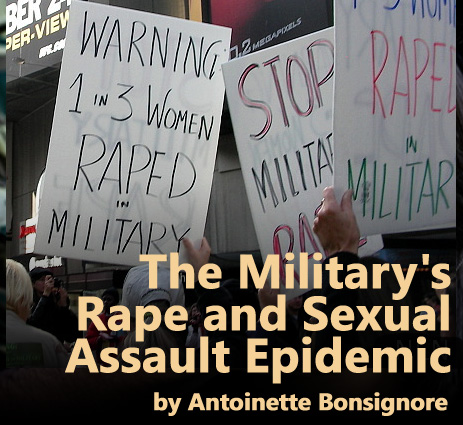
Horrifying . . . devastating . . . infuriating . . . saddening.  These are the emotions I felt as I watched The Invisible War, a new film, written and directed by Kirby Dick, which opened nationally yesterday.  To be sure, The Invisible War isn’t your typical war story.  It’s a gripping docu-film that focuses on the “powerfully emotional stories of rape victims” within the U.S. military, and their “struggles to rebuild their lives and fight for justice.”  Shining a spotlight on a world largely defined by masculinity, combat, force, sex, and concealment, this film unveils the following:

  • 20% of women are assaulted while in the military
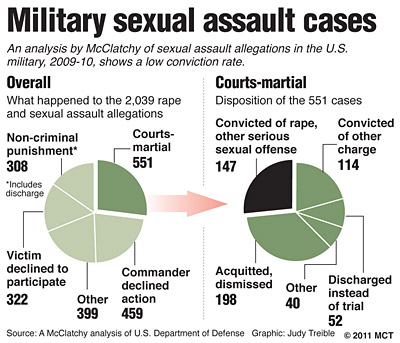
  • Only 8% of the assailants are prosecuted, with only 2% facing conviction
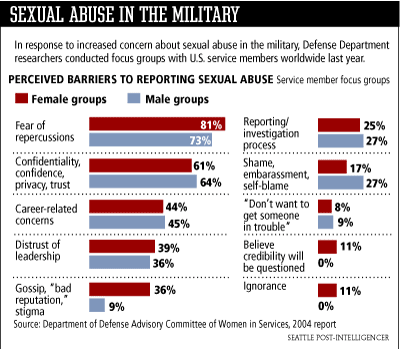
  • 80% of the victims do not report
  • 25% of women do not report rape because the person responsible for receiving the report is oft times also the rapist
  • 1% of men in the military, totaling 20,000, are victims of rape
  • 15% of incoming military recruits acknowledge that they have attempted or committed a rape prior to entering the service
  • 40% of homeless female veterans are victims of rape
  • Of the 3,223 cases that are actually prosecuted, only 175 of the assailants would serve jail time (all numbers are from the film or related press)
  • “The Veterans Administration spends approximately $10,880 on healthcare costs per military sexual assault survivor. Adjusting for inflation, this means that in 2011 alone, the VA spent almost $900 million on sexual assault‐related healthcare expenditures” (press packet).

The Invisible War paints a picture of injustice and sexism, and a culture of sexual violence that has reached epidemic proportions.  However, it does more than offer disheartening and infuriating statistics.  It provides a story, a story about women and men—those who are celebrated as heroes, who receive standing ovations at parades, whose service is lionized and celebrated over and over again—who have been raped while serving in the U.S. military.  Irrespective of yellow ribbons and holidays, it is a story that illuminates rape culture and the ways that victims are multiply victimized within a culture of warfare, camouflage (or cover-up), and sexual violence.

The filmmakers interview roughly 70 survivors of military rape, women and men, who in the face of victimization by their assailants, their military community, and countless others, have decided to fight back.  We learn the stories of women like Kori Cioca who was raped and physically beaten while serving in the U.S. Coast Guard.  We hear how her assailant, who was also her commanding officer, didn’t just rape her, but also broke her jaw during the attack.  And, we learn how Cioca was reminded (over and over again) that her punishment for “lying” would be a court-martial, when attempting to report the assault to those in command.

The Invisible War elucidates a culture of rape and victimization as well as the continual cultivation of revictimization, wherein the military instigates an “in-house” society of violence—among comrades.  Some victims were even charged with adultery due to the assailant being married!  Moreover, of the five women from Marine Barracks Washington interviewed in the film, four were investigated and punished after reporting incidences of rape.  They were told to “suck it up,” unfairly disciplined professionally, threatened with prosecution, and demonized publicly.  And perhaps worse of all, they were often forced to face their assailants every step of the way.

From suicide attempts to physical pain, the film documents several consequences of rape, to include but not limited to rising costs, exacerbated by an “in-house” rape culture.  We see this with Cioca.  The physical pain resulting from her assault is endless.  Because of her broken jaw, Cioca continues to live on a liquid diet, she cannot go outside when it is cold because of pain, and probably most dispiriting, Cioca’s assault remains with her both physically and emotionally.  In fact, she often wakes up screaming.  The dual agony of severe discomfort and traumatic recollection are unceasing.  Unfortunately, this reality has been largely ignored by the VA, which refused to cover all of her medical expenses.

The power of The Invisible War rests with the elevation of the voices and experiences of the soldiers themselves and their families.  The consequences of sexual violence can be felt in the physical and emotional anguish expressed throughout the production.  However, though the film gives voice to victims of rape (and their families) within the military, therefore breaking the silence perpetuated by a complicit media, it misses a critical opportunity to expand the discussion to explore the effects and entwinement of militarism, patriarchy and misogyny in our broader socio-political context.  At times, The Invisible War seems to even downplay how patriarchy and American institutions/ideology(ies) actually sanction and give life to rape culture(s).  In short, in trying to spotlight the injustice facing men and women in the military, and the systematic camouflaging (pun intended) at each level in the chain of command, The Invisible War misses the opportunity to make some pretty significant connections.

A more efficient grasping of sexual violence within the military requires looking at its deployment of gendered language as well as the ways in which women are objectified within and without military culture.  It also demands that we look at “base women,” the relationship between U.S. operations overseas and prostitution, as well as the ways that sexism infects U.S. policies.  In addition, a more critical reading of sexual violence pushes us to explore the treatment of women within the U.S. military, particularly those serving in countries currently occupied by the U.S.
Continue reading @ The Invisible War: A Film on Rape, Women and Combat (A Review) | The Feminist Wire.

Adidas and the Truth About ‘Slavery Sneakers’ – News & Views – EBONY

Adidas and the Truth About ‘Slavery Sneakers’

David Leonard

Adidas’ planned release of its “JS Roundhouse Mids” shoes has been put on hold, but the rightful outrage continues.

The sight of “slave shoes”—sneakers with shackles and chains—prompted widespread indignation and outrage. “The attempt to commercialize and make popular more than 200 years of human degradation, where Blacks were considered three-fifths human by our Constitution is offensive, appalling and insensitive. Removing the chains from our ankles and placing them on our shoes is no progress,” writes Jesse Jackson. “For Adidas to promote the athleticism and contributions of a variety of African-American sports legends … and then allow such a degrading symbol of African-American history to pass through its corporate channels and move toward actual production and advertisement, is insensitive and corporately irresponsible.”

The shoes are yet another reminder of the efforts to sanitize and erase slavery from public consciousness. Whether in the efforts to whitewash history through denying or minimizing the history of slavery, or turning slavery into sources of profit and pleasure, the shoes speak to an effort to reimagine slavery within White America. Whereas the history of slavery is one of violence, bloodshed, and survival in the face of brutality, these shoes disrespect the memories and atrocities at the heart of this country. In turning its symbols – shackles and chains – into something of trendy desire and pleasure, these shoes and its designers not only spit on this history but seek to cash in on the pain and suffering of many people.

The marketing of the shoes also disturbingly capitalize on incidences of shoe violence and media sensationalism. According to the Philadelphia Inquirer, “On Adidas’ Facebook page, the company calls the shoe ‘so hot you [will need to] lock your kicks to your ankles.’” Like those pundits, politicians, and media who sold fear by citing kids being murdered for their shoes, Adidas sees an opportunity in exaggerated stories of death. By telling its consumers that “yes others will desperately want your shoes but not to worry, they are on lockdown,” the company is selling consumers a footwear version of LoJack. As with the politicians and media pundits before them, Adidas is continuing a tradition of peddling and proofing off of racial fears and stereotypes.

As the history of shoe production has been one of exploitation, abuse and “slave-like” conditions, there is sickening irony in these shoes. Do the shackles and chains attached to the shoes mirror those that have been found on children’s feet? Does it symbolically reflect the sweatshop conditions endured by those who produce shoes and apparel throughout the globe?

Continue reading @ Adidas and the Truth About ‘Slavery Sneakers’ – News & Views – EBONY.

NewBlackMan (in Exile): Playing Dead: The Trayvoning Meme & the Mocking of Black Death

Playing Dead:

The Trayvoning Meme & the Mocking of Black Death

by Lisa Guerrero and David J. Leonard | NewBlackMan

The more things change, the more they stay the same. While new media and social networking is “transforming” our society, in certain ways, bringing people closer together, if only seemingly so, its “newness” seems only relative to its potential as a new frontier in which to deploy and recycle the same old narratives and tropes, to continue a history of injustices that define the American experience. As the technologies of communication appear new, the technologies of oppression are anything but. However, as we see with “Trayvoning,” the trend that has White youth posting pictures of themselves as if they were part of the Trayvon crime scene, the marriage of communication innovation with racist stagnation does constitute something new, though not improved, in the history of the system of racism in the United States.

“’Trayvoning’ is when you get a hoodie, Skittles and Arizona iced tea, and pose like you’ve been shot in the chest.” The Facebook page instructs participants in go through the following steps:

1. Get hoodie

2. Get skittles

3. Get Arizona

4. Wear hoodie

5. Go to Florida

6. Get shot 🙂

Trayvon Martin was a 17-year-old African American male who was unarmed and got shot by a raciest [sic] Mexican American.

During Step 7, participants are instructed to post their pictures on the Internet, which has led to widespread circulation of these disgusting and dehumanizing images.

In response to reports about “Trayvoning,” Jasiri X asked on Twitter: “Trayvoning? Really? Why is our pain, suffering & death, always mocked for laughs?” This question gets to the heart of not only the efforts to recreate and disseminate representations of the Trayvon case, but it is also a means to communicate pleasure in the murder of Trayvon. “Trayvoning” recasts and performs injustice by turning someone’s pain and suffering into a spectacle of white pleasure that further denies the humanity of black people. This is reflected not just in “Trayvoning” but with the Orlando businessman who has sought to capitalize by selling Trayvon shooting targets, the media that continues to criminalize and blame Trayvon, and those who have disparaged, mocked (see here for picture of someone who donned blackface), and made light of a dead young man.

The disregard for Black life, and the disparagement of Black death is nothing new; the pleasure and joy garnered from Black suffering and dreams deferred has been central to White supremacy throughout United States history. Evident in minstrel shows, the history of lynching, and jokes about racial profiling or the war on drugs, whites have always found joy in the violence experienced by African Americans.

The history of American public discourse is one marred with both the erasure of black and suffering, and efforts to find happiness and pleasure in the suffering of the OTHER. We saw this during Hurricane Katrina where the sight of African Americans wading through water in search of food or medicine, or stranded families clinging to life on roof tops elicited reactions of shock and horror as well as pleasure and joy at the knowledge that could never happen to White America. Dylan Rodriguez describes Katrina as a “scene of white popular enjoyment, wherein the purging/drowning of black people provided an opportunity for white Americana to revel in its entitlement to remain relatively indifferent to this nearby theater of breathtaking devastation.”

Such joy isn’t simply an outgrowth of the denied humanity of Black people or the refusal to witness and see Black pain, but it is also a celebration of, or at least the solidification of, White humanity, White power, and the protective armor that whiteness provides each and every day. This is the story of race in America, from lynchings to Katrina, from slavery to Trayvon Martin.

But the examples of racialized disregard that have surrounded Trayvon Martin’s death, most recently exemplified in the commodification and “meme-ification” of the tragedy by various White people. This marks a startling new mechanization of racism wherein there has been a complete evacuation of humanity…on both sides, that of people of color and other marginalized groups, the dehumanization of which is, sadly, no longer surprising, but also that of dominant groups who willfully participate in acts of oppression like “Trayvoning” whose humanity becomes increasingly and insidiously taken over by consumption and performance. The joy historically, as well as contemporaneously, taken by many Whites in the violence against and suffering of African Americans has become nearly indistinguishable from the joy of consuming.

Continue reading @ NewBlackMan (in Exile): Playing Dead: The Trayvoning Meme & the Mocking of Black Death.

CHANGING LANES: What if NASCAR was Black? – News & Views – EBONY

CHANGING LANES: What if NASCAR was Black?

By David Leonard

Can you imagine if NASCAR was Black?

In 2010, scholar Tim Wise and rapper-activist Jasiri X called upon their readers and listeners to imagine “If the Tea Party was Black”—how might their perception, reach and behavior be received if the race of the people involved changed?

Two years later, I think we should play this game again, but with NASCAR. Like the Tea Party, NASCAR is overwhelmingly White (there have been 5 Black drivers in its 64 year history), male, and tied to a particular set of reactionary politics. Can you imagine if NASCAR was Black?

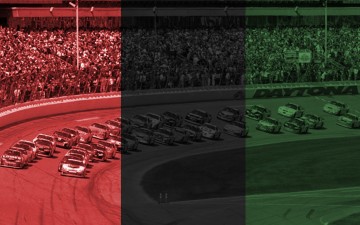
Can you imagine the reaction to fans in “Black Power” shirts lining racetracks, as red, black and green flags and Black Panther Party imagery blanked NASCAR events? Whereas the Confederate flag—a symbol of secession and White supremacy—are commonplace at NASCAR events, symbols of Black pride would surely bring about major criticism and attacks.

What if it was an African-American driver who purposely crashed into another driver’s car, sending him airborne as Carl Edwards did to Brad Keselowski in 2010? Can you imagine if Barry Bonds, Metta World Peace, or Terrell Owens was a race car driver and how the public might respond at the sight of intentional crashes, trash talking, fist fights, and helmet throwing? Would it be “boys will be boys” or “that’s just NASCAR”? Or would the talk to turn to criminality, thugs, and “gangstas?” One has to wonder if hip-hop would take the blame, even though nobody blames country music for this type of behavior from White NASCAR drivers.

Take a recent incident involving Kyle Busch and Ron Hornaday during a Camping World Truck Series race. After bumping each other, Busch proceeded to rear-end Hornaday’s truck into the wall, ostensibly wrecking his car. While Busch received a 1-race suspension and a 50,000 fine, can you imagine the outrage, moral posturing and punishments had the driver not been White?

Although a recent study highlighted the connection between NASCAR viewing and “aggressive driving,” with no such study on the impact of watching hard fouls, one has to wonder what people are actually scared about. If an elbow from Metta World Peace and a hard foul from Udonis Haslem prompts national outrage that focus on how the foul could have killed someone or that if someone did on the street would have been in jail, a Black NASCAR driver would lead to similar statements about “cars being weapons” and “out-of-control” drivers who are obviously crazy and therefore unsafe and off the track.

If the U.S. military gave $136 Million to a Black NASCAR driver as it did to Dale Earnhardt Jr., would people see it as advertisement or maybe a handout, welfare, or affirmative action?

Can you imagine if NASCAR fans that were overwhelmingly (if not entirely) Black booed the First Lady of the United States, what might the reaction be? Whereas White fans can boo Michelle Obama and Jill Biden during an appearance at Homestead-Miami Speedway, which it is hard to imagine Laura Bush and Lynne Cheney receiving similar treatment at a Black NASCAR event; certainly such disrespect would elicit national outrage and condemnation. Can you imagine the reaction from Sean Hannity and Rush Limbaugh, who actually thought the incident to be justifiable given the Obamas’ “uppity-ism?”

That sort of disrespect wouldn’t fly if NASCAR were Black, nor would a group of drivers refusing to meet with the president. Just this year, several White NASCAR drivers passed on an invitation to the White House, citing scheduling conflicts. We don’t have to guess what might happen given the experiences of Craig Hodges, who in 1992 while visiting the Bush White House not only wore a dashiki, but also “handed the President a letter that asked him to do more to end injustice toward the African-American community.” He was soundly denounced in the media and shortly thereafter he was out of the league.

Continue reading @ CHANGING LANES: What if NASCAR was Black? – News & Views – EBONY.

Masculinity, the NFL, and Concussions

Masculinity, the NFL, and Concussions

May 12, 2012

By

The defenders of the National Football League (NFL) have been busy.  In the wake of the suicide of Junior Seau, on the heels of several other untimely deaths, “bountygate,” several former lawsuits regarding concussions, and growing scientific literature highlighting the dangers of football, its protectors have gone on the offensive.  From citing other potential factors that have led to ridiculous rates of suicide, traumatic brain injuries, and a life-after-football defined by depression, memory loss, neurological difficulties and a quality of life no one would associate with America’s heroes, to celebrating the NFL for its efforts to protect the players, the NFL hype machine has gone to great lengths to push back against the growing outcry against football.

Yet probably the most common response has been to place blame on the players, emphasizing their choices and responsibility. “I can’t blame the NFL for every issue that every former player in the NFL has,” noted former player and current ESPN football analyst Cris Carter.  “I signed up to be in the NFL. It wasn’t like someone had to force me. I kinda knew what I was signing up for.”  Responsibility resides with the men who play football and few else. In other words, while terrible, concussions and the long-term impact of those concussions is an unfortunate reality brought about by choices. Players understand the risks, and are rewarded because of the violence and danger, and thus the NFL and any of its partners bear little burden. Illustrating the ways that hegemony works and the illusion of choice, Carter’s comments reflect the erasure of power and ideology.

Greg Doyel, at CBS Sports, further encapsulates the “logic” and framing that turns the violence of football into a choice, one that may have consequences:

For me, it comes down to choice — and football players have a choice whether to play or not. It’s not a blind choice, either. This isn’t the 1960s, when Colts tight end John Mackey had no idea what the violent collisions were doing to his brain. The greatest tight end of his generation was showing signs of dementia in his 50s, in an assisted-living center at age 65, dead at 69. Mackey never knew the risks, but today’s players know. Playing football is like smoking a cigarette: This isn’t the 1960s; everyone knows the risks. . . . Football isn’t dog fighting, where mistreated animals take it out on each other in a cage. Those dogs have no choice. NFL players do. And let’s be honest: The lifestyle of an NFL player is incredible. Even if it ultimately shaves years off their lifespan — and lessens the quality of those remaining years — there’s an argument to be made that it’s worth it. The fortune, the fame. The thrill of the crowd. That’s a lifestyle they can’t get anywhere else. Live like a king at 30, hobbled at 50, dead at 65? Not sure I’d take it, but many would. And do.

Similarly, Karla Milner, who commented on The Washington Times website, offered the following:

… two words people: PERSONAL ACCOUNTABILITY. We all make choices – not all of them are good. But they are our choices and we should own them. If you choose to smoke all your life you should NOT be able to sue the tobacco companies as in my lifetime there’s never been one second that we didn’t know it was bad for our health (and I’m over 50). And if you choose to play football (professionally or otherwise) you should not be able to sue over issues from concussions or other injuries because there’s no way in hell you could NOT know that the risk of injury and issues down the road was a possibility…

She wasn’t alone, with dozens of commenters reiterating the mantra of choice and accountability. One such person, Blair, agreed: “Like you were all forced into playing the game…. Look at boxers? Heck, who warned me that everytime (sic) I got on my bike after school I could get a concussion jumping ramps in the alley?” Patrick Hruby describes the fan and media reaction as follows:

1. Getting hit in the head is bad for you;

1a. Duh;

2. Former football players understood this risk when they signed on the NFL’s dotted line;

3. Ergo, the league is not responsible for helping players deal with subsequent memory loss, lack of emotional control, cognitive decline or early-onset dementia;

4. Also ergo, any former football player with the sheer gall to file a lawsuit is a greedy moocher trying to work the system, akin to the lady who sued McDonald’s over spilled hot coffee.

The ubiquitous links to McDonalds and tobacco are interesting in that in both those cases, the logics of capitalism and the instruments that protect the bottom line sought to minimize or, better said, quash any threats. The tobacco industry, in fact, sought to deny the consequences of tobacco, so why are we to think that such denials or reframes are little more than a tobacco-like distraction?

The constant references to players reportedly hiding symptoms or players refusing to listen to medical advice regarding concussions represent a narrative emphasizing choice. It is the players who bear responsibility for their choices; and more importantly, those who choose to remain in the league, who continue to live the American Dream playing America’s current pastime, do so knowing the risks.

This conservative reactionary response is of little surprise given the links between the U.S. political establishment, the military, commercial culture, and football. The constant emphasis on choice, individual actions, on pulling oneself up by one’s cleat laces, on risks and rewards, is emblematic of the hegemony of a protestant work ethic trope and meritocracy. Never mind the lack of transparency and education that allows one to make “informed choices,” the efforts to defend the NFL and deny culpability erases the ways in which masculinity and dominant notions of good versus bad manhood constrain the choices that players and fans alike make regarding football.

Continue reading @ Masculinity, the NFL, and Concussions | The Feminist Wire.

NewBlackMan: Can We All…Get It Right?: Remembering the LA Uprising

Can We All…Get It Right?: Remembering the LA Uprising

by David J. Leonard | NewBlackMan

There are few days in life where you can say without a doubt, “I know what I was doing 20 years ago today.” This is the case today, on the 20th anniversary of the start of the Los Angeles Uprising.

Having dropped out of the University of Oregon after 2 quarters, I was living in Los Angeles working and taking two classes at UCLA. Like many middle-class white youth I presume, I paused when the verdict was delivered and noted the injustice that spurred my outrage before getting back to my life. I was angry, like many others, because a jury of THEIR peers concluded that 4 police officers did nothing wrong in beating Rodney King 56 times, but the anger lasted only for that second. That was the reaction from many in West Los Angeles. “That’s outrageous, can I get a cold beverage”; “what an injustice, is the mall open yet?”

I remember thinking little about the case after hearing the verdict,. I headed to work and then to my class at UCLA. Driving to my class, through the wealth of West Los Angeles, all was calm. Entering class, an introduction to sociology course that focused on inequality systemic racism and privileges, it was clear that the verdict changed little. Class was planned as usual. Yet, before long, with news reports of violence breaking out in South Central, Los Angeles, our professor announced the end of class out of concern for OUR safety. In a city immensely segregated, defined by systemic divisions that thwart interaction all while enacting violence on its residents of color, it is immensely telling that the Rodney King Verdicts/LA Uprisings became meaningful, if not visible, when people thought the riots were going to cross La Brea or other markers dividing the two LAs.

For the rest of that night and next day, I was paralyzed, watching television almost endlessly. In retrospect, for myself, and maybe others, the LA Uprising put a crack in the walls of segregation. Although living less than 15 minutes from South Central, Los Angeles, it might as well have been 10,000 miles away. That is the specter of segregation in Los Angeles. Even the media reporting then, and the ways that the verdicts and LA Uprising were being talked about demonstrated this fact as people continued to talk about what was happening “over there” concerned that it might “migrate here.” I was uncomfortable with the detached feeling paralyzing me so I decided to leave the state-protected bubble of West Los Angeles and I drove down to South Central on day 2 to donate some food, clothes, and stuffed animals to the First AME Church.

I was most certainly driven by my desire “to help,” as I imagined what that meant twenty years ago, which most certainly reflected my white privileged understanding of privilege. Yet, I was also angered by the clear segregation of Los Angeles, not only in terms of geography, economics, and daily reality, but sentimentality and emotion.

The lack of sadness and anger within West Los Angeles was telling because the LA Uprising was not happening in our world; it was somewhere else, happening to someone who didn’t look like “us.” The power of race and class in eliciting not only empathy and connection, but also sentimentality and humanity, was on full-display in the days after the King Verdict. When I told people that I was heading down to South Central, they looked at me like I was crazy, as if I was driving into a foreign land amid a war. To them, it was a foreign land, one that they neither visited nor thought about except in moments of fear (“will the rioters come to the West Side) or heading to Lakers’ games. Despite voiced concerns about my driving just a few miles down the 10 Freeway, it was rather “uneventful” except in how this moment transformed me.

The drive forced me to reflect on my own assumptions and stereotypes, to think about why neighborhoods so close to my own were places I had never been (and thought of as so far away); it forced me to think about the violence and destruction that predated April 29th and bare witness to communities that West Los Angeles had abandoned; and finally, it forced me to reflect on the power of community, to see beyond the televisual representation of South Central Los Angeles rioting, to see families collecting food, kids playing, and people coming together. It forced me to look inward, to think about whiteness and privilege, to reflect on my stereotypes and assumptions. Even my ability to get my car and drive to South Central Los Angeles is evidence of privilege given the levels of state violence experienced by black and Latino youth entering LA’s white enclaves in West Los Angeles. What should have been a moment of introspection, of racial reconciliation and systemic change, instead became a moment, one that too many of us retreated as we are driving back to the “comfort” of a gated community.

Continue reading @ NewBlackMan: Can We All…Get It Right?: Remembering the LA Uprising.