Under The Hood: A New Take On Activism In Sports | Racialicious – the intersection of race and pop culture

Under The Hood: A New Take On Activism In Sports

By Guest Contributor David J. Leonard

As individuals from throughout the United States and in other parts of the world voiced their anger and outrage at the murder of Trayvon Martin, there was an initial frustration from many in the social media world about the reticence and silence from today’s (black) athletes. The wish that athletes, and really black athletes–since it is rare to hear about the failure of white athletes–would uses their platform to shape change has become commonplace. So when the Miami Heat and several other players joined the calls for justice, there was certainly a level of joy and satisfaction.

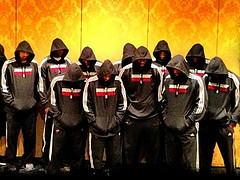
Whereas individual athletes have a long tradition of protest and using the platform of athletes to express political sentiments, from Tommie Smith and John Carlos to Toni Smith, few teams have collectively taken a stand. Donning hoodies, the Heat stood in solidarity with Trayvon, shining a spotlight on the deferred justice in his case and the real-life dangers of racial profiling. As a team, they stood together as one, although it is clear that both Dwyane Wade and LeBron James were the ringleaders beyond this effort. The picture and the tweet, under the hashtag of #wewantjustice, were in fact the impetus of James himself.

Many have expressed surprise at the involvement of James and even Wade, given their emergence as America’s team to hate, as emblematic of the me-first baller generation. This is particularly the case for James, who has been subjected to endless criticism since high school. While much of the condemnation often focuses on his unwillingness to take the “big shot” in important games or his attitude, some progressives have lamented the lack of political engagement from James. While not unique in their eyes, his power and status elevates him in this regard. Writing about James’ refusal to sign a letter from teammate Ira Newble concerning China’s role in the Darfur genocide, Dave Zirin took James to task for his refusal to join the fight:

At the tender age of 22, you have the galactic talent to make us wonder if a mad scientist had Magic and MJ genetically spliced. But talent ain’t wisdom. In a recent interview, you said that your goal in sports was to become “the richest man on earth.” You also told ESPN, “I’m trying to be a global icon … on the level of Muhammad Ali.”

These dreams are compatible only if you choose to emulate Ali the icon and not Ali the man. Ali the icon is used to sell books, computers, snack foods, and anything not nailed down. Ali the man sacrificed his health, future, and untold millions by standing up to racism and war. No one is demanding you do the same. No one is insisting you get in front of a microphone and say, “I ain’t got no quarrel with them Iraqis.”

But you should understand that the reason Ali remains a “global icon” is precisely because he didn’t define himself by his corporate sponsors. When his handlers told him to stop throttling the golden goose of fame he said, “Damn the money! Damn the white man’s money!”

Seemingly challenging James, Zirin highlights a clear choice for the NBA’s next great superstar.

“The choice you face is frankly quite stark: How free do you want to be?,” he asks. “Do you want to be ‘King James of Nike Manor’ or the King of the World? Only by refusing to be owned, only by displaying independence from the very corporate interests that enrich you, will you ever make the journey from brand to three dimensional man.” With his participation with the Million Hoodie March, and the efforts from other Heat players, it is clear that not only has James made clear how he “wants to be” but silenced his critics by highlighting his willingness to take the big shot, one far more significant than any last game heroics.

At one level, the response reflects the connection that James, Wade, and several other players felt with Trayvon. According to James, “I have two boys, D-Wade has two boys and a lot of our teammates have sons. This could be one of our sons someday. The thought of sending your son to the store and never having him return is an emotional one for any parent.” In reading their statements, it is clear that their statement didn’t merely reflect their being fathers but father of black boys.

Continue reading @ Under The Hood: A New Take On Activism In Sports | Racialicious – the intersection of race and pop culture.

SLAM ONLINE | » Leave LO Alone

Leave LO Alone

The callousness of the NBA.

by David J. Leonard / @DR_DJL

Taking a break from LeBron James, the NBA’s resident hateratti have recently focused its attention on Lamar Odom. With Carmelo, Andrew Bynum and Russell Westbrook ballin’; Kobe, DRose and Dwight Howard hurt; a “perfect” Kevin Durant; and Deron Williams and Kevin Love being on the Nets and Wolves, the NBA’s mean machine has turned its attention on the reigning Sixth Man of the Year.

The season began tumultuously for Odom, with his being initially traded to New Orleans only to be sent back to the Lakers, who at his request quickly traded him to the Dallas Mavericks for a draft pick. Media pundits and fans denounced the Lakers’ ineptitude all while praising the Mavericks for reloading their roster as part of their quest to repeat as Champions.

Unfortunately, the trade was probably the highlight of Odom’s (and the Maverick’s) season as things have gotten progressively worse, leading to his recent deactivation. From Sixth Man of the Year to persona-non-grata in less than a year is sad, yet the level of anger, vitriol and demonization directed at Odom is a sad commentary on sport and society.

Odom’s difficulty on the court has been widely attributed to his selfishness and inability to get over the trade. Portrayed as emotional and childish, his career-low statistics have been used to comment on his personality, demeanor and attitude. For example, Jen Engel Floyd, with “Odom mastered The Art of Not Trying in Dallas” argues that “he was hauling a lot of emotional baggage with him from L.A.—and he chose to do nothing.”

While providing zero evidence (reports have been that he wasn’t disruptive in the locker room), Floyd describes Odom as a “toxic force” resulting from his anger about being in Dallas—“There are pejoratives to describe Odom’s behavior. ‘Unprofessional’ and ‘selfish’ immediately spring to mind. I am kind of partial to ‘whiny, soft, narcissistic L.A. jerkhole.’”

Engel was not alone in the ad hominem personal attacks that focused on Odom’s maturity and demeanor over anything else. According to Mike Chiari, “rather than moving on and accepting that he wasn’t with the Lakers any longer, Odom decided to sulk, and his game was severely hindered by it.” Likewise, Benjamin Hochman continued the trend of “hatin’ the player” and not the game, questioning Odom’s “mental toughness.” Most revealing, and weeks before the Mavericks decided to banish Odom from the team, Jason Whitlock condemned Odom for his failure to play against the Lakers, explaining his failures to uphold a standard of masculinity.

Odom has chosen to sulk and brood and hide.

He wants to move back to L.A., and he apparently is willing to withhold his services in an effort to make it happen.

The Lakers dumped him, and, citing family matters, Lamar declined the chance to exact revenge in a nationally televised game.

Are you kidding me? Did Jordan skip games against the Bulls? Did Favre pass up a chance to play the Packers? OK, Lamar Odom is not Jordan or Favre. Kyle Orton took his shot against the Broncos and Tim Tebow. I bet Jeremy Lin will relish his chance to play against his hometown Golden State Warriors.

Family matters. You have to grow a pair to start a family, Lamar.

Evident here and throughout the national “hate on Lamar tour” is a tone that demonizes Odom; one that imagines him as selfish, immature, mentally weak, soft and feminine. Even the criticism directed at him for collecting a paycheck (enter Charles Barkley and 63 percent of fans in one poll) subscribes to the belief that Odom’s failures on the court are reflective of a choice not to commit to the Mavs, the game of basketball, or the fans. These commentaries are both personal and paternalistic, criticizing Odom for disappointing them because he chose to put himself in front of anyone or anything else.

What is disappointing about these responses is that they are yet another reminder of how society—whether it be the sports media or fans—views NBA stars as little more than commodities who are supposed to run up and down the court. The denied humanity and emotions, particularly impactful with the sports media’s treatment of black athletes, has been on full display. The lack of care or concern for his emotions—for the trauma that he is experiencing—embodies not just the ways that athletes are treated as dehumanized commodities who should produce or exit stage left, but also the ways that society denies and demonizes the mental trauma and the stress of African Americans.

Any failure to uphold that role is met with derision and pathologizing. In Odom’s case, his failures are explained in simple terms: He didn’t want to be traded, and rather than “man up,” he sulked, all the while collecting a paycheck. Given this tone, there has been little room to think about how Odom’s own history and recent events in his life might be impacting him.

Continue reading at SLAM ONLINE | » Leave LO Alone.

SLAM ONLINE | » The NBA’s Franchise Player?

The NBA’s Franchise Player?

The untouchable Blake Griffin or the can’t-do-right Andrew Bynum?

by David J. Leonard / @DR_DJL

After watching yet another commercial, seeing yet another magazine advertisement, and trip to Subway, both my 4-year-old son and 8-year-old daughter noted that Blake Griffin seemed to be everywhere.

No matter where they turned, no matter what was on the television, it is almost impossible not to see Griffin, all of which is emblematic of the power of the NBA’s marketing machine. Despite winning nothing of substance to-date and only putting up very good numbers over his short career (20 and 10), Blake has ascended as the face of the League.

Celebrating for his ferocity, his spectacular dunks, and his purported right attitude, Griffin has filled the hero gap left by LeBron’s “Decision,” Dwight Howard’s “Indecision,” Melo’s “New York State of Mind,” and Kobe’s “Baggage.” Griffin, on the other hand, has consistently been represented as a “breath of fresh air,” a throw back player, and someone who fans can cheer for.

Celebrating his balance, the media narrative consistently depicts Blake as a competitor on the floor and a good guy off the floor. For example, TJ Simers highlights the difficulties Blake must endure and the grace that he has shown under this pressure:

That almost speaks to a sensitivity one would never consider Griffin possessing, given the way he imposes his physical will on opponents. But he is still young, and when asked about the highlight of his summer, surprisingly it was his brother’s wedding rather than the Hollywood treatment he received.

Similarly, Justin Verrier offered explanation and, in some regards, an excuse for Blake’s “antics” as a means to celebrate him:

But Cousins and Gasol aren’t entirely wrong, either: While it’s hard to argue that Griffin is “babied” by refs, given the game-by-game punishment he takes in the post, he certainly benefits from his share of favorable calls (in particular, the one that sent Cousins off the deep end to begin with). And Griffin has made a habit of forcefully dropping his off-hand on some of his more memorable dunks, creating both a way to propel himself higher and return some of the force applied to him on his way up (a natural reaction with unintentional consequences, he’s said in the past).

But these are only minor squabbles in a season full of them, throughout the League. Their comments certainly put a national spotlight on Griffin’s on-court demeanor—Cousins’ comments alone overshadowing recent ugly performances by the Heat and Thunder—but they may end up saying more about how players around the League perceive the rise of young stars like Griffin.

You have to crawl before you walk. You’re supposed to intern before you get that big job. And in basketball, like all other professional sports, you’re supposed to pay your dues.

This represents the crux of the Blake the narrative: great kid, whose passion, competitiveness and work ethic at times get the best of him. What could have been a criticism thus becomes a way of celebrating Blake Griffin as unique and special.

“He’s a highlight at any second of the game, but he’s also smart enough to know that the fundamentals are the part that will make him better and help this team,” noted his coach Vinny del Negro. “He handles it very well. He has great humility and great character.”

Evident here is how the Blake Griffin story is very much a figment of the media/NBA imagination. Shooting free throws with the precision of Shaq and Chris Dudley, possessing only two moves—the dunk and a 20-foot, pick-and-pop shot—and of course playing no defense are not the markers of a fundamentally-sound player. The description of Blake as humble doesn’t match his on-court persona of talk trashing in the tradition of Bird and Payton, and relishing the opportunity to embarrass an opponent with a poster shot.

Continue reading at SLAM ONLINE | » The NBA’s Franchise Player?.

White Riot: Kentucky Fans, Trayvon Protesters, and The White Privilege Conference

White Riot: Kentucky Fans, Trayvon Protesters, and

The White Privilege Conference

by Charles Modiano On April 4, 2012(cross posted from POPSspot)
What if Travon Martin Protesters Did This?

Oh, here we go again. This week brought us another sports fueled violent white riot after Kentucky won the NCAA Basketball Championship. The riot, which many had predicted would happen, came just 60 fires and two days after the first one where Kentucky fans burned cars to celebrate its win over Louisville.

The Final Four riots came just months after Penn State fans took to the streets,  crashed down lamposts and flipped over trucks after football coach Joe Paterno was fired for not using his power to prevent the rape of young children.

The Penn State Riots came a year after the Vancouver Canuck Riots which came a year after San Francisco Giants fans cheered their World Series win by looting, setting fires, and attacking cars — or as The San Francisco Chronicle put it — “joyful mayhem“.

And when the games are over, and real life problems come up such as the shooting of Trayvon Martin, the larger criminal justice system that his death symbolizes, and the rallies across the country demanding reform. Led by, but not limited to a divisive conservative media, many have wondered: “Is The Media Inciting Violence?” and “Is Spike Lee’s Tweet the Same kind of Violence That Killed Emmit Till? while “Sanford Frets About Prospects of Riots Over Trayvon Martin Killing“.

Ironically, while thousands of mostly white Kentucky fans were tearing up the Kentucky campus this weekend, more than 1400 mostly white people were gathered in Albuquerque, New Mexico for The 13th Annual White Privilege Conference. At WPC13, participants attended four days of workshops and supportive caucuses to better understand what white privilege iswhat it is not, what’s inside the “invisible knapsack” of privileges, and using this knowledge to facilitate positive social change.

Saturday’s keynote address on “Intersectionality in the Age of Post-Racialism” was given  by law professor Dr. Kimberle Crenshaw. Besides being a pioneering scholar, Dr. Crenshaw  also happens to be a big sports fan rooted in childhood heroes named Jim Brown and Muhammad Ali. I had the privilege of sitting down with Dr. Crenshaw to get her thoughts on today’s sports landscape. In part of the interview which took place just a couple of hours before the first Kentucky riot, she had this to say in response to The Penn State Scandal and protest of Joe Paterno’s firing:

“Fundamentally, we see the difference between how outrage, hurt, and pain is framed sympathetically when it’s about white pain, white institutions, white patriarchs, white heroes, and how just the fear of that kind of acting out [by African-Americans] will create such reactions.

So nothing bad has happened around all of the protests around Trayvon Martin, but everybody is saying: ‘just so it’s non-violent’… ‘just so it doesn’t get out of control’… and ‘let’s not desecrate his memory’.

Well, nothing has happened.

So that very disparity represents precisely the disciplinary fear of Black people that led to Trayvon’s death in the first place.”

By calling into question the inner fears that produce greater concern for imagined Black violence over real actual white violence, Dr. Crenshaw questions the sort of mindset or “gutset” that continually produces so many variations of Trayvon Martin (see Ramarley Graham, Oscar GrantKenneth Chamberlain, Howard Morgan, etc.).

Her comments were in line with the goals of The White Privilege Conference which served as an introspective and productive ”gut-check” for white people (and others) to help eradicate harmful biases by first recognizing their existence .

Says WPC Founder and Program Director, Dr. Eddie Moore, Jr.:

“The White Privilege Conference is designed to critically examine, critically push, and critically challenge participants amidst a loving, family-oriented, and community environment.

In that context, it is important to look at white privilege in comprehensive ways so when you look at Trayvon, you don’t say “I AM TRAYVON MARTIN”, but instead you explore the various ways in which you could identify and say:

“I  AM GEORGE ZIMMERMAN”.

Dr. Moore’s statement signifies an honest recognition of everyday skin privilege, even if it means getting away with less than murder. This declaration also means identifying with George’s stereotyping of Trayvon, even if his gunshots are replaced with disapproving stares.  While identifying with Zimmerman may not be quite as comforting for white participants (including this author) as throwing on a hoodie in symbolic support of Trayvon, it’s definitely necessary if we are going to get real about about racism.

In this broader context, recognizing white privilege includes questioning ”the white right to riot” while the larger white community never has to pay a racial price. Those guys who set all those fires in Kentucky? “It wasn’t me — not my problem.” Being white means the privilege of never having to suffer from “group punishment“.

In her analysis of the OJ Simpson Trial,  Dr. Crenshaw explains that African-Americans received “group punishment” by whites in the aftermath of the case. Despite legitimate reasons for doubt (and , African-Americans were viewed, discussed, and punished as a group — both socially and politically — for the celebratory response to ”The Verdict”.

Conversely, the immediate response to Joe Paterno’s firing drew no group punishment or even group analysis of “white culture” or a “culture of white male privilege”, but instead focused on every  conceiveable “sub-culture” besides race. Even after months of reflection, a recent poll found that Pennsylvania voters favor changing the current stadium name to Joe Paterno Stadium. The poll wasn’t just college fratboys — but registered voters.  And while none of those “yes votes” were likely cast by the then-child victims of rape that Paterno had the power to protect, the life-long trauma of those victims might be worth a national discussion.

But honest national conversations by white people about white people as a group just don’t happen.

At least not in too many circles outside of The White Privilege Conference where I learned at least three things:

1) I have largely taken my hoodie-wearing for granted like I’m Bill Belichick.

2) ”Errupt Big Blue” means the right to riot twice in 48 hours without racial repercussion, and

3) “I AM NOT TRAYVON MARTIN”

RELATED: “We Are Penn State”: Is Hip Hop Culture To Blame?

Now Don’t Say You Weren’t Warned…
Restaurant is Looted

Lexington Fire Department Tweets Detailed Account of Student “Riots”

NewBlackMan: More than a Ball Player: The David West Interview

More than a Ball Player: The David West Interview

by David Leonard | NewBlackMan

One of the more thoughtful and socially active professional athletes, David West, a forward for the NBA’s Indiana Pacers talked with NewBlackMan regular contributor David Leonard, about the current NBA season, the residue of the NBA lockout, the stereotypes of NBA players and what he’s reading these days.

***

DJL – How has the compressed season been physically and mentally?

DW: The games are just coming. It becomes a grind. 4 games in 5 nights. 12 games in 15 nights. This is physically taxing. There have been injuries around the NBA. You do what you can to get your body prepared but sometimes the body won’t respond. It is not going to get better.

DJL: How does the compressed season impact family

DW: Families are rarely taken into account in a regular season and that is even more of an issue this season. There is really no time. Guys make sacrifices in a normal season and that is even greater right now. There is less time to do anything outside of practice and games.

DJL: Describe your assessment of lockout looking back in terms of relationship between players and owners, how race played out

DW: I went to a few meetings and there was some cryptic language that was used. I was offended by the idea we may not understand certain things. Beyond that, when you are dealing with a certain amount of money in business, there has to be a middle and level ground. In the media, we were portrayed as not knowing anything, as greedy and selfish – to just shut up and play basketball. We expected that.

I always tell people that we very fortunate to be in the NBA but there are a lot of personal sacrifices. So during the lockout guys were able to invest time in themselves, something that often went under the radar. This generation of athletes is a bit more conscious than they get credit for, how they spend and invest their money. I have been in the league for 9 years and when I started out there were high-end cars every where in the player parking lots and now you see less of that. That goes unnoticed. The lockout was a personification of that because guys were prepared to miss paychecks, to miss games. This is a change in the mindset of players.

DJL: It seems that one of the struggles was battling the caricature of today’s NBA player

DW: Every guy doesn’t have the machine behind them. As an individual, it is hard to fight the assumptions made about us. When I first entered the league, people were like “David, what are you talking about” because I wasn’t talking about basketball and I wasn’t talking about mundane things that people expected from me. That puts into perspective what people expect of you; people don’t expect athletes to have anything to offer other than being a source for entertainment. The mind is seen as 2nd or 3rd rate. So often the conversation starts and ends with sports. You find yourself boxed in. I have been labeled as stand-offish because when people engage me they often just want to talk about basketball, and that is not what I always want to talk about. Most guys deal with it and just walk around in a bubble because there is no space for original thoughts from athletes within sports.

DJL: What are your passions, what drives you?

DW: I am passionate about knowing more. Every day I wake up, I want to learn something new. I read a lot on African American history, African history, and history in general. I love to read; I want to be engaged with what is going on socially. I love music, the language that is inside the music, what guys are trying to say, especially with hip-hop. It doesn’t have to be the “conscious rap.” All rappers are conscious because they have the wherewithal and freedom to say something. Regardless of what you hear, even the most childlike rapper or those who rap at the highest level, there is a message there. I like to speak to young people; I don’t like to box myself in just because I have been successful as an athlete.

Continue reading @NewBlackMan: More than a Ball Player: The David West Interview.

The NBA’s Glass Wall


My 5-part series with Lay Up-line on gender, sexism, and the NBA
March 7, 2012

NBA’s Glass Wall: Cheerleaders

(This is part four in a special 5-part series by sports analyst David J. Leonard on the NBA’s abysmal performance when it comes to gender equity.)

Mary Jo Kane, in “Sex sells Sex, Not Women’s Sports” links the marginalization of female athletes to the hegemony of sex within sports.  She successfully debunks the claim that sex sells women’s sports: “Sex sells sex, not women’s sports.” As part of the Nation’s series on sports, Kane argues:  “Millions of fans around the globe just witnessed such media images and narratives during coverage of the Women’s World Cup in Germany. Perhaps such coverage will start a trend whereby those who cover women’s sports will simply turn on the camera and let us see the reality—not the sexualized caricature—of today’s female athletes. If and when that happens, sportswomen will receive the respect and admiration they so richly deserve.”

This is pretty easy to see as one looks at the ways female athletes enter into the sports media sphere. Historian Patricia Hill Collins notes how contemporary sports cultures works to “simultaneously” “celebrate and ‘feminize” their athleticism by showing women in action and showing their navels”.  Coming on the WNBA’s marketing campaign, Collins argues that WNBA “ads all shared another feature — unlike their basketball uniforms that provide more than adequate coverage for their breasts and buttocks, each woman was dressed in fitted sweat pants and in a form-fitting top that, for some exposed a hint of their midriffs, an occasional naval”.

In regards to the WNBA, one has to look no farther than google to see the hegemony of sexualization.  If one types in WNBA and “hotties,” “sexy” or “sexiest” one is faced by an avalanche of websites offering top-10 lists.  Whether on the Bleacher Report, Spike TV, ESPN, and YouTube, women in the WNBA are far more readily available as sexual objects than ballers. Routinely radio stations and websites pit women of the WNBA in a battle for who will be crowned as the “hottest” WNBA star (see here for example).   In these contests, presumably male fans vote for the “hottest player” illustrating the ways in which primarily male fans interact with women ballers: as sex objects, as body parts, as sources of pleasure.  Women, thus, enter into the sports realm reaffirming patriarchy and gender boundaries, reinforcing the primacy of males in this space.

The sexualization of women within basketball is of course not limited to WNBA players, but is on full display during each and every NBA game.  Over the past decade women have been deposed from their positions as referees and play by play analysts.  When the NBA hired two women referees, Violet Palmer and Dee Kantner, in 1999 three years after promoting Cheryl Miller as a play by play analyst, it appeared as if women were shattering the NBA”s glass wall that kept women away from on-court positions of authority.   However by 2003, Palmer was the lone woman referee in the NBA and there were no other women doing play by play for nationally televised games.  Therefore if you watched an NBA game on TV in the last thirty years the only women you saw was either a sideline television reporter—but that still depended heavily on which team you were viewing and whether it was a televised game.  So more likely than not the only women you saw gracing the courts during NBA games were cheerleaders.

The sight of scantily clad cheerleaders who make limited wages for their in-game performances (around $100 dollars per game) affirms that the place of women on the basketball floor is quite clear.  Cheerleaders are the most prominent examples of the “sexy babe mode” mode of representing women.  According to Kane, the “sexy babe mode” “represents a “hot” female athlete, falls just short of soft pornography.” This carries over into sports media with websites and “mainstream” sports like NBC Sports or Sports Illustrated offering pictorial slide shows, often showing women in sexualized positions (cleavage shots seem to be a requirement for some websites).

In spite of the fact that it operates a professional woman’s basketball league sex and sexuality remains the predominant vehicle through which the NBA transmits images of women.  While sex sells sex, it also sells “MEN’S SPORTs.”  Whether in advertisements for strip clubs in local newspapers, athlete pictorials, or eye-candy cheerleaders, women in sports remain sexualized objects for the consumption of male consumers.

NBA’s Glass Wall: The Case of Nancy Lieberman

(This is part three in a special 5-part series by sports analyst David J. Leonard on the NBA’s abysmal performance when it comes to gender equity.)

Following the announcement that Nancy Lieberman was going to become the first female head coach in the NBA system in 2009, the sports media gathered around in celebration.  Chris Tomasson asked “Could Nancy Lieberman Become the NBA’s First Female Head Coach?” while Scott Schroeder celebrated Lieberman as  “Still a Pioneer.”  Although clearly a break through movement for the league, the media focused on celebrating the individual achievement rather than the dismantling of the NBA’s boys-only coaching carousel.  For example, Tomasson rhetorically asked: “The D-League today. The NBA tomorrow.”  Depicting her as a pioneer, as a trailblazer, and as someone who will open up opportunities for other women in the NBA, he concluded:  “If there ever will be a female NBA head coach in my lifetime, I’m thinking Nancy Lieberman has got a shot. Lieberman took the first step toward that Thursday when she was named head coach of the Dallas Mavericks’ D-League team in Frisco, Texas.“

Similarly an Associated Press story, quoting Lieberman as a transformational figure, as someone who has the potential to usher in sea change within the NBA, continued the celebratory tone.  It describes her struggle “to break another gender barrier, one she hopes “could be the last barrier.”  The efforts to imagine her as a transformational figure, as someone who could lead the NBA into a post-gender reality is evident in comments from Lieberman herself:  “I kind of look at President Obama,” she noted. “Everybody knows it’s historical because he’s a man of color. But at the end of the day, regardless of his race, creed, color or gender, he has to be president. Everybody knows I’m a woman, but at the end of the day, regardless of my race, creed, color or gender, I have to win basketball games.

Noting the importance of her success, the overall narrative focused on Lieberman as an ideal pioneer, given her ample successes, including her playing against men.  Yet, the media tended to focus on the burden and responsibility she faced.  Her success and failure would invariably impact whether or not other women would have the chance to become coaches. She noted, “If I am successful, I’m sure that I will be looked at (by the NBA).”  Unfortunately, after a 24-26 record in her only season on the bench, Lieberman moved into the front office.  The fanfare and celebratory tone has vanished, as has the commitment to breaking down the gender barriers for female coaches.  The culture of masculinity and the persistence of the old-boys club, all while the narrative focuses on the ways in which it is the league’s players are reluctant to accept a female coach, illustrate that hegemony of the NBA’s gender problem.

A single person, even the great Nancy Lieberman, a lone hire, never had the power to undermine the belief that leaders are male.  The fact that there is little conversation about the lack of female coaches is a testament to the ways in which male coaches have been normalized within the NBA.  It is no wonder that Mark Cuban thinks the NBA will have an openly gay player before it has a female head coach.  It no wonder that Pat Summit, collegiate basketball winningest coach, described the chance of a women coaching in the NBA a “longshot.” Because of patriarchy and sexism, evidenced by the entrenched NBA culture, and given the persistence of Glass Walls within the NBA, I guess the hope of Lieberman is not hope we can believe in.

The NBA’s Glass Wall: The Case of Jeanie Buss

(This is part 2 in a special 5-part series by sports analyst David J. Leonard on the NBA’s abysmal performance when it comes to gender equity.)

One of the more popular minstrel reality shows in VH1’s roster is the program Basketball Wives.  This show is consistently lampooned and derided online whenever it airs for a whole host of reasons, not the least of which is that none of the women on the show are actually NBA Wives, not even in the common law sense.  That wives and girlfriends are interchangeable in VH1 parlance is peculiar enough, but more troubling is the fact that in an era where accomplished women are leading nations, running Fortune 500 companies, and in the case of Oprah Winfrey, a multi-platform media empire, when it comes to the NBA, the most prominent women is this gaggle of pseudo-celebrities.

Clearly, the NBA does not endorse Basketball Wives, so the point here is not to attribute the show as an extension of the league.  No, the issue is how does a multi-national corporation like the NBA which has housed two of the biggest sports stars of the last thirty-years, Michael Jordan and Yao Ming, allow itself to get outmaneuvered by VH1 and its tabloid fare when it comes to the dissemination of women’s images.

One way to begin this discussion is to explore the experiences of Jeanie Buss, which is profoundly instructive as to how the image of the “girlfriend” has become the league’s dominant meme when it comes to women.

In spite of her numerous professional accomplishments, most people know Buss more for her relationship with Phil Jackson, her appearance in Playboy, and her potential participation in the Real Housewives of Beverly Hills, and not as a Los Angeles Lakers executive (she is executive vice president of Business Operations).  It should come as no surprise that little has been made over the assumed anointing of Jim Buss and not her as the next leader of the Lakers.  After all, “It’s a man world,” and her entry into a hyper masculine space has been through her sexuality and body.

While I don’t speculate to understand the dynamics here, but raise the issue in regards to how little has been made about her not even being included in the conversation as a potential successor to Jerry Buss.  Jim Buss’ role as president and his power within the organization is obvious, yet little has been made as why him and not her.  Take a report on ESPN.com shortly before Buss’ promotion:

But now, with legendary coach Phil Jackson retiring and his father, Lakers owner Dr. Jerry Buss, retreating a bit further from the day-to-day operations of the team each year, Jim Buss’ influence on the future of the franchise will be hard to miss.

His whims, his voice, will be the single most important force in the way the Lakers move out of this failed season.

Jim Buss has been constructed as the natural successor while Jeanie is depicted as Phil Jackson’s girlfriend.   Although Jim Buss has been routinely criticized for his decisions and communication skills, it is hard to find anyone suggesting that Jeanie would be better for the job.  This in spite of a fact that her success as a manager dates back to her early days serving as chief executive of the Los Angeles Forum, and overseeing business operations of the Lakers during both the Shaquille-Kobe era and the more recent Kobe-Pau period.  By contrast, Jim Buss’ two most important decisions in the last fifteen years has been hiring Rudy Tomjanovich and Mike Brown.

In short, Jeanie Buss is the most prominent example of the glass wall that seems to permeate the NBA.  Women are able to rise to the executive ranks in the NBA’s league office and the business side of many franchises, but they dare not cross over to managing day to day basketball operations.  That even a family owned franchise like the Lakers that has been extremely successful over the last thirty years would not portend to let a woman exist as a voice of the franchise is really telling about the density of this glass wall.

The themes here transcend the Lakers and the Buss family as we can see how the NBA is a hyper-masculine enterprise and that the participation of women so often comes in the form of traditional supports and sexual objects.  “The NBA would rightly point out that a number of women work in fairly important positions in the league office, where it’s easy to find people who care sincerely about such things,” writes Henry Abbott. “But women not only don’t play basketball for the NBA or its teams. They also don’t coach, make trades or hand out punishments. (They do, however, at almost every public NBA event, dance around in skimpy outfits for money.)”

That Jeanie Buss receives more attention, from media and otherwise, for her relationship history rather than her managerial acumen is indicative of the ways that women are accepted within sporting cultures.  Consumed as sexual object, as fulfilling traditionally accepted gender roles, Jeanie Buss has illustrated the difficulty of being seen in other contexts.

February 27, 2012

NBA Teams Airball When It Comes to Promoting Women


(This is part one in a special 5-part series by sports analyst David J. Leonard on the NBA’s abysmal performance when it comes to gender equity.)

The NBA is often praised for its diversity, celebrated as some model of how sports should handle race.  While researching and writing After Artest I spent ample analyzing the widespread celebration of the NBA in this regard.  The NBA is presumably the gold standard when it comes to the hiring and advancement of racial minorities in front office and head-coaching positions.  However, when we swap gender for race, the NBA’s AAA Diversity rating is significantly downgraded.

This past summer, The Institute for Diversity and Ethics in Sport (TIDES) at of University of Central Florida released its report on the NBA.   While providing ample data, the conclusion/summary was as follows:

The NBA had an A+ for race and an A- for gender for a combined A.

Based on the total points used in these weighted scales, the NBA earned its highest grade combined grade ever at 92.2, up from its previous high of 91.5 in 2010. The NBA grade for race was 95.3, which was up significantly from the 2010 Report when it was 93.8. The combined total and the total for race were both higher than for any other men’s sport in the history of the Racial and Gender Report Card. The NBA again received men’s pro sports’ only A for a combined grade for race and gender. As has often been the case since TIDES began issuing its annual report there were countless headlines praising the NBA’s Diversity Efforts, such as “NBA remains leader in sports diversity” and “NBA gets an ‘A’ for Diversity.”  Yet, as we look at the report and beyond, it is hard to imagine how the NBA can get an “A-” for gender, much less an overall A.

For gender, the NBA earned an A in the league office and an A- for professional administrators. It received a C for team senior administration and an F for team vice presidents.  At best, this is a B average, but a closer look reveals how troubling the NBA’s approach to gender has become.

  • Of the 60 NBA Referees, there was 1 woman (or .02 percent)
  • Women made up 3-percent of Radio/TV Broadcasters
  • Of the 320 Team Vice Presidents, only 48 were women (15%)
  • Women held 27% of team senior administrative jobs (an all-time high)

TIDES depends on close cooperation of league offices to produce its report so there are myriad reasons why it would be in their best interest to accentuate the positives about the NBA.  The league however has been far less complimentary regarding these continued inquiries into their diversity practices.  In a recent article by the New York Times’ Harvey Araton NBA commissioner David Stern is quoted as saying:

“I recognize the presumption that an organization that is not diverse has a job to do. But once you reach a certain critical distribution, the counting should stop.”

Even though the NBA received the highest gender grade of the four major sports, Stern was still overly sensitive regarding ongoing calls for greater gender equity throughout various branches of the NBA.

Interestingly, in this report about diversity in the NBA, there are no grades for gender as it relates to coach, assistant coaches, president/CEO, and general manager.  There are multiple ways to interpret this omission: (1) in the absence of any women in these positions, the grade is obviously an “F.”  Yet, in unmarking that exclusion, the report fails to highlight the absence of female coaches and top executives within the NBA.  (2) The erasure of these numbers normalizes the absence of women within the key basketball-related within the NBA.

In effect, by failing to note these abysmal numbers, the report seemingly renders this reality as both unexpected and a given, not worthy of notation.  This represents a major shortcoming within the report and more importantly the overall tenor of discussions regarding women in the NBA.  Naturalizing exclusion renders women as coaches, presidents, and general managers as unthinkable within the dominant imagination.  The report does grade the NBA as it relates to women vice-presidents, in which the league gets an “F.”  Beyond the abysmal numbers – there were 48 women vice presidents during the 2010-11 NBA season, accounting for 15 percent of vice-presidents league-wide – it is quick to see how few women serve in basketball-related capacities. Female vice-presidents so often found in positions within human resources, marketing, and other business related activities.  There are few women who are both visible, and integral to basketball operations.

Again, it should be noted that this report praises the NBA’s diversity record in the league office, i.e., central administration (“manager, coordinator, supervisor or administrator in business operations, marketing, promotions, publications and various other departments”), giving the NBA an  A- here.  Its when it gets to the individual teams that there is a steep drop off in performance.  Therefore, what becomes evident is that its been normalized that the place for women within the NBA is peripheral; at its best, we see women as league vice presidents, albeit outside of basketball relations.  At worse, and more commonly, women can be found in support roles, in those accepted gender roles as sideline reporters, secretaries, personal-assistants, cheerleaders, and as the case of tomorrow’s subject Jeanie Buss reveals, even when a woman is an accomplished front-office professional she is still rendered as someone’s, girlfriend.

David J. Leonard Reflects on Derek Fisher Trade | The Layup Line

The Derek Fisher Trade

David Leonard

David J. Leonard Reflects on Derek Fisher Trade | The Layup Line

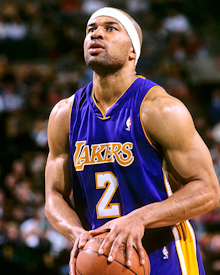
I am a Lakers’ fan. From cradle until grave, I will be a Lakers fan. I was cheering for alley-oops (Coop-a-loop) long before “Lob City;” I have watched games at the Great Western Forum, the Staples Center, and elsewhere. So, when I heard the Derek Fisher had been traded, I was sad. With his jersey hanging in my closet, Fish has always been a favorite player of mine. Defensive-minded, but someone who has always hit key shots – .04 against the Spurs; his 3 against the Magic; his greatness in Game 3 against the Celtics – he has been instrumental in the Lakers’ championships. In a history of the NBA’s greats, Fisher is not one of them, yet his lore and power extends to the likes of West, Baylor, Magic, Worthy, Shaq, and Kobe

At an intellectual level, his trade to the Houston Rockets makes perfect sense. Fish is 37-years old and his best days on the court are certainly behind him. His effectiveness, whether on the defensive end or as shooter, has been in steady decline. Add to this, the economics of the game and that the Lakers’ had just traded for Ramon Sessions, a young and dynamic point guard, one has to concede trade makes sense.

It is clear from yesterday’s trades that the Lakers’ improved their squad, increasing their chances in the playoffs, something every fan has demanded since their last championship two years ago. Yet, I found myself conflicted, uneasy about the trade outside of “basketball reasons.” I was not alone with Lakers’ fan lamenting the trade of Fish (while celebrating the departure of Luke Walton and barely noticing the trade of Jason Kapono). Noting how he was a glue guy, how important he was to the team’s chemistry, and how instrumental he has been for the Lakers’ the overall tone was both reminiscent and predictive. Fans have expressed concern about how his departure may impact the team though little of it has focused on specific contributions – scoring, rebounding, assists, defense, ball-handling – that the Lakers are losing. Kelly Dwyer encapsulates this line of thinking:

There is absolutely no justification for the move. Fisher, to be quite frank, has been absolutely brutal on both sides of the ball over the last two seasons for Los Angeles. He can’t stay in front of even the NBA’s slowest point guards, at this point, and he offers precious little offensively save for the occasional (as in, “32 percent of the time he shoots one”) 3-point basket. By every conceivable standard, he was a millstone for the team on the court. No amount of leadership and smarts (two things Fisher provides in spades) could make up for his shortcomings.

It still doesn’t mean you trade Derek Fisher, heart of the team, to save $3.4 million and a few million more in luxury tax savings. Some guys really should just be untouchable, even as their minutes decrease to nil. Derek Fisher should have been one of those guys.

continue reading @ David J. Leonard Reflects on Derek Fisher Trade | The Layup Line.