NewBlackMan: ‘No [Hoodies] Allowed’: The NBA’s Dress Code & the Politics of New Racism —Excerpt from After Artest: The NBA & the Assault on Blackness

‘No [Hoodies] Allowed’: The NBA’s Dress Code & the Politics of New Racism —Excerpt from After Artest: The NBA & the Assault on Blackness

—Excerpt from After Artest: The NBA & the Assault on Blackness

by David J. Leonard | NewBlackMan

The murder of Trayvon Martin has prompted widespread discussions about race in America, persistent inequalities within the criminal justice system, differential values afforded to different bodies, and the real-life consequences of racial stereotypes. Amid many of the discussions, media reports, and the protests have been questions about the racial signifier of the hoodie. From the million hoodie march to the backlash directed at Geraldo Rivera, who named the hoodie as a co-conspirator along with George Zimmerman, the discourse has reflected on the racial signifiers embedded in the hoodie. In other words, how is a black body, inherently criminal and suspect when read within a hoodie; what are the dialects between the hoodie and the black body within these processes of criminalization? These types of questions have been asked and represented in a spectrum of spaces, highlighting the ways the black bodies are imagined as threatening within the dominant white imagination. Pushing the conversation beyond individual prejudice and “what was in George’s heart,” such counternarratives have reflected on how media narratives, popular culture, and a culture that criminalizes black bodies produces a Trayvon Martin, whose mere presence is seen as a threat, all while producing a George Zimmerman.

As a scholar of race and sport, these questions have long guided my work: how do the representations of black athletes, particularly those in the NBA, buttress larger ideological, political, and criminalizing processes? How does the ubiquitous references to NBA players as “thugs” and “gangstas” as “criminals” and “punks” normalize blackness as questionable, undesirable, and inherently suspect? The murder of Trayvon, the prison industrial complex, the racial segregation in school discipline, and the levels of state violence are a product of these cultural projects. According to a report from the Opportunity Agenda, “distorted media representations can be expected to create attitudinal effects ranging from general antagonism toward black men and boys, to higher tolerance for race-based socio-economic disparities, reduced attention to structural and other big-picture factors, and public support for punitive approaches to problems.”

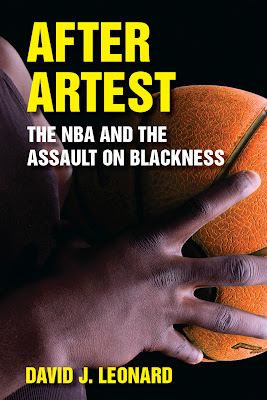
In my recently release book – After Artest: The NBA and the Assault on Blackness (SUNY 2012), I explore the broader criminalization of blackness inside and outside of the NBA’s arenas, that among things has focused on the attitudes, demeanor, and clothing of NBA ballers. I, thus, present to you a short excerpt from the book, one that explores the racialization and criminalization that is evident in the NBA’s dress code as a way to expand our conversation about the murder of Trayvon Martin to reflect on how popular culture, media discourses, and the language of everyday racism both normalizes the criminalization of blackness and points to the importance of intervention in this regard.

Continue reading @ NewBlackMan: ‘No [Hoodies] Allowed’: The NBA’s Dress Code & the Politics of New Racism —Excerpt from After Artest: The NBA & the Assault on Blackness.

NewBlackMan: The NFL or The Hunger Games? Some Thoughts on the Death of Junior Seau

The NFL or The Hunger Games? Some Thoughts on the Death of Junior Seau

by David J. Leonard | NewBlackMan

Last weekend I saw The Hunger Games. When I walked into the theater, I could not have told you one thing about the film, and if not for the uber publicity, I likely would have thought it was a show on the Food Network. While there is much to say about the film, I was left thinking about how it merely recycled the common Hollywood Gladiator trope. Mirroring films like The Running Man and The Gladiator, The Hunger Games highlights the ways that elite members of society make sport and find pleasure out of the pain and suffering of others. That is, they find arousal and visceral excitement in watching people battle until death. Within such a narrative trope is always a class (and at times racial) dimension where those with power and wealth (the tenets of civilization?) enjoy the spectacle of those literally and symbolically beneath them fighting until death. The cinematic representation of the panopticon, whether within the past or in futuristic terms, allows for commentary about the lack of civility, morals, and respect for humanity amongst the elite outside of our present reality. As these morality tales take place in the past (and or future), they exists a commentary about our present condition, statements about how far we have evolved and/or the danger of the future.

Yet, what about The Hunger Games in our midst? What about the NFL, a billionaire enterprise that profits off the brutality, physical degradation, and pain of other people? What about a sport that celebrates the spectacle of violence? Unlike The Hunger Games or Gladiator, films that depict a world where people bear witness to death, hungrily waiting the next kill, football and hockey fans sit on the edge of their seat waiting for the knock out hit, the fight, and bone crushing collision. The game doesn’t end with death but death results from the game. Out of sight, out of mind, yet our hunger for games that kill are no different.

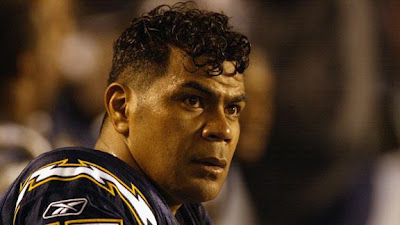
Junior Seau committed suicide today; he shot himself in chest. While his death certificate will surely say “self inflicted gun shot wound,” it might as well say death by football. He, like so many former NFL players, have fallen victim to football-induced death. The links between suicides and concussions, between obesity and heart disease, and between drug abuse and post-NFL physical pain, are quite clear. The NFL Games are killing men before our eyes; yes, death is not taking place on-the-field with fans screaming from the rafters or the comfort of their couches, but make no mistake about, death is knocking on every player’s door. “Suicide, drugs, alcohol, obesity—are ailments the National Football League is getting to know all too well,” writes Dave Zirin. To him, Seau is yet another reminder of the brutality of the NFL and the callousness to this epidemic. He continues:

These are issues NFL Commissioner Roger Goodell and the various team owners are loathe to discuss, but with Seau, they won’t have a choice. In Seau, a larger than life Hall of Fame player, we have someone with friends throughout the ranks of the league and especially in the media. It will be incredibly difficult to keep this under wraps. People will want answers. Over the summer, former Chicago Bears safety Dave Duerson took his own life with a gunshot to the chest so his brain could be studied for the effects of concussive injuries. Junior Seau now joins him, a gunshot to the chest. There is a discussion that the NFL is going to have to have with a team of doctors, players and the public. Right now, this is not a league safe for human involvement. I have no idea how to make it safer. But I do know that the status quo is absolutely unacceptable.

Lester Spence also pushes us to think about suicide as a potential consequence of NFL/NHL careers.

The first thing we should do is think about Wade Belak, Rick Rypien, and Derek Boogaard. They were three NHL enforcers (people who made their hockey careers through their fists rather than through their sticks), who committed suicide over the past year. Each of them had a history of concussions. Boogaard made the courageous decision to offer up his brain to science. The results suggest his suicide may have been the result of brain damage.

It is only after thinking about Belak, Rypien, and Boogaard, that we have the medical context to understand Seau. Not so much to understand why he committed suicide–if there were a simple relationship between concussions and suicides the suicide rate of former NFL/NHL players would be far higher than it is. BUT to understand how his suicide may be at least a partial function of his NFL career.

It is hard not to think about the consequences of sporting violence. It is hard to deny the implications here when NFL players commit suicide at a rate six times the national average; it is hard not to think about a rotten system when 65 percent of NFL players retire with permanent and debilitating injuries. It is hard not to think of the NFL and NHL as a modern-day gladiator ring where our out-of-sight childhood heroes are dying because of the game, because of sport, because we cheered and celebrated brutality and violence. It is hard not to think of the NFL as nothing more than the real-life hunger games, our version of death as sport, when we look at reports following suicide of Dave Duerson:

Continue reading NewBlackMan: The NFL or The Hunger Games? Some Thoughts on the Death of Junior Seau.

He’s Still Metta World Peace – Entertainment & Culture – EBONY

He’s Still Metta World Peace

[OPINION] David Leonard says one mistake on the court doesn’t mean we should ignore the former-Ron Artest’s bold transformation

David Leonard

Metta World Peace is once again America’s most hated athlete. After elbowing James Harden in the head, an indefensible foul netting him a 7 game suspension, he has faced endless criticism on not just the cheap shot but him as a person. In article after article, within television commentaries, media pundits have made their anger clear, often refusing to call him by his name since his actions mirrored those when he was Ron Artest. Announcing that he doesn’t deserve to be called Peace, that he clearly has not changed from his Ron Artest ways, and that his new name was a lie in that he was “still a thug,” the efforts to deny MWP his name is telling. It is both a power play (“we will call you what we want to call you”) and part of argument that MWP is a bad guy who is incapable of changing irrespective of his name.

Part of the refusal to call by MWP seems to come from anger if Metta elbowed the media in the face. This wasn’t simply a foul or even a cheap shot, but a betrayal to all those who believed in Metta’s transformation, who rooted for him, and who gave him a 2nd chance. It was an affront to his new name, a name he didn’t deserve.

Drew Magary, in “Why Did We Ever Think Ron Artest Was Interesting?”, reflects the level of hostility directed at MWP, anger that comes from a feeling of being bamboozled and taken for a fool in believing in this changed man: “I was one of those Internet people who participated in the rebranding of Ron Artest when he arrived in L.A. a couple years ago. Yet “Artest isn’t really a colorful character. He’s not an interesting person. And he’s not sympathetic. There’s nothing to learn from the life of Ron Artest. Like Arenas, he’s just a flaky shithead.”

Capturing the tone of a parent whose child missed curfew again, after having promise to always be on time, the post-elbow tone has been one of disappointment and feelings of betrayal. “I had come to know him and even like him…. I have visited with him countless times after games and eventually understood him as a guy who seemed to be constantly choking down his violent tendencies in an attempt to change,” writes The Los Angeles Times’ Bill Plaschke. “He would say something mean, then turn it into something funny. … I was really starting to believe he was Metta World Peace. I was wrong, and James Harden has the headaches to prove it. He is still Ron Artest.“ As with many others Plaschke refuses to call him by name because in his eyes he is the same old bad person.

Following in the tradition of Muhammad Ali, Kareem Abdul-Jabbar, World B. Free, Mahmoud Abdul-Rauf, and even Chad Ochocinco, Ron Artest’ changed his name to Metta World Peace (MWP) in Summer of 2011. While facing similar scorn and criticism (albeit each in distinct ways), his decision to be come MWP highlights the power of black self-naming in a society that often doesn’t understand the black community. The capacity to name one’s self is in power, a power routinely co-opted and denied by white America. As we are reminded in Coming to America: “A man has the right to change his name to vatever he vants to change it to. And if a man vants to be called” Metta World Peace, “godammit this is a free country, you should respect his vishes, and call the man” Metta World Peace!

Having believed that MWP was a changed man, the elbow betrayed their desire to redeem him because it showed how compassionate, forgiving, and exceptional American could be. As with the anger directed at Tiger Woods, “America’s multicultural son” after news broke of his martial infidelity, and the disappointment directed at Kobe Bryant, who was “different” from his baller brethren, following Colorado, the elbow denies the media THEIR story. And so denying the “we forgive you Metta; isn’t America exceptional story,” these angry commentators have returned the favor in denying him his name. It goes back to that same old (White supremacist) saying: you can take the player out of the ghetto, but you cant take the ghetto out of the player. Or better said, you can take on this flower child name, but you can’t change who you are if who you are is an inherently violent thug. Yet, the man has changed and despite an indefensible foul, he still has the right to be called Metta World Peace.

Continue reading @ He’s Still Metta World Peace – Entertainment & Culture – EBONY.

Black Girls Run! Friendship, Community, and Sisterhood

PART 1

On the website “Stuff White People Like,” marathons are listed as #27.  It describes running a marathon in the following way:

To a white person, the absolute pinnacle of fitness is to run a marathon.  Not to win, just to run. White people will train for months, telling everyone who will listen about how they get up early in the morning, they run when it rains, how it makes them feels so great and gives them energy. When they finish the marathon, they will generally take a photo themselves in a pair of New Balance sneakers, running shorts, and their marathon number with both hands over their head in triumph (seriously, look it up, this is universal). They will then set goals like running in the Boston Marathon or the New York Marathon. If you find yourself in a situation where a white person is talking about a marathon, you must be impressed or you will lose favor with them immediately.  Running for a certain length of time on a specific day is a very important thing to a white person and should not be demeaned.

Playing upon widespread stereotypes about whiteness and African runners, Daniel Tosh celebrated the existence of marathons in racial terms: “The only reason marathons are still around is so 20,000 white people can chase three black guys through the streets of Boston like the good old days.”

This is the world I imagined when I first started running a few years back.  As a white male, nobody ever questioned my “fitness” to run marathons, assuming, despite never being a runner, that it was a natural outgrowth of my past athletic endeavors.  Since then I have done several races, increasingly witnessing the level of racial, class, and age diversity evident within the running world.  Whereas both the Seattle Marathon (Rock n Roll) and San Francisco Marathon were overwhelmingly white, my recent race in Los Angeles challenged the widespread association between running and middle-class white identities.  My experience highlighted the diversity of runners (and Los Angeles).  I was surrounded by black and Latino youth, many who were running as part of the Students Run Los Angeles program. This challenging fact disrupts the celebrated whiteness associated with marathons.  Running is not limited to 5K or 10ks, half or full marathons, but is a daily practice that brings people together in myriad contexts.

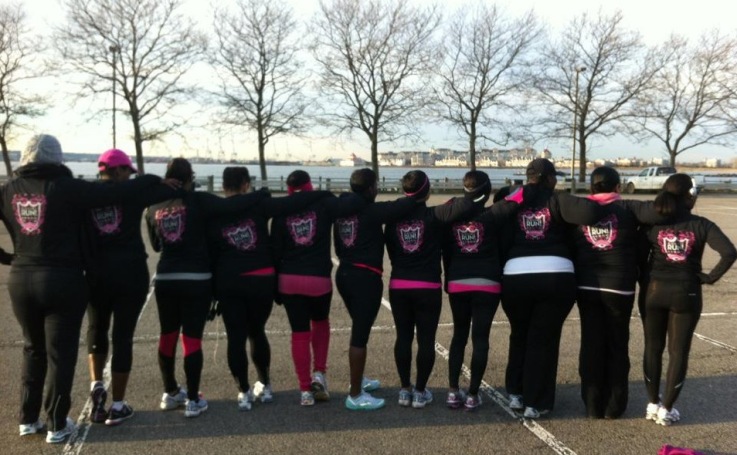
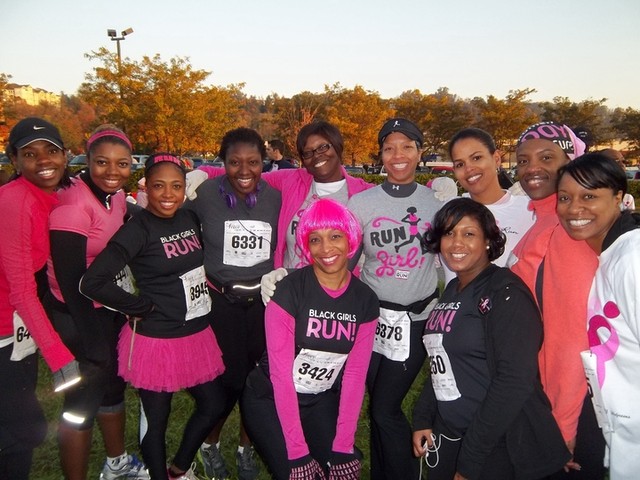
The existence of Black Girls Run! (BGR) is yet another challenge to a narrative that sees running as a white activity and its erasure of people of color, offering a symbolic intervention all while creating a community of betterment with its investment in running, walking, and collective exercise.  Founded in 2009, BGR works “to encourage African-American women to make fitness and healthy living a priority,” yet in talking to its participants, it does so much more.


Throughout the media coverage of BGR it is celebrated as a movement that works to address black obesity and cultural shortcomings that purportedly discourages exercise and encourages poor eating habits.  Erasing the power of the organization, the media focus on pathologies obscures the power and focus of a group committed to supporting black women runners.  Contrary to this popular assumption, most of the respondents I spoke with noted a history of running and exercise, citing BGR as a nurturing community of support, and not one that taught or brought them into running.  While pop cultural representations and various surveys (Running USA Survey found that only 1.6. percent of runners identified as African American) of African American people  paint the running world as white territory, African Americans have always engaged in recreational running.  Adrienne White told Runner’s World how BGR challenged dominant media representations: “You flip through the magazine, and you just don’t see yourself.”  Similarly, Brenda Stallings lamented the erasure of black women from the public running imagination. “If we don’t see us, we don’t think that’s really for us. I read the magazine because it’s insightful, but I’m not going to look down there and see me.”  BGR thus represents a symbolic and material challenge to the white imagination as it relates to running.  It is the announcement of “we are black and we are runners” to a world and culture that so often sees runners as akin to whiteness.  This representational distortion not only erases the experiences of black women runners, but also contributes to a larger discourse that often paints health disparities as the result of individual failures–as opposed to structural inequalities and persistent racism.  Reflecting on the persistence of segregation where spaces of running lack diversity, and the elevation of white runners within media culture, BGR offers a powerful intervention.


Continue reading part 1 at Feminist Wire


*******

Part 2


Whereas gyms often feel like places of tremendous judgment, with its pictures of hard, slender bodies on their walls, mirrors strategically located throughout, and an overall culture that privileges the “beautiful,” BGR works to create a space free of criticism.  While enhancing the exercise experience, the efforts to resist the socially constructed markers of beauty and athleticism, fitness and desirability, represents an important intervention individually and culturally.  “BGR provides a safe, no-judgment zone for beginners and those getting back into a consistent routine of walking/running,” notes Tiffany Cullens of Columbus, Ohio.

Describing the organization as a “nation,” “family,” a “movement,” and sisterhood by its members, BGR offers a community that transcends age, class, geography, and most importantly level of expertise.  It offers not only a supportive space but also one that values all its members.  Whereas exercise is so often framed around achieving a Hollywood body in an effort to fulfill dominant standards of femininity and masculinity, BGR values exercise and the power of a community with a shared goal of running or walking.  “I’m always amazed by all the different body types that come out every weekend. Big hips, big thighs, round bellies, as well as slim, lean, what you imagine is the “typical” runner’s body,” notes Leigh Raiford, a Bay Area BGR member.  “There are women who perhaps you’d never think could run more than a mile, have done half-marathons or even full marathons. For me this has translated from a desire for a more perfect body to pleasure in feeling strong and healthy. I may not have a bikini ready figure but I’m taking care of myself in ways that truly matter.”  Raiford brilliantly compared BGR to both the black church and hair salons given the shared emphasis on community, betterment, and sisterhood: “For someone like me who doesn’t go to church, who has a short fro and doesn’t go to the hairdresser, and who is a transplant to the Bay Area, I don’t have a lot of opportunities to hang out just with black women. So BGR has provided community for me in ways beyond running.”  Similarly, Darlene Baltimore emphasizes the safety and support offered by BGR:

I think why so many women are drawn to BGR! is because we are so much more than a running group. We are a sisterhood, support group, and safe haven for all women who want to get fit and live a healthier lifestyle. BGR! welcomes all levels of fitness from walkers to marathoners. We don’t compete against each other, but inspire and motivate each other to reach our individual goals—whether it’s walking a mile or running a marathon. The name itself is appealing because immediately a black woman can identify.

Yolanda Jones, the Ambassador for the Colorado BGR group, concurs, “I believe it gives the ladies a sense of belonging. I have now found a group of other black women who like myself like to run, jog or even walk. It gives them a community to go to something that now says ‘I am now connected to others who look like me and have common goals.’” To say that this is a community of runners, a community that supports and nurtures a love of running, would be understatement.  Operating at both a local and national level, the BGR community is one of support in the face of public erasure of black women and the ubiquitous demonization of black women’s women bodies, whether Serena Williams or Michelle Obama.  Beyond challenging these stereotypes and larger forces of systemic racism/sexism, BGR provides its members with an environment apart from the daily rhetorical (and real) violence experienced by African American women.

While often dismissed as a running group, BGR is much more.  Regina James, who highlighted the interventions and resistance offered from her participation in the organization, focused on the power of the group given the realities of racism and sexism in America:

I feel it’s important for us to train together. Most of us live and work in environments where we are ALWAYS the minority. It’s nice to have a place where we are a majority. We can just be ‘us’ (whatever that is) and be totally accepted. That is powerful.

We challenge the narrative just by being ‘there’. Most white runners I’ve talked to mention that there aren’t many Black runners at races (except Africans, who win the majority of distance races). Thanks to BGR and the NABM (National Association of Black Marathoners) I know I never have to be the only Black face in a sea of 30,000 people lining up to run a race. If I post online that I’m doing a race or visiting a city, I can find others who will run with me.


While the dominant media narrative of black women’s health often focuses on pathology, dysfunction, and personal shortcomings, the stories told by the women involved with BGR challenges a culture of disparagement and demonization.  Yet challenging the accepted stereotypes isn’t of concern for the women of BGR whose focus remains on the next mile and nurturing a community of support during those long runs and after.  With each step, with each high five, and with each statement of support, the members of BGR demonstrate the power of community and the power to move forward even when others stand in the way.

Continue reading part 2 at Feminist Wire
NewBlackMan: Can We All…Get It Right?: Remembering the LA Uprising

Can We All…Get It Right?: Remembering the LA Uprising

by David J. Leonard | NewBlackMan

There are few days in life where you can say without a doubt, “I know what I was doing 20 years ago today.” This is the case today, on the 20th anniversary of the start of the Los Angeles Uprising.

Having dropped out of the University of Oregon after 2 quarters, I was living in Los Angeles working and taking two classes at UCLA. Like many middle-class white youth I presume, I paused when the verdict was delivered and noted the injustice that spurred my outrage before getting back to my life. I was angry, like many others, because a jury of THEIR peers concluded that 4 police officers did nothing wrong in beating Rodney King 56 times, but the anger lasted only for that second. That was the reaction from many in West Los Angeles. “That’s outrageous, can I get a cold beverage”; “what an injustice, is the mall open yet?”

I remember thinking little about the case after hearing the verdict,. I headed to work and then to my class at UCLA. Driving to my class, through the wealth of West Los Angeles, all was calm. Entering class, an introduction to sociology course that focused on inequality systemic racism and privileges, it was clear that the verdict changed little. Class was planned as usual. Yet, before long, with news reports of violence breaking out in South Central, Los Angeles, our professor announced the end of class out of concern for OUR safety. In a city immensely segregated, defined by systemic divisions that thwart interaction all while enacting violence on its residents of color, it is immensely telling that the Rodney King Verdicts/LA Uprisings became meaningful, if not visible, when people thought the riots were going to cross La Brea or other markers dividing the two LAs.

For the rest of that night and next day, I was paralyzed, watching television almost endlessly. In retrospect, for myself, and maybe others, the LA Uprising put a crack in the walls of segregation. Although living less than 15 minutes from South Central, Los Angeles, it might as well have been 10,000 miles away. That is the specter of segregation in Los Angeles. Even the media reporting then, and the ways that the verdicts and LA Uprising were being talked about demonstrated this fact as people continued to talk about what was happening “over there” concerned that it might “migrate here.” I was uncomfortable with the detached feeling paralyzing me so I decided to leave the state-protected bubble of West Los Angeles and I drove down to South Central on day 2 to donate some food, clothes, and stuffed animals to the First AME Church.

I was most certainly driven by my desire “to help,” as I imagined what that meant twenty years ago, which most certainly reflected my white privileged understanding of privilege. Yet, I was also angered by the clear segregation of Los Angeles, not only in terms of geography, economics, and daily reality, but sentimentality and emotion.

The lack of sadness and anger within West Los Angeles was telling because the LA Uprising was not happening in our world; it was somewhere else, happening to someone who didn’t look like “us.” The power of race and class in eliciting not only empathy and connection, but also sentimentality and humanity, was on full-display in the days after the King Verdict. When I told people that I was heading down to South Central, they looked at me like I was crazy, as if I was driving into a foreign land amid a war. To them, it was a foreign land, one that they neither visited nor thought about except in moments of fear (“will the rioters come to the West Side) or heading to Lakers’ games. Despite voiced concerns about my driving just a few miles down the 10 Freeway, it was rather “uneventful” except in how this moment transformed me.

The drive forced me to reflect on my own assumptions and stereotypes, to think about why neighborhoods so close to my own were places I had never been (and thought of as so far away); it forced me to think about the violence and destruction that predated April 29th and bare witness to communities that West Los Angeles had abandoned; and finally, it forced me to reflect on the power of community, to see beyond the televisual representation of South Central Los Angeles rioting, to see families collecting food, kids playing, and people coming together. It forced me to look inward, to think about whiteness and privilege, to reflect on my stereotypes and assumptions. Even my ability to get my car and drive to South Central Los Angeles is evidence of privilege given the levels of state violence experienced by black and Latino youth entering LA’s white enclaves in West Los Angeles. What should have been a moment of introspection, of racial reconciliation and systemic change, instead became a moment, one that too many of us retreated as we are driving back to the “comfort” of a gated community.

Continue reading @ NewBlackMan: Can We All…Get It Right?: Remembering the LA Uprising.

NewBlackMan: The Elbow Heard Around the Nation: The NBA and the End of ‘Peace’

The Elbow Heard Around the Nation: The NBA and the End of ‘Peace’

by David J. Leonard | NewBlackMan

The Elbow Heard Around the Nation: The NBA and the End of ‘Peace’

by David J. Leonard | NewBlackMan

When Ron Artest announced his intent to change his name to Metta World Peace, I had discussions with several people about potentially changing the name of my book, After Artest (May 2012, SUNY Press) to reflect his metamorphosis. Examining how the Palace Brawl forever changed the NBA, while also highlighting the larger scripts of race and criminalization, After Artest reflects on the processes of demonization and criminalization directed at Artest and his black baller brethren in the aftermath of the 2004 fight between the Pacers-Pistons-Piston fans.  While deciding against changing the book’s title for a myriad of reasons, one principle issue for me in pushing back against a title like “Peace after the Palace” was that in spite of efforts from the NBA, its fans, and the media establishment to police, punish, and control blackness in their efforts to secure peace, neither condemnations and suspensions, dress codes or age restrictions, would bring about peace for the league because of the ways that race and racial narratives operate within the American cultural landscape.  The efforts to recreate the illusion of a racially-colorblind Jordan-esque landscape were futile given persistent anti-black racism and governing stereotypes.  Peace after the palace was not possible because of the ways that blackness and anti-black racism overdetermined its meaning within the national landscape.  Artest and what he embodied in the national imagination guided and served as a lens as the NBA sought to deracialize itself within the national imagination.  This is why I start After Artest as follows:

“The real question, how does it feel to be a problem” – W.E.B. DuBois, 1903 (Quoted in Jackson 2006, p. 9)

“Ron Artest more than likely will be suspended, but so should Kobe” (Resnick 2009)

“Kobe vs. Artest: Proof Artest Will Kill Your Team” (2009)

“NBA Bad Boy Ron Artest of L.A. Lakers Admits He Had A Problem: Drinking During Games! ” (Douglas 2009)

“Trevor Ariza loses shoe, Ron Artest tosses it into the stands” (2009).

Artest, who’s trying to put his bad-boy image behind him, said he could simply display his ring in his living room or he could wear it.’ But I think it’ll be more important to give back to something I believe in, which is providing kids with someone to talk to because it’s so expensive. I pay for parenting counseling, marriage counseling and anger management, and it’s very expensive. This will be for children of all demographics, rich or poor — preferably the rich can pay for their own psychologists — but it’ll be a great way to help kids who don’t know where they’re going in their life at this point’ (“Ron Artest Plans” 2010)

***

Artest, who’s trying to put his bad-boy image behind him, said he could simply display his ring in his living room or he could wear it.’ But I think it’ll be more important to give back to something I believe in, which is providing kids with someone to talk to because it’s so expensive. I pay for parenting counseling, marriage counseling and anger management, and it’s very expensive. This will be for children of all demographics, rich or poor — preferably the rich can pay for their own psychologists — but it’ll be a great way to help kids who don’t know where they’re going in their life at this point’ (“Ron Artest Plans” 2010)

***

At first glance, the above headlines point to the fact that Ron Artest’s personal history, and especially his association with the Palace Brawl, continues to determine the public narrative assigned to him by the dominant media and broader public discourse. Even those instances of praise and celebratory redemption does so in relationship to his past indiscretions. Despite the banality of his exchange with Kobe and his tossing of another player’s shoe off the court (his sportsmanship was questioned by an announcer), and notwithstanding his efforts to admit to a past drinking problem1 or shed light on the issue of mental health, each in varying degrees have been the read through the lens of the Palace Brawl.

In 2009, Ron Artest admitted to drinking alcohol at halftime while he was a member of the Chicago Bulls. Hoping to teach kids by sharing his past mistakes, Artest’s admission, not surprisingly, prompted much media and public debate. Although some people questioned the truthfulness of his admission, others used this moment as an opportunity to speculate about whether Artest was indeed drunk when he entered the stands in 2004. Likewise, his tossing of Trevor Ariza’s shoe into the stands, along with his physical and verbal altercations with Kobe Bryant, were given amplified meaning and importance considering his role. In all four instances, Artest’s past and his character are used as points of reference.

Often invoking his involvement in the 2004 Palace Brawl, the dominant frame that facilitates his representations is not only constrained by Artest’s personal and professional histories, but by the prism of race and blackness. He is consistently imagined as a problem. The nature of these representations point to the ways in which blackness overdetermines not only the meaning of Artest, but of all black NBA players in a post-Brawl context. Post-Artest, blackness is the hegemonic point of reference for both the commentaries and the policy shifts within the NBA, demonstrating that the Palace Brawl changed the racial meaning of the NBA and thus changed the regulatory practices governing the league. . . . .

The Palace Brawl was the culmination of the recoloring of the NBA. It represented a moment when the blackness of the league was irrefutable and thus needed to be managed, controlled, and, if necessary, destroyed. After Artest argues that the Palace Brawl served as that “aha moment” in which blackness displaced the racially transcendent signifier of Michael Jordan. This blackness, and its representative threat, were undeniable and, as such, necessitated intervention, termed as an assault within this book’s title. Not surprisingly, anti-black racist/white racial frames have anchored the debates and policies that have followed Artest; frames based on racial transcendence or colorblindness remain in the background. In this sense, Artest mandated a reversal wherein race/blackness had to be noticed (and controlled/destroyed), leading to public articulations of the white racial frame instead of denials of racial significance.

With this in mind, it is not surprising that the sports media establishment, and the social media world is all abuzz following a Metta World Peace foul on James Harden on Sunday in a nationally televised game.  A hard foul that was reckless and dangerous; one that warranted an injection (unlike others I have no idea his “intent”) and a suspension; and one that was disappointing to say the least and not worry of defense. I am not here to defend the foul or explain, although those who use the foul as a referendum on Metta, the NBA, or blackness need to check themselves.

It was unfortunate; yet equally unfortunate and more destructive have been the response.   Hayden Kim, on The Bleacher Report, referenced Metta’s “unstable mental stable” and an inability to maintain control; worse yet, he described his outburst in the following way:  “As he pounded his chest, acting like a gorilla during mating season, he caught James Harden with an ill-advised elbow that could have caused an earthquake” (the original piece no longer has this language but can still be found here and here).  The hyperbole notwithstanding, the descriptor of Metta as a “gorilla” given its historic meaning is disturbing to say the least – disgraceful, in fact.

Ken Berger focused more on the typical hyperbole and ‘what ifs” with his discussion of the elbow heard around the world.  “Metta World Peace’s vicious, dangerous elbow to the head of James Harden Sunday was no garden variety NBA elbow, and it probably will result in longer than your typical elbowing suspension,” writes Berger. “It should, anyway. This was about as cheap as a cheap shot gets. It’ll have nothing to do with the fact that Metta World Peace is really Ron Artest, he of Malice at the Palace fame. World Peace, after all, has come a long way since his 73-game suspension for going into the stands in Auburn Hills, Mich., in 2004, and even won the NBA’s citizenship award last season (when his name was still Ron Artest).”  Berger, unlike so many others notes his recent citizenship award, falls into the trap that he cautions against: reading the incident through the Palace Brawl.


Continue reading @NewBlackMan: The Elbow Heard Around the Nation: The NBA and the End of ‘Peace’.

SLAM ONLINE | » Condemn The Foul, Not The Mind

Condemn The Foul, Not The Mind

Leave the mental assessments for professionals.

by David J. Leonard / @drdavidjleonard

There is no defense for the elbow seen around the world. Metta, why? Irrespective of intent, it was a hard flagrant foul, one that has no place in the beautiful game of basketball. The seven-game suspension, while a bit on the high side, is measured and appropriate.

In fact, given the incendiary rhetoric from the media, the continuous loop of the incident, and their overall efforts to excite anger, the decision from David Stern to issue a sensible suspension (not the case with the Palace Brawl) is worthy of praise.

As such, there is nothing to debate regarding Metta World Peace elbowing James Harden in the head—it was vicious, uncalled for and disheartening. As a Lakers, Metta World Peace and basketball fan—it was disappointing. It is indefensible; yet, that fact is not a defense for a media spectacle-defined unnecessary cheap shots, much of which has nothing to do with the incident.

From the hyperbole and rhetoric designed to incite anger, to the constant invoking of the language of the criminal justice system and the demonization of Metta as a crazy person, much of the sports media has failed to inform and elevate the discussion, instead embracing roles as referee, commissioner and worse yet, doctor.

A common theme evident since the nationally televised elbow has been the constant mention of Metta’s mental state. While one might think mental illness mitigates culpability (it can within our justice system), the media establishment has used his purported mental fabric and wiring as part of a narrative that depicts him as pathological and dangerous. Although painting him as unstable and mentally weak, the ubiquitous references to his mind reflect an effort to mock, make fun and ridicule Metta World Peace.

The references have saturated the airwaves. “To say that something is wrong with Artest would not do him justice. This is the guy who applied for a job at Circuit City to get a discount, has come to practice in a bath robe and has admitted to drinking cognac at halftime,” writes Jason Black. “After winning the NBA Championship in 2010 he thanked his psychiatrist. There are many people who need therapy or have mental health disorders, so the fact that he publicly talked about having a psychiatrist isn’t a bad thing, but it tells us there is a problem.”

Black goes onto argue that Metta’s mental illness represents a threat to himself, other players and the game itself, calling for extensive punishment as a method of protection: “Having a mental health issue and getting help for it is commendable, but what price does somebody have to pay before it’s too late?” As with media pundits like Stephen A. Smith, who described Metta as “not that far away from coo-coo nest,” “as touched,” and as someone who has refused to take his medication in the past, the media narrative demonizes Metta for his mental issues.

Describing him as having “violent tendencies,” Bill Plaschke furthers the picture of MWP as psychopath, as crazy dangerous man: “This was about a celebration that turned caustic when somebody walked into the middle of it, the weird mind of World Peace switching from jubilation to rage in a matter of seconds. Maybe even scarier than the elbow was the look in his wild and crazy eyes as he stalked around the floor immediately afterward.”

Continue reading @ SLAM ONLINE | » Condemn The Foul, Not The Mind.