Taylor Townsend: Too Big for Tennis? – Entertainment & Culture – EBONY

Taylor Townsend: Too Big for Tennis?

David Leonard

Dear Patrick McEnroe:

I write you to express my anger and disgust as to how you and the UTSA have treated Taylor Townsend. Despite being the world’s #1 junior girl’s tennis player, and the future of American tennis, you decided to shut her out, to take away her financial support, and otherwise block her from entering tournaments. You asked her “to stop competing?” And why? Because you think she is too fat; because you think she needs to get into better shape and slim down.

Who died and made you Jillian Michaels?

I am glad to see you decided to pay for Taylor’s travel costs from Chicago to New York. Better late than never. How about you now apologize for publicly ridiculing and shaming a 16-year old girl? How about you fly to Chicago to express your regret for not only punishing Taylor Townsend, but also embarrassing her in front of the world. In what world do you live that you would think this strategy would be to her benefit? There is no valid explanation for a bunch of middle-age males telling her what to eat, when to exercise, what to dress, and how to look. I hope you realize how much you hurt her. Let her words sink into your skinny head: “It was definitely shocking. I was actually very upset. I cried. I was actually devastated. I mean, I worked really hard, you know, it’s not by a miracle that I got to number one.”

I hope you understand that you follow in a long tradition of sexist institutions that have told women and girls, particularly those of color, that they are inadequate and ugly; that they are undesirable, and so disgusting that they should not even be in public. This was the message you sent to Taylor and millions of other girls. If you can’t get this idea through your thick privileged skull, head over to Sports Illustrated to read the words of Courtney Nguyen.

The implications of your statements and actions are disturbing on so many levels, especially given the epidemic of eating disorders and body image struggles inside and outside of sports. Training session in the library?

Continue reading @ Taylor Townsend: Too Big for Tennis? – Entertainment & Culture – EBONY.

NewBlackMan (in Exile): Higher Education in Mitt Romney’s America

Higher Education in Mitt Romney’s America

by David J. Leonard | NewBlackMan (in Exile)

The media focus on student debt, on congressional battles over student loans, and the scarcity of jobs for college graduates obscures the racial and class dynamics that define America’s colleges and universities. With the public discourse surrounding the unfairness of affirmative action for Whites, the threat that Ethnic Studies represents to (White) America, and the absence of “White student unions” in college campuses, public discussions re-imagine Whiteness as precarious, and Whites as victim and at the frontlines of a changing educational landscape. Despite the daily lamenting of the state and future of America’s White students, particularly those with middle and upper-middle incomes, college campuses are still White. In fact, Whites, particularly those whose parents are part of the top 5% of the income distribution, continue to reap the benefits of privilege in (1) admittance, (2) scholarship, and (3) treatment. Let’s not get things twisted here; these colleges and universities are in America, so yes the rules of the game (racism, sexism, classism) do apply.

In 2005, less than one in eight youth from the poorest 25% of society would enroll at a 4-year college university within 2 years of high school graduation. According to Peter Schmidt, author of The Color of Money, “a rich child has about 25 times as much a chance as a poor one of someday enrolling in a college rated as highly selective or better.” Colleges’ overreliance on SAT scores, heightens cultural bias, and the unequal advantages resulting from SAT prep classes, which have proven to benefit Whites and the middle-class. In addition, because admissions give credence to a school’s reputation (which cannot be seen apart from segregation, and racial and class inequality), the rules and the game of college are set up to advantage Mitt Romney’s America: the already privileged. Worse yet, the hegemony of the narratives of meritocracy and the illusion of diversity—which Lani Guiner describes as “a leaf to camouflage privilege”—obscure the endless privileges afforded to the members of middle and upper middle class White America, before they ever step foot on a college campus.

This is evident as we look at the racial and class stratification of student loans and other forms of aid. The Chronicle of Higher Education found that “colleges with more than $500 million in their endowments…served disproportionately few students from families with incomes low enough to qualify for federal Pell Grants.” In other words, the money that makes college a possibility is funneled to those whose families often have the requisite dollars to make college a reality. Schmidt tells us that “[j]ust 40 percent of the financial aid money being distributed by public colleges is going to students with documented financial need,” adding that “[m]ost such money is being used to offer merit-based scholarships or tuition discounts to potential recruits who can enhance a college’s reputation, or appear likely to cover the rest of their tuition tab and to donate down the road.” Despite the widely circulated, albeit factually false ideas about students of color and scholarships, the vast majority of scholarship money finds its way into the pocket of White students.

Continue reading @ NewBlackMan (in Exile): Higher Education in Mitt Romney’s America.

NewBlackMan (in Exile): Ballin’ at the Graveyard: A Film Review

Ballin’ at the Graveyard: A Film Review

by David J. Leonard | special to NewBlackMan (in Exile)

Growing up in Los Angeles, I spent many weekends, some evenings, and most of my summers on the basketball court. Whether on the courts at my high school, at any number of local parks, or other spots spread out around West Los Angeles, pickup basketball was a fixture of my teenage years. I love to play ball; while a mediocre player on my best days the chance to run with my boys or prove myself to others was something I relished growing up.

Through college and graduate school, I continued to play whenever I made it back to Los Angeles; visits home came with an expectation of multiple days of ballin’. Although kids and AGE, not to mention geography (not a lot of pick-up games in Pullman) has resulted in my retirement from the game, the cultural, social, and personal significance of this space remains strong in my mind. Based on both nostalgia for the Saturdays spent on the court, calling “next,” and even the arguments about a travelling calls, and my intellectual curiosity about the subculture of the “pickup game,” I was very excited to watch Ballin’ at the Graveyard, a new film from Basil Anastassiou and Paul Kentoffio.

Chronicling the weekend battles at Albany, New York’s Washington Park – the Graveyard – the film is much more than a basketball film. It is a glimpse into the sociology – the rules, the community – of the subculture of pickup basketball.

Continue reading @ NewBlackMan (in Exile): Ballin’ at the Graveyard: A Film Review.

NewBlackMan in Exile: Freeloading Muppets: Mitt, the Conservative Right and its Assault on Sesame Street

Freeloading Muppets:

Mitt, the Conservative Right and its assault on Sesame Street

by David J. Leonard

| NewBlackMan in Exile

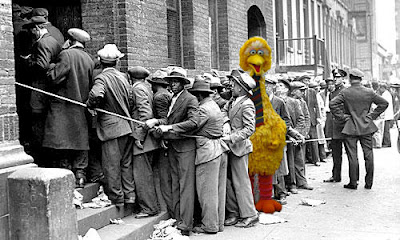
During last night’s presidential debate, which was lackluster to say the least, Mitt Romney finally unveiled some specifics as it relates to his slash the deficit, taxes, and spending economic plan – the “no reason to hope, the future will be grim” plan. He announced his desire to defund PBS, which according to Neil deGrasse Tyson, accounts for .012% of the federal budget. His war on Muppets prompted a deluge of social media posts ranging from images of an unemployed Big Bird to an angry Elmo seeking revenge.

While reflecting people’s anger and anxiety about the nature of the political process, his oft-handed remark is revealing. At one level, it demonstrates the Republican Party’s opposition to public support for institutions and organizations that advance a social good. It represents their contempt for the social contract. At another level, it embodies an ideological movement that promotes divestment from public education, health care, and countless other social programs. The recasting of Cookie Monster, Grover, and Snuffy as freeloading welfare recipients constitutes a continuation of the GOP’s structural adjustment program that started some thirty years ago. Whether or not Mitt Romney like’s Big Bird, or public teachers, firefighters, or health care workers is irrelevant.

The gutting of public higher education throughout the nation, the destruction of America’s parks and recreation facilities, and now the proposed foreclosure on Sesame Street is part of a larger movement to divested from public support and institutions, that which is utilized by the middle-class, working-class and America’s poor. It is yet another example of the true essence of the GOP AKA POP – Privatization Old Party.

Continue reading @ NewBlackMan in Exile: Freeloading Muppets: Mitt, the Conservative Right and its Assault on Sesame Street.

Shoes, Diplomas, and the American Dream – The Conversation – The Chronicle of Higher Education

(Christian Petersen/Getty Images for Nike, via ABC News)

Shoes, Diplomas, and the American Dream

September 7, 2012, 12:26 pm

By David J. Leonard

The media is abuzz with reports of Nike’s fall release of the LeBron X. Not surprisingly, the widespread commentary doesn’t focus on production conditions or even the technological components of the shoe, but instead on the cost of the shoes. According to The Wall Street Journal, the LeBron X would retail for a whopping $315 dollars; subsequent reports noted that Nike would market the model with all the hi-tech bells and whistles for only $290, with a basic model costing around $180. Pushing the boundaries of what constitutes a shoe (not just laces and “leather”), the LeBron X will include Nike’s + technology, which allows athletes to measure vertical leap, activity, and otherwise assess basketball progress.

Rumors of a $315 shoe led commentators to wax sociological, using the moment to lament the values and cultural priorities of the nation. More specifically, these sociological impersonators lamented the warped values of the poor, of inner-city residents, and of youth—blacks—who would probably flock to stores to purchase the shoes. “The lust for expensive LeBron X sneaker signals a bigger problem,” writes Daryl E. Owens, a columnist at the Orlando Sentinel. Whether linking it to warped priorities or reviving memories of black youths murdering each other for expensive shoes in the 90s (and more recently), Owens points to the dangers of consumption from certain communities: “For too many, the problem is a malignant mutated strain of conspicuous consumption, crossed with hardship and low self-esteem.” Greg Doyel of CBS Sports also objected that “LeBron is trading on the most vulnerable part of his fan base: their self-image.”

Imagining black youth as lacking values, self-esteem, and agency, Doyel and company see the shoes—and not poverty, job and housing discrimination, the prison-industrial complex, divestment in public education, etc.—as the destructive influence on the future of this generation. In other words, the allure of these shoes, and the desire to get one’s hands on them at any cost, is the explanation for persistent inequality. Painting a picture of black youth rioting and killing for these shoes, of a community lacking values, these commentators play on the worst kind of stereotypes and misinformation.

Yet it seems clear that Nike does have a message to market. The company is selling high-school and college athletes the prospect of not just a career but also a future. As with higher education as a whole, this is a message directed at the middle-class—at suburban whites rather than blacks. The LeBron X provides the electronic wizardry for student athletes to better their game. These shoes are imagined as yet another device or investment in a path toward the American dream. Akin to private coaches, the best equipment, nutritionists, private traveling teams, and other financial burdens, the shoes are yet another example of how sports achievement is tied to consumption and investment, to privilege. Akin to spending hundreds of thousands of dollars for a degree from an elite college, tens of thousands on private high schools or preschools because they are pipelines to the American dream. The shoe itself—and the reaction—is a metaphor for what is happening to higher education.

Continue reading @ Shoes, Diplomas, and the American Dream – The Conversation – The Chronicle of Higher Education.

NewBlackMan (in Exile): Blaming Hip-Hop for Hate Rock?

Blaming Hip-Hop for Hate Rock?

David J. Leonard & C. Richard King | NewBlackMan (in Exile)

Little says more about the state of racism and the centrality of the white racial frame in the USA today than the rapidity with which pundits transformed a conversation about white power, racialized violence, and hate rock into a critique of hip-hop. Indeed, a number of discussions of the spree killing at the Sikh temple outside of Milwaukee, echoing broader political currents, reference the evils of hip-hop as both a defense and a scapegoat.

Perhaps not surprisingly, in The New Republic, John McWhorter rehearsed this well worn conversation to turn the killings into another referendum on hip-hop. “It has been fashionable,” he asserts, “to speculate on whether the White Power music he [Wade Michael Page] listened to helped stoke him into the senseless murders he committed…such speculations,” he suggests are both “incoherent” and “pointless—and they are marked, above all, by a cloying air of self-congratulation.” To “prove” his point, he invoked the tried and tested “hip-hop” comparison as if it represented mainstream rap, failing to note, of course, that he is specifically talking about a small subset of hip-hop music):

A comparison with another musical genre helps put the debate into relief. Indeed, in assessing White Power music’s influence on Page, it helps to acknowledge that rap music—savored by people of all colors, ranging in age from “youth” to middle-aged—has its own tendency to celebrate the indefensible. Some practitioners casually boast about hurting women—whether attacking a partner during intercourse (Cam’ron, “Boy, Boy”), or kicking a woman in the stomach to make her abort (Joe Budden, “Confessions II”) and, of course, all varieties of maiming and murder.

However, nasty as all of this is, and whatever one might say about its implications for the street culture that produced it, it’s all symptom rather than cause. Those who listen to rap—including myself—are not passively consuming its message, but actively seeking it as a release. Indeed, last I heard, the enlightened take on rap lyrics is that their violence must be taken not as counsel but as poetry, poses of strength from disenfranchised people—“Black Noise” as Brown’s Tricia Rose calls it. Other academics, priding themselves on their connection with the music, crown the makers of violent rap as “Prophets of the Hood” (Imani Perry, Princeton) or “Hoodlums” (William Van Deburg, University of Wisconsin), the latter meant as an arch compliment to men celebrated for speaking truth to power.

And there is more than a little bit of truth to this treatment of rap’s violent strain. It is, indeed, an attitude that functions as a response to the frustrations of everyday life. In that light, rapademics have been fond of noting that old-time “toasts” among black people had their violent strains as well. Despite the prevalent anxieties in the 1990s about the social consequences of rap music, evidence that the music causes actual violence never actually surfaced.

These arguments are as tired as they are simplistic; the failure to see any difference between rap music and hate rock is absurd on every level. Yet, they keep getting published. Yet another failure to account for white supremacy. Importantly, invoking the purported ills associated hip hop simultaneously recycles dangerous stereotypes about blacks and lets whites off the hook. Indeed, it encourages white readers to misrecognize the force of white racism and dissociate themselves from deeper structural arrangements, while essentially giving a pass to the violence, antipathy, and dehumanization at the core of white power music specifically, and white power thinking more generally. It is as if McWhorter would like to conclude: there are haters everywhere, stop picking on isolated whites who do bad things and pay attention to the ubiquitous threat of black pathology.

Continue reading @ NewBlackMan (in Exile): Blaming Hip-Hop for Hate Rock?.

Dr. David J. Leonard: Got Solutions? Beyond Denial and Toward Transformation (Part 2)

Got Solutions?

Beyond Denial and Toward Transformation (Part 2)

David J. Leonard

As I noted in part 1, white denial about racism and demands for solutions (for the racial injustices often dismissed) go hand in hand. As Mark Anthony Neal brilliantly reminded people in a Facebook status update: “The very essence of ‘privilege’ is when you enter into a space and are fundamentally unaware that not only have you changed the conversation, but have made the conversation about you.” Beyond attempting to turn the conversation into what they want, what these demands fail to recognize is white denial about racism, male denial about sexism, and heterosexual denial about homophobia is problematic and is instrumental in the perpetuation of violence, inequality, and privilege. While I remain wary of the demands for solutions, especially in absence of a willingness to work toward social change and accountability, there are many individual and systemic changes that will not only foster greater equality and justice but will address historically produced inequalities. There is much that can and must be done as part of a movement of racial reconciliation and change.

Universal Health Care: A consequence of America’s history of racism, violence, segregation, wealth disparity, and inequality represents stark differences between life and death. Whether looking at life expectancy, infant mortality, and countless illness, we see that racial inequality has consequences. In other words, racism kills. To combat the health consequences of American Apartheid, we must adopt a single-payer national health system. The grave impact of a Jim Crow system of “health care” is seen each and every day. According to a recent study from Harvard University, “Nearly 45,000 people die in the United States each year — one every 12 minutes — in large part because they lack health insurance and can not get good care.” Race matters here. Tim Wise notes that each year 100,000 African Americans die “who wouldn’t if black mortality rates were equal to that of whites.” Universal health care would not solve these disparities but it would certainly dramatically intercede against racism’s assault on the basic human right of life. Lesley M Russell makes this clear:

Racial and ethnic minorities make up more than half of America’s uninsured and they suffer higher rates of chronic illness than the general population. They are more likely to experience risk factors that predispose them to chronic illnesses such as obesity, and are much less likely to receive preventive screenings, regular care, and to fill needed prescriptions that could prevent or ameliorate their conditions. Because being uninsured often means postponing needed heath care services, people of color are diagnosed at more advanced disease stages, and once diagnosed, they receive poorer care. Inevitably, they are sicker and die sooner.

A single payer system may not be a complete solution but it is a way to save lives, improve lives, and challenge the ongoing history of racism. Who is on board? It would seem that providing health care and dismantling America’s prison nation is the ultimate fulfillment of family values. You want a solution, how about respecting and valuing every person’s family; now that’s some values I can get on board with.

While we are nationalizing things, how about we abandon the inequitable local funding formulas employed by school districts and ensure that equity and equality is maintained in each and every school district. Since I know everyone is interested in change, how about a higher education that is open and accessible to everyone.

Solutions are a-plenty. Abolish the Electoral College and move toward publicly funded elections.

There are of course many solutions, from the Dream Act to dramatically changing the tax code and increasing minimum wage would take us on a path toward equality, justice, and racial reconciliation. If you want solutions, join me in fighting for them: if people get to deduct mortgage payments from their taxes, how about rental tax deductions; if children are deductible what about no children? Free childcare for all; what about public transformation in every community – interested? An end to the war on drugs and the military industrial complex! Are these the solutions you had in mind?

Continue reading @ Dr. David J. Leonard: Got Solutions? Beyond Denial and Toward Transformation (Part 2).