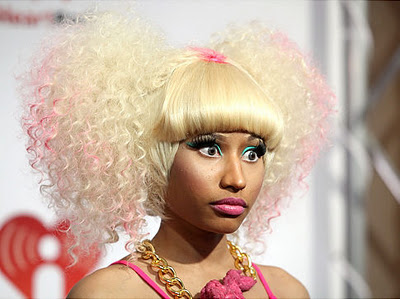
Javon Johnson @NewBlackMan: “Right Thru Me”: Authenticity, Performance, and the Nicki Minaj Hate


“Right Thru Me”: Authenticity, Performance, and the Nicki Minaj Hate

by Javon Johnson | special to NewBlackMan

I began teaching at the University of Southern California in fall 2010 as the Visions and Voices Provost’s Postdoctoral Fellow. Among others, one of my duties as Postdoc is to teach African American Popular Culture. One of the biggest difficulties with teaching a course such as this is the seemingly impossible task of trying to get my students to move beyond simply labeling aspects of Black pop culture as good or bad – that is, getting them to unearth and critically discuss the political, social, economic, and historical stakes in Black film, music, theater, dance, literature and other forms of Black popular culture.

I struggled mightily with getting them to see how a Black artist or sports figure could simultaneously be good and bad and how those labels, even when collapsed, do little to explain how violent rap lyrics are used as justification for unfair policing practices in Black communities, how literature and music is often used as a means for many Black people to enter into a political arena that historically denied us access, or even how Black popular culture illustrates that the U.S., since pre-Civil War chattel slavery, has had, and will continue to have, a perverse preoccupation with Black bodies.

My class is not the only group of people who have trouble moving beyond the ever-limiting dualities of good and bad. Like my students who could not wait to tell me all of the reasons they feel Nicki Minaj is a bad artist, icon, and even person, many Black people that I speak with are quick to throw the Harajuku Barbie under the bus on account that, as one of my students put it, “She makes [Black women] look bad, like all we are good for is ass, hips, and partying.” Fellow rappers such as Lil Mama and Pepa have commented on Nicki’s over-the-top dress up and character voices, with Kid Sister asking, “do people take her seriously?” What is most troubling about comments such as these is how reductive they are, how readily they dismiss Black women’s identity possibilities, in that anyone who dresses and talks like Nicki must be selling out and doing a disservice to real hip-hop, real Black people, and real women.

The politics of selling out aside, I am deeply troubled with how we read Lady Gaga as a brilliant postmodern pop artist and Nicki as little more than a fake who plays dress up for cash. What does that say about our understandings of Black women as related to the politics of respectability? Nicki disserves applause for carving out a space in an overly male dominated rap world, and, as she did in a recent Vibe.com interview, she often uses that space to tell women and girls they “are beautiful…sexy…[and powerful because] they need to be told that.”

Mixing the zaniness of ODB and Busta Rhymes with lyrical prowess of Lil Wayne and the creativity of Lil Kim and Andre 3000, all wrapped in a Strangé Grace Jones bow, the fact that Nicki can tell all the men in rap, or perhaps the world for that matter, “you can be the king or watch the queen conquer,” that is – join me or be destroyed by me, highlights the strength and boldness she possesses.

More than her ability to dominate a male driven hip-hop community or the lines promoting women’s empowerment throughout her work, it is her playfulness, coupled with her perceived sexuality and gender identity that causes the most panic. It is our inability to define and pin down Nicki’s identities that scare us most. Her voices and dress up lead many to question not only if Nicki is “real,” that indefinable quality that permeates every fiber of hip-hop, but also for some to question her sexuality. In a hip-hop world where the most valuable currency is authenticity, the anxiety, or hate for that matter, Nicki causes stem mostly from the fact that she puts front stage all the things most rappers hide behind the curtains. Her entire persona, which relies on a healthy amount of theatricality, exposes how the real is as constructed as the reel, which makes her performance shattering because too many of us invest a lot in the idea that hip-hop is undeniable and unapologetic truth.

In this way, it is my larger contention that we are reading Nicki Minaj all wrong. Rather than figuring her characters, voices, and costumes as faking, I propose that we read it as making, as a performance of multiple reals that exist on the same body. And, it is quite precisely her Barbie like plasticity, her ability to mold herself into the woman she needs to be at any given moment, which is most amazing. Nicki’s malleability, her ability to be such a monster and such a lady in the same verse, complicates our understanding of identity performances to account for the ways in which people can be dynamic, complex, contradictory, and fractured beings all at once.

via NewBlackMan: “Right Thru Me”: Authenticity, Performance, and the Nicki Minaj Hate.

Megan Greenwell: “To End the NBA Lockout, David Stern Must Shut His Mouth – Business – GOOD


To End the NBA Lockout, David Stern Must Shut His Mouth

Megan Greenwell

Greedy bosses want to cut employees’ pay. The union tries to fight back. So the CEO, a longtime bully to organized labor, pats the workers on their heads with an admonition: You can’t possibly understand such complex negotiations. Let the grownups decide what’s best for you.

If this were Walmart, we’d all be outraged, but not when it’s millionaires fighting against billionaires in the NBA. Yet the paternalism is no less ugly because of the amount of money involved. And it gets uglier when you consider the racial undertones that necessarily lurk in an industry where every owner but one is white and 83 percent of the workers are black [PDF]. Lately, those tensions have been bubbling to the surface—most egregiously in the acidic condescension of Commissioner David Stern.

The lockout has already claimed the first month of NBA games, and the possibility of losing the entire season grows more likely every day. The players and team owners remain miles apart on how to structure the league’s salary cap and revenue-sharing agreement in the age of ballooning player contracts and a weak national economy. There are legitimate disagreements at work here, but that doesn’t justify Stern’s condescension toward the men who are ostensibly his colleagues.

Things started to heat up a week ago, when commentator Bryant Gumbel voiced what many people sympathetic to the players had been thinking: Commissioner David Stern is on a power trip that knows no bounds. Stern has “always seemed eager to be viewed as some kind of modern plantation overseer, treating NBA men as if they were his boys,” Gumbel said, adding that Stern seems most interested in showing “how he’s the one keeping the hired hands in their place.”

It’s important to note, as Deadspin has, that “hired hands” are not the same as slaves, even in the context of a plantation. Gumbel didn’t “play the race card”; he correctly identified the power dynamic that has arisen from Stern and the owners’ fundamental misunderstanding of the value the players bring to a basketball league. Many people have said they refuse to sympathize with players making millions of dollars a year, but they, too, miss the point: Paternalism is paternalism, no matter how much money is involved.

Before the week was out, another prominent sports commentator had drawn fire for his own interpretation of the dynamic between players and owners. In a column largely critical of the owners, Bill Simmons wrote, “I don’t trust the players’ side to make the right choices, because they are saddled with limited intellectual capital. (Sorry, it’s true.) The owners’ side can’t say the same; they should be ashamed.” This came on the heels of a piece in which Simmons argued that Kobe Bryant, Kevin Garnett, and Paul Pierce shouldn’t have been allowed to talk in a meeting because they spent a combined total of three years in college—as if higher education was the main criterion for being able to represent one’s own interests.

Simmons’ labeling of basketball players as stupid—he later defended himself by tweeting that other athletes are equally dumb—has been roundly criticized, most eloquently by David J. Leonard on the New Black Man blog. But what struck me is not that a sportswriter thinks the players he covers have “limited intellectual capital,” but that the NBA commissioner agrees with him.

The same day Simmons wrote about players’ lack of higher education, Stern blamed National Basketball Players’ Association chief Billy Hunter—an attorney, not a basketball player—for misleading union members about the specifics of the owners’ proposals in an interview on The Dan Patrick Show. It was not the first time Stern had tried to bully Hunter and NBA players through the media, but on this occasion, he went further than ever.

Continue reading @ To End the NBA Lockout, David Stern Must Shut His Mouth – Business – GOOD.

Dave Zirin: The Sporting Scene: Economics, Race, and the N.B.A. Lockout : The New Yorker


October 24, 2011

Economics, Race, and the N.B.A. Lockout

Posted by Dave Zirin


Last Tuesday evening, at the end of HBO’s “Real Sports,” Bryant Gumbel referred to David Stern, the commissioner of the N.B.A., as a “plantation overseer.” Coming at a point when the players have been locked out for four months, negotiations are at a standstill, and a substantial part of the season has already been cancelled, the remarks added to a simmering debate.

How can the horrors of the slave trade possibly be compared to a billion-dollar labor negotiation? It’s a fair question, but the metaphor, and the conflict it evokes, is as old as professional sports itself. In the nineteenth century, a white player named John Montgomery Ward was described as leading a “slave revolt” against Major League Baseball. In 1964, Muhammad Ali said that he would “no longer be a slave.” Five years later, the baseball player Curt Flood called himself “a well paid slave” because of his inability to exercise free agency (for which he went to court, and lost both the case and his career). Contemporary athletes such as Larry Johnson, Anthony Prior, Warren Sapp, and Adrian Peterson have used the formulation. It’s been deployed by players to describe a feeling of being condescended to—of being treated as boys instead of men—and of lacking control of their own livelihoods.

In the N.B.A., where every owner but one (Michael Jordan) is white, and eighty-six per cent of the players are black, racial tensions have been unspoken but tangible—as illustrated by a scene two weeks ago. David Stern was sitting across the negotiating table from a constellation of the league’s stars. He then became, per his usual style, openly contemptuous of the players “inability to understand” the financial challenges faced by ownership, according to ESPN’s Ric Bucher. He rolled his eyes. He took deep breaths. He then pointed his finger repeatedly toward the face of the Miami Heat’s Dwyane Wade. Wade, who is twenty-nine, is one of the most popular faces in the N.B.A. among fans. He interrupted Stern. “You’re not pointing your finger at me,” Wade said, according to Bucher. “I’m not your child.”

Most immediately, Gumbel’s comments looked at David Stern’s management style through a racial lens. That is, in a sense, tragic, since Stern’s résumé has all the trappings of a racial progressive. He’s served on the board of the N.A.A.C.P. He’s led a league that has long had the best record in terms of hiring people of color as coaches and executives. Even in ownership, the N.B.A. is the only major sport in which a person of African descent sits in the owner’s box. But none of that has protected him from the latest accusations. These dynamics didn’t develop overnight, and for that he bears most of the blame.

Over the last decade, Stern has built reservoirs of bad will. After an infamous 2004 brawl between members of the Indiana Pacers and fans of the Detroit Pistons, Stern said that he had a responsibility to “the ticket-buying fan” to clean up the league. He instituted a dress code. He created a list of verboten establishments where players couldn’t socialize when on the road. He set age limits on when players could enter the league. He met with the Republican strategist Matthew Dowd to discuss how to give the league “red state appeal.” When he had the N.B.A.’s official magazine, “Hoop,” airbrush out Allen Iverson’s tattoos, it was seen as an attack on the “hip-hop generation” of players. Yet Stern did little to reach out or correct the record.

For N.B.A. fans, the most maddening part about this should be that the suspicion of Stern means that no one on the players’ side trusts either him or the financial figures he has been pointing to in negotiations. The league is coming off of the most profitable season in its history, but Stern insists that as many as twenty-three of its thirty teams are losing money. Players don’t believe him, especially as his solution to “the crisis of team profitability” is to take back money that is going to them. Stern refuses to consider a solution that would involve his owners sharing television revenue, as N.F.L. teams do.

Continue reading @ The Sporting Scene: Economics, Race, and the N.B.A. Lockout : The New Yorker.

NewBlackMan: Is the NBA Lockout About Race?


Is the NBA Lockout About Race?

by David J. Leonard | NewBlackMan

thought I would write a follow-up to my piece, “Bill Simmons and the Bell Curve: The ‘limited intellectual capital’ of the NBA’s Players” which has elicited a significant reaction.   It should be clear from the outset, I am not interested in conversations about individuals, intention, or motivation.  To paraphrase the always-brilliant Jay Smooth, the conversations should focus around what has been said, what has been done, and what all of this means in a larger context rather than the individual actors.  The discussion needs to be about how ideology, narrative, and frames operate within these larger discussions. 

One of the common responses to Bill Simmons’ commentary and more specifically the criticism directed at me for reflecting on the racial meaning in those comments has been that Simmons was talking about all NBA players, not just those who are black.  Given the racial demographics of the league and the racial signifiers associated with basketball, it is hard to accept the idea that “NBA player” isn’t a mere code for blackness.  In other words, blackness and basketball become inextricably connected within the dominant imagination, akin to Kathryn Russell-Brown’s idea of the criminal blackman.  Just as the “criminal Blackman” exists as contained identity within the dominant white imagination, the blackballer functions in similar ways. 
The process of both essentializing and bifurcating the black baller is evident in the very distinct ways that the white racial frame conceives of both white and black players, playing upon ideas of intelligence and athleticism.  Whereas the blackballer is imagined as athletic, naturally gifted, and physically superior, white basketball players are celebrated for their intelligence, work ethic, and team orientation.  In Am I Black Enough for You, Todd Boyd identifies a dialectical relationship between racialization and styles of play where whiteness represents a “textbook or formal” style basketball, which operates in opposition “street or vernacular” styles of hooping that are connected to blackness within the collective consciousness.   In both styles of play, notions of intelligence, mental toughness, and mental agility are centrally in play. 
A second and widely circulated denunciation against those critical voices has been our lack of fairness or the double standards of this portion of the discourse.  Whereas I honed in on Simmons’ comments, little has been made about those of Jason Whitlock (Bryant Gumbel has been the at the center of media commentary).  Lets be clear: the comments of Jason Whitlock, irrespective of intent, are worthy of criticism in that his recent commentary plays upon and reinforces dominant narratives and frames about race and blackness.  Looking at his comments, alongside with those of Simmons, further illustrates the ways in which ideologies are circulated, and how commentaries such of these cannot be understood outside of these larger contexts.


A belief in the superiority of white intelligence has been commonplace within American history.  This remains the case today. In one earlier study (during 1990s; see here for another source) about the persistence of racial stereotypes, the author found the following:

More than half the survey respondents rated African Americans as less intelligent than whites. Fifty-seven percent of non-African Americans rated African Americans as less intelligent than whites and thirty percent of African Americans themselves rated African Americans as less intelligent than whites. Sixty-two percent of the entire sample rated African Americans as lazier than whites and more than three out of four survey respondents said that African Americans are more inclined than whites to prefer welfare over work.

In a 2010 study about race and politics, researchers at the University of Washington found that stereotypes about blacks as it relates to intelligence, work ethic, and trust-worthiness remain prominent. Another recent study about race, politics, and stereotypes found that while there has been slight progress in terms of the rejection of longstanding prejudices, they remain constant within the national discourse. 

Continue reading (there is more) @ NewBlackMan: Is the NBA Lockout About Race?.

“We’re a culture, not a costume.” STARS, a student org at Ohio University « Eternal Sunshine of the Spotless Mind


“We’re a culture, not a costume” is campaign by STARS, a student organization at Ohio University.  Their efforts to highlight the issue of racial costumes and parties is truly amazing


This mission of the group is as follows: “to educate and facilitate discussion about racism and to promote racial harmony and to create a safe, non-threatening environment to allow participants to feel comfortable to express their feelings.”

via “We’re a culture, not a costume.” STARS, a student org at Ohio University « Eternal Sunshine of the Spotless Mind.

Bakari Kitwana and Urban Cusp on Kanye West @Occupy Wall Street

From http://newblackman.blogspot.com/

As the nation and global community turns its attention to the rise of the Occupy Wall Street movement, celebrity involvement has been a growing hot topic. Last week, controversy erupted over Kanye West’s presence at the protest site, Zuccotti Park in New York City, at the invitation of Russell Simmons. One article of particular interest, Why Kanye West Doesn’t Belong at Occupy Wall Street, was written by GOOD Senior Editor Cord Jefferson. Highlighting the selling price of his outfit and his image as the “Louis Vuitton Don,” the writer concluded by saying that “what OWS doesn’t need is everyone who’d like to be seen as a populist jumping on Rboard for a photo opportunity before leaving to go buy $500 jeans. Lip service and deceit is what got us into this mess in the first place.”
Watch this videotaped discussion to hear Urban Cusp’s Editorial Director Rahiel Tesfamariam reflect on the author’s points with Bakari Kitwana, who has a forthcoming new book entitled Hip-Hop Activism in the Obama Era. Kitwana has been seen and heard on CNN, Fox News, C-Span, PBS and NPR. He is the CEO of RapSessions.org and Senior Media Fellow at the Harvard Law-based think think, the Jamestown Project. Kitwana is also the former editor of The Source, co-founder of the National Hip-Hop Political Convention and author of the best-selling The Hip Hop Generation: Young Blacks and the Crisis in African American Culture.

My newest piece @NewBlackMan: Bill Simmons and the Bell Curve: The “limited intellectual capital” of the NBA’s Players

Bill Simmons and the Bell Curve:

The “limited intellectual capital” of the NBA’s Players

by David J. Leonard | NewBlackMan

Like many sports writers, Bill Simmons has used his columns this week to condemn NBA players, ostensibly blaming them for the cancellation of games. On Friday, he offered the following that put the onus on the players:

Should someone who’s earned over $300 million (including endorsements) and has deferred paychecks coming really be telling guys who have made 1/100th as much as him to fight the fight and stand strong and not care about getting paid? And what are Garnett’s credentials, exactly? During one of the single biggest meetings (last week, on Tuesday), Hunter had Kobe Bryant, Paul Pierce and Garnett (combined years spent in college: three) negotiate directly with Stern in some sort of misguided “Look how resolved we are, you’re not gonna intimidate us!” ploy that backfired so badly that one of their teams’ owners was summoned into the meeting specifically to calm his player down and undo some of the damage. (I’ll let you guess the player. It’s not hard.) And this helped the situation … how? And we thought this was going to work … why?

Congratulations, players — you showed solidarity! You showed you wouldn’t back down! You made things worse, and you wasted a day, but dammit, you didn’t back down! Just make sure you tell that to every team employee who gets fired over these next few weeks, as well as to all the restaurant and bar owners near NBA arenas who are taking a massive financial hit through the holidays. I’m sure they will be proud of you.

Beyond trotting out the “angry black man” trope, which seems to be commonplace within the NBA punditry, and blaming the players for the forthcoming unemployment facing many employees within of the NBA, Simmons hinges his evidence about the incompetence of the players by citing the amount of formal college education of Piece, Bryant and Garnett. In other words, people are losing jobs and fans are losing games because the NBA is at the mercy of its stupid/uneducated black players. And, Simmons wasn’t done here, offering additional clarity about his comments in “Behind the Pipes: Into the Arms of the NHL.” Explaining why he started going to hockey games, Simmons once again returns to the lockout or better said the player caused cancellation of games. In this column (sandwiched in between his general arrogance, dismissive rhetoric, and overly simplistic analysis that presumes sports exists in his theoretical mind and not reality), he writes

Where’s the big-picture leadership here? What’s the right number of franchises? Where should those franchises play? What’s worse, losing three franchises or losing an entire season of basketball? What’s really important here? I don’t trust the players’ side to make the right choices, because they are saddled with limited intellectual capital. (Sorry, it’s true.) The owners’ side can’t say the same; they should be ashamed. Same for the agents. And collectively, they should all be mortified that a 16-hour negotiating session, this late in the game, was cause for any celebration or optimism. In my mind, it was more of a cry for help.

Unusually Simmons offer some blame for the owners. As the intelligent ones, they have an obligation to fix the situation. Although they have the intelligence they allow the players, who lack intelligence, to have input in the situation. To Simmons, this is the source of the NBA’s problem.

The racial paternalism here is as striking as are his efforts to resuscitate the bell curve. What we are left with is an argument that the NBA faces a lockout because those who possess the requisite intelligence, who posses the proper fitness, have failed to control their inferior players. Michael Eric Dyson described such rhetoric as central to the history of American white supremacy: “Skepticism about black intelligence and suspicion about black humanity have gone hand in hand throughout the history of this country in feeding the perception that black people don’t quite measure up.” Writing about black male athletes and processes of representation, Ben Carrington invokes Frantz Fanon, who wrote about the incompatibility of blackness and intelligence within the white imagination. Carrington notes Fanon’s exploration of the ways in which blackness was conceptualized and envisioned through white supremacy:

When Fanon gives his white patients a word association test, it is significant to note how often his respondents mention either sports, or prominent black athletes of the period. Fanon informs us that the word, ‘Negro brought forth biology, penis, strong, athletic, potent, boxer, Joe Louis, Jesse Owens, Senegalese troops, savage, animal, devil, sin’. For Fanon, the black male was the repository of white fears, fantasies and desires, and of all of these constructions, there was one figure above all others that held a central place within the colonial imaginary: ‘There is one expression that through time has become singularly eroticized: the black athlete’.

In reading Simmons, it is clear that the black athlete remains both eroticized and demonized, a repository for white fears, fantasies, and desires, as well as a rhetorical space to articulate white fantasies, desires, and ideas about whiteness. It is no wonder that Simmons recycles the bell curve, explaining the lockout as simply a violation of nature or what happens when the intellectually inferior get to have input in a world where adults should make those important decisions.

Post script:

This is not a question of intent or even individuals, but the ways in which larger narratives and the white racial frame (stereotypes about
intelligence, athleticism) plays out within public discourse.  This is a discussion of the words, the ideology, and the history within them and how
they impact OUR collective discussions.  It is one of stereotypes and the assumptions that are embedded within our language.  It is the ways in which
race and a history of racism imprisons our assumptions and the ways that it impacts our collective imagination.  This is NOT a commentary on Simmons as a person or him at all but the words themselves, which have a larger social context, that carry with them assumptions and history.  Those assumptions, those ideas, and the ideologies guides my discussion and the ways in which those assumptions cloud both the discourse and policy inside and outside of the NBA

via NewBlackMan: Bill Simmons and the Bell Curve: The “limited intellectual capital” of the NBA’s Players.