NewBlackMan (in Exile): At the Borderlands of Mass Incarceration: A Review of Middle of Nowhere

At the Borderlands of Mass Incarceration: 
A Review of Middle of Nowhere
by David J. Leonard |
NewBlackMan (in Exile)

With all the talk within social media circles since Ava DuVernay won best director at the Sundance Film Festival, I cannot remember anticipating a film as much I anticipated Middle of Nowhere. While a testament to the film’s use of social media, my excitement reflected its storyline and its offering of a humanizing story. The New York Times aptly described the film as follows: a “poignant portrait of Ruby (Emayatzy Corinealdi), a nurse doing hard time in emotional limbo while her husband serves a prison sentence.” The Los Angeles Times summarizes the film’s story as somewhat classic with a story of marital crossroads, personal transformation, and self discovery: “the focus is on the couple’s relationship and, gradually, on a different kind of journey that Ruby is making, the classic one of self-actualization, of finding yourself when you feel emotionally in the middle of nowhere, a journey that allows for no shortcuts or easy answers.” While the film does play upon dominant themes, its embrace of tropes and themes specific to the history of African American film, and its intervention in the hegemony of dehumanizing narratives, especially those surrounding prisons, illustrates a film that is battling and challenging in a myriad of ways.

Middle of Nowhere gives voice to an all-too-familiar circumstance facing million of American families, particularly those of color. It chronicles the impact of mass incarceration on families, living on the outside, with relatives on the inside. According to a report entitled “Children of Incarcerated Parents,” in 2007 America was home to 1.7 million children (under 18) whose parent was being held in state or federal prison – that is 2.3 percent of American children will likely be celebrating father’s day away from dad. Despite hegemonic clamoring about family values, the prison industrial complex continues to ravage American families. Since 1991, the number of children with a father in prison has increased from 881,500 to 1.5 million in 2007. Over this same time period, children of incarcerated mothers increased from 63,900 to 147,400. Roughly half of these children are younger than 9, with 32 percent between the ages of 10 and 14. This reality is not just about children but about families forced to live at a crossroads between lack – of contact, lack of physical contact – and desire – to be free, to touch, to be with family. It is a reality that separates families and pushes members farther and farther apart. On average, children live 100 miles away from their incarcerated parents. This is the same of partners, and other family members, who are dislocated, punished and literally left out in the cold.

Chronicling the story of Ruby and Derek (Omari Hardwick) Middle of Nowhere shines a spotlight on trickle down incarceration, whereupon arrests and imprisonment travel downstream to the detriment of both families and communities. From Ruby’s conflict with her mother over her decision to wait for her husband to be released from prison to her choice to forgo medical school for a career in nursing because of their financial needs; from Derek’s inability to pay child support to his daughter’s mom, to the amount of time families must spend on buses just to remain connected to their loved ones; Middle of Nowhere brilliantly reveals the costs and consequences of mass incarceration. Derek is literally stuck in the middle of nowhere, detached geographically, physically, emotionally – he cannot see his daughter; his wife cannot kiss him. With no his release precarious at best and his future bleak given the lifetime sentences resulting from felony convictions, Derek is resigned to the middle of nowhere, existing without any paths toward freedom or even existence. It is not just Derek and his fellow incarcerated men and women housed in places like Victorville are confined to the middle of nowhere, hidden behind barbered wire fences, walls, and isolation, but their families as well.

Continue reading 2 NewBlackMan (in Exile): At the Borderlands of Mass Incarceration: A Review of Middle of Nowhere.
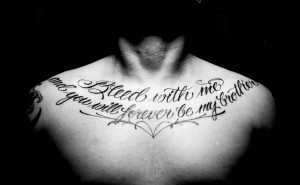
The Inked Academic Body – The Conversation – The Chronicle of Higher Education

Paraphrased “Henry V” as tattoo; photo by beau-foto

**

The Inked Academic Body

October 25, 2012, 1:26 pm

By David J. Leonard


Look around: As Mary Kosut, an associate professor at Purchase College, has written, “America has become a tattooed nation.” Indeed, our shared ink transcends race, class, gender, sexuality, political affiliation, ideology, and even our sports loyalties. According to a 2012 Harris Poll, 20 percent of Americans have ink; the visibility in today’s world is startling. In kids’ culture—tattooed Barbie—and popular/sports culture and politics, tattoos are almost as mainstream as the iPhone or apple pie.

The ubiquity of ink has made me wonder about prevalence of tattoos among college faculty. Given the stereotypes of tweed jackets and bookworm glasses, and those of tatted bikers and inked basketball players, how much does the tattooed professor violate social expectations?

There is no question that professors are frequently tatted. Within my own department, at least six of us, out of 14 faculty, have ink. (Before we merged with another department, six out of eight had tattoos.) While at a certain level, tattoos represent novelty for us, there is more. As scholars within the field of ethnic studies, we are always the “others.” That is especially true for my colleagues of color, and those GLBT scholars within ethnic studies and the academy at large.

The inked body, already questioned, suspect, even undesirable, represents an effort to reassert power and control. My work is interdisciplinary and often crosses the border of race, religion, and culture. A couple of years back, while attending a Jewish-studies conference, I was questioned about tattoos, reminded over and over again that ink and Jewishness are incompatible. For many, my tatted body made me an outsider. With each comment, I rolled up my sleeves to reveal more of my tatted arms, trying hard to reassert myself.

Although tattoos operate as ritual, as a method of memorializing significant life moments or articulating group membership, they are at their core about reasserting control over one’s body, which—because of the demands of work, consumer culture, and unattainable beauty standards—is increasingly illusive. As we are adorned with logos, assailed by images of how to look and dress, how to style one’s hair, and subjected to messages about what is proper, control over our bodies is a dream continuously deferred. Tattoos challenge that dehumanizing reality.

Continue reading The Inked Academic Body – The Conversation – The Chronicle of Higher Education.

Obama and the Death of White Power – News & Views – EBONY

Obama and the Death of White Power

by David J. Leonard

The re-election of Barack Obama to the office of President of the United States prompted a wide range of hateful reactions. From tearful Romney supporters to enraged bigots, the prospects of an African American leading the nation for another four years sent many within White America into panic mode or what I like to call “WDD:” White Delusional Disorder.

Teenagers took to twitter to hurl racial slurs without concern for the blowback; college students at Ole Miss and Hampden-Sydney (among others) took to the streets to voice their anger. In displays of violence usually reserved for sports celebrations, or disgust over an early bar closing, White males made their prejudices clear, hurling racial epithets and rocks with little fear of consequence. As editor Jamilah Lemieux said of those on twitter “the fact that there are so many people willing to publicly express these views… is troubling.”

Predictably, much of the chatter has focused on individual reactions, imagining racism in terms of emotion, anger, and frustration. The media’s shock and awe is not surprising given its failure to shine a spotlight on the resurgent White nationalism since 2008 and persistent racial inequality in the United States. Worse yet, the media has consistently portrayed racism as extreme in nature—-the extremely young, the extremely bigoted, the extremely Southern, the extremely uneducated, and the extremely low-class. But most of us know that it is more common than any newspaper may have you believe.

The anxieties, anger, and outrage weren’t so much about backlash against liberal values, but what Obama’s victory revealed about the nation. There was a clear, alarming message about demographic shifts and waning White male control. According to Keisha Bentley-Edwards, “The anger wasn’t only about President Obama and his re-election. It was overall frustration at the emerging power of diverse people in this country.”

It became yet another moment to lament “White victimhood,” a fantasy too fictitious for even Hollywood. It became an instance to mourn “the end of White America,” which for everyone from Bill O’Reilly to Donald Trump, from David Duke to White nationalists marks the demise of American civilization. O’Reilly laments “a changing country” given the increased power of “people who want things,” recycling the proven politics of White resentment.

Not surprisingly, while White tears were flowing, White nationalists seized upon President Obama’s re-election to further its movement. At Stormfront.org, the hub for global racism, readers were met with a new introduction to the website:

Continue reading at Obama and the Death of White Power – News & Views – EBONY.

When Sorry Isn’t Enough: Blackface and the Duke Problem

When Sorry Isn’t Enough: Blackface and the Duke Problem

Dr. David J. Leonard

This past month students at Duke University attended a Halloween party at the home of Duke lacrosse coach, Kerstin Kimel. At this party for the Women’s Lacrosse team, a group decided to come as Our Gang/The Little Rascals, which, not surprisingly, included Buckwheat. With one player donning blackface, this became the latest incident at a university demonstrating the intransigent nature of white privilege and racism.

The decision to follow in the footsteps of American popular culture and their collegiate brethren is not surprising given the ubiquity of racism within contemporary parties. Dr. James Braxton Peterson describes the broader issues at work here:

White students put on blackface at Halloween, take pictures and generally circulate and celebrate their ‘costumes.’ I think of this as the “southern strategy” of the Halloween holiday. Young white folks, usually male, are able to express their racial and racist angst (conscious and subconscious) in a space and at a time that for the most part sanctions backwards, demeaning behavior. This has happened at every institution of higher learning at which I have ever worked or learned. It is strategic because the blackfacers almost never face the facts of our dark American history and almost always claim ignorance in the aftermath of outrage and the pain communicated (perennially) by the black university communities that must bare witness to these regular insults.

Although ignorance is not excuse for the student (or those other students who sat idly by), what can we say about the adults who allowed for the costume to be worn, who watched as pictures were snapped to memorialize the event, who put them on the Duke website and who left them there for multiple days. Multiple days! Yes, I said that correctly: officials at the university saw fit to put an image of the student in blackface on its website. There are many questions that deserve to be asked of the students; there are also questions that need to be answered about why a coach is hosting a party at her home. The ubiquity of blackface and parties based on degradation also deserves attention in that they have become so common that one needs to simply write a generic article, filling in the specifics of each incident. Yet, the failures of Duke University, from coaches to see a problem in blackface, on its website is telling. The failure of members of the Athletic Department/Media Relations to see an image of its student-athlete in blackface should give pause. The recent “apology” is equally troubling, pointing a systemic failure.

Responding to the outrage about a blackface costume and its appearance on a Duke website, Coach Kimel offered the following faux apology that seems to have been purchased from nonapologies.com:

This year, some of our costume choices were insensitive and entirely inappropriate. No offense was intended, but that does not matter because we should have realized how these choices would be viewed by those outside of our program. On behalf of our coaching staff and our student-athletes, we apologize to anyone we may have offended and understand while we believed we were making decisions in good fun, we should have been much more sensitive to the implications of our actions.

Yes, this was “insensitive” and “inappropriate”; that should be the starting point of an apology, one that also acknowledges the pain, violence, and hurt resulting from this “party.” Do you always have parties that dehumanize and mock, or just on special occasions? The focus on “intent” and the reaction of others demonstrates the power and persistence of privilege. The cross-generational white allegiance to blackface is illustrative of a sense of power and superiority. Amid claims of lost power and the changing demographics, it is the living example of the sedimented realities of white privileges. It becomes a moment to tell the world, particularly communities of color, “Hey we can still mock you; we can still become you; we can still degrade you; we can still control you.”

If I accidentally stepped on your foot, or knocked you over, is it fair for me to say, “I didn’t mean to knock you over; no offense was intended and I didn’t realize it would hurt if I stomped your toe. I didn’t realize you were so sensitive about your toe being squished.” That is what the above “apology” does, ostensibly telling those outraged by blackface, by university officials allowing blackface to take place at a party, by university officials thinking it was a good idea to put blackface images on its official website, “our bad, we are sorry you are oversensitive.”

The actions and the fraudulent apology leave me wondering, are you apologizing for what you did or for getting caught? Rather than apologizing for actions, it is about the reaction; rather than highlighting steps that will be taken to address the behavior of university officials (coaches; publicity department) and the players themselves, the “faux apology” was imagined as a sufficient step. Not even close.

While the incident at Duke is yet another example of Blackface 2.0, the specific inclusion of the Our Gang characters also deserves pause. In Our Gang, “the black characters were often buffoons in racially stereotypical ways. They spoke in dialect — dis, dat, I is, you is, and we is. Farina, arguably the most famous pickaninny of the 1920s, was, on more than one occasion, shown savagely eating watermelon or chicken,” notes The Jim Crow Museum. “He was also terrified of ghosts — this fear was a persistent theme for adult coons in later comedy films. Farina and Buckwheat wore tightly twisted ‘picaninny pigtails’ and old patched gingham clothes which made their sex ambiguous.” In other words, the costume embodies multiple traditions of American racism: Blackface and the dehumanizing and stereotypical representations of the American media.

Continue reading @ Dr. David J. Leonard: When Sorry Isn’t Enough: Blackface and the Duke Problem.

Ain’t Your Father’s Southern Strategy: Whiteness as Mass Appeal

Ain’t Your Father’s Southern Strategy: Whiteness as Mass Appeal

Dr. David J. Leonard

The 2012 election, like every election before it, has been defined by race. This is America, and race always matters. Death, taxes, and race. While 2008-2012 has prompted more explicit racial assault on then candidate and ultimately President Obama, race, racism, and white supremacy defines the history of American politics. Sister Souljah, Willie Horton, anti-Muslim appeals, demonization of undocumented immigrants, “the welfare queen,” the southern strategy, and countless other examples point to the ways that race defines American political campaigns. And these are just examples since the late 1960s from national presidential campaigns.

Yet the vitriol, the explicit racial appeals, and the ubiquitous racial rhetoric has been a noteworthy outcome of the 2012 election. Adele M. Stan, in “Romney Pushed Boundaries of ‘Acceptable Racism’ to Extremes” aptly describes the campaign as a long and winding campaign of racism, one that irrespective of the outcome has had its consequences:

If asked what one thing about the 2012 campaign most impacted everyday American life, one answer stands out above all others: racism. The wink-wink racial coding Romney uses, combined with the unabashed racism of such surrogates as former Bush administration chief of staff John Sununu, adds up to quite a wash of race-baited waters over the campaign. Then add to that the steady stream of racist rhetoric that characterized the Republican presidential primary campaign, and the wash looks more like a stew set on simmer for the better part of a year.

Since the early months of 2011, our politics have been marinating in the language of racial hatred, whether in former U.S. senator Rick Santorum’s “blah people” moment, or former House speaker Newt Gingrich’s tarring of Barack Obama as “the food stamp president.”

The consequences and context of a campaign based in racism, based in a thirty-year racial assault on the civil rights movement is fully visible in AP’s recent poll, which found that both explicit and implicit racial bias against African Americans and Latinos is on the rise. According to the AP, “51 percent of Americans now express explicit anti-black attitudes,” which was a 3 percent rise since 2008. When examining implicit bias, “the number of Americans with anti-black sentiments jumped to 56 percent, up from 49 percent during the last presidential election.” Should we be surprised?

The likes of John Sununu and Donald Trump, the sight of racist t-shirts and posters at GOP rallies and elsewhere, and the explicitly racist discourse point to the strategy of racist appeals and the consequences of such appeals. The impact of racism isn’t simply voters picking Mitt Romney because of their anti-black racism, or even the ways that the accusations against President Obama as a “food stamp president,” as “lazy” as a “socialist” and as “anti-White” resonate because of an entrenched white racial frame, but in the yearning and appeal of a white male leader. Race doesn’t just matter in why whites are voting against President Obama but also why they are voting for Mitt Romney. Tom Scocca, in “Why Do White People Think Mitt Romney Should Be President?” argues that anti-black racism, dog “whistles” and prejudice isn’t the only reason why white males are casting their vote for Romney-Ryan but because they are white and because white masculinity is associated with toughness, leadership, intelligence, and countless other racial stereotypes. “White people — white men in particular — are for Mitt Romney. White men are supporting Mitt Romney to the exclusion of logic or common sense. Without this narrow, tribal appeal, Romney’s candidacy would simply not be viable. Most kinds of Americans see no reason to vote for him.”

Continue reading @ Dr. David J. Leonard: Ain’t Your Father’s Southern Strategy: Whiteness as Mass Appeal.

Dr. David J. Leonard: An Open Letter to White America, Particularly White Youth

An Open Letter to White America, Particularly White Youth

This is not the first time I have written an open letter to you, and clearly my previous letters have not had the necessary impact. Despite history lesson after history lesson, from a myriad of people, certain sh*t continues. Despite reminders that Blackface is never funny, the “N-Word” should never be uttered in any context, and making jokes about racial violence, domestic violence, or sexual violence is never okay. They are all forms of violence that continue to be perpetuated and celebrated each and every day. While the racism, sexism, and homophobia evident in these social spaces and at GOP political rallies are nothing new, the justification, the denial, and the overall societal complacency about racism (and sexism) because our president is black, speaks to a broader issue confronting America.

I know how hard conversations about race can be, and how invariably these conversations lead to claims about the “race card” or it being “just a joke,” and I know the defensiveness that ensues, but if not now, when? Today I read about a horrible and disheartening example of American racism. At a pep rally at Waverly High School, which is located in Upstate New York and is 97% white, three white students decided to put on a skit involving blackface, simulation of domestic violence, and a disgusting level of callousness. The sight of students in blackface, as if that makes them look like Chris Brown and Rihanna as opposed to Al Jolson and Shirley Temple, is yet another reminder that we have a long way to go with race. And when I say “we,” I mean white America. The sight of a skit designed to mock and find humor in domestic violence is evidence of a misogynistic culture that sanctions and promotes violence against women. Within the United States, a woman is assaulted or beaten every 9 seconds; “Domestic violence is the leading cause of injury to women.” In fact, 1 in 5 teenage girls reports having a boyfriend who threatened violence at the prospects of a breakup. So spare me “it’s just a joke” or “relax” responses. It isn’t funny; is reprehensible, sickening, and should be condemned nationwide. And while “it” is the skit and the response (yes, those in the comments section), it is also a racist and sexist culture that perpetuates these daily examples of violence. I am angry and wonder why you aren’t similarly outraged, so I am going to make it plain.


There is no acceptable reason to ever don Blackface. It’s not a joke, it ain’t funny, and it’s not some creative license that adds to the value of your artistic endeavors. Blackface has a long tradition that is part and parcel with white supremacy. It is part of a history of dehumanization, of denied citizenship, and efforts to rationalize, excuse, and justify state violence. From lynchings or mass incarceration, white supremacy has utilized dehumanization as part of its moral and legal justification for violence. Spare me your reference to “White Chicks,” the Chappelle Show. Stop with your references to satire. Spare me your dismissive arguments about intent and not being racially motivated. Blackface is part of the violent history of white supremacy. If you don’t know, now you know, and if you still don’t know, go here or here.


While we are on the subject, there is no place for racist costumes that dehumanize and demean, that mock and ridicule, that stereotype and otherwise reenact a larger history of racism. As the students at Ohio University reminded us this year, they “are a culture, not a costume.” Were you not listening or just don’t care? The costumes have to go along with those theme parties. I am talking about “ghetto parties, “cowboy and Indian parties,” “pimp and ho parties,” “South of the Border parties or any number of gatherings that see humor in mocking and demeaning others. If dressing up “as janitors, female gangsters and pregnant women” for Cinco de Mayo is in your plans or a Martin Luther King, Jr. celebration includes a “gangsta party,” or Black History month is celebrated with the most disturbing stereotypes, it’s time to reevaluate. Just say no!

Continue reading at Dr. David J. Leonard: An Open Letter to White America, Particularly White Youth.

NewBlackMan (in Exile): Review of ‘The Passion of Tiger Woods’

A Review of The Passion of Tiger Woods:

An Anthropologist Reports on Golf, Race, and Celebrity Scandal by Orin Starn

by David J. Leonard | NewBlackMan (in Exile)

For some golf is a game; for others it is leisure. Golf, at its core, is about mastery; it’s about fantasy; it’s about fulfillment of the possibility of greatness. It is about that hole-in-one at the local public course or the bullet drive that covered 300+ yards. Golf provides the fulfillment of a myriad of “fantasies.” With his new book, The Passion of Tiger Woods, Orin Starn leads on a journey not to Pebble Beach or the courses of Hawaii, not into these fantasies playgrounds, but into the treacherous world and real-life drama that he describes as “Tigergate.”

Starn starts his discussion with a foray into the sociology of golf, highlighting the emotional appeal of the game. Describing golf as the “last chance to do “childish things” and as a cheap replacement for masculine yearning for outdoor adventures, Starn locates golf’s appeal within the mental stimulation and imagination afforded by golf’s immense challenges. It’s appeal rests not with improved cardiovascular health, the camaraderie of pickup basketball or soccer, or even tradition (fathers and sons bonding), but with the mental stimulation; it appeal rests with its similarity to a video game rather than basketball or soccer. “The game’s most elementary lure … is that flush of satisfaction and even inner delight that comes from a good shot.” The popularity of the game that Mark Twain once described as a “good walk spoiled” rests with the prospect of making “a twisting twenty-five foot put curving into the hole; a cleaver escape from under the tree.” While “none of us will ever know the ecstasy of running as fast as Usain Bolt or cutting through the water like Michael Phelps,” every once in a while, “even a rotten golfer will hit a shot as magnificent as if it had been hit by Tiger Woods” (15).

It is no wonder that golf is one of the most popular games despites its cost. While not at the levels of baseball, football, or even NASCAR and basketball, golf is tremendously popular as a spectator sport and a leisure activity. With over “17,000 golf courses, covering an area the size of Rhode Island and Delaware combined” (XV), golf may not be America’s national pastime it might America’s most prominent and important hobby. Golf is a national obsession, at least within certain (white; male; middle and upper-class) segments of the American populace.

This analysis isn’t simply an interesting examination of golfing cultures but one that provides an important backdrop for understanding the rise and fall of Tiger Woods. The popularity of golf, its cultural meaning, the ascendance of celebrity culture, and the increased power of new media all contributed to his ultimate tumble before the nation.

Starn identifies the media spectacle surrounding Woods as evidence of the hegemony of the scandal industrial complex. “Now scandal has become a multibillion dollar industry. Talk shows and trash television, glossy magazines, supermarket tabloids, and gossip blogs power this vast and viral entertainment complex” (45). Identifying “Tigergate” as the perfect storm, Starn argues that the media obsession and sensationalism embodied in the “celebritaization” of modern athletes. Yet, his discussion goes beyond the missed placed priorities of today’s tabloid media circus to highlight Tiger Woods’ specific place within the American landscape.

Continue reading @ NewBlackMan (in Exile): Review of ‘The Passion of Tiger Woods’.