Kasandra Michelle Perkins: We Must Say Her Name | The Feminist Wire

Kasandra Michelle Perkins: We Must Say Her Name

December 3, 2012

By David J. Leonard


In the aftermath of the tragic murder of Kasandra Michelle Perkins, and the subsequent suicide of Jovan Belcher, much of the media and social media chatter have focused on Belcher. Indeed, Kasandra Michelle Perkins has been an afterthought in public conversations focused on questions regarding the Chiefs’ ability to play, concussions, masculinity, guns, and the culture of football in the aftermath of this tragedy. Over at the always brilliant Crunk Feminist Collective website, one member described the situation in sobering terms:

Headlines and news stories have focused on the tragedy from the lens of the perpetrator (including speculation of potential brain trauma, his involvement, as an undergraduate, in a Male Athletes Against Violence initiative, and his standing as an allstar athlete), in some ways dismissing or overshadowing the lens of the victim, who in headlines is simply referred to as “(his) girlfriend.”

Mike Lupica, at the NY Daily News, offered a similar criticism about our focus and misplaced priorities:

That is why the real tragedy here — the real victim — is a young woman named Kasandra Michelle Perkins, whom Belcher shot and killed before he ever parked his car at the Chiefs’ practice facility and put that gun to his head.

She was 22 and the mother of Belcher’s child, a child who is 3 months old, a child who will grow up in a world without parents. At about 10 minutes to 8, according to Kansas City police, Jovan Belcher put a gun on the mother of his child in a house on the 5400 block of Chrysler Ave. in Kansas City and started shooting and kept shooting. You want to mourn somebody? Start with her.

Kasandra Michelle Perkins

While disheartening and indefensible, I get the turn towards concussions, guns, and the masculinity of sporting cultures. The murder-suicide shines a spotlight on a number of issues that many have been grappling with for many years. It encapsulates people’s discomfort about a culture that condones on-the-field violence that may contribute to so much pain off-the-field. It highlights society’s moral failures whereupon profits are put in front of people. There will be a time for these conversations, but for now the spotlight needs to be on Kasandra Michelle Perkins.

Upon hearing about this tragic murder of Kasandra Michelle Perkins, I too turn my attention to these issues; I am guilty of this failure, having tweeted about concussions, suicide, and the culture of the NFL. These issues are real, but so is the tragic death of Kasandra Michelle Perkins.

Kasandra Michelle Perkins cannot be a footnote. She cannot be an afterthought.

Continue reading @ Kasandra Michelle Perkins: We Must Say Her Name | The Feminist Wire.
NewBlackMan (in Exile): Déjà vu: Jordan Davis and the Danger of American Racism

Déjà vu: Jordan Davis and the Danger of American Racism

by David J. Leonard | NewBlackMan (in Exile)

Sadly, as I look back at a piece I wrote about Trayvon Martin, I find myself wondering, if I could simply replace Trayvon with Jordan, Martin with Davis. I don’t say this to mean their lives were interchangeable nor do I want to erase their individuality or uniqueness. Yet, American racism brings them together; the daily realities of violence, stereotypes, demonization and differential values ascribed to different brings them together; they are brought by together by what Imani Perry identifies the “conflict between American ideals and our social reality.”

I grew up in segregated Los Angeles. While often celebrated for its diversity, Los Angeles is an immensely segregated community. Divided by freeways, inequalities, and policing, the Los Angeles I remember was defined by its segregation. For middle-class white kids such as myself I was in constant ignorance about the persistence of inequality and differential opportunities. I never thought a second about leaving my house to buy a bag of Skittles; I never contemplated how others – teachers, employers, and even the police – might interpret my saggin’ pants or my hoodie; I did not even give a second thought when I showed up to play basketball at my local park with my hair in braids. The ignorance about privilege and the power of whiteness defined my youth. Yet, the privileges of whiteness were not simply in my head but conferred each and every day. I was able to move throughout the city without fear from driving while white, and without fear of being suspicious, because in America “the assumption is that the natural state of black men is armed and dangerous.”

Continue reading @ NewBlackMan (in Exile): Déjà vu: Jordan Davis and the Danger of American Racism.

Fear of a Black Body | The Feminist Wire

Hank Willis Thomas

***

Fear of a Black Body

David J. Leonard

“Suspicious;” “he feared for his life;” “it looked like a weapon;” and “it was a dangerous situation.” Such explanations and sources of defenses have become commonplace #every36hours. As black men and women die at alarming rates, amid claims that racism or race is not at issue, those who want to explain away these deaths, disregarding the injustice and lost futures, continue to rationalize and blame, criminalizing black bodies even, perhaps especially, in death.

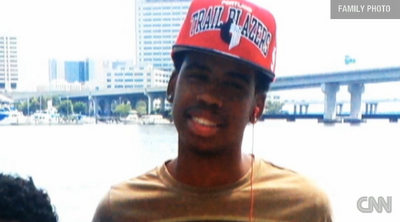
Jordan Davis spent his last night hanging out with a group of his friends. He, like many American youth, spent the evening laughing and chatting. Shortly after his family celebrated Thanksgiving, he breathed his last breath. Michael Dunn would shoot him to death. Claiming that “he felt threatened” and he “fired his handgun eight times … only after one of the four teenagers in a car threatened him and pointed a shotgun his way,” Dunn hinged his defense on fear and safety—his own.

Yet, according to Davis’ father, “There wasn’t a gun. They were just kids, 17-year-old kids. They have never been in trouble. The kids had no weapon, they had no drugs in the car.” While Davis lost his life, while his friends have been vilified and criminalized in the media, while his family grieves, Dunn is working overtime to construct himself as a victim. While this shooting is yet another that is happening #every36hours involving an African American victim, Dunn’s defense is denying that race matters.

Then there is Shelly Frey, who was killed in front of her two children after she ALLEGEDLY stuffed items into her purse. When confronted by a Wal-Mart security guard, Frey, “ran to a car — that had two small children in it — and mashed the accelerator as he attempted to open the door.” In response, he fired one deadly shot into the car, fatally wounding her. Yet, again, claims of fear and suspicion justify the aftermath. Thomas Gilliland, spokesperson for Harris County Sheriff’s Office, offered additional justification noting: “I think it knocked him off balance and, in fear of his life and being ran over, he discharged his weapon at that point.” He added, “He confronted the suspects at the exit of the store before they left. One female wouldn’t stop, struck the deputy with her purse, and ran off.”

And while some will note that the off-duty officer who was moonlighting at a security guard was African American to deny the racial implications, race always matters. In a country where black is suspicious, where the site of a black body compels fear, where stereotypes lead people to see things that aren’t actually happening, to note weapons that are never found, can we ever talk about fear, danger, and suspicion away from race. “The frightening thing, if you are a young African-American man, is that you know nothing makes some folks feel more ‘threatened’ than you,” writes Leonard Pitts. “Nor do you threaten by doing. You threaten by being. You threaten by existing. Such is the invidious result of four centuries of propaganda in which every form of malfeasance, bestiality and criminality is blamed on you.”

The consequences of racism are clear from Jordan Davis to Trayvon Martin and from Rekia Boyd to Shelly Frey. A report from the Malcolm X Grassroots Movement (MXGM) entitled, “Report on Extrajudicial Killings of 110 Black People,” highlights the epidemic of killings, by police, security guards, and others empowered to “protect and serve.” A great number of killings, the police and others have justified shootings with claims of self-defense, fear, suspicion, and alleged weaponry.

  • Stephon Watts, a boy with Asperger’s Syndrome was shot and killed after police claimed he “lashed out with a kitchen knife.”
  • Justin Sipp lost his life after an off-duty police officer “thought Sipp looked suspicious.” Following a routine “traffic stop for broken tail light” and argument,
  • Dante Price was shot 22 times by security guards who claim he tried to run them over with his car.

Sadly there are many more cases – Rekia Boyd, Canard Arnold, and Dakota Bright, just to name a few. To be sure, racism is at the center of each one.

Continue reading @ Fear of a Black Body | The Feminist Wire.

Revealing the Stigma Against Tattooed Athletes

Revealing the Stigma Against Tattooed Athletes

Dr. David J. Leonard

Dear Mr. Whitley:


I recently decided to take a break from public writing; I needed to catch my breath, to catch up on life, work, and recharge. Yet, after reading your most recent piece about Colin Kaepernick, I found myself unable to shake my anger; your words had gotten under my skin.


From the first sentence in your column — “San Francisco’s Colin Kaepernick is going to be a big-time NFL quarterback. That must make the guys in San Quentin happy” — to your description of people with tattoos as looking as though they are on parole, you make clear that you see a tattooed body as a criminal body. You question Colin Kaepernick because he looks “like a criminal.” This makes me wonder if you think he looks like a criminal because he has tattoos or because he has tattoos and he is black. To me, he looks like a chef, a college student, a soldier, or one of the many professors that I know who are covered with tattoos. He looks like many of the 20-30 percent of Americans who currently sport ink.


And so what if he looks like someone locked up in one of America’s many prisons? I know the extent of your knowledge of the criminal justice system begins with Cops and ends with Lockout, but did you know that the vast majority of America’s incarcerated are nonviolent drug offenders? Did you know or care that they are people — mothers and fathers; sons and daughters; brothers and sisters. Why is looking like someone who has gone to prison such a bad thing in your mind? Your comfort in imagining those locked up as violent criminals, as “tatted thugs,” gives me pause. I mean your entire argument is premised on fact that “criminals” have tattoos and therefore why would any person want to have a tattoo. Maybe you should do some research about the millions of incarcerated people, and those on probation and parole; hopefully that would lead you to be a little less callous. To lament Kaepernick’s inked arms by demonizing incarcerated people is reprehensible.


And forgive me if I don’t buy your claim that your point isn’t about race. Forgive me if I don’t buy the explanation that race isn’t an issue because you have two adopted African American daughters, or because your editor is black. Is it just a coincidence that you lament tattoos in sports by focusing on their place on African American bodies? I must have missed your exposés on Josh Hamilton and the death of America’s pastime. Your piece on Danica Patrick and NASCAR’s tattoo problem must have been left on the editing room floor. And yes, I realize that you note that Ben Roethlisberger and Alex Smith both have tattoos, yet they seem to get a pass because they aren’t visible. Are tattoos bad or do you have a problem when the ink is visible? You remind me of the person who denies they are homophobic, and claims, “I don’t have a problem with gay people,” but laments the sight of men holding hands or worse, kissing in public. Oh wait, you are that person.


Do you think Tim Duncan and Kevin Durant look like “criminals?” Have you questioned their leadership abilities? I think not. The “NFL quarterback is the ultimate position of influence and responsibility. He is the CEO of a high-profile organization, and you don’t want your CEO to look like he just got paroled.” Those are your words. Did you know that Barry Goldwater, Antonio Villaraigosa , Senator Jim Webb, Rep. Duncan Hunter, and John F. Kennedy, Jr. all had tattoos? Does this change your opinion of them? What about President Franklin D. Roosevelt, Winston Churchill (and his mom), President Theodore Roosevelt, King George V, and Thomas Edison? All tatted! This isn’t surprising, as among the elite tattoos have a long history. Throughout the early part of the twentieth century, aristocracy often got tattoos as evidence of their sophistication, cultured ethos, and worldly cosmopolitanism. Maybe before your next column about tattoos you should do a little reading about the subject you are writing about, rather than recycling stereotypes.


Your column mirrors so much of today’s lamenting discourse, which bemoans the changing racial demographics, the shifting cultural values, and the challenges to white male heterosexual power. It works through your own nostalgia, all of which seems wrapped up in your own racial assumptions. In sounding like Mittens O’Reilly and those afflicted with White Delusional Disorder (WDD), I can’t help but think this is all about your racial anxiety. Do you fear what will happen if the bastion of white masculinity — the quarterback position — is challenged not just by Cam Newton, but also by tatted Colin Kaepernick? “If you can’t draw the tattoo line at NFL quarterback, you can’t draw them anywhere.” Why is there an impulse to draw a line in the first place and how empowered you do draw such boundaries? How does this represent your desire to contain bodies? I can’t but see your column as part of a long line of efforts to police black bodies. Does the sight of Kaepernick’s ink body lead you think that he might be “bad boy black athlete” (Collins 2005, p. 153) and not “Tim Tebow.” We know that contemporary sports culture consistently represents black male athletes as “overly physical, out of control, prone to violence, driven by instinct, and hypersexual.” Are tattoos and blackness seen as inseparable? Or does ink mean something depending on the body it is attached to? While you seem OK in using tattoos as evidence of worthiness, as markers of being “unruly and disrespectful,” “inherently dangerous” and “in need of civilizing” (Ferber 2007, p. 20), I am not.

Continue reading @ Dr. David J. Leonard: Revealing the Stigma Against Tattooed Athletes.

The B-Word: A Breakdown of a Word That Breaks Down | Urban Cusp

The B-Word: A Breakdown of a Word That Breaks Down

By David J. Leonard

“Ain’t that a “b****” “Stop “b****ing” “Stop acting like a “b****” “You go to the basket like a “b****” “You throw like a “b****” “You hit like a “b****” “I ain’t your “b****”

The “B word” is ubiquitous within our contemporary culture. It can be heard on television, at the student recreation center, on college campuses, on the street, at schools, in songs, and in countless other spaces. Notwithstanding this over saturation, the word remains entrenched within a history of violence and patriarchy. No amount of mental gymnastics and argumentation can take away from its history, and ideological baggage. It is a slur; it is demeaning, disrespectful, and hurtful.

“‘B*tch’ is a slur; and there’s no doubt that the word has a female referent, and a nonhuman one at that,” writes Sherryl Kleinman, Matthew B. Ezzell, and A. Corey Frost. As a dehumanizing slur, this word is wrapped up within a larger history of violence against women, rape, domestic abuse, and state-sanctioned and state practiced violence against women. Its meaning and origins cannot be understood apart from slavery, lynchings, war, forced sterilization, vaginal ultrasounds, labor exploitation and abuse, and so much more. Just go to Google, type the word in the search box and you will see how many different images that normalize and justify violence against women through the dehumanizing deployment of this slur.

In researching for this piece, I came across a site that shocked and sickened me. I found myself asking how, why, and what we can do to stem the tide of dehumanizing language, normalized violence, and the brutality of sexism and misogyny. In “How to Smack a B*tch,” Matt Stone provides readers with a “how to” list, disgustingly describing each type of slap with a casualness. As part of a website called the “guy code,” this sort of “logic” imagines violence against women, and seeing women as less than human as both normal and required to be a real man. While easy to dismiss this outrageous and reprehensible post and page as the extreme (or try to describe it as “satire” as a way to insulate from rightful indignation and condemnation), it speaks to the ways that the language of sexism normalizes violence, discrimination, inequality, and injustice.

Irrespective of this history and the connections seen above, the defenders of the word often notes that the “B word,” as it is used to describe men and women, is not sexist because (1) it is just a word (2) the meaning has changed and (3) men use it to describe other men and therefore it’s not offensive to women. Let me respond to each. (1) it’s not just a word; words matter.

“Words can elevate or deflate us. Words often precede action. Harsh words are exchanged and a fight breaks out. Words tell us, empirically, about increases or decreases in inequality; old inequalities in new guises; false power among members of an oppressed group (more on that, later); unconscious sexism, racism, or other forms of inequality; subordinates’ resistance to injustice” (from Reclaiming Critical Analysis: The Social Harms of ‘B*tch’).

(2) Its meaning remains entrenched in misogyny and patriarchy and (3) it doesn’t matter. The claims that the word has been recuperated, that its meaning has changed over time, and that because men now use it in relationship to other men it precludes a gendered meaning is simplistic and fails to account for the broader implications of the word. It fails to account for what men are saying when they use it to describe another male. Take the examples from above: “stop whining” – “stop “b****ing”; “don’t bring that weak sh*t to basket” – “stop playin like a “b****” or “I don’t want to get you something to drink; I ain’t your “b****.”

In each case, the B-word is used to convey weakness, subservience, and undesirability through a constructed idea of femininity. Whether talking about physical power, intellectual strength or control, the b-word serves as a stand-in for female. “Stop acting like a girl;” “You throw or ball like a girl [or woman];” “I ain’t a woman.” All of these phrases, and the dehumanizing deployment in regards to men demonstrate how the “B word” is wrapped in the logic of sexism; the worst thing one can be is a female within the misogynist imagination.

Continue reading @ The B-Word: A Breakdown of a Word That Breaks Down | Urban Cusp.

NewBlackMan (in Exile): Women of Color and the Political Economy of Sympathy

Women of Color and the Political Economy of Sympathy

by Stephanie Troutman and David J. Leonard |

NewBlackMan (in Exile)

“Given the racist and patriarchal patterns of the state, it is difficult to envision the state as the holder of solutions to the problem of violence against women of color. However, as the anti-violence movement has been institutionalized and professionalized, the state plays an increasingly dominant role in how we conceptualize and create strategies to minimize violence against women—Angela Davis.

Words sadly ring true given the daily realities of state violence, and the limited care and concern for the daily realities of violence in our country. What is wrong with us/U.S.? The endless examples (in a long, sad history of violent acts) act of violence against a woman of color to NOT make headlines is beyond devastating. It is pedagogical in pointing to the material consequences of the intersections of race and gender.

This has been all too clear with reports about the horrific circumstances of Glenda Moore, a Black mother who lost her two young sons during Hurricane Sandy. According to The Daily News Moore was “holding onto them, and the waves just kept coming and crashing and they were under,” the mother’s sister told the Daily News at her home. “It went over their heads … She had them in her arms, and a wave came and swept them out of her arms.” In the midst of the storm, Moore knocked on doors searching for help to no avail. As Moore’s sister recounted to The Daily News “They answered the door and said, ‘I don’t know you. I’m not going to help you,’”…”My sister’s like 5-foot-3, 130 pounds. She looks like a little girl. She’s going to come to you and you’re going to slam the door in her face and say, ‘I don’t know you, I can’t help you’?’”

Although there seems to be reticence and an unwillingness to talk about racism and sexism – implicit biases – in this case, the limited (yes there has been some media attention) concern and national mourning for the death of these children, and the pain endured by Moore is telling. While people came together to raise over $313,000 dollars for a tormented school bus monitor, the Moore family is fighting just to raise enough money to bury their children (as of today, there is just short of $11,000 dollars). It is yet another reminder that not all pain, not all suffering is created equal.

While the reports surrounding Sharmeeka Moffitt, who accused several men of attacking her because she wore an Obama t-shirt, proved unsubstantiated, her experiences point to how racism and misogyny is operationalized within contemporary culture. Yet another reminder of the violence besieging the United States and the media’s silence (and complicity) on the violence experienced by women of color; the fact that Sharmeka Moffitt’s name did not initially warrant front-page news, a lead story on the national news, or national conversation is telling. The fact that people required more evidence in this stance is revealing. The fact that people dismissed the initial reports by noting “We don’t know what happened;” “we don’t know the specifics;” “we don’t know if it is a hate crime” is not without consequence.

Continue reading @ NewBlackMan (in Exile): Women of Color and the Political Economy of Sympathy.

“Can I Have Another Snack?” The Trials and Tribulations of Parents and Food | The Feminist Wire

“Can I Have Another Snack?” The Trials and Tribulations of Parents and Food

November 12, 2012

By David J. Leonard


Food is always a challenge on the parental grind. Whether competing with commercials that highlight the nutritional value of the latest sugary cereal (food coloring, sugar, corn syrup, and FIBER) or the newest cross marketing promotion that requires a burger to secure “that thing,” I often find myself fighting an uphill battle. If only fast food “restaurants” and tween characters were in the business of selling apples and broccoli, I might find the challenge a little less taxing.

While the challenges of competing with hyper-marketed, colorful, and processed sugar delivered in various shapes and sizes is nothing new, I have found the struggle to be especially difficult with my oldest daughter (almost 9) over the last year. Partially reflecting her increased independence – the ability to get her own food from the pantry – and her growing appetite that has not resulted in an expanded menu, I have really had to look inward to evaluate my own reactions. Is my concern about her intake a normal response to children’s insatiable desire for unhealthy yet appealing foods? Is this about my failures as a parent, as someone running around, pulled in different directions, and thus unable or unwilling to have the conversations and the battles over the difference between fresh fruit and packaged fruit snacks? Or is it a gendered reaction particular to my buying into society’s demands about female beauty and skinniness? In other words, is this specific to my daughter, whereupon my level of awareness when it comes to my son will be different? I don’t know the answer to these questions, which is telling in itself.

I have found myself in dialogue with myself, asking often if my reaction is wrapped up in the gendered policing of girls’ and women’s bodies? For example, is it two cookies is too much or two cookies for her is too much? In this regard, am I giving voice to the daily lessons widely disseminated in the media and countless other institutions? Am I serving as a conduit of these destructive and hurtful lessons? Whether I am subconsciously buying into these societal beauty standards, merely trying to “protect” her from a sexist society (or harmful foods), or simply just trying to get her to eat in healthy ways, these moments have forced introspection as a parent. They have forced me to think about my own capitulation, wondering if the lessons learned from media, from schools, from everyday interactions, those grounded in misogyny and sexism, are impacting my parental choices.

While the efforts to empower our children with food knowledge (yes, fruit snacks are not fruit; 100% fruit juice doesn’t mean right squeezed into the bottle) and to provide knowledge so that kids can make good choices about what they put in their bodies through their own lives, I also find myself worrying about how my parenting, how the arguments about food, how the struggles about soda or snacks, may have a deleterious impact on her in the long term. That is, is making food into a source of conflict a problem in itself? Anthony T. DeBenedet, explores the larger issues at work here:

Sure, promoting healthy eating, regardless of one’s weight or age, seems like a positive thing on the surface. But here’s the potential downside: We know kids and teens react differently than adults to external pressures like persistent messaging. Sometimes these pressures can translate into incredible waves of anxiety and fear. At the extreme, a healthy-weight youth could be pushed to monitor his weight more frequently or even begin an unsupervised diet — behaviors that might represent an impending eating disorder.

continue reading at “Can I Have Another Snack?” The Trials and Tribulations of Parents and Food | The Feminist Wire.