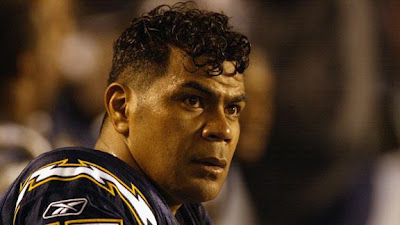
NFL Bounties and the Criminal Justice System: Not So Different? – Entertainment & Culture – EBONY

NFL Bounties and the Criminal Justice System:

Not So Different?

by David J. Leonard

Roger Goodell has spoken, which is never good for an NFL player. Because of their participation in “bountygate,” the NFL commissioner suspended Jonathan Vilma (entire season), Anthony Hargrove (8 games), Will Smith (4 games) Scott Fujita (3 games). And what was their infraction? They participated in a program, along with their coaches, that provided big dollars for vicious hits on the playing field, especially those leading “‘knockout’ or ‘cart-off’ hits.”

While others questioned the NFL’s commitment to safety, calling the punishments excessive, Roger Goodell justified suspensions as part of league’s commitment to root out unnecessary violence and protect its players: “It is the obligation of everyone, including the players on the field, to ensure that rules designed to promote player safety, fair play, and the integrity of the game are adhered to and effectively and consistently enforced. Respect for the men that play the game starts with the way players conduct themselves with each other on the field.” Linking the punishment to its effort to promote “safety, fair play and integrity,” Goodell seems to have concluded that encouraging on-the-field violence with financial incentives is counter to not just the NFL but the morals and values of society.

While drawing a wide range of opinions as to whether the “punishment fit the crime,” there seems to be agreement about the evils of a bounty system. According to Bill Plaschke, “The integrity of this country’s most popular sports league has been battered, and its commitment to safety bloodied, with the NFL’s report…that the New Orleans Saints spent three years operating a management-approved bounty pool that paid big money for inflicting injury.”

Similarly Jeff Schultz positioned “bountygate” in the context of morals and values “We’ve addressed this before: Anybody who trivializes the bounty program with comments like, ‘Everybody does it’ (not true) or the NFL loves violence (true, but they don’t love concussions and torn ligaments) is missing the point. There’s a difference between rewarding an athlete for an unscripted play and a premeditated assault. Payments for ‘cart-offs’ aren’t acceptable. We’re taking about people’s livelihoods. And lives.”

For them, Roger Goodell needed to send a message, one made clear that the league would not tolerate any efforts to reward and encourage on-the-field violence.

These suspensions have made clear that “bounties” have no place within football. But as the NFL’s crackdown on paid smackdowns takes hold, what about the bounty system that exists throughout our culture? If encouraging violence with financial incentives, if promises of cash and fame are unacceptable within football, can we say the same about the criminal justice system? If risking people’s lives and potentially destroying their careers violates the values of sport, can we not agree that it is also antithetical to justice and democracy?

If encouraging violence with financial incentives, if promises of cash and fame are unacceptable within football, can we say the same about the criminal justice system?

What is bad for football is surely bad for a system committed to justice and equal protection under the law. And yet ours is a criminal justice system that rewards officers for arrests and tickets, that provides financial incentives for the “war on drugs”, that encourages racial profiling and “stop and frisk” programs.

Continue reading @ NFL Bounties and the Criminal Justice System: Not So Different? – Entertainment & Culture – EBONY.

NewBlackMan: ‘No [Hoodies] Allowed’: The NBA’s Dress Code & the Politics of New Racism —Excerpt from After Artest: The NBA & the Assault on Blackness

‘No [Hoodies] Allowed’: The NBA’s Dress Code & the Politics of New Racism —Excerpt from After Artest: The NBA & the Assault on Blackness

—Excerpt from After Artest: The NBA & the Assault on Blackness

by David J. Leonard | NewBlackMan

The murder of Trayvon Martin has prompted widespread discussions about race in America, persistent inequalities within the criminal justice system, differential values afforded to different bodies, and the real-life consequences of racial stereotypes. Amid many of the discussions, media reports, and the protests have been questions about the racial signifier of the hoodie. From the million hoodie march to the backlash directed at Geraldo Rivera, who named the hoodie as a co-conspirator along with George Zimmerman, the discourse has reflected on the racial signifiers embedded in the hoodie. In other words, how is a black body, inherently criminal and suspect when read within a hoodie; what are the dialects between the hoodie and the black body within these processes of criminalization? These types of questions have been asked and represented in a spectrum of spaces, highlighting the ways the black bodies are imagined as threatening within the dominant white imagination. Pushing the conversation beyond individual prejudice and “what was in George’s heart,” such counternarratives have reflected on how media narratives, popular culture, and a culture that criminalizes black bodies produces a Trayvon Martin, whose mere presence is seen as a threat, all while producing a George Zimmerman.

As a scholar of race and sport, these questions have long guided my work: how do the representations of black athletes, particularly those in the NBA, buttress larger ideological, political, and criminalizing processes? How does the ubiquitous references to NBA players as “thugs” and “gangstas” as “criminals” and “punks” normalize blackness as questionable, undesirable, and inherently suspect? The murder of Trayvon, the prison industrial complex, the racial segregation in school discipline, and the levels of state violence are a product of these cultural projects. According to a report from the Opportunity Agenda, “distorted media representations can be expected to create attitudinal effects ranging from general antagonism toward black men and boys, to higher tolerance for race-based socio-economic disparities, reduced attention to structural and other big-picture factors, and public support for punitive approaches to problems.”

In my recently release book – After Artest: The NBA and the Assault on Blackness (SUNY 2012), I explore the broader criminalization of blackness inside and outside of the NBA’s arenas, that among things has focused on the attitudes, demeanor, and clothing of NBA ballers. I, thus, present to you a short excerpt from the book, one that explores the racialization and criminalization that is evident in the NBA’s dress code as a way to expand our conversation about the murder of Trayvon Martin to reflect on how popular culture, media discourses, and the language of everyday racism both normalizes the criminalization of blackness and points to the importance of intervention in this regard.

Continue reading @ NewBlackMan: ‘No [Hoodies] Allowed’: The NBA’s Dress Code & the Politics of New Racism —Excerpt from After Artest: The NBA & the Assault on Blackness.

NewBlackMan: The NFL or The Hunger Games? Some Thoughts on the Death of Junior Seau

The NFL or The Hunger Games? Some Thoughts on the Death of Junior Seau

by David J. Leonard | NewBlackMan

Last weekend I saw The Hunger Games. When I walked into the theater, I could not have told you one thing about the film, and if not for the uber publicity, I likely would have thought it was a show on the Food Network. While there is much to say about the film, I was left thinking about how it merely recycled the common Hollywood Gladiator trope. Mirroring films like The Running Man and The Gladiator, The Hunger Games highlights the ways that elite members of society make sport and find pleasure out of the pain and suffering of others. That is, they find arousal and visceral excitement in watching people battle until death. Within such a narrative trope is always a class (and at times racial) dimension where those with power and wealth (the tenets of civilization?) enjoy the spectacle of those literally and symbolically beneath them fighting until death. The cinematic representation of the panopticon, whether within the past or in futuristic terms, allows for commentary about the lack of civility, morals, and respect for humanity amongst the elite outside of our present reality. As these morality tales take place in the past (and or future), they exists a commentary about our present condition, statements about how far we have evolved and/or the danger of the future.

Yet, what about The Hunger Games in our midst? What about the NFL, a billionaire enterprise that profits off the brutality, physical degradation, and pain of other people? What about a sport that celebrates the spectacle of violence? Unlike The Hunger Games or Gladiator, films that depict a world where people bear witness to death, hungrily waiting the next kill, football and hockey fans sit on the edge of their seat waiting for the knock out hit, the fight, and bone crushing collision. The game doesn’t end with death but death results from the game. Out of sight, out of mind, yet our hunger for games that kill are no different.

Junior Seau committed suicide today; he shot himself in chest. While his death certificate will surely say “self inflicted gun shot wound,” it might as well say death by football. He, like so many former NFL players, have fallen victim to football-induced death. The links between suicides and concussions, between obesity and heart disease, and between drug abuse and post-NFL physical pain, are quite clear. The NFL Games are killing men before our eyes; yes, death is not taking place on-the-field with fans screaming from the rafters or the comfort of their couches, but make no mistake about, death is knocking on every player’s door. “Suicide, drugs, alcohol, obesity—are ailments the National Football League is getting to know all too well,” writes Dave Zirin. To him, Seau is yet another reminder of the brutality of the NFL and the callousness to this epidemic. He continues:

These are issues NFL Commissioner Roger Goodell and the various team owners are loathe to discuss, but with Seau, they won’t have a choice. In Seau, a larger than life Hall of Fame player, we have someone with friends throughout the ranks of the league and especially in the media. It will be incredibly difficult to keep this under wraps. People will want answers. Over the summer, former Chicago Bears safety Dave Duerson took his own life with a gunshot to the chest so his brain could be studied for the effects of concussive injuries. Junior Seau now joins him, a gunshot to the chest. There is a discussion that the NFL is going to have to have with a team of doctors, players and the public. Right now, this is not a league safe for human involvement. I have no idea how to make it safer. But I do know that the status quo is absolutely unacceptable.

Lester Spence also pushes us to think about suicide as a potential consequence of NFL/NHL careers.

The first thing we should do is think about Wade Belak, Rick Rypien, and Derek Boogaard. They were three NHL enforcers (people who made their hockey careers through their fists rather than through their sticks), who committed suicide over the past year. Each of them had a history of concussions. Boogaard made the courageous decision to offer up his brain to science. The results suggest his suicide may have been the result of brain damage.

It is only after thinking about Belak, Rypien, and Boogaard, that we have the medical context to understand Seau. Not so much to understand why he committed suicide–if there were a simple relationship between concussions and suicides the suicide rate of former NFL/NHL players would be far higher than it is. BUT to understand how his suicide may be at least a partial function of his NFL career.

It is hard not to think about the consequences of sporting violence. It is hard to deny the implications here when NFL players commit suicide at a rate six times the national average; it is hard not to think about a rotten system when 65 percent of NFL players retire with permanent and debilitating injuries. It is hard not to think of the NFL and NHL as a modern-day gladiator ring where our out-of-sight childhood heroes are dying because of the game, because of sport, because we cheered and celebrated brutality and violence. It is hard not to think of the NFL as nothing more than the real-life hunger games, our version of death as sport, when we look at reports following suicide of Dave Duerson:

Continue reading NewBlackMan: The NFL or The Hunger Games? Some Thoughts on the Death of Junior Seau.

He’s Still Metta World Peace – Entertainment & Culture – EBONY

He’s Still Metta World Peace

[OPINION] David Leonard says one mistake on the court doesn’t mean we should ignore the former-Ron Artest’s bold transformation

David Leonard

Metta World Peace is once again America’s most hated athlete. After elbowing James Harden in the head, an indefensible foul netting him a 7 game suspension, he has faced endless criticism on not just the cheap shot but him as a person. In article after article, within television commentaries, media pundits have made their anger clear, often refusing to call him by his name since his actions mirrored those when he was Ron Artest. Announcing that he doesn’t deserve to be called Peace, that he clearly has not changed from his Ron Artest ways, and that his new name was a lie in that he was “still a thug,” the efforts to deny MWP his name is telling. It is both a power play (“we will call you what we want to call you”) and part of argument that MWP is a bad guy who is incapable of changing irrespective of his name.

Part of the refusal to call by MWP seems to come from anger if Metta elbowed the media in the face. This wasn’t simply a foul or even a cheap shot, but a betrayal to all those who believed in Metta’s transformation, who rooted for him, and who gave him a 2nd chance. It was an affront to his new name, a name he didn’t deserve.

Drew Magary, in “Why Did We Ever Think Ron Artest Was Interesting?”, reflects the level of hostility directed at MWP, anger that comes from a feeling of being bamboozled and taken for a fool in believing in this changed man: “I was one of those Internet people who participated in the rebranding of Ron Artest when he arrived in L.A. a couple years ago. Yet “Artest isn’t really a colorful character. He’s not an interesting person. And he’s not sympathetic. There’s nothing to learn from the life of Ron Artest. Like Arenas, he’s just a flaky shithead.”

Capturing the tone of a parent whose child missed curfew again, after having promise to always be on time, the post-elbow tone has been one of disappointment and feelings of betrayal. “I had come to know him and even like him…. I have visited with him countless times after games and eventually understood him as a guy who seemed to be constantly choking down his violent tendencies in an attempt to change,” writes The Los Angeles Times’ Bill Plaschke. “He would say something mean, then turn it into something funny. … I was really starting to believe he was Metta World Peace. I was wrong, and James Harden has the headaches to prove it. He is still Ron Artest.“ As with many others Plaschke refuses to call him by name because in his eyes he is the same old bad person.

Following in the tradition of Muhammad Ali, Kareem Abdul-Jabbar, World B. Free, Mahmoud Abdul-Rauf, and even Chad Ochocinco, Ron Artest’ changed his name to Metta World Peace (MWP) in Summer of 2011. While facing similar scorn and criticism (albeit each in distinct ways), his decision to be come MWP highlights the power of black self-naming in a society that often doesn’t understand the black community. The capacity to name one’s self is in power, a power routinely co-opted and denied by white America. As we are reminded in Coming to America: “A man has the right to change his name to vatever he vants to change it to. And if a man vants to be called” Metta World Peace, “godammit this is a free country, you should respect his vishes, and call the man” Metta World Peace!

Having believed that MWP was a changed man, the elbow betrayed their desire to redeem him because it showed how compassionate, forgiving, and exceptional American could be. As with the anger directed at Tiger Woods, “America’s multicultural son” after news broke of his martial infidelity, and the disappointment directed at Kobe Bryant, who was “different” from his baller brethren, following Colorado, the elbow denies the media THEIR story. And so denying the “we forgive you Metta; isn’t America exceptional story,” these angry commentators have returned the favor in denying him his name. It goes back to that same old (White supremacist) saying: you can take the player out of the ghetto, but you cant take the ghetto out of the player. Or better said, you can take on this flower child name, but you can’t change who you are if who you are is an inherently violent thug. Yet, the man has changed and despite an indefensible foul, he still has the right to be called Metta World Peace.

Continue reading @ He’s Still Metta World Peace – Entertainment & Culture – EBONY.

NewBlackMan: The Elbow Heard Around the Nation: The NBA and the End of ‘Peace’

The Elbow Heard Around the Nation: The NBA and the End of ‘Peace’

by David J. Leonard | NewBlackMan

The Elbow Heard Around the Nation: The NBA and the End of ‘Peace’

by David J. Leonard | NewBlackMan

When Ron Artest announced his intent to change his name to Metta World Peace, I had discussions with several people about potentially changing the name of my book, After Artest (May 2012, SUNY Press) to reflect his metamorphosis. Examining how the Palace Brawl forever changed the NBA, while also highlighting the larger scripts of race and criminalization, After Artest reflects on the processes of demonization and criminalization directed at Artest and his black baller brethren in the aftermath of the 2004 fight between the Pacers-Pistons-Piston fans.  While deciding against changing the book’s title for a myriad of reasons, one principle issue for me in pushing back against a title like “Peace after the Palace” was that in spite of efforts from the NBA, its fans, and the media establishment to police, punish, and control blackness in their efforts to secure peace, neither condemnations and suspensions, dress codes or age restrictions, would bring about peace for the league because of the ways that race and racial narratives operate within the American cultural landscape.  The efforts to recreate the illusion of a racially-colorblind Jordan-esque landscape were futile given persistent anti-black racism and governing stereotypes.  Peace after the palace was not possible because of the ways that blackness and anti-black racism overdetermined its meaning within the national landscape.  Artest and what he embodied in the national imagination guided and served as a lens as the NBA sought to deracialize itself within the national imagination.  This is why I start After Artest as follows:

“The real question, how does it feel to be a problem” – W.E.B. DuBois, 1903 (Quoted in Jackson 2006, p. 9)

“Ron Artest more than likely will be suspended, but so should Kobe” (Resnick 2009)

“Kobe vs. Artest: Proof Artest Will Kill Your Team” (2009)

“NBA Bad Boy Ron Artest of L.A. Lakers Admits He Had A Problem: Drinking During Games! ” (Douglas 2009)

“Trevor Ariza loses shoe, Ron Artest tosses it into the stands” (2009).

Artest, who’s trying to put his bad-boy image behind him, said he could simply display his ring in his living room or he could wear it.’ But I think it’ll be more important to give back to something I believe in, which is providing kids with someone to talk to because it’s so expensive. I pay for parenting counseling, marriage counseling and anger management, and it’s very expensive. This will be for children of all demographics, rich or poor — preferably the rich can pay for their own psychologists — but it’ll be a great way to help kids who don’t know where they’re going in their life at this point’ (“Ron Artest Plans” 2010)

***

Artest, who’s trying to put his bad-boy image behind him, said he could simply display his ring in his living room or he could wear it.’ But I think it’ll be more important to give back to something I believe in, which is providing kids with someone to talk to because it’s so expensive. I pay for parenting counseling, marriage counseling and anger management, and it’s very expensive. This will be for children of all demographics, rich or poor — preferably the rich can pay for their own psychologists — but it’ll be a great way to help kids who don’t know where they’re going in their life at this point’ (“Ron Artest Plans” 2010)

***

At first glance, the above headlines point to the fact that Ron Artest’s personal history, and especially his association with the Palace Brawl, continues to determine the public narrative assigned to him by the dominant media and broader public discourse. Even those instances of praise and celebratory redemption does so in relationship to his past indiscretions. Despite the banality of his exchange with Kobe and his tossing of another player’s shoe off the court (his sportsmanship was questioned by an announcer), and notwithstanding his efforts to admit to a past drinking problem1 or shed light on the issue of mental health, each in varying degrees have been the read through the lens of the Palace Brawl.

In 2009, Ron Artest admitted to drinking alcohol at halftime while he was a member of the Chicago Bulls. Hoping to teach kids by sharing his past mistakes, Artest’s admission, not surprisingly, prompted much media and public debate. Although some people questioned the truthfulness of his admission, others used this moment as an opportunity to speculate about whether Artest was indeed drunk when he entered the stands in 2004. Likewise, his tossing of Trevor Ariza’s shoe into the stands, along with his physical and verbal altercations with Kobe Bryant, were given amplified meaning and importance considering his role. In all four instances, Artest’s past and his character are used as points of reference.

Often invoking his involvement in the 2004 Palace Brawl, the dominant frame that facilitates his representations is not only constrained by Artest’s personal and professional histories, but by the prism of race and blackness. He is consistently imagined as a problem. The nature of these representations point to the ways in which blackness overdetermines not only the meaning of Artest, but of all black NBA players in a post-Brawl context. Post-Artest, blackness is the hegemonic point of reference for both the commentaries and the policy shifts within the NBA, demonstrating that the Palace Brawl changed the racial meaning of the NBA and thus changed the regulatory practices governing the league. . . . .

The Palace Brawl was the culmination of the recoloring of the NBA. It represented a moment when the blackness of the league was irrefutable and thus needed to be managed, controlled, and, if necessary, destroyed. After Artest argues that the Palace Brawl served as that “aha moment” in which blackness displaced the racially transcendent signifier of Michael Jordan. This blackness, and its representative threat, were undeniable and, as such, necessitated intervention, termed as an assault within this book’s title. Not surprisingly, anti-black racist/white racial frames have anchored the debates and policies that have followed Artest; frames based on racial transcendence or colorblindness remain in the background. In this sense, Artest mandated a reversal wherein race/blackness had to be noticed (and controlled/destroyed), leading to public articulations of the white racial frame instead of denials of racial significance.

With this in mind, it is not surprising that the sports media establishment, and the social media world is all abuzz following a Metta World Peace foul on James Harden on Sunday in a nationally televised game.  A hard foul that was reckless and dangerous; one that warranted an injection (unlike others I have no idea his “intent”) and a suspension; and one that was disappointing to say the least and not worry of defense. I am not here to defend the foul or explain, although those who use the foul as a referendum on Metta, the NBA, or blackness need to check themselves.

It was unfortunate; yet equally unfortunate and more destructive have been the response.   Hayden Kim, on The Bleacher Report, referenced Metta’s “unstable mental stable” and an inability to maintain control; worse yet, he described his outburst in the following way:  “As he pounded his chest, acting like a gorilla during mating season, he caught James Harden with an ill-advised elbow that could have caused an earthquake” (the original piece no longer has this language but can still be found here and here).  The hyperbole notwithstanding, the descriptor of Metta as a “gorilla” given its historic meaning is disturbing to say the least – disgraceful, in fact.

Ken Berger focused more on the typical hyperbole and ‘what ifs” with his discussion of the elbow heard around the world.  “Metta World Peace’s vicious, dangerous elbow to the head of James Harden Sunday was no garden variety NBA elbow, and it probably will result in longer than your typical elbowing suspension,” writes Berger. “It should, anyway. This was about as cheap as a cheap shot gets. It’ll have nothing to do with the fact that Metta World Peace is really Ron Artest, he of Malice at the Palace fame. World Peace, after all, has come a long way since his 73-game suspension for going into the stands in Auburn Hills, Mich., in 2004, and even won the NBA’s citizenship award last season (when his name was still Ron Artest).”  Berger, unlike so many others notes his recent citizenship award, falls into the trap that he cautions against: reading the incident through the Palace Brawl.


Continue reading @NewBlackMan: The Elbow Heard Around the Nation: The NBA and the End of ‘Peace’.

SLAM ONLINE | » Condemn The Foul, Not The Mind

Condemn The Foul, Not The Mind

Leave the mental assessments for professionals.

by David J. Leonard / @drdavidjleonard

There is no defense for the elbow seen around the world. Metta, why? Irrespective of intent, it was a hard flagrant foul, one that has no place in the beautiful game of basketball. The seven-game suspension, while a bit on the high side, is measured and appropriate.

In fact, given the incendiary rhetoric from the media, the continuous loop of the incident, and their overall efforts to excite anger, the decision from David Stern to issue a sensible suspension (not the case with the Palace Brawl) is worthy of praise.

As such, there is nothing to debate regarding Metta World Peace elbowing James Harden in the head—it was vicious, uncalled for and disheartening. As a Lakers, Metta World Peace and basketball fan—it was disappointing. It is indefensible; yet, that fact is not a defense for a media spectacle-defined unnecessary cheap shots, much of which has nothing to do with the incident.

From the hyperbole and rhetoric designed to incite anger, to the constant invoking of the language of the criminal justice system and the demonization of Metta as a crazy person, much of the sports media has failed to inform and elevate the discussion, instead embracing roles as referee, commissioner and worse yet, doctor.

A common theme evident since the nationally televised elbow has been the constant mention of Metta’s mental state. While one might think mental illness mitigates culpability (it can within our justice system), the media establishment has used his purported mental fabric and wiring as part of a narrative that depicts him as pathological and dangerous. Although painting him as unstable and mentally weak, the ubiquitous references to his mind reflect an effort to mock, make fun and ridicule Metta World Peace.

The references have saturated the airwaves. “To say that something is wrong with Artest would not do him justice. This is the guy who applied for a job at Circuit City to get a discount, has come to practice in a bath robe and has admitted to drinking cognac at halftime,” writes Jason Black. “After winning the NBA Championship in 2010 he thanked his psychiatrist. There are many people who need therapy or have mental health disorders, so the fact that he publicly talked about having a psychiatrist isn’t a bad thing, but it tells us there is a problem.”

Black goes onto argue that Metta’s mental illness represents a threat to himself, other players and the game itself, calling for extensive punishment as a method of protection: “Having a mental health issue and getting help for it is commendable, but what price does somebody have to pay before it’s too late?” As with media pundits like Stephen A. Smith, who described Metta as “not that far away from coo-coo nest,” “as touched,” and as someone who has refused to take his medication in the past, the media narrative demonizes Metta for his mental issues.

Describing him as having “violent tendencies,” Bill Plaschke furthers the picture of MWP as psychopath, as crazy dangerous man: “This was about a celebration that turned caustic when somebody walked into the middle of it, the weird mind of World Peace switching from jubilation to rage in a matter of seconds. Maybe even scarier than the elbow was the look in his wild and crazy eyes as he stalked around the floor immediately afterward.”

Continue reading @ SLAM ONLINE | » Condemn The Foul, Not The Mind.

SLAM ONLINE | » Restricted Access

Restricted Access

On David Stern’s push to eliminate one-and-done players.

by David J. Leonard / @drdavidjleonard

It should come as no surprise that David Stern wants to change the NBA’s age restriction. The effort to curtail the straight-from-high-school baller has been longstanding, gaining the necessary steam and leverage in wake of the Palace Brawl.

With the lockout behind them, the League is obviously seeking to further modify the rule, requiring players to be two years out of school prior to entering the NBA. Stern, who has offered several different rationales for the age restriction over the years, is now focusing on basketball reasons:

“That’s not our rule. Our rule is that they won’t be eligible for the Draft until they’re 19. They can play in Europe, they can play in the D-League, they can go to college. This is a not a social program, this is a business rule for us. The NFL has a rule, which requires three years of college. So the focus is often on ours, but it’s really not what we require in college. It’s that we say we would like a year to look at them and I think it’s been interesting to see how the players do against first-class competition in the NCAAs and then teams have the ability to judge and make judgments, because high-ranking draft picks are very, very valuable.”

Stern is not alone with much support from those who yearn for a repeat Championship run from Kentucky or those who pine for a Jared Sullinger redemption tour as well as those who trot out arguments about maturity, the value of education, and countless other explanations.

Ironically, one of the loudest sources of support for adding a year to the NBA’s age restriction has come from Mark Cuban. He offers multiple reasons for a bolstered age restriction, recycling two of the most commonly articulated arguments: the cautionary tale and they are role models:

I just think there’s a lot more kids that get ruined coming out early or going to school trying to be developed to come out early than actually make it. “For every Kobe (Bryant) or (Kevin) Garnett or Carmelo (Anthony), there’s 100 Lenny Cooke’s.

It’s not even so much about lottery busts It’s about kids’ lives that we’re ruining. Even if you’re a first-round pick and you have three years of guaranteed money—or two years now of guaranteed money—then what? Because if you’re a bust and it turns out you just can’t play in the NBA, your ‘rocks for jocks’ one year of schooling isn’t going to get you far.

These sorts of arguments are not new. In my book, After Artest: The NBA and the Assault on Blackness (SUNY 2012), I explore the history behind the rule, the arguments offered to support it, and the larger implications of the end to the straight-out-HS baller.

While clearly arguing against the rule, I reflect on the larger implications as it relates to race, class and America’s education system. To highlight these broader issues and my belief that the rule is neither fair nor needed and that it embodies the NBA’s efforts to deal with race more than basketball issues, I offer you an excerpt from the book.

After Artest

In an interview in Sports Illustrated, Phil Jackson denounced the NBA for its increased emphasis on young talent, offering insight into long-standing discursive articulations about the necessity and burden of Whiteness controlling savage, child-like Blackness. “It doesn’t matter whether they can play or not. We’ve ended up becoming a service for growth. Now it’s, ‘We’ll hire a chef, we’ll hire laundry, we’ll hire Mom, we’ll hire somebody to come and live with them so that they can perform at this level’” (Quoted in Thompson 2004, p. 84).

David Stern’s successful institutionalization of an age limit for those under 19 did provide an answer to Phil Jackson and others calling for a blockade to the NBA’s youth movement. That wasn’t its true motive. It did, however, seek to appease fans by projecting its purported image problem on to the backs, bodies and cornrows of young straight-out-of-high-school ballers. While the sports world celebrates the youth movement in golf, soccer and tennis, as “prodigies” and geniuses, the opposite seems to be the case in the world of basketball.

Continue reading @ SLAM ONLINE | » Restricted Access.