NewBlackMan: Serena Williams and the Politics of Hate(rs)

Serena Williams and the Politics of Hate(rs)

by David J. Leonard | NewBlackMan

Following a first-round victory in the Brisbane International tournament, Serena Williams expressed her sentiments about tennis, sport, and her labor of unlove. “I mean, I don’t love tennis today, but I’m here, and I can’t live without it … so I’m still here and I don’t want to go anywhere any time soon,” she explained. “It’s not that I’ve fallen out of love; I’ve actually never liked sports, and I never understood how I became an athlete. I don’t like working out; I don’t like anything that has to do with working physically.” Williams comments, not surprisingly, elicited widespread commentary, most of which used her confession as a source of criticism and demonization.

In “Woe is Serena: Tennis star says she doesn’t love tennis,” Chris Chase criticizes Williams as narcissistic and otherwise incapable of being self-reflective and self-critical. While acknowledging her candor, he uses that candor as a source of condemnation:

From one view, her candor could be seen as refreshing. Here’s a top athlete discussing the delicate balance of passion and obligation and fear of the unknown. She’s revealing herself to the press, something she rarely has in the past. Then you step back and realize Serena has the least self-awareness of any great athlete of the past decade. Two years later, she can’t bring herself to acknowledge that she was wrong to threaten a lineswoman at the U.S. Open. She’ll likely never admit her actions in last year’s U.S. Open final crossed the line. Unless she gained some insight in the past four months, these quotes are selfish nonsense.

Chase, unwilling to limit the criticisms to the quote, rehashes and recycles those previous incidences that in his mind provide context for understanding Serena’s dislike of tennis. In other words, just as she violated the rules of tennis, just as she has been unable to apologize for her past missed deeds, and just as she hasn’t been able to acknowledge her own faults, these comments are construed as evidence of her deficiencies as a person and athlete. Chase goes on to argue:

Nobody is surprised Serena doesn’t like tennis. Like Andre Agassi before her, she seems to only love the winning and is willing to put up with what it takes to get there. The grind doesn’t interest her much. These aren’t new insights into her soul. The underlying tone isn’t that Serena is a reluctant sports hero, it’s that she’s able to be so much better than the rest of the tour without caring about the game like they do. Her “I don’t love tennis” quote isn’t a revelation, it’s a self-congratulatory declaration. It’s as if she’s saying, “Just imagine what I could do if I cared.

Pete Bodo, with “The real question facing Serena Williams,” expresses a bit more sympathy given Williams’ litany of injuries. Yet, he still concludes: “Serena’s problem appears to be that she likes the reward (celebrity and money) but not the process. She would like to win the Australian title and any number of other tournaments, but she hates having to go through the motions – you know, the long practice sessions, the diet, the gym workouts and even that messy business of playing matches. It’s not a good problem to have, at least not for an athlete.” Beyond the efforts to link her comments to selfishness and a sense of victimhood, several commentaries link her disinterest with tennis to her diverse interests (fashion specifically), as if that is a shortcoming.

Continue reading @ NewBlackMan: Serena Williams and the Politics of Hate(rs).
NewBlackMan: Jason Whitlock’s Ideal America?

Jason Whitlock’s Ideal America?

by David J. Leonard | NewBlackMan

One of the common arguments offered during the NBA lockout was that David Stern and the owners had to initiate the lockout in an effort to make the league better. Citing the success of the NFL, these advocates predicted that the NBA would be more successful economically, more important culturally, and just a better game if it adopted the rules and policies of the NFL. Such arguments have not died down with the end of the lockout or with the start of the NBA season.

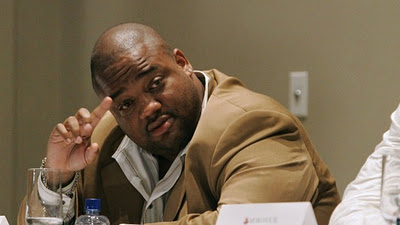
Embodying this logic is Jason Whitlock’s recent column, “NFL is model for American success.” Whitlock argues that NFL is a model of success not just for the NBA, but the nation. With a salary cap, revenue sharing, a requirement that players attend at least three years of colleges, its amateur draft design, its “emphasis on teams over individuals while making room for superstars” and “a free-agent system that allows franchises to retain their marquee players”, the NFL offers “the perfect blend of capitalism and socialism.” He remarks further:

One hundred years from now, when scholars analyze the rise and fall of our dynasty, the NFL might be considered America’s greatest invention, the cultural and economic force that should’ve been our guide to 200 more years of global domination.

If only Pete Rozelle had been our president rather than the architect of the modern-day national pastime, Americans would understand the value of restraints on capitalism, revenue sharing and a system that strengthens the poor.

There is so much wrong with the argument and the analysis that it is hard to know where to start. The idea that the NFL’s age restriction leads to a better or more successful system, even in absence of any sort of evidence, is reflective of Whitlock’s propensity to sell myths as fact. The ample success of NBA players, whether those who skipped college or those who were “one-and-done” ballers, runs counter to the rhetoric offered by Whitlock.

Likewise, the premise that NFL is superior because it emphasizes teams over individuals, which has led to increased fan interest, erases the overall popularity of NBA stars throughout the world. Whereas LeBron James, Kobe Bryant, and Michael Jordan are transnational icons, whose talents generated profits for the NBA and its corporate partners, the same cannot be said for the NFL. Think about it, can you name an NFL player that captures the global imagination?

When Michael Jordan was playing, he was one of the most recognizable people in the world; Kobe Bryant’s visits to Asia lead to mass hysteria. Would any NFL player – past or present – elicit such reactions? Despite the fact that the NBA erases these global realities from its economic picture, the NBA global success is very much a result of its emphasis on individual stars over teams.

Likewise, the ascendance of dynasties within the NBA – Bulls, Lakers, Spurs, Celtics –, which has certainly enhanced the NBA’s brand, is reflective of the structure of the NBA. In many regards, the NBA system is superior even though David Stern and the owners seem intent on slowly undermining what has been successful for the league in so many ways.

What is most striking, however, is Whitlock’s celebration of the NFL as an ideal model for the entire nation. Should the NBA and the nation at large emulate the model provided by the NFL given that: 21 former NFL players recently sued the NFL for not protecting players against the harms of concussions. In the lawsuit, they “accuse the NFL of deliberately omitting or concealing years of evidence linking concussions to long-term neurological problems.”

Is the NFL the ideal business and social model, given that: according to a 2006 Study in the St. Petersburg Times, for every year an NFL player spends it the league, it takes 3 years off his life expectancy. In other words, given that the average career of an NFL player is 4 years, his life expectancy will be 55 (as opposed to 75, the national average for American males). Put succinctly by Greg Doyle, “The NFL is killing its players, literally leading them to an early grave — and now the NFL is trying to kill them even faster. That’s a fact, people.” While some may call this rhetoric incendiary and hyperbolic, consider that in 2010, almost 280 players spent time on injured reserve, with 14 suffering head injuries, 13 experiencing neck injuries, and one dealing with spine injury.

continue reading @ NewBlackMan: Jason Whitlock’s Ideal America?.

The Layup Line » Is The 2011 NBA Season A Money Grab?

Is The 2011 NBA Season A Money Grab?

by David J. Leonardon January 6, 2012

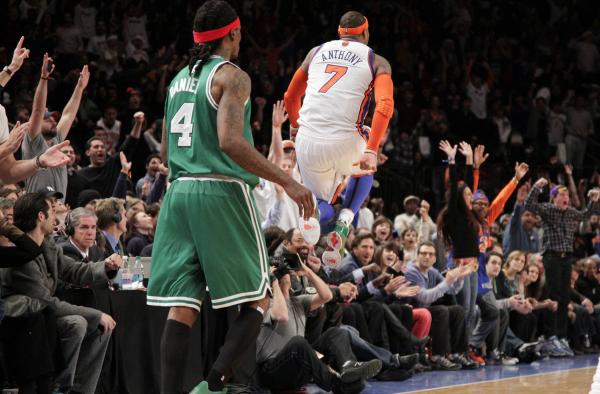
The NBA is where injuries happen. While still early to measure the playoff implications, or more importantly any long-term impacts on a particular player’s health, the NBA lockout, the shortened preseason, and the tight packed schedule are having an immediate impact on the health of the league’s players and the quality of its games.

Players like Eddy Curry or Jerome James are easy fodder for fans and NBA analysts, but as the recent retirement of Brandon Roy reminds us, many NBA players risk their careers in attempting to get back on the court as soon as possible so their team can make a playoff run. Speaking on the long-term impact that Roy’s ill-fated return from during the 2010 playoffs had on his career, New York Times’ Rob Mahoney makes this salient point:

Few figures in the basketball narrative are treasured as highly as the Willis Reed archetype, and Roy has taken to the role of hobbling star time and time again.

The image of Reed hobbling onto the court during the 1970 playoffs is stuff of legend. As is the sight of a flu-ridden Michael Jordan willing his team to victory during the 1997 NBA finals. Both of these moments made Sports Illustrated’s top-10 Playing With Pain Moments, and Reed’s valiant return was chosen as the greatest all-time.

Until the 2011-12 season finds its heroic or Reed or Jordan moment, this money grab masking as an NBA season is only spurring higher health care costs and declining fan interest.

Take TNT’s Thursday night game that pit the Heat against the Hawks. The game ultimately ended after 3 OT periods, although the game was anything but thrilling. With LeBron James and Dwayne Wade sitting out, the most compelling match-up was Chris Bosh v. Ivan Johnson. The NBA isn’t where amazing happens, since much of amazing is sitting on the bench wearing street clothes.

The impact of injuries is evident as one scans ESPN’s rumor tab, which is a long list of injuries. No more reports on potential trades or trends in the league – just a medical report. Of course, you don’t have to bother with “rumor tab” when you can just go to CBS Sports Basketball injuries. I did just that, looking at the page on the evening of January 5, 2012. The number of players out for a single game, doubtful, questionable and probable is pretty astounding. Each of the following players are out for their team’s next game:

Ray Allen,

LeBron James,

Dwayne Wade,

Tyrus Thomas,

Correy Maggette,

Jason Kidd,

Nene,

Continue reading (to read about many more injuries) at  The Layup Line » Is The 2011 NBA Season A Money Grab?.

The Layup Line » Are You From Here?

The Layup Line » Are You From Here?

Are You From Here?

by David J. Leonard on January 4, 2012

As part of its efforts to expand its market share, and make inroads with basketball players in America’s inner cities, Under Armour recently launched its “Are you from here?” campaign.

Pairing commercials with exhibition basketball games in various American cities, Under Armour embraced a grassroots marketing strategy: “While established brands are able to market globally with ease, Under Armour is building from the ground up using unique grassroots schemes to become a player in the ultra competitive world of basketball endorsement,” writes Peter Walsh in Slam Magazine. Walsh goes on to add, “With this strategy, Under Armour is hopeful that they will be able to build relationships with younger players and fans to build for the future as their popularity continues to grow.” Featuring Kemba Walker, Brandon Jennings, and Derrick Williams, these commercials theoretically introduce the future generation of consumers to the future of the NBA. While the NBA lockout limited the exposure and visibility of these commercials, now that the season is in full swing and the campaign is getting a second life, it is worth noting the interesting representations of race, class, and basketball simmering in these ads.

These commercials reify the dominant narrative that most NBA players grew-up in inner-city communities. While this fiction continues to hold sway, in reality a majority of NBA players spent their formative years in suburban and outer-burban neighborhoods. It is more convenient and potentially lucrative to portray NBA players emanating “straight-out-of Compton,” Chicago’s Southside, Coney Island, Oakland, or Harlem. To wit Under Armour’s commercials are laced with shots of metal fences, graffiti and other signifiers of urban life play upon the hegemonic visual signifiers of blackness, urbanity, and the NBA.

The commercial featuring Kemba Walker for example features him saying, I “grew up in the projects” a place “where every kid dreams about winning.” Likewise, the one featuring Brandon Jennings, with countless visual representations of Compton and the urban streets of Los Angeles, has him saying, the “streets are filled with chance and choice and always one move from losing it all.” According to Kemba Walker, “We’re just trying to show our faces in the communities man, we hood guys.”

Imagining America’s inner-cities as spaces of violence and opportunity, as space of despair and play, these commercial erase the complex experiences of urban America. Historian Robin D.G. Kelley in discussion of media representation of street ball elucidates the harmful messages delivered here. Commercials such as “Are you from here?” “romanticize the crumbling urban spaces in which African American youth play.” Such “representations… are quite remarkable; marked by chain-link fences, concrete playgrounds, bent and rusted nettles hoops, graffiti-scrawled walls, and empty buildings, they have created a world where young black males do nothing but play.”

continue reading @ The Layup Line » Are You From Here?.

The Layup Line » Is Andrew Bynum Really The NBA’s New Bad Boy?

Is Andrew Bynum Really The NBA’s New Bad Boy?

by David J. Leonard on January 3, 2012

Lakers center Andrew Bynum has become persona non grata within the Los Angeles media. Bynum has become the source of media condemn and criticism, most of which has nothing to do with basketball, minus the manufactured panic over the Lakers’ non-struggles, and hand-wringing over whether Bynum is a viable trade asset in a deal for Dwight Howard.

T.J. Simers, in “Lakers need one more big man, fewer Chicken Littles,” feeds this panic over the Lakers in typical and clichéd demonization of Andrew Bynum. Depicting him as a “big baby,” unreliable and injury-prone, Simers is skeptical about Bynum’s worth to the Lakers:

“If the Lakers are going to be successful, they need Bynum playing shoulder-to-shoulder with Gasol and Kobe, making it the Big Three. That would mean Bynum stepping forward as a professional,”

Simers piles it on further

“I have my doubts. I was in his corner before he went punk in the playoffs, the big baby walking off the court while removing his jersey.”

The infantilization of Bynum while seemingly without much basis is especially troubling given the history of representing black men as immature boys. This column, however, doesn’t limit itself to the basketball arena offering cheap shots that would make any number of NBA “enforcers” proud. He follows-up his discussion of the basketball issues with the following:

Then he became the walking embodiment of the entitled athlete, twice in a span of two months having his car photographed parked in a handicap spot. Obviously he doesn’t care about the rules, civility or what others think. How many times did he park wherever he wanted without being caught?

The criminalization of black athletes is nothing new and Simers deploys this common deployed narrative with ease. According to sociologist Jonathan Markovitz, “The bodies of African American athletes from a variety of sports have been at the center of a number of mass media spectacles in recent years, most notably involving Mike Tyson and O.J. Simpson, but NBA players have been particularly likely to occupy center stage in American racial discourse.”

Continue reading @ The Layup Line » Is Andrew Bynum Really The NBA’s New Bad Boy?.

The Tim Tebow Affect or Celebrating Whiteness? | Loop21

The Tim Tebow Effect or Celebrating Whiteness?

By David J. Leonard and James Braxton Peterson

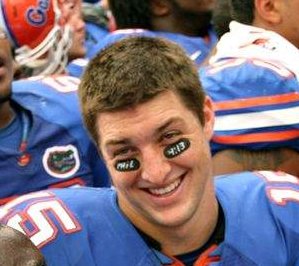
Tim Tebow is ubiquitous. Everywhere we look, Tim Tebow is there. Whether celebrating his “accomplishments,” attributing the Broncos season to his comeback heroics, reflecting on his now famous on-field genuflections, or debating his treatment by media and fans alike, Tim Tebow has captured the national imagination.

In many ways, the national fascination with Tebow reflects the power of whiteness. Historically the quarterback has been a positioned reserved for white men. Seen as a position that requires intelligence, leadership qualities, and proper mechanics, the NFL has historically engaged in, position segregation, and more than a little bit of Jim Crow on the field. That said, Tebow doesn’t follow in this tradition; he plays the position in a gritty running style that has long been associated with blackness.

In Am I Black Enough for You, Todd Boyd identifies a dialectical relationship between racialization and styles of play where whiteness represents a “textbook or formal” style, which operates in opposition to “street or vernacular” styles that are connected to blackness within the collective consciousness. As such, he describes a hegemonic narrative where “white” players adhere to “ . . . a specific set of rules [that] determines one’s ability to play successfully and ‘correctly’” (1997, p. 115). In both styles of play, notions of intelligence, mental toughness, and mental agility are all at work.

Tebow embodies a vernacular or extemporaneous style that has (historically) been associated with blackness and as a result of this association that same style has been devalued. Yet, for Tebow it has been embraced, celebrated as both innovative and as an example of athletic heroism. The celebration of Tebow, like the praise for some receivers, or safeties, comes from the shock and awe of white success in areas that are generally (assumed to be) dominated by black bodies.

Writing about Jordy Nelson, a white receiver with the Green Bay Packers, Ron Demovsky attributes his success to racial stereotypes: “There’s a joke in the receivers meeting room that Nelson benefits by being the only white receiver on the team because perhaps opposing defensive backs don’t take him seriously.” So while Tebow may only complete a few passes per game, the power in his athletic narrative rests with his ability to play quarterback in a style not associated with whiteness; the beauty for many commentators is in the spectacle and in his ability to convert this style of play into victories.

Continue reading @ The Tim Tebow Affect or Celebrating Whiteness? | Loop21.

NewBlackMan: What’s in a Name? The ‘Plantation’ Metaphor and the NBA

What’s in a Name? The ‘Plantation’ Metaphor and the NBA

by David J. Leonard | NewBlackMan

Several weeks back, at the conclusion of HBO’s Real Sports, Bryant Gumbel took David Stern to task for his arrogance, “ego-centric approach” and eagerness “to be viewed as some kind of modern plantation overseer, treating NBA men, as if they were his boys.” Highlighting the power imbalances and the systematic effort to treat the greatest basketball players on earth as little more than “the help,” Gumbel invoked a historic frame to illustrate his argument.

If the NBA lockout is going to be resolved anytime soon, it seems likely to be done in spite of David Stern, not because of him. I say that because the NBA’s infamously ego-centric commissioner seems more hell-bent lately on demeaning the players than resolving his league’s labor impasse.

How else to explain Stern’s rants in recent days? To any and everyone who would listen, he has alternately knocked union leader Billy Hunter, said the players were getting inaccurate information, and started sounding Chicken Little claims about what games might be lost, if players didn’t soon see things his way.

Stern’s version of what’s been going on behind closed doors has of course been disputed. But his efforts were typical of a commissioner that has always seemed eager to be viewed as some kind of modern plantation overseer, treating NBA men, as if they were his boys.

It’s part of Stern’s M.O. Like his past self-serving edicts on dress code or the questioning of officials, his moves were intended to do little more than show how he’s the one keeping the hired hands in place. Some will of course cringe at that characterization, but Stern’s disdain for the players is as palpable and pathetic as his motives are transparent. Yes the NBA’s business model is broken. But to fix it, maybe the league’s commissioner should concern himself most with a solution, and stop being part of the problem.

Not surprisingly, his comments have evoked widespread criticism and scorn. Even less surprising, commentators have chastised Gumbel for inserting race into the discussions, as if race isn’t central to the lockout, the media coverage, and fan reaction. As evidence, the response to Gumbel, and the ubiquitous efforts to blame the lockout and the labor situation on the players through racialized language (see here for example – h/t @resisting_spec), illustrates the ways in which race and hegemonic ideas of blackness operates in this context.

Also revealing has been the response to Jeffrey Kessler, a lawyer for the NBA players Association, who similarly described David Stern’s treatment of the players. He told the Washington Post: “To present that in the context of ‘take it or leave it,’ in our view, that is not good faith. Instead of treating the players like partners, they’re treating them like plantation workers.” While his comment elicited some backlash along with an apology, the vitriol and the level of indignation didn’t match the reaction to Gumbel.

Beyond the power of white privilege in this regard, what has been striking has been the references to history by the anti-Gumbel/Kessler crowd; much of the criticism at Gumbel and Kessler has focused on their historic amnesia. That is, their comments, while being inaccurate, unfair, and infusing race into otherwise colorblind situation, are disrespectful towards the history of slavery in America. References to slavery in this context betray the violent history of American slavery. In “Occupy the NBA: A Plea from an Avid Basketball Fan” Timothy Jones takes Gumbel to task for the historic slight here:

I’m appalled that anyone would compare this situation to slavery. I have great respect for Bryant Gumbel, but his quote that David Stern sees himself as a modern day plantation overseer is not only disrespectful to our ancestors, but it also did nothing to help this situation. Stern may not be handling this situation well, he may not have the best interest of the players in mind, he may be a mean person (I really have no clue), but I do know that brothers making millions of dollars are nothing like slaves on a plantation.

Charles Barkley agreed, referring to Gumbel’s comments as “stupid” and “disrespectful to black people who went through slavery. When (you’re talking about) guys who make $5 million a year.” Likewise, Scott Reid questioned the use of such an analogy given history: “The point is that too many people inappropriately use slavery and enslaved people to make points about things that are nowhere close to comparison. All of these casual slavery analogies do nothing but diminish one of the worst crimes against humanity in human history. Comparing enslaved Africans, or anyone else for that matter since slavery still exists for many enslaved people, is not only absurd, it is just plain disrespectful to the memory of the millions who perished under the worst kind of injustice.”

Continue reading @ NewBlackMan: What’s in a Name? The ‘Plantation’ Metaphor and the NBA.