SLAM ONLINE | » Remember the Alamo (Heights)

Remember the Alamo (Heights)

How an inflammatory chant at a high school game is deeper than basketball.

by David J. Leonard and C. Richard King

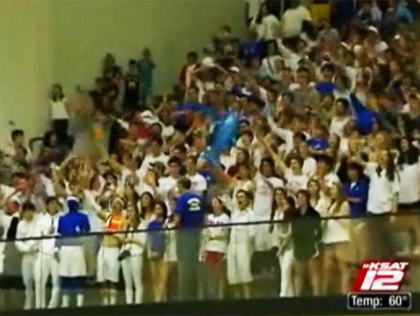
The Texas Region IV-4A high school boys basketball championships that pitted San Antonio Edison High School against Alamo Heights High School ended with a handshake and a celebration. It also ended with a racial and nationalist taunt from several fans from Alamo Heights, who chanted “USA, USA, USA” to celebrate its primarily white team and the school’s victory over the mostly Latino squad. While the Alamo coaches tried to quiet the crowd, the damage was done.

“Our kids try real hard and work extra hard to get to the regional tournament, and then we have to worry about them being subjected to this kind of insensitivity,” noted Edison coach Gil Garza. “To be attacked about your ethnicity and being made to feel that you don’t belong in this country is terrible. Why can’t people just applaud our kids? It just gets old and I’m sick of it. Once again, we’re on pins and needles wondering what’s going to happen.”

This incident was not the first anti-immigrant outburst on the floor in San Antonio. In 2011, Cedar Park High School, a predominantly white school with an equally white basketball squad, battled Lanier, a high school with an all-Latino squad. During the course of the game, Cedar Park fans chanted a myriad of anti-Latino chants, including “USA, USA.” They also cheered “Arizona, Arizona,” a clear reference to SB 1070, legislation that institutionalized anti-Latino racism. And, fans yelled “this is not soccer, this is not soccer” clearly linking their teams success (and ultimate victory) to their whiteness over and against a group of foreigners, marked as such because of their project affinity for and ability at an un-American game. Stereotypes about Latino and soccer reduced the basketball court to nothing more than a competition for racial superiority, another opportunity to police the border through the assertion of white nationalism.

The chant represents a brief, local reiteration of the long-standing equation where USA equals White within the national imagination. It reflects and is a consequence of the vitriol and the anti-immigrant sentiment that dominated the national landscape in recent years. The chant should not be surprise in a moment when presidential candidates “joke” about immigrant deaths or wish they would just deport themselves, when state legislatures make culture and skin color probable cause, and when public officials declare ethnic studies illegal. The chant reflects the same sentiments as those articulated by Rush Limbaugh, who has described America’s immigration in the following way: “[S]ome people would say we’re already under attack by aliens—not space aliens, but illegal aliens.” It is an outgrowth of a historic sentiment that imagines Latinos irrespective of citizenship as foreigners and undesirable. It reflects an increasingly ferocious anti-Latino sentiment that both represents and treat Latinos as “illegal aliens” neither welcome nor deserving of the legal protections of the United States. It should come us no surprise given this larger history and the ramped up anti-immigrant sentiment in recent years. It embodies as Tanya Golash Boza, assistant professor of sociology at University of Kansas, told one of us: “In the white American mindset, the only group that gets an unhyphenated American identity is white.” It should come us no surprise given this larger history and the ramped up anti-immigrant sentiment in recent years.

According to Alexandro José Gradilla, an Associate Professor in the Department of Chicana and Chicano Studies at Cal State Fullerton, the chant embodies “a new political climate of ‘papers please’” where all Latinos are presumed to be outsiders, threats to the national success of the United States. The racial hostility and the nationalist celebration at these high school basketball games, notes Gradilla, “signal a new racializing paradigm of conflating Mexican Americans with Mexican Immigrants—hence the chants of USA USA were appropriate to use against these possibly ‘illegal’ and ‘alien’ people.” Given the history of sports, so often a place to authenticate national superiority, play out racial tensions, and exhibit masculine prowess, the efforts to nationalize the basketball, to use the victory as evidence of national/racial superiority, is reflective of the political orientation of sports.

The staging of anti-immigrant sentiments at a basketball game and the ease with which chanting for a predominantly White team slides into rooting for America is not surprising. The outrage and the ultimate apology from the school district (“Unfortunately, after the game, we had a handful of students who made a bad decision and we’re very sorry it happened. They made a mistake and we’re going to use this as a learning experience…”) has prompted conservative commentators to argue political correctness run amuck and to otherwise deny any racial animus.

via SLAM ONLINE | » Remember the Alamo (Heights).

[EXCLUSIVE] UVA Football Star Joseph Williams Talks Hunger Strike

[EXCLUSIVE] UVA Football Star Joseph Williams Talks Hunger Strike

Williams explains what inspired him to stand up for worker’s rights

By David Leonard Writer

On February 17, a group of students at the University of Virginia embarked on a hunger strike in “to protest the economic and social injustices perpetrated by the UVA administration against the vast majority of the University’s service-sector employees.” Although a living wage is 13 dollars per hour, the starting pay for many UVA employees is $10.65, egregious in itself but even more so when considers that its administrators make between $400,000-700,000 and the school’s basketball coach makes 1.7 million per year.

Two days after the strike began, Joseph Williams, a member of the school’s football team, joined the protest. In a column on Michaelmoore.com, he explained his personal reasons behind his decision:

“On a personal level, this cause is one that hits very close to home. As one of four children supported by a single mother, I have experienced many periods of economic hardship in my life. Growing up, I moved over 30 times – including various stays in homeless shelters, the homes of family friends, and church basements. As a result of these experiences, I know firsthand what the economic struggle is like for many of these underpaid workers. One UVA employee anonymously shared that though she works full time for the University, over 40 hours a week, her family was still forced to go without electricity for nearly 3 months, unable to pay for the rent, electric bill and other basic necessities on the meager wages she is paid by the University. Such stories are the reason that I and countless other Living Wage supporters have chosen to take up this cause and give a voice to the many University employees who often cannot speak up for fear of retaliation from the administration.”

Over the course of the week, countless faculty, community members and students Charlottesville campus have joined Williams and the other student protestors in voicing their discontent with the wage issues on campus. I had the opportunity to talk to Joseph six days into his hunger strike about the movement for fair pay and his involvement.

EBONY: What is the Living Wage Campaign about and why a hunger strike?

Joseph Williams: The Living Wage Campaign has been active and we have a number of demands, including a living wage for the majority of direct and contracted workers at Virginia. We also want to have an oversight board put in place so employees feel comfortable and safe speaking out. Currently a lot of employees supporting us anonymously; they are afraid to do so publicly. In the past, they have written up or been fired because of involvement with the campaign. For the past 14 years we have exhausted every tactic, so we decided to move forward with a hunger strike to pressure the administration to negotiate with us.

I had a responsibility to speak out for those who aren’t able to have the same things I have been enjoying.

EBONY: What led you to get involved in the campaign?

JW: I have been involved with the Living Wage campaign for several years while at UVA although not (always) to the extent I am now. It really inspired me that they were willing to start a hunger strike because it revealed their seriousness, a willingness to their livelihoods and their bodies on the line for a cause that was bigger than them. Specifically, the cause spoke to me because I have been in a place similar to a lot of the workers in terms of economic struggles and hardships. To be at this university, to have such a position as a student, as a student-athlete, to have the spoils that come with being here, I had a responsibility to speak out for those who aren’t able to have the same things I have been enjoying, who have been systematically marginalized by the university administration.

Continue reading at Ebony

Broke Ballers: The Financial Crises of Allen Iverson and Terell Owens – Entertainment & Culture – EBONY

Broke Ballers:

The Financial Crises of Allen Iverson and Terell Owens

Two gifted and formerly-paid ball players face devastating money woes

By David Leonard and James Braxton Peterson

Allen Iverson and Terrell Owens are not the kind of athletes that necessarily invite compassion and/or understanding, either from the media or from the sports fan community. Each of them have at various points in their all-too-brief careers, enjoyed the scorn of both fans and sports media alike, and usually simultaneously. It’s no small coincidence that each of them enjoyed their most successful stints in the Philadelphia, where T.O.’s histrionics and A.I.’s nihilism found brilliant exposure in a city that claims “brotherly love” and thrives on working class values with the not-so-subtle suggestion that said values are inherently White. Yet, the media coverage of their current financial woes, seems to take too much of the “I told you so” tones of a media waiting for these kinds of disappointing outcomes to occur – especially to those ungrateful athletes who deserve what ever bad fortune they get.

Bomani Jones recently wrestled with the news that A.I.’s current financial challenges are punctuated by some extraordinarily absurd amount of money owed on jewelry (i.e. bling in snarky parlance totaling some 375K or 860K with court costs attached) – bling that of course, he should never have purchased in the first place. Jones’ take on A.I.’s current challenges is fair and insightful. He notes his own sadness and the complexities that athletes face post-career.

A.I.’s overall financial status is unknown, but one thing we can be certain of is that he has been frozen out of the NBA and basketball more generally. Considering that he has anything left in the tank, and that there are any number of teams that might be able to play him off the bench – it is of course, a point-guard’s game at the moment – we can only conclude that public perceptions dictate his fate. His attitude, his willingness to be a coachable player, and the negative reporting that dogged his career, all work in concert to prevent him from what must be his last few years of professional sports play. But sadly these misperceptions about A.I. will likewise prevent him from entering the coaching/scouting ranks or from even having a crack at the sports commentating game. These possibilities are truly troublesome for a player who by some reports was “pound-for-pound” one of the greatest players ever to pick up a basketball.

Like it or not, attitude matters, and sadly, perceptions of one’s attitude matters even more. Unfortunately we can’t know whether or not A.I. was actually a “team” player. All we are supposed to understand is that A.I.’s current financial challenges suggest that he has cavalierly squandered the American Dream. In retrospect, too much of the coverage on his career centered on his hair, his tattoos, his rap lyrics, his entourage, his . . . almost anything but the fact that he was one the best damn players to ever dribble a basketball.

In a recent GQ profile, Nancy Hass highlights the trials and tribulations of Terrell Owens, offering readers a stereotyped and troubling story of the “fall” of an NFL star. “As you’re planning your Super Bowl party this year, give a thought to future Hall of Famer Terrell Owens. He’s out of work, out of money, and currently in court with all four of his baby mamas.” These, the first lines of the story, punctuate its peddling of widely circulated stereotypes of Black athletes, recycling the tacitly accepted trope of the once famous and wealthy Black athlete who threw it all a way. Focusing on his loss of 80 million dollars, his personal demons, and his pain, Hass turns Owens into a spectacle for readers to condemn, gawk at, and otherwise ridicule in an effort to hate the player not the game.

Despite the caricatures, stereotypes and the troubling narrative, the GQ article actually provides some insight into Owens’ financial situation. Partially challenging the dominant narrative that he simply wasted the money by highlighting failed investments and depreciating home values (he bought one home for 3.9 million but was forced to sell it for 1.7 in 2010), Hass’s work approaches complexity in its coverage. Yet, the media, which simply took the GQ story to create their own, erases any of the complexity and tragedy, instead using the moment to further demonize Owens and place the blame on his shoulders. For example, Deron Synder who claims that TO “appears to have serious money problems, due largely to the four paternity suits.” The cases are not questioning the paterning of these children, but the amount of child support Owens should pay given the end of his career.

Continue reading at Broke Ballers: The Financial Crises of Allen Iverson and Terell Owens – Entertainment & Culture – EBONY.

ESPN’s Week in Whiteness: Why White Fans Dislike Athletes of Color By Charles Modiano

Cross posted from POPSspot

ESPN’s Week in Whiteness:

Why White Fans Dislike Athletes of Color

By On February 10, 2012

Forbes came out with its poll this week on sports most-disliked players, and the names ring familiar. In order, they are Mr. Vick, Tiger, Plaxico, NDamukong, Kris Humphries, Lebron, Kobe, Terrell, ARod, before Kurt Busch comes in at #10. Quite notably, Joe Paterno or Jerry Sandusky [1], Ben Roethlisberger (accused twice of rape), and the allegedly “polarizing” Tim Tebow didn’t crack the top 10.

These types of polls are almost always dominated by white voters, and the “most disliked” people are almost always dominated by athletes of color. While there is disturbing bigotry inherent in these lists, media plays a critical role in perpetuating and maintaining views of white fans [2].

This past week offers an excellent illustration of white privilege in action. Here is a quick recap on some of what you might have missed amidst Super Bowl week.

Feb. 1: Kevin Love Hacks Danny Granger and Talks Big-time Trash to Pacers
Feb. 2: Josh Hamilton Relapses
Feb. 3: Lance Armstrong Walks as his Federal Case is Dismissed
Feb. 3: Cardinals Announcer Joe McLaughlin – Repeat DUI Arrestee — Keeps Job
Feb. 4: Kevin Love Stomps on Face of Luis Scola after throwing him to floor
Feb. 5: Super Bowl Sunday – Congrats Giants! Manning-to-Manningham!
Feb. 6: Rob Gronkowski Dances Night Away After Super Bowl Loss
Feb. 7: George Brett Has Lawsuit filed against him for false advertising
Feb. 7: Kevin Again: Suspended Two Games (and finally receives own ESPN article)
Feb. 7: Lance Again: WADA Urges Feds to Hand Over Evidence

Some of the stories were purposely delayed to coincide with Super Bowl week, and in the previous 10 days in January Ben Roethlisberger very quietly settled on his rape case, Ryan Braun made an MVP award speech, and Dirk Nowitzki sat out games due to poor conditioning while all came with little national media hype.

With the exception of announcer McLaughlin – whose DUI continues a long Cardinals narrative – all are stand-out all-stars. With the possible exception of Josh Hamilton’s relapse (note: POPSspot wishes Josh the very best with his continued recovery), just about every story [3] mentioned was either ignored, buried on website, or downplayed by ESPN judging by black athlete standards.

What are “black athlete standards”? On Tuesday, ESPN “sauced” up a front-page DUI story on a 3rd string running back. On Thursday, a retired average pitcher received front-page treatment for his heavy cocaine use 25 years ago. In between, “Kendrick Perkins rips Lebron” over innocuous tweet, “Lebron Won’t Apologize for Tweet” while both ESPN stories received: prime web-link placement, video commentary, and front-page “staying power” that helped produce 5000+ comments for each article. And that’s just the last three days.

Now back to the white guys. The stories of Armstrong, Roethlisberger, and Love deserve a closer look:

1) Lance Armstrong Federal Case is Dismissed and Legacy Endures:

Outside of owners, Lance may be the most powerful man in sports today.  There is more evidence of Lance’s doping than Bonds, Clemens, and Hulk Hogan combined. Yet his federal case is dismissed. Says Betsy Andreu one of many, many accusers:

“Our legal system failed us. This is what happens when you have a lot of money and you can buy attorneys who have people in high places in the Department of Justice.”

Our sports media has also failed us with over 12 years of allegations against Armstrong being ignored. Now Armstrong “luckily” got the news announced on the Friday afternoon before Super Bowl Sunday. ESPN.com opens up with the news: “Los Angeles — The case against Lance Armstrong is closed. His legacy as a seven-time Tour de France champion endures.”

Really? Is Lance’s legacy is tied to his federal case? Was ESPN, AP, Sports Illustrated or anyone else patiently awaiting court verdicts before deciding if Bonds legacy and his 762 home runs “endured”? Lance’s multi-layered power over (American, not European) sports media deserves its own article if not book (in America, not Europe). On Tuesday, ESPN’s story read: “WADA: Turn Over Lance Armstrong Info”. Another important story, but AP reprint was buried on website (note only 9 comments). USA Today has a better take.

While ideally, no doping athlete should be subject to a federal investigation, Bonds 7-year federal pursuit changed those rules. While hundreds of millions might protect any athlete from media, the media pursuit of Tiger Woods changed those rules. While Lance’s work on behalf of cancer patients is important and laudable, off-the-field contributions has never protected an athlete of color) from media (see Tiger again, Stephon Marbury, and NDamukong Suh. Lance is not protected solely by green or white – he is protected by the intertwined and exponential power of both.

2) ESPN is STILL Protecting Ben Roethlisberger:

In 2008, ESPN famously did not report the civil suit alleging rape against Ben Roethlisberger for 2.5 days. The omission was so egregious that the rest of sports media, both mainstream and blogs, took notice and charged both corporate influence and racial bias. Well 2.5 years later, ESPN’s protection of Ben remains. In virtually every website on January 20th, the story’s title read: “Ben Roethlisberger Settles Lawsuit Alleging 2008 Rape” 

Do you see that last word “rape”? ESPN changed the title to: Ben Roethlisberger Lawsuit Settled”. A closer and longer look at both separate rape allegations against Roethlisberger will show that removing “the R word” is a common practice for ESPN and Ben, but most definitely not Lawrence Taylor! ESPN has repeatedly removed “the R word” from title for over two years.

Kevin-love-danny-granger1_crop_340x234

3) ESPN Loves Kevin:

Love did more than just tweet this week. Love hacked Danny Granger and talked made-for-ESPN trash afterwards. Days later, Love threw Luis Scola to the ground, and stomped on his face (not arm like NDamukong Suh). Neither incidents garnered articles beyond game recaps. Thanks to Commissioner David Stern’s 2-game suspension, ESPN was finally forced to cover Love with a standard AP article on the suspension. ESPN’s only additional article was “Short Fuses in Shortened NBA Season” where the picture caption reads:

“Kevin Love doesn’t lack for passion. In a compressed season, that can result in some unwise explosions”.

Author Mark Kreidler goes on:

“[Love] won’t be the last to lose it on the court in this weird NBA experiment: Take the most competitive players in the world, deny them adequate training time, put them into ridiculous travel schedules, cram 66 games into 123 days, and see what happens.”

Beyond two disclaimer sentences, it was the tough intense schedule that led Love to his “series of tantrums”. Did you get that Mr. Suh and Ms. Serena Williams? ESPN offered no companion articles on the usual cadre of “personal responsibility”, “what about the kids” or “what kind of message does this send” memes. For more in-depth media analysis, or doubt about the intentionality of Love’s stomp, please read David Leonard’s: Silence, Innocence, and Whiteness: The Undemonization of Kevin Love.

The protection of Armstrong, Roethlisberger, and Love only scratch the surface of white privilege in sports media. When day after day, a massive sports media says that the courts of law should decide Lance’s legacy, that black tweets trump white stomps, and that Lebron’s “decisions” are worse than Big Ben’s – too many white fans will actually believe it.

Ideally, the solution is not for media to treat white players like athletes of color it is to treat all athletes as if they were white. But until that day comes, let there be one standard.

—-


[1] On Paterno/Sandusky: Forbes article mentions that owners were eligible for list, so we also assume coaches as has been the case in the past.

[2] Views of “white” fans are singled out for two reasons. White always make up the vast majority of fans polled. Also, a 2011 ESPN poll shows that only 28% of white sports fans believe that “the media put more of a spotlight on problems involving black athletes”. That same poll showed that 65% of African-American fan believed that problems of black athletes received a greater media spotlight.

[3]  Unlike USA Today, original Gronkowski dancing story received no ESPN article (it did only after Rodney Harrison responded). McLaughlin story was never printed by ESPN or AP. George Brett AP story was buried in ESPN webspace.

SLAM ONLINE | » The Dribble Drive-By in the New NBA

The Dribble Drive-By in the New NBA

The misguided obsession with rivalries.

by James B. Peterson and David J. Leonard

Since the announced trade of Chris Paul to the Los Angeles Clippers (yes, L.A. has two basketball teams), the NBA punditry has been abuzz, focusing almost exclusively on the trade as it relates to the future of the Lakers. Asking if the Clippers are now better than the Lakers, if Los Angeles is a Clippers city, and otherwise playing up the rivalry, media outlets have turned the Chris Paul trade into a source of conflict between the Clippers and the Lakers. SLAM’s Dave Zirin captured the essence of a media narrative that portrayed the trade as a Clipper victory over the Lakers:

The morning buzz in sports is about the greatest point guard of our generation, Chris Paul, joining the Los Angeles Clippers. It’s a dizzying thought, but the Clippers, the much-mocked baby brother to the mighty Lakers in L.A., now have the city’s better basketball team. This is a day for Frank Stallone, for Billy Carter, for Roger Clinton…. the day that your little bro with the runny nose and the toilet paper stuck to his shoe inherited the earth.

The near obsession of manufacturing a rivalry between these two teams is emblematic of the League’s direction. Concerned about a future where superstars join forces in a few select locations, owners sought to reconfigure the League so that rivalries and teams sell the game to the future fans. A league whose motto was once “Where Amazing Happens” is being transformed to one where the motto might as well be “Where Rivalries Happen.”

The efforts to build-up other franchises—and now play-up the Lakers-Clippers feud—reflect this trend, despite their absurdity. The Clippers didn’t trade for Chris Paul to “punk” the Lakers; they didn’t do it to beat L.A. or become the best team in Los Angeles. They did it to make money and win games (which will lead them to make more money). If anything, it elevates the Clippers into contention for the Western Conference title.

At the core of the media coverage has been the idea that the Clippers will dominate the Lakers because, in the battle for Chris Paul, they won. Imagined as David defeating Goliath, the sports punditry is celebrating the trade as a victory for the “little guy.” Yet, the Chris Paul trade has everything and nothing to do with the Lakers. The Clippers didn’t defeat the Lakers. David Stern and the League’s owners defeated the Lakers, with the Clippers ultimately benefiting. The celebration of the Clippers as victors embodies a fallacious belief in free markets and neoliberal capitalism.

The celebration of the trade, establishment of a binary between the Lakers and Clippers, erasure of David Stern and the League itself, and the overemphasis placed on one team is on full display in Bill Simmons’ post-trade column. Despite previously lamenting David Stern’s decision, Simmons used this column to play up the rivalry. In an article about the Lakers and Clippers, Chris Paul and the future of both franchises, Bill Simmons invoked the following analogy:

Yesterday, the Lakers were hanging out in front of the Staples Center, twiddling their thumbs and coming to the depressing realization that Josh McRoberts was their fourth-best player, when suddenly the Clippers did a drive-by shooting, popped them in the leg and sent them limping away. It wasn’t a fatal blow, but the Lakers definitely lost a ton of blood. And they might spend the next few years walking with a lif

Simmons’ comparison is off by more than a few coordinates. First, if one insists on this analogy, it’s the NBA doing the drive-by and Stern is the trigger man. This simply would not have taken place if the NBA/New Orleans Hornets had not flexed their hegemonic muscle to derail L.A.’s bid to bring Chris Paul into the purple and gold fold. The Lakers’ “limp” was initiated by the move to send Lamar Odom to Dallas for future picks—a move made in anticipation of acquiring Superman, which is now about as likely as the owners exposing their earnings/holdings. Funny how the super-rich understand resource equality when it’s about divvying up resources among the 1 percent.

But the Simmons analogy is off in other ways as well. It reflects an abiding disregard for professional athletes and a pervasive misunderstanding of their success and status in (and out) of black/brown/urban communities. Most sports commentators believe(d) that Plaxico Burress was a fool for carrying a loaded gun with him on a night out in New York City.

Continue reading @ SLAM ONLINE | » The Dribble Drive-By in the New NBA.

NewBlackMan: Business as Usual: Big Time College Sport and Inequality

Business as Usual: Big Time College Sport and Inequality

by Richard C. King and David J. Leonard | NewBlackMan

On December 6, 2011, amid the jubilation of students and alumni, fanfare from the marching band, and media hype, Washington State University (WSU) presented its new football coach to the public. After four losing seasons, the announcement that a proven winner would take the helm had Cougar nation in a frenzy, excited by the high scoring offense and return of fun to the Palouse. Much of the media coverage echoed fan sentiment: With headlines like “Why Mike Leach is Awesome” and “Leach is a Dream hire,” journalists and pundits alike celebrated the bold decision making of Athletic Director Bill Moos and the promising future of the once great program.

Apparently, the unfolding sex abuse scandals at Penn State and Syracuse, the play of Ndamukong Suh, and the NBA labor agreement have exhausted the always-limited critical powers of the sport media and sport fans alike. Even in a social moment seemingly primed for connections between sport and society, few, if any public voices seemed willing or able to do so: the short lived outrage sparked by Taylor Branch’s “The Shame of the Game” a scant two month earlier had no lasting resonance, no place in public discourse. In fact, when framed critically for students on campus, our classes reacted with indifference, if not hostility.

Two fundamental issues are lost in the hype, pleasure, and possibilities surrounding the new hire: the racial politics of college athletics and the increasingly inadequate resources devoted to higher education. Indeed, the hiring of Mike Leach exposes the workings of higher education in stark terms, highlighting the ways in which the status quo simultaneously perpetuates economic and racial inequality and masks structures of power.

Fifty years after integration of it began in earnest, big time college athletics remains one of the clearest of examples of racial inequity and racist exclusion in the United States. Historically white colleges and universities exploit black bodies for publicity and profit. Although black athletes have dominated football for decades, few coaches and fewer administrators are African American. Efforts by organizations like Black Coaches and Administrators have made a difference to be sure: African American head coaches have rise from 1 in 1979 to 25 at the start of this season and today 31 of 260 offensive and defensive coordinators (11.9%) are black. The recent firing of Turner Gill at the University of Kansas not only reduces the total number of active head coaches, but reminds us how limited the success of black coaches is: only one black coach (Tyrone Willingham) has been hired after being fired as a head coach (see here for additional information). The hiring of Mike Leach thus fits a broader pattern. Historically white universities headed by white Athletic Directors, such as Bill Moos at WSU, tend to hire white coaches.

Arguably more troubling is how Leach was hired. The search committee appears to have been Moos, who wanted to make a bold statement about Cougar athletics, increase attendance and alumni interest, and make the program relevant again. This too resonates with prevailing practices in college athletics, ranging from unilateral hires to selecting internal hires groomed for the position, and virtually ensures the unbearable whiteness of college coaching, where the failure to take measures to cultivate and promote a diverse athletic leadership, it is unlikely it will ever materialize. This has nothing to with overt racism and isn’t a question about the intentions of any individual. Rather priorities and preoccupations render such questions largely unthinkable, and when asked they are deflected by defensiveness about “how race doesn’t matter” and how he was “best qualified person.” In the end, don’t we need to reflect on why, how and the significance of candidate pool being overwhelmingly white?

In its most recent Annual Hiring Report Card, the BCA gave WSU a C for its hiring practices. No doubt, the fait d’accompli hiring of Leach would receive an F. But one might wonder when did grades ever stop fans and alumni from enjoying college football. As with the larger shifts in our society that has resulted in further economic inequality, even more evident as we examine persistent and worsening racial inequality, we are struck by the symbolism here of the a millionaire white coach profiting off the labor of black players even while the students, faculty and staff at the university are left behind by tuition increases, worsening working conditions, and a culture defined by budget cuts.

As with much of the 1%, Leach’s salary far exceeds that the 99% of faculty and staff at Washington State University. Earning an astounding 2.25 million dollars per year, Leach is set to become the third highest coach in the Pac-12. Compared to the average associate faculty members’ salary, who makes $74,700, the disparity in income is significant.

via NewBlackMan: Business as Usual: Big Time College Sport and Inequality.

Megan Greenwell: “To End the NBA Lockout, David Stern Must Shut His Mouth – Business – GOOD


To End the NBA Lockout, David Stern Must Shut His Mouth

Megan Greenwell

Greedy bosses want to cut employees’ pay. The union tries to fight back. So the CEO, a longtime bully to organized labor, pats the workers on their heads with an admonition: You can’t possibly understand such complex negotiations. Let the grownups decide what’s best for you.

If this were Walmart, we’d all be outraged, but not when it’s millionaires fighting against billionaires in the NBA. Yet the paternalism is no less ugly because of the amount of money involved. And it gets uglier when you consider the racial undertones that necessarily lurk in an industry where every owner but one is white and 83 percent of the workers are black [PDF]. Lately, those tensions have been bubbling to the surface—most egregiously in the acidic condescension of Commissioner David Stern.

The lockout has already claimed the first month of NBA games, and the possibility of losing the entire season grows more likely every day. The players and team owners remain miles apart on how to structure the league’s salary cap and revenue-sharing agreement in the age of ballooning player contracts and a weak national economy. There are legitimate disagreements at work here, but that doesn’t justify Stern’s condescension toward the men who are ostensibly his colleagues.

Things started to heat up a week ago, when commentator Bryant Gumbel voiced what many people sympathetic to the players had been thinking: Commissioner David Stern is on a power trip that knows no bounds. Stern has “always seemed eager to be viewed as some kind of modern plantation overseer, treating NBA men as if they were his boys,” Gumbel said, adding that Stern seems most interested in showing “how he’s the one keeping the hired hands in their place.”

It’s important to note, as Deadspin has, that “hired hands” are not the same as slaves, even in the context of a plantation. Gumbel didn’t “play the race card”; he correctly identified the power dynamic that has arisen from Stern and the owners’ fundamental misunderstanding of the value the players bring to a basketball league. Many people have said they refuse to sympathize with players making millions of dollars a year, but they, too, miss the point: Paternalism is paternalism, no matter how much money is involved.

Before the week was out, another prominent sports commentator had drawn fire for his own interpretation of the dynamic between players and owners. In a column largely critical of the owners, Bill Simmons wrote, “I don’t trust the players’ side to make the right choices, because they are saddled with limited intellectual capital. (Sorry, it’s true.) The owners’ side can’t say the same; they should be ashamed.” This came on the heels of a piece in which Simmons argued that Kobe Bryant, Kevin Garnett, and Paul Pierce shouldn’t have been allowed to talk in a meeting because they spent a combined total of three years in college—as if higher education was the main criterion for being able to represent one’s own interests.

Simmons’ labeling of basketball players as stupid—he later defended himself by tweeting that other athletes are equally dumb—has been roundly criticized, most eloquently by David J. Leonard on the New Black Man blog. But what struck me is not that a sportswriter thinks the players he covers have “limited intellectual capital,” but that the NBA commissioner agrees with him.

The same day Simmons wrote about players’ lack of higher education, Stern blamed National Basketball Players’ Association chief Billy Hunter—an attorney, not a basketball player—for misleading union members about the specifics of the owners’ proposals in an interview on The Dan Patrick Show. It was not the first time Stern had tried to bully Hunter and NBA players through the media, but on this occasion, he went further than ever.

Continue reading @ To End the NBA Lockout, David Stern Must Shut His Mouth – Business – GOOD.