“His headstone said
FREE AT LAST, FREE AT LAST
But death is a slave’s freedom
We seek the freedom of free men
And the construction of a world
Where Martin Luther King could have lived and preached nonviolence”
Writing about Dr. King, Nikki Giovanni reflcts on the irony of freedom emanating from death. Yet, so is the logic of white supremacy, a system and ideology that has not only denied African Americans the rights of freedom, but “life, liberty, and the pursuit of happiness.”
Recently, I woke up thinking about this poem because “death isn’t freedom for the enslaved or those free yet shackled by the grips of white supremacy. For Renisha McBride, Trayvon Martin, Jordan Davis and countless others, death has not resulted in “freedom.” Freedom from the grips of white supremacy has not happen in death; no period of mourning or “don’t speak ill of the dead” has been afforded to the, From drug tests to criminalization, from media demonization to the hurling of the same stereotypes that resulted in their deaths, racism traveled with them. dream Hampton spotlights this when she talks about a system and society that is “‘criminalizing Black Corpses’.” Death is not a “slave’s freedom”
Her headstone says
Still not yet free
For death is not freedom for the enslaved
For death is not freedom for the criminalized, for people of color living in American Apartheid
Yet, we fight for freedom and justice for all women and men
And the construction of a world
Where Renisha McBride, and Johanthan Ferrell could have sought help without being pushed through death’s door
Yet we imagine a world where justice is not defined as Shana Redmond notes through “handcuffs and cages”
Yet we fight for a world where justice isn’t placed in the hands of another arrest of George Zimmerman or the ultimate charging of Theodore Paul Wafer
Yet we imagine a world where safety isn’t an axiom for more police and prisons but freedom from prisons, from police, from violence, and from guns
From poverty, from state violence, and from American exceptionalism
Until then, freedom will remain a dream deferred
Justice will continue to remain illusive
Dreams will fill our hearts, nourish our activist souls and be our oxygen
As we fight against white supremacist violence
And the construction of a world
Where Trayvon can walk freely, where Jordan can listen to his music, where Marissa can defend herself, and where the living & the dead are treated with humanity and dignity
The upcoming Sochi Olympics are already shrouded in violence and inequality. It is the Olympics after all, so the political, social, and cultural entanglements between the world’s largest sporting spectacle and the broader social realities (injustices) are nothing new. Yet, with the Olympics just over the horizon, 2014 will spotlight the ongoing oppression facing GLBTQ communities and their allies in Russia (and beyond).
As with U.S. outrage over racism within European fútbol or “hooliganism” in the world’s most popular game, the national response to Russian state-sanctioned homophobia has been wrapped in a narrative of American exceptionalism. More than the rightful condemnation, the calls for a boycott of the Sochi Winter Olympics speak to a level of holier-than-thou exceptionalism that locates evil, hatred, and violence elsewhere, all while seeing goodness, love, and equality in the hearts and minds of people in the United States.
Don’t get me wrong: the anti-GLBTQ violence in Russia mandates protest and widespread censure. The Sochi Olympics are an opportune moment, but not because of a dehistoricized and naïve understanding of the Olympics as the apolitical celebration of the world’s humanity. Nor is Sochi an important space of intervention because homophobia and inequality run counter to the Olympic charter and its call for nations to put aside differences in a celebration of friendly athletic competition. I know these messages are what NBC and the International Olympic Committee are selling, but I ain’t buying.
At the core, the Olympics are about Western hegemony – a celebration of colonization and imperialism. Christina Ting Kwauk notes,
According to John Bale and Mike Cronin, modern sport is a legacy of colonialism. It is a product of the implantation of sport by Western colonizers into societies all over the globe in an effort to civilize the “savages” in the image of the Englishman. Bale and Cronin argue that although “modern sport may serve to promote the modern post-colonial state, they initially served as a form of colonial social control.” Through sport, colonialists could first train the body and then capture the mind.
White supremacy, misogyny, and homophobia, not too mention the violence and destructive logics of capitalism, have always been core to colonial projects and thus are central to understanding the history of the Olympics. The anti-GLBTQ violence is thus not out of step with the history of the games. To deny this broader history is a mistake and a shortcoming given the complicity of everyone from the IOC to the Olympics corporate sponsors.
And yet, the Olympics do provide a platform for resistance. “But this year’s Winter Olympics offer us all an opportunity to look beyond sports and athletics and focus on the ways that sports can often highlight and intersect with human oppression,” writes Wade Davis II. “As we move closer to the 2014 Olympics, the oppression and violence directed towards LGBTQ individuals in Russia takes center stage, alongside the determination of who’s the world’s best in various sports.” Whether challenging Russia’s discrimination laws, U.S. drone strikes in Pakistan, #every28hours, or transnational sweatshops, the Olympics provide a powerful space of opposition.
I was on CNN yesterday, talking Marissa Alexander and domestic violence, with Esther Armah and Don Lemon. Of course, I am replaying the interview in head, processing and thinking about the many more things I want to say. Here are a few more thoughts:
(1) To understand why Marissa Alexander remains in prison requires talking about racism and sexism, patriarchy and institutional racism. It reflects societal sanctioning and perpetuating of violence against women. The violence she lived through, and her prosecution and incarceration reflects the insidious violence directed at women on so many levels: at home by an abuser, by police, prosecutor, and criminal justice system that punishes the victim, by a prison system that locks women in yet another unsafe and violence place, and a society that remains silent. At the same time, it reflects the lack of institutional care/empathy/ concern/legal protection afforded to black bodies, particularly those of African American women. Yes, intersections matter.
(2) Domestic violence is a societal injustice; it cuts across class, race, sexuality, and geography. It’s rooted in patriarchy; it’s rooted in pathological definition of masculinity; it’s rooted in media and popular culture that turns domestic violence into a spectacle, a source of profit and pleasure. Clearly we can think about race and class operates here. Domestic violence is rooted in the legal and cultural views about the “home” as a man’s castle, which contributes to systemic views about it being a “private issue.” All of this embodies domestic violence culture, where violence, the pain and bloodshed, the despair, and heartache, the injuries and terror are imagined as a personal and familial issue. In all, domestic violence culture ignores the rights, futures, wellbeing, and humanity of women, particularly women of color.
(3) Angela Davis once noted that, “prisons do not disappear problems, they disappear human beings.” The incarceration of Marissa Alexander and the national silence on this injustice (and domestic violence) reflects an effort to make the victims of domestic violence disappear. The fact that a women is assaulted every 9 seconds in America reveals how the problems, the violence, and the despair are fully present.
(4) As noted in a discussion between Suey Park and Summaya Fire: “Black women are 35 percent more likely than white women and 2.5 times more likely than any non-Black woman of color group to experience domestic violence. However, they are also less likely than other women to use social services. More Black women are likely to go to the hospital for domestic violence than social services.” In this same discussion, Summaya Fire points out how the stereotypes of black women has not only shaped the conversation/media coverage/ response from the criminal justice system but also plays out in terms of the lack of services/intervention from social welfare as it relates to black women. The history of movements against domestic violence, media coverage, and even political discourse has erased the experiences of African American women. I wish we had more time to discuss these structural barriers to safety and security; to understand Marissa Alexander is to look at racism and sexism.
(5) A few statistics to know: Estimates range between 70-80% (some studies are lower) of women convicted of murder acted in self-defense against their abusers. One study found that cases involving domestic violence victims defending themselves against abusers had a higher conviction rates than in other cases. That is women defending and protecting themselves from violent men were more like to be convicted. They were also more likely to be given longer sentences (on average 15 years). Additionally, African American women convicted of killing an abusive spouse/partner were the most likely to be convicted. All women, and particularly black women, face harsh punishments from the criminal justice when trying to protect themselves from a violent partner. Marissa Alexander and the thousands of women locked up for defending themselves against violent is evident of this horrifying reality.
And finally, the parallels between Marissa Alexander and Trayvon Martin are ample: neither Trayvon nor Marissa were given the right (legal or moral) to stand their ground. Race and gender matters; racism and sexism matters. Both Trayvon and Marissa have been criminalized despite being victims of violence; each have been blamed, question, and otherwise convicted within the criminal justice system, within much of the media, and within the public at large. We already know the outcome in the struggle for #Justice4Trayvon. The fight for Marissa’s release and the dropping of the charges continues.
Adele, Justin Timberlake, Eminem, Teena Marie. White musicians and fans are embracing the cultural performance—jazz, rock ‘n’ roll, rhythm & blues, hip-hop—that African-Americans have given life to over the last century.
In 1957, Norman Mailer spoke to the existence of the “White Negro,” an urban hipster whose fascination and fetishizing of blackness resulted in a set of practices that reflected a white imagination: part cultural appropriation, a subtle reinforcement of segregation, and a desire to try on perceived accents of blackness. “So there was a new breed of adventurers, urban adventurers who drifted out at night looking for action with a black man’s code to fit their facts,” he wrote. “The hipster had absorbed the existentialist synapses of the Negro, and for practical purposes could be considered a white Negro.”
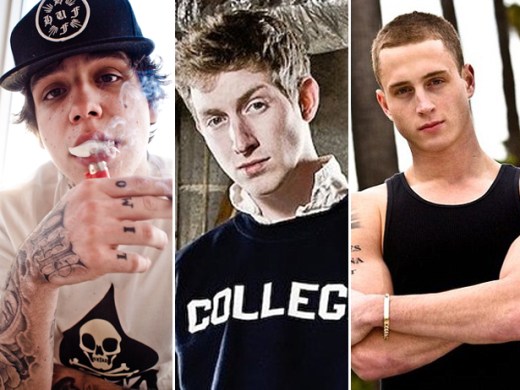
As the Princeton University professor Imani Perry has noted, “there is a sonic preference for blackness, the sounds of blackness, but there is a visual preference for whiteness in our culture.” It should come as no surprise, then, that white rappers are slowly beginning to dominate the college music scene with the ascendance of a genre that can loosely be called “frat rap.”
Be it the thumping bass of artists like Mac Miller and Mike Posner, or the blaring noise of Asher Roth, Sam Adams, or Hoodie Allen, the white rappers who are gaining a foothold in the college scene need to be seen as part of a longstanding tradition of white theft of black artistry. The popularity of those artists, alongside that of Ryan Lewis and Macklemore—who can be heard interrogating white privilege, marriage, and materialism in their music—cannot be understood outside their whiteness.
The frat-rap craze saw its origins in 2009, with the release of Asher Roth’s “I Love College.” This subgenre not only markets itself to white college students but also marries the aesthetics and sensibilities of hip-hop with the experiences and narratives of white, male college students. Rather than building on oppositional traditions of hip-hop, which the former frontman for Public Enemy, Chuck D, once identified as “CNN for black people,” frat rap rhymes about all things white and middle class: desires that begin and end with parties, drinking, girls, and fun.
The moniker of frat rap is powerful because it reflects a desired level of ownership. White-fraternity claims to the music and culture displace a long association of rap with blackness, urbanity, and the inner city. Instead, the music exists within the context of the university.
White Victimhood and the Media Erasure of Black Death by David J. Leonard
by David J. Leonard | NewBlackMan (in Exile)
Racism is racism. Extreme or mainstream, racism is racism. If it looks like white supremacy, talks like white supremacy and acts like white supremacy, it is white supremacy. What does it mean when the extreme and mainstream trumpet the same tune. What does it mean if white nationalist on Stormfront and Fox and friends similarly lament white victimhood? What does it mean when Skinheads and talk radio similarly rally the white community through fear of black criminals? This convergence and shared ethos has been crystal clear in the aftermath of the Zimmerman trial.
Over the last month, the Right\’s endless trolling about Chris Lane and Delbert Belton is yet another instance where facts are tossed aside for demonization and criminalization of black bodies. According to Jamelle Bouie, “If Rush Limbaugh, Glenn Beck, and Fox News sell anything, it’s white anger and racial resentment. And for them, Christopher Lane isn’t a person as much as he’s a product.” In fact, their response points to three core principles of the Right: (1) white resentment; (2) a sense of white victimhood; and (3) fear and criminalization of blackness. If a story or a reality doesn’t fulfill those prerequisites, they ain’t got time for it.
Either forgetting or ignoring fact that killing of Trayvon Martin did not make news for weeks, if not months, after his death, erasing the specifics of the case, the narrative about the media not covering “Black-on-White” crime with equal vigor as “White-on-Black Crime” is at its core about an imagined white victimhood.
If the Right and the mainstream media wants to have a conversation about media coverage and the impact of race, that is a conversation to be had, yet it will need to start with the muted media coverage of the killings of Darius Simmons, Bo Morrison, and Jordan Davis; what about the systemic failure to shine a spotlight about #every28hours.
Or how about the almost no coverage of the killing of Kollin Elderts and the trial of Christopher Deedy? It will need to account of the recent shooting of Donald Maisen Jr, who one minute was playing tag and another was lying on the ground in a pool of blood. No coverage from Fox and their Friends across the media; no condemnation from John Boehner, James Woods, or Rush Limbaugh
For such a conversation, it might be useful to look at the spectrum of research regarding not only the overrepresentation of news coverage of cases involving black perpetrators (or those alleged to have committed a crime) or the silence when involving victims of color. It might be helpful to not only look at media silence, but also the crickets from the criminal justice and from the populace as a whole when involving victims of color?
If the Right wants to talk double standards, lets talk about Rekia Boyd and Mark Carson; Anna Brown and Islan Nettles. WDD and the efforts to play up white resentment through a narrative of white victimhood is the true story, not media bias, not political correctness, or not the attack on white America.
Last night, 60 minutes aired a segment that focused on mental health and mass shootings, highlighting the consequences of systemic neglect of mental illness. Documenting the history of policy that has transformed America from a nation of asylums (those dehumanizing warehouses) into a prison nation that makes those with mental illness disappear all while creating entire populations of untreated mental illness, the segment offered an important intervention.
The criminalization of mental illness has led to mass incarceration and divestment in necessary treatment. The cost and consequences of these policies has been evident as it relates to mass shootings. It introduced the issue as follows:
The mass shooting at the Washington Navy Yard two weeks ago that resulted in the deaths of 13 people, including the gunman, was the 23rd such incident in the past seven years. It’s becoming harder and harder to ignore the fact that the majority of the people pulling the triggers have turned out to be severely mentally ill — not in control of their faculties — and not receiving treatment.
Although the segment neglected to reflect on how masculinity (and the reproduction of narrow definitions of masculinity) operates within this discussion, it raises important questions in terms of the criminalization of mental illness and the deadly consequences of American policies.
While the result of many decades of neglect, the segment documented the cost and consequences of the Reagan revolution and the “small government” mantra of the GOP. On the eve of a government shutdown, it should be a striking reminder of the deadly consequences of policy decisions and neglect.
While a very important topic, it also represented a missed opportunity to push the conversation to reflect on how mental health and the lack of available treatment options has consequences as it relates daily violence. Where is the conversation about mental illness as it relates to gun violence? Where is the discussion of PTSD as it relates to Chicago, Stockton, or New Orleans? Where is the conversation about the consequences and dangers of a criminal justice system that only fails to treats mental health issues, that ignores treatable illness, but actually creates a sick population (seemingly guaranteeing sizable prison populations). The entire segment seemed to imply that certain violence, that which is disproportionately carried out by white boys and men, is treatable; yet those instances of gang violence or “everyday gun violence” are unavoidable. No discussion about mental health as it relates to other types of violence, in communities where violence is imagined as inevitable and natural. We need to have a conversation about mental illness and violence, mental illness and guns in multiple contexts not just as it fits the dominant (white) definitions of innocence and guilt, safe and dangerous, treatable and criminal.
If solutions, interventions, and transformation were a true goal, we might begin to ask “why?” We might begin to look at issues of mental health in every instance of gun violence; we might begin to talk about PDST and trauma in EVERY CASE. We might look at a recent study from the Department of Health and Mental Hygiene (DOHMH), which concluded that 50 and 65 percent of male and female juveniles experienced traumatic brain injuries.
“This shows us that we have a real serious organic medical problem among the adolescents,” Dr. Homer Venters, assistant commissioner of the city’s Correctional Health Services, said at a Board of Corrections meeting in March. “We often end up giving someone a mental health diagnosis, who does not have a mental health problem, but rather TBI.” …. In 2008, the city Department of Health and Mental Hygiene, which runs Correctional Health Services, created a surveillance and tracking system for new injuries suffered by inmates at Rikers Island, including head injuries. But Venters recognized that head injuries sustained even before an individual is incarcerated could also impact his patients and affect their mental health and even their length of stay in jail. Two of the most significant manifestations of traumatic brain injuries are emotional dysregulation and impaired processing speed. “This means you can’t control your emotions and you can’t follow directions,” Venters told the corrections board. “These are two very serious complications for people who find themselves in jail.”
The high rate of TBI, which likely predates incarceration, surely needs to be part of the conversation about “crime.” It certainly needs to be part of the “why” or is that a question one only asks when violence occurs involving people we don’t expect to kill or for those we don’t see as “legible” (Neal 2013) threats. If only we asked the same questions, demanded the same answers of why, we might be able to move forward to actually address mass shootings and “street violence.” But that would require seeing humanity outside of our race-colored glasses.
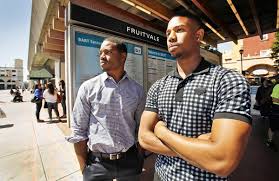
Walking out of the theater in West Los Angeles, I felt a lot of emotions. Even before Ryan Coogler’s Fruitvale Station started, I felt the film at a visceral level: I was sad, anxious, angry, and disheartened as I sat down. Emotionality is central to the film.
As brilliant as the film is at tapping into the emotionality of Oscar Grant’s killing, it is not simply a film of anguish or one that builds upon the outrage and sadness compelled by murders #every28hours. It is a work of art; a tapestry of images, narratives, and movements. It is a story of depth about a layered life put together through sight and sound, image and voice.
There is a lot to be said about the film at an intellectual, artistic, and cinematic level. For example, Coogler’s ability to “make Oakland a character” is crucial to the film; it is done with great precision and depth. The shots of street signs, the Bay, BART, and several Oakland landmarks are critical to the film’s situating of Grant’s life and death within a physical landscape. To understand Oscar Grant and to reflect on his death, requires an ability to see and hear, feel and understand, Oakland in post civil rights, post 9/11 America. His life and death is a story of Oakland; it is also a story of neighborhoods and communities across the nation.
With its use of the camera, from the close-ups of Tatiana scrubbing crabs to the various moments that brought Grant’s humanity to life, Fruitvale Station forces viewers to not only confront Grant’s death and his killing in 2009, but his life: his relationship with his girlfriend, Sophina (Melonie Diaz); his adoration for his mother Wanda Johnson (Octavia Spencer) and sister; his beautiful interactions with his daughter; and the many obstacles he faced in an unforgiving America. Wesley Morris offers an important assessment of the film when he writes:
Fruitvale Station speaks to that yawning discrepancy. What feels slight, shaggy, and ordinary about it is also rather remarkable. To present Grant this way — as a son who loves his mother, as a father who loves his daughter, as the sort of person who comforts a dying dog and pleads with a shop owner to permit a pregnant woman to use his restroom — is to remove the stigma. He’s a lower-middle-class kid who got mixed up with crime. But most of the narrative belongs to a charming, charismatic, devoted young man, someone striving to better himself. It’s not only that this Grant is a person. It’s that, to a fault, he’s made to be more than black male pathology.
Rahiel Tesfamariam similarly emphasizes the film’s cinematic and narrative success in humanizing Grant – in challenging the systemic flattening of black bodies. Fruitvale Station gives voice to Grant and the injustice evident in his death and in doing so challenges America’s racial landscape.
We also see this vulnerability play out in his dealings with the matriarchs in his family… These women are his anchors in life. Sophina keeps him honest, holds him accountable and brings out his sensual side. Through their relationship, we see his desire to be a protector and provider. His mother Wanda grounds him in prayer and nurtures him through wise words and good food. Her “tough love” approach often haunts him in his actions and decision-making. Then, there’s Grandma Bonnie who keeps him connected to tradition and the family history that proceeds him.
This backdrop is so important to the film, and to a larger landscape of anti-black racism; yet as I watched and cried, I found myself asking myself: does the persistence of segregation in Hollywood constrain the impact of such an important film? Does the nature of distribution limit the reach of films centering African American voices and experiences into “red state America”?
Given the ubiquity of the criminalized black body, and given the widespread practice of blaming Grant or Trayvon Martin for their own deaths, it is disheartening to know that those who continue to peddle and profit in/from anti-black racism will unlikely watch Fruitvale Station.
It is infuriating that those who blame inequality on “single mothers” and “children born out-of-wedlock” will never be forced to digest the beautiful relationship that Tatiana had with her father Oscar, who would be part of that 72% statistic cited without any thought over and over again.
The anger I felt is about the killing of Oscar Grant – and Trayvon Martin, Jordan Davis, Ayana Jones-Stanley, Rekia Boyd, Amadou Diallo; yet it was about a theater with only a handful of people; it is about knowledge of multiplexes across the country screening zombie movies and another about a snail rather than films that have the potential to transform a generation. It is about knowledge that Madea, the Help, or the Butler will more likely be screened than the stories of Oscar Grant or Ruby.
Frustration, sadness, and anger.
Almost 100 years after the release of D.W. Griffith’s Birth of a Nation, a film steeped in white supremacy and anti-black violence, Fruitvale Station brings a level of black humanity that has remain on the periphery of the Hollywood imagination for a century. Almost 100 years after the release of a film that celebrated the rise of the Klan as the necessary force to thwart black savagery, Fruitvale Station stepped into a cinematic and larger racial landscape to offer a powerful counter narrative to the anchors of contemporary racism. Yet, 100 years after Birth of a Nation was celebrated as “history written in lightening,” the prospect of Fruitvale Station receiving similar treatment feels to the right of impossible.
As with the struggle for justice itself, the actual hearing and seeing of Grant, Martin, Diallo, and so many others remains a distant possibility. As with the activists who have used their cell phones to document the specter of police violence and anti-black/brown racism, Coogler uses his camera to further force a nation to confront these realities. Fruitvale Station shines a spotlight on this empathy deficit and the denied humanity. And like the killing of Grant, this is the source of my frustration, sadness, and anger.
But be clear, Fruitvale Station is reality written in lightening; a piercing ray of truth telling that is painful. It is a disheartening, infuriating, and devastating reality; one that everyone should confront before another train arrives at Fruitvale Station.




 Dr. David J Leonard