NewBlackMan: Bigger Than Rush: The Violence of Language and Language of Violence

Bigger Than Rush: The Violence of Language and Language of Violence


Bigger Than Rush: The Violence of Language and Language of Violence


by David J. Leonard | NewBlackMan


Rush Limbaugh has once again demonstrated the entrenched misogyny of American culture.  Calling Sandra Fluke a “slut” and a “prostitute,” among other things, is telling of both his own ideological foundation as well as society’s.  Unfortunately, the conversation and public outrage has often drifted away from the broader issues of violence, sexism, and misogyny, away from the broader attack on girls and women, instead focusing on “politics,” on removing Rush from the airwaves, on sponsors, and myriad other issues.  Increasingly, as Rush’s defenders cite double standards, whether in the form of societal acceptance of sexism within hip-hop or from liberal commentators, the debate is moving away from the issues of violence.  In focusing on only Rush (he is reprehensible), the politics, and in debating claims about hypocrisy, we are failing to see Rush and his comments as a symptom thereby obscuring the consequences of this language and its place within the broader war against young girls and women. 


Rush Limbaugh once again illustrated the reasons we need to “occupy” the airwaves.  As I wrote last month about Fox News and the soiling of already violent public discourse, the ubiquity of racism, sexism, homophobia, and xenophobia within the public square represents a major threat:


Racism, homophobia, immigrant bashing, misogyny and a general tone of violent rhetoric is almost commonplace at Fox.  Their motto of “Fair and Balance” seems apt at this point where they are fairly balance with comments of racism, sexism, homophobia, and xenophobia.  The saturation has produced an almost normalizing effect whereupon progressives and society at large don’t even notice at this point, simply dismissing as Fox being Fox.  Yet, the consequence, the pollution of the public discourse, the assault on the epistemology of truth, and an overall souring of the public airwaves with daily morsels of disgusting, vile, and reprehensible rhetoric, illustrates that “Fox being Fox” poses a serious threat to Democracy, not too mention justice and equality. 


Limbaugh’s recent comments are yet another example of “Rush being Rush” and the level of violence that “occupies” America’s airwaves.   The demonization of women, the criminalization of blacks and Latinos, and the overall climate of racial/gender pathologizing are as commonplace as the scapegoating of hip-hop within today’s media.  This is evident in the language of everyday life.   Violent rhetoric has consequences evident in ubiquity of sexual violence, racial profiling, and job and housing discrimination.  They matter not only because the words themselves are violent, but also because they provide a window into a larger structural reality; words matter because they hurt and because the sources of meaning, the history embedded in our language, and our sense of imagination all emanate from this place. 


In a recent Daily Beast column, Kirsten Powers, citing examples of misogyny from the likes of Bill Maher, Keith Olbermann and Chris Matthews, among others (not surprisingly as a Fox contributor she doesn’t cite any examples from her employer despite the following examples), argues that, “It’s time for some equal-opportunity accountability. Without it, the fight against media misogyny will continue to be perceived as a proxy war for the Democratic Party, not a fight for fair treatment of women in the public square.”


While not buying the narrative that seeks to directly or indirectly excuse Rush’s comments by noting the sexism of the “left” as evidence of both a double standard and a selective denunciation of sexism from the right (see here for example and here and here and here and here and here), any effort to transform public discourse must account for all forms of violence and the ways that racism, sexism, homophobia, and xenophobia pollute and define media culture.  Rush’s comments are not an isolated incident (for him or talk radio) given his consistent demonization of Michelle Obama (#1, #2).  Yet, Rush’s comments must also be understood in relationship to the disgusting comments from Michael Moore (among others), who responded to Limbaugh with the following tweets:


I guess Romney knew that Rush, who made the mistake of saying what most Republicans think (women as sluts), had cost him the Nov. election.


Or after losing 6 sponsors yesterday Rush decided he loved $ more than he loved calling women prostitutes. Musta been a tough call, eh Rush?


Some sponsors don’t care how much Limbaugh apologizes: mmflint.me/Awf562 (I know – what were they doing there in the 1st place?)


RT @pattonoswalt Ayn Rand would be very pleased with how the free market bitch-slapped Limbaugh today.


Dear Rush: Please don’t stop! You say what the R candidates don’t. Voters must hear every day til Nov what Republicans truly think of women.


Don’t give up, Rush! It’ s a WAR ON WOMEN & you’re the Supreme Leader. Keep reminding voters how hate & violence drives the Republican agenda


Rush – As soon as u started losing the big $$ from your hate speech, you caved & obeyed the men who pay u. Who’s the prostitute now, bitch?


And BTW Rush, your vile & vicious attacks on me over the years – I wear them as a badge of honor. You are sad & sick & I’ve always pitied u.


The use of “bitch,” “bitch-slapped” and prostitute here, just as the sexualization of women from the likes of Bill Maher, is not a cover for the likes of Limbaugh.  Sure, the ideological underpinnings and the larger visions of society are different, but that doesn’t sanction the language nor does it limit the consequences.  Limbaugh’s comment read inside of a larger context points to the necessity of not simply removing Rush Limbaugh from the airwaves but transforming a society that needs and props up the Rushes in our mix. 

Continue reading @ NewBlackMan: Bigger Than Rush: The Violence of Language and Language of Violence.

[OPINION] Trayvon, Sports and Me – News & Views – EBONY

Trayvon, Sports and Me

David J. Leonard

I grew up in segregated Los Angeles. While often celebrated for its diversity, L.A. is community. Divided by freeways, inequalities, and policing, the Los Angeles I remember was defined by its segregation. For middle-class white kids such as myself I was in constant ignorance about the persistence of inequality and my own White privilege. I never thought a second about leaving my house to buy a bag of Skittles; I never contemplated how others – teachers, employers, and even the police – might interpret my saggin’ pants or my hoodie; I did not even give a second thought when I showed up to play basketball at my local park with my hair in braids. The ignorance of privilege and the power of Whiteness defined my youth. Yet, the privileges of Whiteness gifted me each and every day. I was able to move throughout the city without fear from driving while White, and without fear of being suspicious, because in America “the assumption is that the natural state of Black men is armed and dangerous.”

It took leaving Los Angeles for the Pacific Northwest to truly understand the nature of American racism. In the 20 weeks that I attended the University of Oregon, notions of colorblindedness and equality shattered before my eyes. Walks to the store, to dinner, or to class with African American friends often found us followed by the police, stared at by others. It was a lesson in the ways that Blackness equals suspicion whereas Whiteness protected me from prejudgments. Racism wasn’t just the daily assault on my Black friends, but the unearned privileges I was granted each day.

Looking back, these experiences taught me not just about racial profiling and “Walking While Black”, but the many contradictions that exist in an integrated country that never came to terms with its racism. Several of my friends on campus at the time were student-athletes (another issue, of course: the disproportionate number of Black students in the athletics program versus the few who were present at the school otherwise); these young men and women regularly experienced praise and adoration while on the court. Celebrated as heroes, cheered as superstars, and anointed as celebrities, they were desired, wanted, and cherished… as commodities. Yet, while walking the streets, while eating at restaurants, while in class, and while attending various parties, the desirability was replaced by suspicion, contempt, and surveillance.

The murder of Trayvon Martin speaks to this country’s fear of Black people, particularly males. It also reflects the country’s contradictory concept of Blackness. The fact that Trayvon ventured out during the halftime of the NBA All-Star game (taking place in Orlando as well) only to lose his life at the hands of George Zimmerman highlights the valuing of Blackness inside the arena and the devaluing of Black life elsewhere. As fans cheered Kobe, CP3, and King James, Trayvon lied in a pool of blood. Having seen pictures of Trayvon in his football uniform and read about his love of sports, his murder taking place during this grand celebration of Black athleticism speaks volumes. Like DJ Henry and Robert Tolan, both of whom were shot (Henry died) by the police, Marcus Dixon, Mychel Bell, and Genarlow Wilson, all of whom despite athletic prowess endured the grips of a Jim Crow justice system, the status as athlete, star or otherwise, did not protect Trayvon Martin.

The murder of Trayvon Martin speaks to this country’s fear of Black people, particularly males.

Even as millions of fans announce their love for Kobe and LeBron, even as tens of millions voted for Barack Obama, even as a growing Black middle-class has made inroads throughout society, the likes of Trayvon Martin, Oscar Grant, Sean Bell, and countless others remind us about the dangers of living while Black in America even in 2012. Essex Hemphill, in his brilliant poem “American Hero” describes a world where Black men can simultaneously be celebrated for dunking a basketball during a globally televised game while just miles a way a young Black male is dying at the hands of American racism:

Squinting, I aim at the hole fifty feet away. I let the tension go. Shoot for the net. Choke it. I never hear the ball slap the backboard. I slam it through the net. The crowd goes wild for our win. I scored thirty-two points this game and they love me for it. Everyone hollering is a friend tonight. But there are towns, certain neighborhoods where I’d be hard pressed to hear them cheer if I move on the block.

via [OPINION] Trayvon, Sports and Me – News & Views – EBONY.

NewBlackMan: In Conversation with History: Speaking Back to Trayvon

In Conversation with History: Speaking Back to Trayvon

by David J. Leonard | NewBlackMan

In wake of the murder of Trayvon Martin, in the face of anger, sadness, frustration, outrage, sadness, and more anger, I found myself returning to several quotes that reflect on racism, violence, injustice, and resistance. I found myself wanting to dialogue with these thinkers, these organic intellectuals, and those who continue to promote “freedom dreams.” This is my conversation within an experimental dialogue that emphasizes the continuity of violence and resistance throughout our history.

Sojourner Truth: “That man over there says that women need to be helped into carriages, and lifted over ditches, and to have the best place everywhere. Nobody ever helps me into carriages, or over mud puddles, or gives me any best place! And ain’t I a woman?”

DJL: Why does this continue to be so true for women, for people of color, for the poor? The parent over there sends their child out to play, without a worry; the child over can go to the park, walk to school, or go to the store, without any fears. Innocence is protected. Nobody can say that for Trayvon Martin; ain’t he a person; ain’t a child?

Frederick Douglas: “Where justice is denied, where poverty is enforced, where ignorance prevails, and where any one class is made to feel that society is an organized conspiracy to oppress, rob and degrade them.”

DJL: Mr. Douglas, your words remain true today. Where Trayvon’s was deprived of his humanity, where his rights were ignored, where his future was denied “neither persons nor property will be safe.”

Kahil Gibran: “Learnt silence from the talkative, toleration from the intolerant, and kindness from the unkind; yet, I am ungrateful to these teachers.”

DJL: Yes, in just three weeks, we have seen injustice from those responsible for justice, terror from those who claim to protect, and erasure from those responsible for education and informing the collective. We have once again seen the stains and violence of American racism. Yet, we have seen the apathy and ignorance concerning these painful realities.

Shirley Chisholm: “Most Americans have never seen the ignorance, degradation, hunger, sickness, and futility in which many other Americans live. Until a problem reaches their doorsteps, they’re not going to understand. . . Racism is so universal in this country, so widespread and deep-seated, that it is invisible because it is so normal.”

DJL: Ms. Chisholm, we are still seeing this today. When black and suspicious becomes normalized, racism is invisible; when the murder of black youth is not breaking news “it invisible because it is so normal.” When black death goes unnoticed it has become normal and acceptable. Only when fathers and mothers, grandmothers and grandfathers, brothers and sisters, and sons and daughters begin to contemplate “what if,” what if my family or friends couldn’t go to the store without fear, without threat, without potential death will we see change.

Albert Camus: “In such a world of conflict, a world of victims and executioners, it is the job of thinking people, not to be on the side of the executioners.”

DJL: Why do people continue to side with the executioners? But not in every case? It must stop. In a world where black youth can’t walk to the store to buy skittles and something to drink, where black youth are deemed suspicious for walking while black, in “a world of victims and executioners, it is the job of thinking people, not to be on the side of the executioners.” It is the job of thinking people not to silence the critics, the fighters of freedom.

Continue reading @ NewBlackMan: In Conversation with History: Speaking Back to Trayvon.

The White Coach’s Burden | Racialicious – the intersection of race and pop culture

The White Coach’s Burden

By Guest Contributor Dr. David J. Leonard

During my “glory days” playing high school football–among other positions I played linebacker–there was a game where, after several tackles (pretty amazing tackles if I remember them correctly), I found myself rolling on the ground in pain. Their running back decided to thrust his helmet into my gut leaving me gasping for air. I would later find out that the opposing coach encouraged his players to “take me out”: a helmet to the gut would do that for at least one play.

The fact that a nobody player in a nothing high-school football game between two tiny private schools in Los Angeles was “taken out” illustrates how encouraged violence is part and parcel to football culture, even if there were no “‘knockouts’…worth $1,500 and ‘cart-offs’ $1,000, with payments doubled or tripled for the playoffs,” rewards uncovered as part of the New Orleans Saints’ “bounty program” last week.

Yet, the NFL, much of the media, and others have acted as if the Saints’ actions are an aberration that can be easily corrected. As such, the league’s response was predictably clichéd:

The [anti-] bounty rule promotes two key elements of NFL football: player safety and competitive integrity. It is our responsibility to protect player safety and the integrity of our game, and this type of conduct will not be tolerated. We have made significant progress in changing the culture with respect to player safety and we are not going to relent. We have more work to do and we will do it.

The NFL wasn’t alone with its shock and outrage (and hypocrisy). The Los Angeles Times’ Bill Plaschke referred to the bounty system as “sanctioned evil” that in one game constituted a “blatant mugging by the New Orleans Saints.” Eamon Quinn described bounties as antithetical to the values of sports: “Such malicious intent—regardless of whether the particular hit was legal by the letter of the law—totally undermines the camaraderie and goodwill inherent in participation in sports. It is diametrically opposed to the inherently benevolent nature of sporting competition.” Similarly, ESPN’s Gregg Easterbrook identified the bounty issue as “Sinnersgate” which “is about being paid to cause injury, which takes a beautiful sport and makes it a low, filthy thing.”

Dave Zirin rightfully highlights the hypocrisy in the league’s resisting calls for reform while marketing itself on the “Orwellian staple” of comparing NFL players to warriors:

There is no morality in war — but that doesn’t stop our political and military leaders from insisting otherwise. Invariably, the enemy consists of immoral, medieval cave dwellers who respect neither human life nor the sacred rules of combat. Our side, on the other hand, engages in “surgical strikes” to limit “collateral damage” in a noble effort to liberate the shackled from tyranny. They tell us to ignore the innocent killed in drone attacks, the piling body counts, and just remember that our enemies are savages because they don’t play by civilized rules.

The moral indignity of the media is striking given its own promotion of on-the-field violence. The proliferation of a highlight culture dominated by jarring hits is as much a bounty as any direct or indirect payment system.


An ESPN culture that leads with bone-crushing, de-cleating tackles, turning relatively obscure defensive players into household names, illustrates the role of the media in offering incentive for viciousness on the field. The hypocrisy and faux-outrage from the media as well as fans, given the widespread acceptance of a culture of violence, seems more about disappointment the behavior of any coaches involved; bounty gate isn’t a challenge to perception of football and the NFL, but the league’s patriarchs – the coaches.

Continue reading @ The White Coach’s Burden | Racialicious – the intersection of race and pop culture.

Andrew Luck and Racial Assumptions: Are Stereotypes a Part of the Game? | Urban Cusp

Andrew Luck and Racial Assumptions:

Are Stereotypes a Part of the Game?

By David J. Leonard

By now you are probably sick of reading and talking about Jeremy Lin. Thankfully, with Linsanity calming down, the conversation has turned back to the court, a shame given his own struggles and those of the Knicks in recent weeks.

Yet, at the same time, I find myself disappointed and frustrated by the missed opportunities within the media avalanche. Amid the endless articles about Lin, many reflected on the ways in which race and stereotypes about Asians limited the ability of scouts to recognize Lin’s talent. Stereotypes not only about the lack of athletic ability of Asians as well as the stereotypes about African American success within basketball impacted the difficult roads traveled by Lin.

“Lin was almost certainly underestimated, or misevaluated, because as an Asian American he does not look the way scouts and general managers expect an NBA player to look,” wrote Touré. “If he’d walked into the gym and wowed everyone right away he would’ve stood out, but when he didn’t, it confirmed the societal script that does not expect Asian Americans to be pro-level basketball players. That’s the prejudice Lin had to fight through.” This sentiment was commonplace throughout the public discussion, revealing a willingness to acknowledge that race does matter, that racism exists as an obstacle, and that stereotypes impact the ways that people interact on a daily basis.

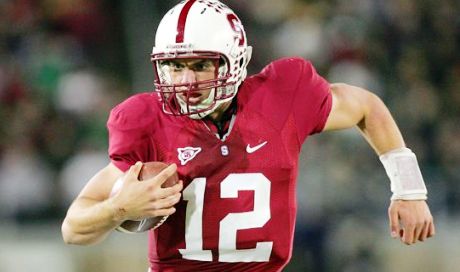
Similar conversations about stereotypes and obstacles faced by athletes because of racial assumptions have followed the NFL Scouting Combine. The likely two-top picks, Andrew Luck (Stanford) and Robert Griffin III (Baylor), have been at the center of these conversations. Luck, a white quarterback, has shocked scouts because of his surprising speed, whereas Griffin has been praised with a level of surprise for his intellect and his field vision (still despite his precision in passing some scouts have lamented his propensity of “mental mistakes”).

With both men, stereotypes have guided the conversation, either through the replication and recycling of longstanding ideas associated with white and black athletes, or with a shock and awe over their not fitting into these boxes. For example, in “Andrew Luck is pretty fast, too,” Michael David Smith highlights how racial stereotypes associated with speed and quickness that leads black quarterbacks to be labeled as scramblers and white quarterback as pocket passers, has led to surprise about Luck, even though his 40 time matched that of Cam Newton:

Luck turned in an excellent 40-yard dash time today of 4.59 seconds at the NFL Scouting Combine, the third-fastest among quarterbacks this year behind only Baylor’s Robert Griffin III and Wisconsin’s Russell Wilson.

No one runs like Griffin, but Luck is faster than the vast majority of NFL quarterbacks. To put Luck’s time in perspective, it’s exactly the same as the time turned in by Cam Newton at last year’s Combine.

In “Do Racial Stereotypes Dictate NFL Success,” kgans laments the ways in which race impacts personnel decisions and the NFL product:

Racial stereotypes in draft evaluations are something you can see all the time, and it’s not only for the quarterback position. All the time you have draft evaluations describing white defensive ends as “high-energy guys, with great motors.” Or a black linebacker described as being “freakishly athletic with sideline-to-sideline speed.” These racial stereotypes are ignorant and they hurt the integrity of the game.

Just recently, Jeremy Lin, an Asian-American point guard has taken the NBA by storm. On http://www.draftexpress.com, the website described Lin as being “deceptively quick and assertive off the dribble.” Deceptively quick, what does that mean? Is he deceptively quick because you didn’t expect him to be quick since he is Asian?

Kgans makes clear that racial stereotypes are not only restricting the opportunities afforded to athletes but at the same time undermining the quality of the game. Because of racial stereotypes, players are not judged by the content of their crossover, or the precision of their passing, but the color of their skin. “I think racial stereotypes in draft evaluations could have something to do with this. If we could all be more “colorblind” in our talent evaluations we might be able to increase the amount of black quarterbacks in the NFL,” writes Gans. “And believe me, after NFL GM’s have seen what Linsanity has done for the Knicks no one wants to miss out on the NFL’s version of Jeremy Lin. Being more ‘colorblind’ in talent evaluations will help make sure that doesn’t happen.”

via Andrew Luck and Racial Assumptions: Are Stereotypes a Part of the Game? | Urban Cusp.

GONE TOO SOON: Infant Mortality – Wellness & Empowerment – EBONY

GONE TOO SOON: Infant Mortality

By David Leonard Writer

The text message I received this morning should have brought a smile to my face. My younger sister let me know that doctors would be inducing her this evening. With her first child set to join the world, I found myself overcome with fear and anxiety. Five years ago, my second child Sophie was born. Some 12 hours later, she would succumb to an infection, dying right in front of her mother and I. In an instant, we had lost our child.

My sister’s message immediately took me back to that day, thinking about the past while scared about the future (I have previously written about this). My thoughts are not a simple manifestation of association or my yearning to be a protector for my younger sister, but genuine fear because that day is still with me.

Every detail of that day still sits with me: getting dropped off at the hospital; how sick my wife looked when I entered the room; the sights and sounds when Sophie entered the world. More vivid and painful are the memories of where I was sitting when she went into cardiac arrest, the clothes I was wearing, the hospital smell, and the sounds of “code blue.” To this day, I still cannot see a helicopter without thinking about the 60+ mile trip I took in the dark, so close to my dying daughter yet unable to help or hold her. Today I think about my parents sitting in the waiting room anticipating the arrival of my nephew just as I sat in the waiting room – waiting for things to turn around, waiting for my wife to arrive, waiting for the pain to stop; waiting . . . waiting, only to see her die in front of us.

My fear and anxiety are not simply an outcome of our own experience but the bubble that burst when our daughter passed away. For every 1,000 live births, 4.5 babies die in the United States. The U.S. accounts for the second largest amount of neonatal deaths (that includes child deaths within the first 27 days of life) in the industrialized world. Compared to other countries around the world, the United States ranks with Croatia, United Arab Emirates, and Qatar, and lags behind Cuba, Slovakia, all of Western Europe and Scandinavia. The situation is even worse when as we look at racial inequality, especially as we look at the first year of life. African American children are 2.5 times more likely to die before their first birthday than White ones.

Infant mortality is even more devastating in the developing world. Each year, three million babies die in the first week of life, with an additional one million dying by their 27th day. Four million babies do not live past their 28th day of life, mostly from preventable diseases and malnutrition. A recent study found that babies under the age of 1 month account for 41% of all child death, with over half of those deaths occurring in five countries: Pakistan, Nigeria, China, Congo, and India, where more than 900,000 babies die each year. In Afghanistan, 1 out in every 19 babies born die shortly after they enter the world. Every minute, 7 newborn babies die, even though a vast majority of them could be saved. Where are the YouTube revolutionaries to eradicate this malady?

Babies are not the only ones in danger; in the United States, 400 women die each year while giving birth.There are no words for pain, despair, and sense of injustice I feel when I think of the millions of women across the world who have passed away as they were set to bring forth life. And I know that I am tremendously blessed knowing that my partner, who spent a week in the hospital following the birth of Sophie, survived. This cannot be said for women throughout the world. Amnesty International reports that one woman dies every 90 seconds during pregnancy or while giving birth. A total of 350,000 women die each year. With 80 percent of those deaths occurring in only 21 nations, 15 of which are located in sub-Saharan Africa, the consequences of poverty, colonization, and a lack of global commitment to this issue are clear.

Continue reading @ GONE TOO SOON: Infant Mortality – Wellness & Empowerment – EBONY.

SLAM ONLINE | » Ballers, Political Shot Callers and the ‘Show Your Papers’ Movement

Ballers, Political Shot Callers and the ‘Show Your Papers’ Movement

An outbreak of racist taunts continues to be a problem at NCAA basketball games.

by C. Richard King and David J. Leonard

The past month has witnessed a series of racist cheers at sporting events. Fans at a University of Minnesota at Duluth mocked the visiting University of North Dakota hockey team, jeering “Small Pox Blankets”—a chant that belittles the school and Native Americans through a reference to its mascot, which converts the reality of genocide into a sporting smack down. In Pittsburgh, during a recent basketball game, fans (as well as players) from Brentwood High hurled racial epithets at Monessen High players. Three fans dressed banana costumes surrounding the primarily black Monessen team, as the left for the locker at halftime, yelling epithets while making monkey noises. Some parents reported that members of the Brentwood squad joined in, calling its opponent, “monkeys and cotton pickers.”

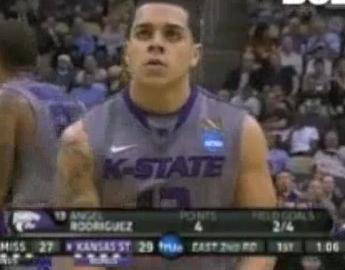
More recently, students at the predominantly white Alamo Heights High School celebrated the defeat of the largely Latino Edison High School with a chant of “USA, USA!” So, it was little surprise in the round of 64, members of the pep band from the University of Southern Mississippi (USM) yelled, “Where’s your green card?” at Kansas State University freshman Angel Rodriguez (who was born in Puerto Rico) as he took foul shoots.

Administrators were quick to apologize following each transgression, offering some variant on the standard refrain: we regret any offense…this is not us…we are not racist…we will take appropriate action. And to be fair, these chants are brief, spontaneous, and passing utterances. They lack sanction and surely do not represent the image that these schools hope to project. Their apologies to the contrary, in an historic moment marked by the rhetoric of color blindness, but not the alleviation of structural racism, the eruption of overt bias, particularly in the guise of clichéd hate speech and “jokes,” far from being abnormal actually reveals the norm, offering keen insights into historically white institutions and the persistence of white supremacy.

While taunting a fellow American citizen by inquiring about his green card exposes great ignorance (Puerto Ricans are US citizens and have been since 1917) and reflects deep antipathy toward Latinos, it is actually in keeping with the history of the University of Southern Mississippi (and countless other colleges and other universities). In fact, USM epitomizes the arc of white supremacy in college sport. Founded in 1910 as an institution devoted to training teachers, USM was like most peers in the South segregated. And like many other public spaces in the USA, students at USM were enamored with Indianness, despite (or perhaps because of) the historic removal of embodied Indians to make way for settler society in southern Mississippi. They choose Neka Camon, “a Native American term meaning ‘The New Spirit’,” as the title for the school’s yearbook. Later, the student body opted to formalize the moniker of the sport teams, selecting the Confederates in 1940. A year later, a slight modification, the Southerners, was substituted. Although in light of the better known history of Ole Miss, this is not surprising, the mascot chosen for athletics a decade later is: USM did not name an anonymous rebel or plantation owner; no, it enshrined Natan Bedford Forest, the infamous leader of the Ku Klux Klan, as its mascot. Desegregated in 1965, USM changed its moniker and mascot to the Golden Eagles in 1972. USM is a quintessential institution of higher learning: historically white, segregated, playing Indian, and celebrating the Confederacy in defiance of the civil rights movement.

The jeer from members of the pep squad (or band) also suggests that USM remains typical, and, despite protestations from administrators, that what is chanted at a basketball game says much about the social landscape of Mississippi today and much about all of us today.

The students chanting, “where’s your green card” were not alone this day, with the state’s politicians legislatively demanding the same of Latinos throughout the state of Mississippi. The state’s House of Representatives passed the “Support Our Law Enforcement and Safe Neighborhood Act,” a copycat bill to Arizona’s anti-immigrant legislation. Among other things, the bill mandates the police verify immigration status for any person arrested

continue reading @ SLAM ONLINE | » Ballers, Political Shot Callers and the ‘Show Your Papers’ Movement.