NO WAY OUT: Mother Jailed for ‘Stealing’ Child’s Education – News & Views – EBONY

NO WAY OUT:

Mother Jailed for ‘Stealing’ Child’s Education

The Tanya McDowell case is (yet another) heartbreaking example of the country’s failure to educate its youth

By David Leonard Writer

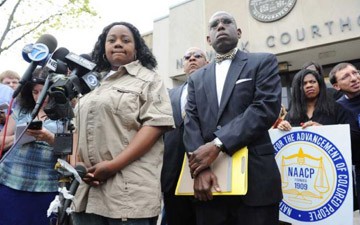
Tanya McDowell has joined the ranks of millions of people, mostly of color, facing incarceration. In April 2011, McDowell was arrested and charged with larceny for allegedly enrolling her 6-year old child in a Norwalk, Connecticut elementary school instead of the required Bridgeport school associated with her “residence” (she was reportedly homeless at the time).

Less than a year later, McDowell entered an Alford Plea, which is not an admission of guilt but rather an acceptance that the state has sufficient evidence to make its case. In exchange for her plea as well as a guilty plea stemming from a drug case, the court sentenced McDowell to 12 years in prison with the possibility of release after 5 years.

The media response has emphasized how her sentence reflects punishment for her “stealing of an education,” worth over 15,000 dollars as well as a consequence of the narcotics arrest. Subsequent to her arrest for educational larceny, McDowell allegedly sold drugs to an undercover officer on three separate occasions. While the timing of this arrest was questionable (her attorney at the time described the investigation that led to the drug charges as “‘retaliatory’ because the community was embarrassed by McDowell’s April 14 arrest for allegedly sending her son, A.J., to Norwalk’s Brookside Elementary School while they lived in Bridgeport), the efforts to paint her as a bad parent, as a criminal, as an unredeemable person is further revealing. Upon her arrest, Norwalk Mayor Richard Moccia scoffed at those who represented McDowell as a victim: “This is not a poor, picked-upon homeless person. This is an ex-con, and somehow the city of Norwalk is made into the ogre,” he noted. “She has a checkered past at best … This woman is not a victim.”

Her subsequent arrest has been used to further substantiate these claims, justifying the initial charges and the subsequent sentence of 12 years. The conflating of these cases (beyond their simultaneously adjudication) points to the ways that the drug case has obscured the horrible injustice of the wrongful enrollment arrest. It would be a mistake and a further miscarriage of justice to excuse the criminalization of her decision to enroll her child at a school that provided better services, a better education, and a better future for her child by referencing her drug arrest.

She was forced to choose between terrible schools and violating the law so that her child could receive a quality education. Fordham University professor Mark Naison says “If there were enough good schools around so that any school you chose would be acceptable, and if there were enough decent paying jobs to keep your head above water through legal work, that would be one thing. But what if NEITHER of those things were true. What are you supposed to do? Let your child go hungry to a terrible school.” Even so, she became the first person in the history of Connecticut to be prosecuted for enrolling a child out-of-district, even though experts claim it to be a common practice.

She was forced to choose between terrible schools and violating the law so that her child could receive a quality education.

McDowell isn’t the first Black woman to face criminal prosecution and jail for enrolling her children out-of district. In Akron, Kelley Williams-Bolar was charged and served 10 days in jail for enrolling her two daughters at a Copley Fairlawn school even though they should have attended an Akron school. Her decision was easy to understand given that Copley-Fairlawn School District met 26 out 26 standards set up the Ohio Department of Education, whereas Akron City School District met only 4 of these same standards. Graduation rates were equally disparate with almost 98% of students graduating from Copley-Fairlawn compared to 75% within Akron City. Williams-Bolar, like McDowell, sought to challenge the inequity and segregation that defines America’s school system, and thus faced the sanctions and condemnation from a system that mandated that she stay in her place.

McDowell’s incarceration on drug charges reflects a willingness to wage the war on drugs with the greatest force and consequence against communities of color. According to the Drug Policy Alliance, Latinas are 1.6 times and Black women are 3.8 more times more likely to be sent to prison than White women despite similar rates of usage and distribution. McDowell is indicative of the consequences of a racialized war on drugs. It reflects the pipeline from failed schools to prisons; it reflects an effort to incarcerate those who challenge this process.

Yet, the attempts, whether from the criminal justice system, the media, or the broader community to justify her criminalization and ultimate incarceration by linking the drug charges with the larceny charges is both troubling and without basis. The state prosecuted her before any drug charges so the injustice of her arrest cannot take cover from a subsequent arrest.

Continue reading @ NO WAY OUT: Mother Jailed for ‘Stealing’ Child’s Education – News & Views – EBONY.


NewBlackMan: ‘Affirmative Action,’ ‘Black’ GPAs and the Discourse(s) of Black Intellectual Inferiority

‘Affirmative Action,’ ‘Black’ GPAs and the Discourse(s) of Black Intellectual Inferiority

by David J. Leonard | NewBlackMan

The racial culture wars (i.e. the demonization of black students) are once again raging on college campuses. A recent study authored by Peter Arcidiacono, Ken Spenner, and Esteban M. Aucejo concludes that African American students are less qualified and academically prepared to succeed at Duke University. “What Happens After Enrollment? An Analysis of the Time Path of Racial Differences in GPA and Major Choice” cites evidence of African Americans switching from science (STEM) majors to easier liberal arts majors as evidence for a lack of preparation.

According to a group of Duke Alumni, “The study opens with a bold statement that affirmative action admissions in higher education allow for the college admission of minority students who have ‘weak’ preparation for college-level work. This implies that students of color are not as intelligent or prepared as their white counterparts.” The study is thus not simply an assault on affirmative action and the struggle for diversity on college campuses, but an effort to reassert notions of white superiority. “What many people of color discovered upon entering those previously closed corridors was not white superiority but, for the most part, white mediocrity. Now, to preserve such a system, what is often brought up is the mediocrity of blacks and other groups of color who enter,” writes Lewis Gordon. “What is not brought up, however, is the group of blacks and brown people who were excluded on the basis of their excellence. The prevailing view in predominantly white institutions about such candidates is fear of whether such candidates are ‘controllable.’” Leaving readers with the conclusion that blacks are not controllable (and thus not desirable), the study has dangerous implications.

In relying on and working from a series of stereotypes and accepted narratives, the study fails to answer a number of questions that points to both its deficiencies and its danger:

How does the study define blackness; does it differentiate between first generation African immigrants or students whose family have been in the United States? Does it account for class differences? In talking about SAT courses, and preparation, how does it account for educational inequalities, such as differential resources, access to SAT preparation courses, and the availability of advanced placement courses and countless other examples that point to the ways in which racism produce an uneven playing field?

How does the study account for extracurricular activities, demands of work, student involvement, and engagement with the community? Are there differences between different disciplines? How does it account for the ways that the demands of life, and the potential involvement of students as organizers, community leaders, athletes, artists, and active citizens differs between the sciences and the liberal arts, and the potential impact on grades? How does it explain high rate of entry for black students in STEM majors and how does it account for high exit rates?

In failing to actually talk with students and learn from their experiences, in an effort to understand how the institutions and higher education is potentially failing, the authors instead explain once again put the onus back on black students. Offering a narrative that focuses on “qualifications,” “work ethic,” educational unpreparedness, the authors not only deploy a dominant white racial frame that consistently images whites as superior and deserving, and blacks as inferior and therefore undeserving, but erases the meaningful ways that racism and white privilege operate in contemporary society

The study works from a premise that sciences are harder, demand more study time, and are more demanding; the evidence provided for each of these claims is lower grades amongst students despite greater academic preparation. The authors argue at great lengths – “and perhaps related to the differences in grading practices, students are working harder in natural science and economics classes and perceive these classes to be more challenging than classes in the humanities and social sciences”—that African American students are fleeing from harder classes and majors because they cannot handle them. Without any evidence, such claims should give pause on a number of levels. The assumptions here are extensive as the authors provide little evidence that these classes are harder or more demanding; the authors merely recycle the assumptions that Schwarz Reflection Principle and Heisenberg Uncertainty Principle are far more challenging to students than understanding the use of metaphors by Shakespeare and Ellison, analyzing Ferdinand de Saussure’s idea of signifier and signified within The Matrix, or applying the theories of Karl Marx, Max Weber and Walter Rodney to globalization.

Continue reading @ NewBlackMan: ‘Affirmative Action,’ ‘Black’ GPAs and the Discourse(s) of Black Intellectual Inferiority.

NewBlackMan: Politics as Usual: Decoding the Attacks on a Liberal Education

Politics as Usual: Decoding the Attacks on a Liberal Education

by David J. Leonard, Mark Anthony Neal and James Braxton Peterson | NewBlackMan

Few university courses generate much attention from mainstream media, but Georgetown Professor Michael Eric Dyson’s course “The Sociology of Hip-Hop: Urban Theodicy of Jay-Z” has drawn national attention from NBC’s Today Show, The Washington Post, The Associated Press, USA Today, and Forbes.com among many others. To be sure such attention is not unusual for Dyson, who is one of the most visible academics in the United States and has offered courses dealing with hip-hop culture, sociology, and Black religious and vernacular expression for more than twenty-years. Yet, such attention seems odd; hundreds of university courses containing a significant amount of content related to Hip-hop culture and Black youth are taught every year—and have been so, for more than a decade. In addition, there are dozens of scholarly studies of Hip-hop published each year—Julius Bailey’s edited volume Jay-Z: Essays of Hip-Hop’s Philosopher King, among those published just this year—and two Ivy League universities, Harvard and Cornell, boast scholarly archives devoted to the subject of Hip-Hop.

Any course focused on a figure like Jay-Z (Shawn Corey Carter), given his contemporary Horatio Alger narrative, and his reputation as an urban tastemaker, was bound to generate considerable attention, but the nature of the attention that Dyson’s class has received and some of the attendant criticism, suggest that much more is at play.

In early November, The Washington Post offered some of the first national coverage of the class, largely to coincide with the arrival of Jay-Z and Kanye West’s Watch the Throne tour to Washington DC’s Verizon Center. Jay-Z dutifully complied with the attention by giving Professor Dyson a shout-out from the stage. The largely favorable article about the class, did make note, as have many subsequent stories, about the cost of tuition at Georgetown; as if somehow the cost of that tuition is devalued by kids taking classes about hip-hop culture.

Other profiles of the course and Dyson have gone out of their way to make the point that the course had mid-term and final exams, as if that wouldn’t be standard procedure for any nationally recognized senior scholar at a top-tier research university in this country. Such narrative slippages speak volumes about the widespread belief that courses that focus on some racial and cultural groups, are created in slipshod fashion and lack rigor; it is a critique that is well worn, and that various academic disciplines, such as Women’s Studies, Ethnic Studies and even Sociology have long had to confront.

via NewBlackMan: Politics as Usual: Decoding the Attacks on a Liberal Education.

NewBlackMan: Business as Usual: Big Time College Sport and Inequality

Business as Usual: Big Time College Sport and Inequality

by Richard C. King and David J. Leonard | NewBlackMan

On December 6, 2011, amid the jubilation of students and alumni, fanfare from the marching band, and media hype, Washington State University (WSU) presented its new football coach to the public. After four losing seasons, the announcement that a proven winner would take the helm had Cougar nation in a frenzy, excited by the high scoring offense and return of fun to the Palouse. Much of the media coverage echoed fan sentiment: With headlines like “Why Mike Leach is Awesome” and “Leach is a Dream hire,” journalists and pundits alike celebrated the bold decision making of Athletic Director Bill Moos and the promising future of the once great program.

Apparently, the unfolding sex abuse scandals at Penn State and Syracuse, the play of Ndamukong Suh, and the NBA labor agreement have exhausted the always-limited critical powers of the sport media and sport fans alike. Even in a social moment seemingly primed for connections between sport and society, few, if any public voices seemed willing or able to do so: the short lived outrage sparked by Taylor Branch’s “The Shame of the Game” a scant two month earlier had no lasting resonance, no place in public discourse. In fact, when framed critically for students on campus, our classes reacted with indifference, if not hostility.

Two fundamental issues are lost in the hype, pleasure, and possibilities surrounding the new hire: the racial politics of college athletics and the increasingly inadequate resources devoted to higher education. Indeed, the hiring of Mike Leach exposes the workings of higher education in stark terms, highlighting the ways in which the status quo simultaneously perpetuates economic and racial inequality and masks structures of power.

Fifty years after integration of it began in earnest, big time college athletics remains one of the clearest of examples of racial inequity and racist exclusion in the United States. Historically white colleges and universities exploit black bodies for publicity and profit. Although black athletes have dominated football for decades, few coaches and fewer administrators are African American. Efforts by organizations like Black Coaches and Administrators have made a difference to be sure: African American head coaches have rise from 1 in 1979 to 25 at the start of this season and today 31 of 260 offensive and defensive coordinators (11.9%) are black. The recent firing of Turner Gill at the University of Kansas not only reduces the total number of active head coaches, but reminds us how limited the success of black coaches is: only one black coach (Tyrone Willingham) has been hired after being fired as a head coach (see here for additional information). The hiring of Mike Leach thus fits a broader pattern. Historically white universities headed by white Athletic Directors, such as Bill Moos at WSU, tend to hire white coaches.

Arguably more troubling is how Leach was hired. The search committee appears to have been Moos, who wanted to make a bold statement about Cougar athletics, increase attendance and alumni interest, and make the program relevant again. This too resonates with prevailing practices in college athletics, ranging from unilateral hires to selecting internal hires groomed for the position, and virtually ensures the unbearable whiteness of college coaching, where the failure to take measures to cultivate and promote a diverse athletic leadership, it is unlikely it will ever materialize. This has nothing to with overt racism and isn’t a question about the intentions of any individual. Rather priorities and preoccupations render such questions largely unthinkable, and when asked they are deflected by defensiveness about “how race doesn’t matter” and how he was “best qualified person.” In the end, don’t we need to reflect on why, how and the significance of candidate pool being overwhelmingly white?

In its most recent Annual Hiring Report Card, the BCA gave WSU a C for its hiring practices. No doubt, the fait d’accompli hiring of Leach would receive an F. But one might wonder when did grades ever stop fans and alumni from enjoying college football. As with the larger shifts in our society that has resulted in further economic inequality, even more evident as we examine persistent and worsening racial inequality, we are struck by the symbolism here of the a millionaire white coach profiting off the labor of black players even while the students, faculty and staff at the university are left behind by tuition increases, worsening working conditions, and a culture defined by budget cuts.

As with much of the 1%, Leach’s salary far exceeds that the 99% of faculty and staff at Washington State University. Earning an astounding 2.25 million dollars per year, Leach is set to become the third highest coach in the Pac-12. Compared to the average associate faculty members’ salary, who makes $74,700, the disparity in income is significant.

via NewBlackMan: Business as Usual: Big Time College Sport and Inequality.

Newest piece from @NewBlackMan: Party Like It’s 1899: Arizona Football and Blackface Fans

Party Like It’s 1899: Arizona Football and Blackface Fans

by David J. Leonard | NewBlackMan

To celebrate their new football uniforms, Arizona State University officials encouraged students to come to their Friday game against University of Missouri wearing all black. Four students decided to use this moment as an opportunity to party like it was 1899 by donning blackface. The media reaction, thus far, has been muted, not surprising given the persistent intrusion of minstrelsy into contemporary popular culture and the overall dismissal of most behavior from white college students as harmless revelry. Yet, this instance point to several larger issues at work.

The practice of white students donning blackface is not an isolated incident but reflects a larger trend within America’s college’s and universities. While usually taking place at parties, outside the view of the public at large, the minstrel tradition is alive and well. Tim Wise, in “Majoring in Minstrelsy: White Students, Blackface and the Failure of Mainstream Multiculturalism,” notes that during the 2006-2007 school year there were 15 publicly known instances of racial mockery. He describes this practice in the following way:

Given the almost monthly reports that white college students at one or another campus have yet again displayed a form of racist ignorance so stupefying as to boggle the imagination. For some, it means dressing up in blackface. For others, a good time means throwing a “ghetto party,” in which they don gold chains, afro wigs, and strut around with 40 ounce bottles of malt liquor, mocking low-income black folks. For still others, hoping to spread around the insults a bit, fun is spelled, “Tacos and Tequila,” during which bashes students dress up as maids, landscapers, or pregnant teenagers so as to make fun of Latino/as.

At the core of any of these instances is a sense of power and a perceived right to mock and degrade irrespective of its impact; it may also potential reflect ignorance about the larger history and meaning of blackface. In either instance, we see white privilege in action. “It’s certainly true that most whites are unaware of the way that blackface has been used historically to denigrate the intellect and humanity of blacks,” writes Tim Wise. “And most probably know little about the history of how ghetto communities were created by government and economic elites, to the detriment of those who live there. Yet, at some level, most of those engaged in these activities had to know they were treading on offensive ground.”

Whereas in the more commonplace practice of “ghetto parties” or other racial mocking parties the ignorance argument makes less sense given the efforts gone to limit outside exposure, it is easy to see how a lack of knowledge about the meaning and history of blackface might have led these students to attend nationally-televised football game in blackface. Ignorance, however, is no excuse.

The ability to be ignorant, to be unaware of the history and consequences of a person’s action, to simply do as one pleases is a quintessential element of privilege. It reflects a level of power to be either unaware or unconcerned with the potential offense; the ability to ignore and dismiss history is a privilege, one that the state of Arizona promotes through its very policies. “One thing we know about racism is that much of it is learned. We also know that young people must also learn racial sensitivity. In both cases, Arizona State University appears to have failed the test,” writes Boyce Watkins. “Students are a reflection of those who teach them, and it’s interesting that these four white women made the plan to wear black face, went out and bought the makeup, told their friends about their plan, put on the makeup and went to the game, without anyone even taking a second to realize that what they were doing would be incredibly offensive to millions of people.” Watkins’ assessment seems particularly important given we are not talking about Arizona, the epicenter of the anti-ethnic studies movement.

In 2010, on the heals of its decision to institutionalize racial profiling, the legislature followed-up with its ban on ethnic studies classes “designed primarily for students of particular ethnic groups, advocate ethnic solidarity or promote resentment of a race or a class of people.” It is hard not to make a connection here, as well as the larger history of Arizona and race.

Whether arguing that blackface at ASU football game reflects ignorance about the larger history of racism and the potential offense many might take from the sight of 4 white college students reenacting a racist tradition of minstrelsy; or that their decision is a conscious push-back against what they perceive as political correctness run amuck, the larger context is crucial. Ignorance of this larger history or disregard for its meaning is “Decrying the ghetto party as ‘modern-day minstrelsy’ is surely an expression of righteous indignation, but it is only the beginning of the story rather than the end,” noted Jared Sexton in a 2007 piece that I co-wrote for Colorlines. “The persistent challenge is to understand why the perverse pleasure of cross-racial caricature and its disavowed currents of mockery, ridicule, envy and hatred are so powerfully attractive to its participants—participants who, as a rule, rely on the dynamics of racial segregation that have produced the ghetto for the very form and substance of the most public and the most intimate aspects of their social lives.”

In other words, the sight of these four students in blackface is a reminder of the consequences of persistent racial segregation, the cost of a hegemonic multiculturalism that avoids issues of inequality and racism, the manifestation of white privilege, and most importantly, in the context of Arizona, evidence of the importance of ethnic studies as a curricular intervention.   It demonstrates the necessity of ethnic studies because those are spaces where the history of and meaning within the tradition of minstrelsy is learned.  That is the opportunity to rectify that ignorance or unlearn the acceptance of these practices. 

Jay Smooth, in “How To Tell People They Sound Racist,” distinguishes between “what they did and what they are conversations,” calling upon people to avoid the traps that results from the common practice of debating whether or not someone is racist.  Whereas the “what they are” conversations focuses on motives and intent of an individual, “the what they did conversation focuses strictly on a person’s words and actions, and explaining why what they did and what they said was unacceptable.”   Hopefully, we can use this moment to not only to point out the unacceptability of blackface in any context (“what they did conversation”) but to also reflect on its roots and the broader implications at work here.  We need to have “the it’s bigger than this incident” and “it ain’t just about these four students” conversations so that we can maybe stop having THESE conversations so often. 

via NewBlackMan: Party Like It’s 1899: Arizona Football and Blackface Fans.

Liz Dwyer: Want to Boost Minority Achievement? End School Bullying – Education – GOOD

Want to Boost Minority Achievement? End School Bullying

Liz Dwyer

Education Editor

It’s no secret that victims of school bullying have a tough time keeping up their grades. After all, thanks to all that taunting and name-calling, almost 160,000 children stay home from school every day because they’re afraid to show up. Now, a study released Tuesday concludes that bullying has an even greater negative impact on the GPAs of black and Latino students than those of their white peers.

Lisa Williams, a doctoral student in sociology at The Ohio State University, and Anthony Peguero, a sociology professor at Virginia Tech, used national bullying data as well as survey results from 9,590 students attending 580 schools nationwide for their study, which they presented at the annual meeting of the American Sociological Association. They found that black high school freshmen earning 3.5 grade point averages saw their grades drop to a 3.2 average by senior year as a result of bullying.

The effect of bullying was even worse for Latino students. Freshman with 3.5 GPAs who were bullied as sophomores ended high school with a 3.0 average. In comparison, high-achieving white freshman who experienced bullying only saw their GPAs decrease from 3.5 to 3.47.

Why does bullying effect high achieving black and Latino students so disproportionately? “Stereotypes about black and Latino youth suggest that they perform poorly in school,” Williams says. When students from those backgrounds “do not conform to these stereotypes,” they end up being “especially vulnerable to the effect bullying has on grades.”

Continue reading @ Want to Boost Minority Achievement? End School Bullying – Education – GOOD.