Dr. David J. Leonard: Innocence Lost in Colorado? For Whom?

Innocence Lost in Colorado? For Whom?

The violent killing of 12 people and wounding of 58 in Aurora, Colo., has, not surprisingly, prompted national attention. And while the concern and unease are understandable, I ask why this moment compels national conversations about life and death, about guns, about safety, about mental health, and about tragedy, when countless other horrific moments don’t elicit similar sadness and outage. Clearly, all of these emotions, the shock and the desire to understand how/why this happened stem from a belief that such violence is not supposed to happen “there,” that it is not supposed to impact suburban communities, that it is not supposed to involve shooters who look like James Holmes. Although the media imagines this act of domestic terrorism as “unthinkable” and “beyond explanation” — since Holmes is just a normal (white, middle-class) kid — it also portrays the violence as extraordinary, as fostering fear and anxiety where it didn’t exist before.

Ian Landau epitomizes this sense of innocence lost that pervades the media coverage with “Colorado Movie Theater Shooting Shatters Our Sense Of Safety”: “Traditionally in America movie theaters are a safe, family environment where everybody goes and settles down into the dark,” notes New York psychiatrist Alan Manevitz. “You can watch a scary movie because you know you’re safe in the movie theater and can enjoy the experience. The Aurora shooting has suddenly turned that upside down. That presumption of safety gets shattered and you feel the vulnerability at that moment.”

Beyond the erasure of cinematic violence and a larger history of racist images on screen, the imagination of lost innocence speaks to the powerful ways that race and class matters. For communities of color, innocence remains a dream deferred. In America, only certain kids are entitled to “innocence,” so much so that denied innocence and systemic exposure to violence is both normalized and accepted.

Normalizing the experiences of (white) middle-class suburbia, the media response has not only privileged this idealized space but has imagined it as a tragedy of immense proportions because of the shattered innocence that is predicated on an assumption of white privilege. “Is there anything more innocent than a child eating popcorn and sipping Coke with the lights of a movie screen reflecting off his face?,” writes Bert Weiss. “Is there any place I can feel my children are totally safe? Rather than being excited to share this movie together, now I’ll spend a considerable amount of time addressing what happened in that theater with my sons. Frankly, I wish someone could explain it to me. As a parent, I wish I could postpone the reality of conversations like this for just a little longer; keep my kids innocent for as long as possible.” Would Mr. Weiss describe a movie theater within America’s inner cities as “safe places”; would he paint such a rosy picture if his children ran the risk of being stop and frisked on their way to the movies? Within the national imagination, there remains a dividing line whereupon violence at certain premiers and at certain theaters is both expected and accepted.

Erasing the fears produced by racial profiling, stop-and-frisk policies, political brutality, extrajudicial killings and the violence that plagues communities throughout the United States, the heightened media and political concern points to the power of whiteness.

Continue reading @ Dr. David J. Leonard: Innocence Lost in Colorado? For Whom?.

The Privilege to Murder?


The Privilege to Murder?
by David J. Leonard | NewBlackMan
During a discussion about James Holmes and the Aurora, Colorado shooting, Touré asked, “how can someone so young be so depraved?” Citing a “festering rage from that stems from feeling marginalized and powerless,” a feeling “that leads to them to try to get back at the world, ” Touré feeds the public’s insatiable desire to understand Holmes and his alleged crimes.   He goes to great lengths to explain why Holmes – a white male who grew up in San Diego, a white male who has been identified as “nice,” “easy-going,” “smart” and “quiet” within the media; a white male who we are now learning was nothing more than a very shy, well-mannered young man who was heavily involved in their local Presbyterian church” – allegedly committed this heinous crime.
The efforts to describe Holmes as “otherwise normal” who must have gone crazy, who must have lost it, who must have faced something to make him go into a movie theater and shoot 70 people, speaks to the ways that the (il)logics of race and gender operate in the context of America.
“The freedom to kill, maim, commit wanton acts of violence, and to be anti-social (as well as pathological) without having your actions reflect on your own racial group, is one of the ultimate, if not in fact most potent, examples of White Privilege in post civil rights era America,” writes Chauncey DeVega in “What James and the Colorado Movie Massacre Tell us about While (male) Privilege.” “Instead of a national conversation where we reflect on what has gone wrong with young white men in our society–a group which apparently possesses a high propensity for committing acts of mass violence – James  Holmes will be framed as an outlier.” In fact the media narrative has gone to great lengths to him as “mentally unstable and as a loner,” and as a “good kid who happened to shoot up a movie theater” all speaks to the efforts to define him through an outlier narrative.
In “White Privilege and Mass Murders in America,” the blogger Three Sonorans, highlights how race runs through the center of the media discourse here:
You already know that if it was a Muslim that did the crime, the news would be speaking right now about the threat of “Muslim” terrorism.
This Batman shooting will never be referred to as “White” terrorism or “American” terrorism. Everyone knows that American and terrorism are exact opposites! ….
What if the shooter was not white? The Virginia Tech shooter was not white, and we all know thanks to the news that he was an immigrant from South Korea. They chose only the best pictures with a smiling face to let Americans know what that killer looked like.
Now just imagine if the mass shooter was a former Mexican American Studies student! You know that news would be all over that!
Likewise, “The Dark Knight, Terrorism, Big Gulps and White Privilege” points to the double standards and the ways that race continues to define the media coverage:
Regardless, this is a significant story, and the media has responded accordingly.  Go ahead and do a Google news search.  Myriad articles will pop up, titles all containing such words as “shooter” and “gunman.”  Of course, if this guy was brown, I guaran-fucking-tee you he’d be a terrorist.  But don’t worry.  James Holmes is white, and it’s all good according to the Obama Administration, who “…do not believe at this point there was an apparent nexus to terrorism.”  Whew, thank goodness!  The last thing I need is to have to walk past more of these assholes:
In just a few short days, the media has gone to great lengths to explain what we are told over and over again is unexplainable (and impossible): a white criminal, a white murderer, a white “thug,” a white “pariah” and a “white terrorist.”  That is, in the dominant white imagination, a white terrorist, a white thug, and a savage white man are all contradictions in terms.  The national whisper is clear: “a dangerous middle-class suburban white criminal isn’t possible. How could this happen?”  Whiteness is innocence, goodness, and normalcy within the national imagination.

White Supremacy and the Wisconsin Shooting Spree

Dr. David J. Leonard: White Supremacy and the Wisconsin Shooting Spree

White Supremacy and the Wisconsin Shooting Spree

by David Leonard and Richard King

While we learn more hourly about the recent shooting spree targeting Sikhs in Wisconsin, to properly understand it, one must understand white power today, which is no longer about cross burnings and white robes. This is especially important since the media appear ill-equipped, if not unable, to talk about white supremacists.

Rather than reflecting on the deathly consequences of white supremacy, rather than look at the burgeoning white nationalist movement, rather than look at the recruiting efforts from white supremacist organizations within the military, the narrative has already been in overdrive to individualize and contextualize, to describe this murderous rampage as a “senseless act.” Yet, as noted by Rinku Sen in Colorlines, these murders “are neither senseless nor random, and the vast majority of such incidents here involve white men. Racism holds a terrible logic, for a concept with no grounding whatsoever in science or morality, yet too many white people don’t see any pattern.”  Equally powerful, Harsha Walia reminds readers to break down the walls between extreme and mainstream, between individual and societal, between civilian and military, to look at this violence not as yet another instance of a bad apple but yet another of the rotten tree(s):

The crimes of white supremacists are not exceptions and do not and cannot exist in isolation from more systemic forms of racism. People of colour face legislated racism from immigration laws to policies governing Indigenous reserves; are discriminated and excluded from equitable access to healthcare, housing, childcare, and education; are disproportionately victims of police killings and child apprehensions; fill the floors of sweatshops and factories; are over-represented in heads counts on poverty rates, incarceration rates, unemployment rates, and high school dropout rates. Colonialism has and continues to be shaped by the counters of white men’s civilizing missions.

To our minds, if this properly projects the arc of media coverage, until the next trauma or panic, we fear we will have lost real occasion to put into dialogue two key elements of Page’s biography: he was a white supremacist and he was a veteran.

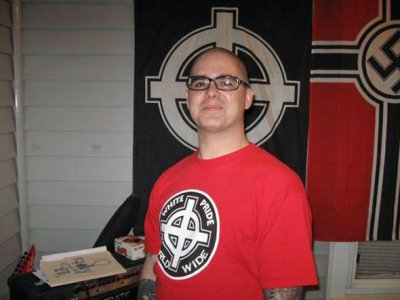
According to reports from the Southern Poverty Law Center, Wade Michael Page has a long association with white power. In 2000, he allegedly made purchases from the National Alliance, a once prominent white supremacist groups. He also appears in pictures in front of a Nazi flag.

Several websites have shown pictures of Page’s left bicep revealing a “Celtic cross” with the number 14 on top of it. Both are common white power symbols: the former with connections to the Ku Klux Klan, while the latter references the “14 Words,” a key phrase coined by David Lane, a founding member of the Aryan inspired terrorist group the Order: “We must secure the existence of our people and a future for White Children.” It represents the core of contemporary white nationalist ideology, emphasizing the importance of the white race protecting its future, one they believe to be imperiled by multiculturalism, immigration, integration, homosexuality, and globalization. The focus on the family and the protection of progeny underscores the entanglements of race, gender, and sexuality in the white power subculture today.

Page was a member of multiple hate rock groups named End Apathy and Definitive Hate. Its album “Violent Victory” contains a picture of a white hand, tattoo with the letters “HFFH” (“Hammerskins Forever, Forever Hammerskins”) punching a black male in the face. According to its website, the Hammerskins is “a leaderless group of men and women who have adopted the White Power Skinhead lifestyle… the Hammerskin brotherhood is way of achieving goals which we have all set for ourselves… summed up with one phrase consisting of 14 words.”

While many took comfort in the election of Barack Obama, it, along with the intensification of globalization and worsening economics, has sparked a rise in skinhead, neo-Nazi, and other white supremacists groups in the United States and around the world. According to a report from the SPLC, which has tracked such groups for more than a quarter-century, while more than 1,000 hate groups were identified in 2011, up from roughly 600 in 2000, militia and patriot groups numbered 1,274, up more than 450 from the year before.

Continue reading @ Dr. David J. Leonard: White Supremacy and the Wisconsin Shooting Spree.

The Criminalization of Mental Illness in Black America | Urban Cusp

The Criminalization of Mental Illness in Black America

By David J. Leonard

It was a normal night in 2009 at Delonte West’s house. Tired from a long day, West retreated to his room to get some rest. As usual, he took a dose of Seroquel, medication he uses for his bipolar disorder. “Sadness is a normal human emotion,” explains West. “And there’s a mechanism that kicks in and lets you know it’s time to stop being sad. With bipolar, that mechanism is out, so you don’t even know when you’re sad.” Despite certain side effects, Seroquel helps to regulate these mechanisms.

Shortly after falling asleep, West was awoken and told that his friends were downstairs messing around with some guns in the house. Despite feeling the effects of the medication, West decided that the best course of action was to remove the guns from his home, transporting them to a house nearby. He described the situation to Slam Magazine in the following way:

A few of my cats had found some stuff in the studio and they were living the whole gangsta life thing- guns in the air and this and that. And I said, ‘Oh my God. What the fu*k are y’all doin’ in here? Y’all got to go. Momma ain’t on that. Kids are running around upstairs. It’s time to go.’

Gassed up from the commotion, West decided it would be prudent for him to relocate the guns to an empty house he owned nearby. So, with his other vehicles blocked in by guests’ cars, and expecting it to be a short trip, he haphazardly loaded up his Can-Am and placed the weapons in a Velcro-type of bag – “not a desperado, hardcase, gun-shooting-out-the-side type case” -and set off.

Unfortunately, while responsibly moving the guns, he found himself unable to shake his groggy feeling. Realizing the terrible predicament he faced, he sought out a police officer, only to find himself under arrest and ultimately in jail. While clearly a result of his Bipolar Disorder and his need to medicate, West would be punished by the criminal justice system (1-year house arrest), by the media (in terms of ridicule and a narrative that consistently imagined him as criminal), and with a 10-game suspension from the NBA. Named as a member of The Bleacher Report’s “all thug team” and also a member of a list of players who “could double as gang members,” and often described as a “thug” and a “gangsta” in comment sections, Delonte West highlights the ways the criminality and mental health becomes within the black body.

His difficulties and troubles are rarely linked to his disease, instead positioned as yet another criminal baller. Moreover, even acknowledgment about his Bipolar Disorder provides little cover or context given the stigmas directed at black males. Knowledge of medical conditions, instead, are used as further evidence of his criminality and danger. “West wouldn’t be the first person to be picked on for having a mental health condition, and certainly not the first to be picked up for the same,” notes Sam Eifling. “But it’s worth noting that, despite harming precisely no one, West likely became another example of the criminalization of mental illness in America. Now he’s stigmatized as not just sick, but criminal.” Ain’t that a truth known all too well by a disproportionate number of African Americans.

Continue reading @ The Criminalization of Mental Illness in Black America | Urban Cusp.

BIGGER THAN PENN STATE: Does Our Culture Neglect Child Abuse Victims? – News & Views – EBONY

BIGGER THAN PENN STATE: Does Our Culture Neglect Child Abuse Victims?

By David J. Leonard


Amid all the self-righteousness and demands for accountability, justice and changes are the realities that speak to a societal disregard for the injustice of child abuse. Clearly, Penn State, a culture of hero worship, and most specifically those who turned their back on Jerry Sandusky’s victims in the name of bowl victories and football tradition, are complicit. Dollars and wins were deemed more important than the safety of children, an indictment of many.

We can all point to the various enablers within Penn State – administration, the Board of Trustees, Joe Paterno and countless others. Yet, the NCAA and the sports media, which not only promote a culture of football, a “victory culture,” and a “win by any means necessary” are also complicit here. They provided the incentive, the financial remunerations, and the institutional support that gave rise to this tragedy. Did what the NCAA did today make kids any safer; did it change the culture of college sports; did it adjust societal priorities; did it change the ways we define heroes. The plague of child abuse necessitates systemic action, including budgetary support for the prevention of child abuse; it requires financial commitment that actually puts kids first, that cares for those who have faced the unthinkable injustice for child abuse. As the NCAA wags its finger at Penn State and as ESPN and others in the sports media congratulate them, I am left to wonder who will hold the American political structure accountable for making kids more vulnerable.

For the first time in 18 years, the budgetary support for the Victims of Child Abuse Act was cut to ZERO for the 2013 budget. Monies that supported the victims of child abuse, that served almost 300,000 abused children in 2011, are gone, unless Congress restores them. According to the National Children’s Alliance, the cutting of funding for the Victims of Child Abuse Act will result in among other things:

  • Fewer abused children will receive services in every jurisdiction;
  • CACs will not receive the technical assistance and training they need to do their work effectively;
  • Prosecutors would not receive the training and technical assistance they need to get successful prosecutions, hold offenders accountable, and keep our communities safer;

If we as a society are truly concerned about child abuse, lets put our money where our mouth is. Instead of purchasing tickets for one game, instead of donating to our favorite athletic program, instead of donating to politicians who vote against the interest of children, instead of forking over $$ for the latest game gear, lets make our priorities clear with some investment in those actually promoting justice.

Continue reading @ BIGGER THAN PENN STATE: Does Our Culture Neglect Child Abuse Victims? – News & Views – EBONY.

White Privilege, Wealth and the U.S. Criminal Justice System | Urban Cusp

White Privilege, Wealth and the U.S. Criminal Justice System

By David J. Leonard

I can still see myself standing in my office. I was gathering my things as I prepared to go on leave with the birth of my son that following day. Although my excitement and anxiety provided a joyous distraction, my focus was elsewhere. My father was in New York, awaiting the verdict in his trial. We were all waiting for the verdict yet he was probably waiting for judgment about his future. Having lived under the stress and anxiety of my father facing jail time for many years (including two prior trials that had ended with hung juries) and having lived under the continual fear that our collective lives could forever change in an instant, I sat almost paralyzed by my trepidation. I couldn’t help but think about a recent conversation with my father, where he asked me to help out my Mom if he was hauled off to jail without being able to tie up loose ends. Deep in these thoughts and unable to focus on anything, my phone rang. He had been found guilty on all counts and was convinced that he had not only been “screwed” but that his life was over.

While an injustice did take place, his life was not over. We have made it though these circumstances because of family, love, and privilege. Yes, privilege. My experience with an injustice, with a prosecutor who was more focused on creating a factual scenario that fit his preconceived conclusions, with a criminal justice system more focused on wins than truth or justice, with a bureaucracy focused on justifying its bloated budgets and state power than fostering peace and safety, and individuals more concerned with personal interests than the families and communities that their actions impacted, taught me about the power of privilege.

My dad had the financial privilege to be able to hire a top-notch lawyer; he had a house that could be used to offset the costs of a trial. Unlike the vast majority of people swept up by an unforgiving criminal justice system, he was able to go to trial (multiple times as it turned out). While he was not ultimately successful in blunting the power of the government (more than 90% of prosecutions by the federal government result in convictions), his lawyer’s efforts to highlight the injustice that was being done, surely played a role in keeping him out of prison. While clearly an injustice, the real-life meaning of whiteness, of class privilege, is hard to deny when thinking about our entire experiences with the criminal justice system.

Yes, my family faced what we knew was an injustice. Yet, as a middle-class white family from Los Angeles, we learned that we were (to a degree) exempt from many of the injustices that befall those who must fight the system without the benefits and privileges of being white and middle class. My father was able to contest a matter three thousand miles from his home. How many individuals can carry on a fight over many years at that kind of distance including numerous cross-country flights, weeks of living in a hotel, the cost of transporting witnesses across country and related financial burdens? Anyone without the financial resources to fight would have no choice but to simply concede defeat at the outset.

My father was able to hire an attorney. Access to a private attorney as opposed to a public defender or assigned counsel is in many ways determinative of one’s fate. According to Paul Rubin and Joanna Shepherd, economic professors at Emory University, and Morris B. Hoffman, a trial judge, “the average sentence with serious cases was almost three years longer than the average for clients of private attorneys.” The mere fact that 90-95% of criminal cases never go to trial, whereas my father was able to standup before the world and announce his innocence, is evidence of both our privileges and the injustice of the criminal justice system.

Continue reading White Privilege, Wealth and the U.S. Criminal Justice System | Urban Cusp.

A Lynching Happens Every 40 Hours


A Lynching Happens Every 40 Hours

By David J. Leonard // Huffington Post


Throughout the early part of the twentieth century, African-American activists fought to thwart the systemic scourge of lynching. Faced with a silent and complicit populace, particularly the media and political establishment, African Americans forced the nation to bear witness to the depravity of American racism. Between 1882 and 1968, close to 5,000 lynchings (73% of the victims were black) took place on American soil, and that is of course an estimate that does not account for the countless unknown souls who lost their lives at the hands of White supremacy. According to Richard Perloff, racial lynchings had become commonplace in part because of the media’s failures to bring the injustice to light. He quotes a white resident of Emelle Alabama, who questioned a reporter’s inquiry into the killing of an African American: “A few White residents who had been on hand when the men were killed refused to talk about the events to reporters from The Tuscaloosa News. “What the hell are you newspaper men doing here?” asked a White man who had been part of the vigilante group. ‘We’re just killing a few negroes that we’ve waited too damn long about leaving for the buzzards. That’s not news'” (Raper, 1933, p. 67). The silence from the mainstream media about blacks victims burned to death, hung, and dismembered, embodied the normalization of white supremacist violence.

Activists and Black journalists responded to American media that often downplayed the practice of white-on-black violence and/or named African Americans as deserving of torment and murder. According to Perloff, writing in The Journal of Black Studies, “It is next to impossible to locate a newspaper article that does not identify the victim as a Negro or that refrains from suggesting that the accused was guilty of the crime and therefore deserving of punishment. For example, The New Orleans Picayune described an African-American who was lynched in Hammond, Louisiana for robbery as a ‘big, burly negro’ and a ‘Black wretch'”.

Amid this silence and sanctioning of White-on-Black violence, Ida B. Wells-Barnett and others within the Black press not only documented each and every lynching, but in providing the graphic details, they challenged the very fabric of American racism. From displaying signs announcing “A Lynching Happened Today” to the publication of various pamphlets, activists worked to force America to come to grips with the contradiction between its purported creed and the ongoing violence perpetuated within its boundaries

The more things change, the more things stay the same.

The history of racist violence, of lynchings, of state violence, or a complicit media and systemic injustice, all of which define the era of Jim Crow, remain a reality despite our purportedly post-racial moment. A recent report from the Malcolm X Grassroots Movement (MXGM) entitled “Report on Extrajudicial Killings of 110 Black People” elucidates the contemporary struggle against lynchings. In the first six months of 2012, the police, security guards, and self appointed agents of “justice” have killed 110 African-American men, women, and children. Since its publication, there have been 10 additional killings in total, 2012, which means that in 2012, there has been 1 killing every 36 hours.

Of those who lost their life at the hands of a police or security officer, 47 did not have a weapon at the time of their killing. Another 40 were said to have a weapon (including a cane, a BB gun and a toy gun), although witnesses have disputed these purported facts. A small number of those killed, 21 people, were armed at the time they were sentenced to death. None were afforded the presumed right of innocence until proven guilty.

Many of these deaths are the consequences of stop and frisk policies, racial profiling, and a culture of White racist stereotyping of African Americans as criminals and suspects. According to Rosa Clemente, a member of Malcolm X Grassroots Movement and former vice-presidential candidate of the Green Party, “Nowhere is a Black woman or man safe from racial profiling, invasive policing, constant surveillance, and overriding suspicion.” In the press release, she notes “all Black people – regardless of education, class, occupation, behavior or dress – are subject to the whims of the police in this epidemic of state initiated or condoned violence.”
The study showed that 43% of those killed on these streets, prior to any legal proceedings, were stopped because of “suspicious behavior or appearance” or because of traffic violations. Another 10% were not involved in criminal behavior at all, with another 18% resulting from 9-1-1 calls, including several from family members seeking assistance with individuals suffering from mental illness, only to see them killed in the streets. With only 33% of those killed resulting from an actual investigation, we must begin to ask protecting and serving whom?

Among its victims are: Rekia Boyd, an innocent bystander shot and killed in Chicago; Dante Price, who was shot 22 times, while trying to pick up his children; and Travis Henderson, a “a suicidal man sitting in a church parking lot with a gun. When he got out of the car, he allegedly pointed the gun at an officer and was shot.” An Orange County Sherriff killed Manuel Loggins, a former marine and father of two daughters, in front of his children. The “sheriff initially said he feared for his own safety and later revised his story to say he feared for the girls’ safety.” And there is Anton Barrett, “who was allegedly driving without headlights and running stop signs when a DUI Saturation Patrol signaled him to stop. According to the report, “he led the officers on a high speed chase, when his tires went flat, he fled on foot. One officer confronted him in a darkened alley and shot him multiple times, claiming he thought he saw him pull a ‘metallic object’ from his sweatshirt pocket. After Barrett was shot, he attempted to rise and a second officer tasered him. He was cuffed and died at hospital. Police admit they mistook wallet for gun.” The history of state violence, of the consequences of systemic racism, a story often imagined as a concluded chapter in American history, remains a grave problem of the twenty-first century.

In the spirit of Ida B. Wells and other freedom fighters, this report continues the tradition of baring witness to the atrocities of state violence. Under a cloud of silence, denial, and denied accountability, the death toll rises. While the media, political “leaders,” and citizens alike ignore and justify these killings by blaming the victims, MXGM and this report make clear that African Americans continue to live “without sanctuary” in America, demanding that we not only “bare witness” to these ongoing atrocities but join them “in demanding that the Obama administration implement a National Plan of Action for Racial Justice to stop these killings and other human rights violations being committed by the government.”

A lynching happened today;

One happens every 36 hours;

Will another happen tomorrow?

As Ida B. Wells-Barnett powerfully reminds us, “The way to right wrongs is to turn the light of truth upon them.”

To read the report visit www.mxgm.org. For information on the petition visit