Silence and Spectacle: How the Sports Media Sanctions Racist Mascots
By Guest Contributors C. Richard King and David J. Leonard
One would hope sport media outlets might take their civic duty to foster critical thinking, public engagement, and informed debated seriously. Their approach to the representations in Native Americans in sport suggest otherwise. Under the veil of fairness and balance, they opt to speak for, to be silent and to silence as preferred pathways.
When ESPN columnist Rick Reilly offered a defense of Native American mascots because the American Indians he knew did not have a problem with them. Flouting his whiteness and playing his privilege with little regard, he spoke for Native Americas. His word – his whiteness, his platform – made their words meaningful. His editors neither batted an eye nor cleared a space for Native Americans to express themselves.
In fact, Reilly misrepresented his key source, his father-in-law, who wrote a lengthy retort in Indian Country Today that noted he found the name of Washington D.C.’s National Football League team to be objectionable. Reilly still stood by his piece and neither he nor his publisher have offered a correction or an apology.
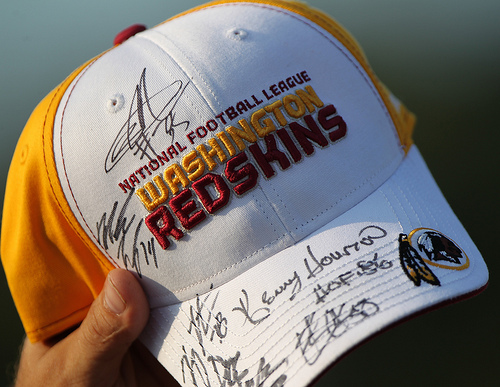
Fans of Washington, D.C.’s NFL team. Image by Keith Allison via Flickr Creative Commons.
Similarly, Daniel Snyder, the owner of the franchise, continually invokes American Indians to support the team name, imagery and traditions, as in his recent sentimental letter to the public, from one-time coach Lone Star Dietz (who claimed to be but was indeed not indigenous) as the inspiration of the honorific name to the Red Cloud School (a reservation school which does not support it).
Not surprisingly, someone who loves and profits from the invented Indian figure he owns does not have a problem with offering up insincere fictions in his defense. He doesn’t invoke the history of colonization and genocide, or the specific racial history of his own franchise. Predictably, someone who reaps the daily benefit of white supremacy sees little problem with the football team located in the nation’s capital having for its mascot a racist slur seeped in white supremacist colonial history.
“His headstone said
FREE AT LAST, FREE AT LAST
But death is a slave’s freedom
We seek the freedom of free men
And the construction of a world
Where Martin Luther King could have lived and preached nonviolence”
Writing about Dr. King, Nikki Giovanni reflcts on the irony of freedom emanating from death. Yet, so is the logic of white supremacy, a system and ideology that has not only denied African Americans the rights of freedom, but “life, liberty, and the pursuit of happiness.”
Recently, I woke up thinking about this poem because “death isn’t freedom for the enslaved or those free yet shackled by the grips of white supremacy. For Renisha McBride, Trayvon Martin, Jordan Davis and countless others, death has not resulted in “freedom.” Freedom from the grips of white supremacy has not happen in death; no period of mourning or “don’t speak ill of the dead” has been afforded to the, From drug tests to criminalization, from media demonization to the hurling of the same stereotypes that resulted in their deaths, racism traveled with them. dream Hampton spotlights this when she talks about a system and society that is “‘criminalizing Black Corpses’.” Death is not a “slave’s freedom”
Her headstone says
Still not yet free
For death is not freedom for the enslaved
For death is not freedom for the criminalized, for people of color living in American Apartheid
Yet, we fight for freedom and justice for all women and men
And the construction of a world
Where Renisha McBride, and Johanthan Ferrell could have sought help without being pushed through death’s door
Yet we imagine a world where justice is not defined as Shana Redmond notes through “handcuffs and cages”
Yet we fight for a world where justice isn’t placed in the hands of another arrest of George Zimmerman or the ultimate charging of Theodore Paul Wafer
Yet we imagine a world where safety isn’t an axiom for more police and prisons but freedom from prisons, from police, from violence, and from guns
From poverty, from state violence, and from American exceptionalism
Until then, freedom will remain a dream deferred
Justice will continue to remain illusive
Dreams will fill our hearts, nourish our activist souls and be our oxygen
As we fight against white supremacist violence
And the construction of a world
Where Trayvon can walk freely, where Jordan can listen to his music, where Marissa can defend herself, and where the living & the dead are treated with humanity and dignity
The upcoming Sochi Olympics are already shrouded in violence and inequality. It is the Olympics after all, so the political, social, and cultural entanglements between the world’s largest sporting spectacle and the broader social realities (injustices) are nothing new. Yet, with the Olympics just over the horizon, 2014 will spotlight the ongoing oppression facing GLBTQ communities and their allies in Russia (and beyond).
As with U.S. outrage over racism within European fútbol or “hooliganism” in the world’s most popular game, the national response to Russian state-sanctioned homophobia has been wrapped in a narrative of American exceptionalism. More than the rightful condemnation, the calls for a boycott of the Sochi Winter Olympics speak to a level of holier-than-thou exceptionalism that locates evil, hatred, and violence elsewhere, all while seeing goodness, love, and equality in the hearts and minds of people in the United States.
Don’t get me wrong: the anti-GLBTQ violence in Russia mandates protest and widespread censure. The Sochi Olympics are an opportune moment, but not because of a dehistoricized and naïve understanding of the Olympics as the apolitical celebration of the world’s humanity. Nor is Sochi an important space of intervention because homophobia and inequality run counter to the Olympic charter and its call for nations to put aside differences in a celebration of friendly athletic competition. I know these messages are what NBC and the International Olympic Committee are selling, but I ain’t buying.
At the core, the Olympics are about Western hegemony – a celebration of colonization and imperialism. Christina Ting Kwauk notes,
According to John Bale and Mike Cronin, modern sport is a legacy of colonialism. It is a product of the implantation of sport by Western colonizers into societies all over the globe in an effort to civilize the “savages” in the image of the Englishman. Bale and Cronin argue that although “modern sport may serve to promote the modern post-colonial state, they initially served as a form of colonial social control.” Through sport, colonialists could first train the body and then capture the mind.
White supremacy, misogyny, and homophobia, not too mention the violence and destructive logics of capitalism, have always been core to colonial projects and thus are central to understanding the history of the Olympics. The anti-GLBTQ violence is thus not out of step with the history of the games. To deny this broader history is a mistake and a shortcoming given the complicity of everyone from the IOC to the Olympics corporate sponsors.
And yet, the Olympics do provide a platform for resistance. “But this year’s Winter Olympics offer us all an opportunity to look beyond sports and athletics and focus on the ways that sports can often highlight and intersect with human oppression,” writes Wade Davis II. “As we move closer to the 2014 Olympics, the oppression and violence directed towards LGBTQ individuals in Russia takes center stage, alongside the determination of who’s the world’s best in various sports.” Whether challenging Russia’s discrimination laws, U.S. drone strikes in Pakistan, #every28hours, or transnational sweatshops, the Olympics provide a powerful space of opposition.
This weekend marks the beginning of the college basketball season. For Oregon and Georgetown, it began in South Korea as part of the 2013 Armed Forces Classic. Putting aside the hyper nationalism, and the collective efforts from the NCAA/ESPN to convert patriotism into profits, to convert athlete labor into financial rewards, the event shined a spotlight of the collegiate sporting hypocrisy. And I am not even talking about the fact that student-athletes travelled to Korea IN THE MIDDLE OF THE SEMESTER. Student’s first, right?
Rather, I am talking about two Oregon student-athletes who were denied the ability to play in this game, or even travel with the team. The NIKE Ducks, in consultation with the NCAA, suspended Dominic Artis and Ben Carter for selling their shoes; yes, their offense was selling the shoes the university gave them as part of COMPENSATION for making the school, the NCAA, ESPN, NIKE, and countless others billions of dollars. “It’s gotta be the shoes.” They lost a chance to travel to South Korea, and likely play in 9-12 games. They also will need to donate $1,800 to charity (this is the amount of money they reportedly made through selling shoes) as part of their punishment. Wear the swoosh, good job; advertising swoosh, part of the collegiate experience. Try to see the swoosh, watch out.
The suspension of these two student-athletes, and the rule allowing for this punishment, encapsulates everything that is wrong with the collegiate sports. While NIKE makes billions, in part because of the visibility provided by student-athletes, while colleges and universities get filthy off the labor of student-athletes, while coaches get paid (Dana Altman, Oregon coach, signed a 12.6 million contract with the school in 2011), student-athletes are left to accept table scraps – and punished if they try to sell them.
Amid the hoopla and the media-created fantasy of the glamorous life of collegiate athletes, one should pause to ask themselves: “why would two young men risk so much for $1,800 dollars?” While I don’t know the answer to this, it’s hard not to speculate given the larger landscape facing college athletes. In “The Price of Poverty in Big Time College Sport,” Ramogi Huma and Ellen J. Staurowsky note the following:
College athletes on full scholarship do not receive a “free ride”. For the 2009-2010 academic year, the average annual scholarship shortfall (out of pocket expenses) for Football Bowl Series (FBS) “full” scholarship athletes was $3,222.
The compensation FBS athletes who are on “full scholarship” receive for living expenses (room and board, other expenses) situates the vast majority at or below the poverty level.
The percentage of FBS schools whose “full” athletic scholarships leave their players in poverty is 85% for those athletes who live on campus; 86% for athletes who live off campus.
The average FBS “full” scholarship athlete earns less than the federal poverty line by $1874 on campus and $1794 off campus.
If allowed access to the fair market like the pros, the average FBS football and basketball player would be worth approximately $121,048 and $265,027 respectively (not counting individual commercial endorsement deals).
Football players with the top 10 highest estimated fair market values are worth between $345k-$514k on 2009-10. The top spot was held by University of Texas football players. While 100% of these players received scholarships that left them living below the federal poverty line and with an average scholarship shortfall of $2841 in 2010-11, their coaches were paid an average of over $3.5 million each in 2010 excluding bonuses.
Basketball players with the top 10 highest estimated fair market values are worth between $620k-$1 million in 2009-10. The top spot was held by Duke basketball players. While 80% of these players received scholarships that left them living below the federal poverty and with an average scholarship shortfall of $3098 in 2010-11, their coaches were paid an average of over $2.5 million in 2010 excluding bonuses.
The poorest football and basketball players (generated combined FB and BB revenues of $30 million or more in 2009-10, yet live in the poorest bottom 1/3 of all of the players in the study live between $3,000-$5,000 below the poverty line in the report for further details.
The financial predicament facing student-athletes stands in stark contrast to the gold-lined pockets of college coaches, the platinum realities of colleges and universities, or their diamond studded realities of the sports media. They don’t even own their own likeness, their books, their time, their shoes or their futures. Billions of dollars fall into everyone’s hands but theirs. Still student-athletes struggle to make ends meet, in part through the profits and allure of shoes and apparel. The myth of amateurism is alive and well. Punishing those who sell shoes is all about sustaining the myth of amateurism; and that’s about protecting profits.
The suspensions of Dominic Artis and Ben Carter have not prompted national conversations about a corrupt and hypocritical NCAA; it has not led to columnist after columnist predicting reform for an organization dedicated to protecting its profits; it has not led to more #APU declarations from university faculty, who should be standing up for their students. Instead, we have gotten endless celebrations of the spectacle of collegiate sports; countless stories about student-athletes living the American Dream, ignoring the fact for all too many student-athletes collegiate sports remains fool’s gold. While celebrated for the mythology of “bootstraps” or pulling themselves up by their shoelaces, student-athletes that dare to challenge exploitation are punished. Treated as commodities themselves they are not allowed to sell and profit off other commodities. Stick that in your RULE book. It’s gotta be the shoes
I was on CNN yesterday, talking Marissa Alexander and domestic violence, with Esther Armah and Don Lemon. Of course, I am replaying the interview in head, processing and thinking about the many more things I want to say. Here are a few more thoughts:
(1) To understand why Marissa Alexander remains in prison requires talking about racism and sexism, patriarchy and institutional racism. It reflects societal sanctioning and perpetuating of violence against women. The violence she lived through, and her prosecution and incarceration reflects the insidious violence directed at women on so many levels: at home by an abuser, by police, prosecutor, and criminal justice system that punishes the victim, by a prison system that locks women in yet another unsafe and violence place, and a society that remains silent. At the same time, it reflects the lack of institutional care/empathy/ concern/legal protection afforded to black bodies, particularly those of African American women. Yes, intersections matter.
(2) Domestic violence is a societal injustice; it cuts across class, race, sexuality, and geography. It’s rooted in patriarchy; it’s rooted in pathological definition of masculinity; it’s rooted in media and popular culture that turns domestic violence into a spectacle, a source of profit and pleasure. Clearly we can think about race and class operates here. Domestic violence is rooted in the legal and cultural views about the “home” as a man’s castle, which contributes to systemic views about it being a “private issue.” All of this embodies domestic violence culture, where violence, the pain and bloodshed, the despair, and heartache, the injuries and terror are imagined as a personal and familial issue. In all, domestic violence culture ignores the rights, futures, wellbeing, and humanity of women, particularly women of color.
(3) Angela Davis once noted that, “prisons do not disappear problems, they disappear human beings.” The incarceration of Marissa Alexander and the national silence on this injustice (and domestic violence) reflects an effort to make the victims of domestic violence disappear. The fact that a women is assaulted every 9 seconds in America reveals how the problems, the violence, and the despair are fully present.
(4) As noted in a discussion between Suey Park and Summaya Fire: “Black women are 35 percent more likely than white women and 2.5 times more likely than any non-Black woman of color group to experience domestic violence. However, they are also less likely than other women to use social services. More Black women are likely to go to the hospital for domestic violence than social services.” In this same discussion, Summaya Fire points out how the stereotypes of black women has not only shaped the conversation/media coverage/ response from the criminal justice system but also plays out in terms of the lack of services/intervention from social welfare as it relates to black women. The history of movements against domestic violence, media coverage, and even political discourse has erased the experiences of African American women. I wish we had more time to discuss these structural barriers to safety and security; to understand Marissa Alexander is to look at racism and sexism.
(5) A few statistics to know: Estimates range between 70-80% (some studies are lower) of women convicted of murder acted in self-defense against their abusers. One study found that cases involving domestic violence victims defending themselves against abusers had a higher conviction rates than in other cases. That is women defending and protecting themselves from violent men were more like to be convicted. They were also more likely to be given longer sentences (on average 15 years). Additionally, African American women convicted of killing an abusive spouse/partner were the most likely to be convicted. All women, and particularly black women, face harsh punishments from the criminal justice when trying to protect themselves from a violent partner. Marissa Alexander and the thousands of women locked up for defending themselves against violent is evident of this horrifying reality.
And finally, the parallels between Marissa Alexander and Trayvon Martin are ample: neither Trayvon nor Marissa were given the right (legal or moral) to stand their ground. Race and gender matters; racism and sexism matters. Both Trayvon and Marissa have been criminalized despite being victims of violence; each have been blamed, question, and otherwise convicted within the criminal justice system, within much of the media, and within the public at large. We already know the outcome in the struggle for #Justice4Trayvon. The fight for Marissa’s release and the dropping of the charges continues.
I recently watched League of Denial, an important documentary on head trauma and the NFL. It looks at the relationship between football, concussions, and Traumatic Brain Injury (TBI) and Chronic Traumatic Encephalopathy (CTE). In not only telling the stories of Mike Webster and Junior Seau, and the evolution of the medical understanding of concussions, League of Denial documents the failures of the NFL to protect its players from the horrifying consequences of America’s violent pastime.
I was little disappointed with this “controversial” documentary. I didn’t find anything about controversial unless you are a flat-earth/global warming hoax/concussions are no biggie kinda person. Maybe that was who the film made for; for me, I wanted more nuance, more complexity, and less “got ya” NFL thematic focus
In an effort to trace the history of evolving understanding of the long-term effects of concussions the documentary also took the focus away from the players themselves. In focusing on the failures of the NFL to adequately intervene, and even inform players of risks, it shifted the conversation away from the players. Having watched a number of reports, I found Real Sports exposes to be far more powerful because they showed the consequences; it spotlighted the pain, the physical and mental toll on former players and their families. The sight of childhood heroes, men often celebrated as warriors and gladiators, as fragile and wounded people, haunts me to this day. The sight of fathers and sons, brothers and friends, suffering with depression, dementia, ALS and countless other neurological issues shapes my understanding of the concussions here – these stories and images, not the NFL doctor’s who denied or the NFL’s changing protocol, is what changed my relationship to football. I wish League of Denial had done more to document and give voice to those who suffer because of the culture of football. Along these lines, I was surprised that the film did not address the growing research that links head trauma to ALS and tell the stories of those former players who are enduring this disease.
While not given much attention, the film does take on sexism (albeit briefly) within the medical community/the NFL as it relates to the dismissal of Dr. Ann Mckee’s important research, it failed to address the racism directed at Dr. Bennet Omalu. It was not only a MISSED moment to comment on how racism and sexism (“white male racial framing”) contributes to systemic silence and erasure, but also how the NFL, like corporate America as a whole, remains a system mired by the “old boys network” and the hegemony of white male power.
While the documentary is on the specific situation within the NFL, it missed an opportunity to highlight the crisis associated with the long-term consequences of head trauma on countless playing fields. The crisis documented within the film is one that is potentially talking place within the collegiate ranks, from football to women’s soccer. In fact, research shows that female athletes suffer concussions at a higher rate than their male counterparts. The film missed an opportunity to reflect on a culture and society of silence.
One of the biggest shortcomings from the film is its lack of attention to masculinity. The culture of denial and acceptance is wrapped up in the scripts of masculinity, which condone and celebrate violence. The GOP and its friend’s obsession with the “war on football” and its claims about the America getting soft is part of a culture that perpetuates and sanctions at a game that is leading many down a lifetime of pain, despair, and life-altering (destroying) injuries. Whether reflecting on the violence of football or the “put some dirt” on it mentality that surrounds football, and the larger cultural-political context, it is impossible to talk about concussions without talking about masculinity. I have written about this before:
To be a real man is not only to play football, but also to do so without regard for safety; to be a real man is to stay out on the field, to disregard pain and long-term harm as any warrior would do. To be a real man is to ring an opponent’s bell, to knock him out, leaving you and him in a state of delirium. The demands to “suck it up” or “play like a man” within a league that is 68% African American deserves pause and critique, given the ways that race and masculinity operate within American culture. “Using white masculinity as a yardstick for a normal masculinity grounded in ideas about strength as dominance, African American men become defined as subordinates, deviant, and allegedly weak, and black men’s reported weakness as men is compared to the seeming strength of white men,” writes Patricia Hill Collins in Progressive Black Masculinities (edited by Athena Mutua). “Definitions of black masculinity in the United States reflect a narrow cluster of controlling images situated within a broader framework that grants varying value to racially distinctive forms of masculinity.”
The demands to “tough it out” or claims about choice cannot be understood outside these “controlling images” and history, one that includes nostalgia for an era of football defined by toughness, ruggedness, uber masculinity, and whiteness.
A culture that celebrates vicious hits, that develops highlights packages based around the most violent and physically dangerous contact, makes this clear. Is this real choice? Is it a choice when these values are taught to young boys, who learn early how to play football? A football culture that questions a player’s commitment and manhood when he puts his health in front of anything else sends this message each and every day. Is this really choice? In a culture where “complaining about pain is tantamount to weakness” and “playing hurt is as common as a forward pass,” it is no wonder that guys “choose” to play hurt, to conceal injuries, to “risk” their long term health for a game. Sure, money is an issue and there are potential consequences of putting body and mind ahead of tackles, touchdowns and victories, all of which would certainly lead to a quick exit from the league. Yet, any refusal to subscribe to the prerequisites of football players puts more in danger than a paycheck, leading to questions about toughness, strength, and masculinity – are you a real man?
To this day, I still can recall the praise and celebration for not only every bone-crushing hit I had during my short high school football career, but every time my own bell was rung I heard nothing but praise and adoration. I can also recall a concussion I got playing baseball, which led me to actually sit out one game. I remember sitting out with a sense of pride and joy since a concussion was a measure of my commitment to athletic excellence and a battle scar that proved that indeed I was a real man. I was willing to sacrifice, play through pain (in the game where I was injured), and otherwise put my body on the line. Yes, I made a choice, one that was constrained and influenced by a culture that expected me to “play sports like a man”–a lesson that is contributing to the death sentences of too many of its students.
To ignore the harmful manifestations of masculinity is to ignore the root issues in play. It would be like talking about health problems related to breathing without actually looking at the toxins in the air.
Likewise, the film fails to deal with race and racism as it relates to the lack of public outcry over concussions. While clearly the league has been complicit through its public denial, the lack pressure from fans is also at play. Race matters here. According to Jason Silverstein, the racial empathy gap plays out in a spectrum of places; hard not to think about its relevance to the NFL.
The racial empathy gap helps explain disparities in everything from pain management to the criminal justice system. But the problem isn’t just that people disregard the pain of black people. It’s somehow even worse. The problem is that the pain isn’t even felt. A recent study shows that people, including medical personnel, assume black people feel less pain than white people. The researchers asked participants to rate how much pain they would feel in 18 common scenarios. The participants rated experiences such as stubbing a toe or getting shampoo in their eyes on a four-point scale (where 1 is “not painful” and 4 is “extremely painful”). Then they rated how another person (a randomly assigned photo of an experimental “target”) would feel in the same situations. Sometimes the target was white, sometimes black. In each experiment, the researchers found that white participants, black participants, and nurses and nursing students assumed that blacks felt less pain than whites.
The focus on the NFL at the expense of a discussion of the larger issues of race, gender, and sports culture limits the potential intervention here. The film’s celebration of changes within the NFL, while ignoring the lack of transformation in the root issues at play, further illustrates its unfulfilled potential. Thankfully it has started a conversation for the NFL isn’t merely a league of denial but one defined by pain, sorrow, and lives cut short. It’s bigger than the NFL.
Johnny Manziel is No Rosa Parks by David J. Leonard
by David J. Leonard | NewBlackMan (in Exile)
Johnny Manziel is no Rosa Parks – six words that no one should ever need to type. Yet thanks to Jen Floyd Engel, a FOX Sports columnist, I can now cross this off my bucket list: Johnny Manziel is no Rosa Parks.
Engel, who is clearly a member of the Johnny Football Reclamation project, has gone to great lengths to elevate his importance. With “Manziel case was tipping point,” Engel recast the one time football player by day, partier by night, as a collegiate freedom fighter. That is, his defiance, his refusal to play by the NCAA rules, and his “show me the money” approach to autographs is all part of a plan to bring down the NCAA. Problematic enough, Engel is not content with simply demanding change, that NCAA do it for Johnny.” Manziel is a game changer; a transformative hero within a larger history of struggle.
“Once upon a time in this country, there were ugly, racist, tyrannical rules dictating where a black person could sit on a bus. There were all kinds of these laws, actually, created and defended by the racists who benefited from them,” notes Engel. According to Engel, this chapter in America’s history of racism (notwithstanding subprime loans, stop and frisk, mass incarceration….) ended because an “everyday woman named Rosa Parks, who had grown tired of being tired” said no. She “was merely the tipping point for many Americans long since tired of these immoral laws.” Johnny Manziel, who was also tired, albeit of the NCAA making money off his labor, name, and signature. And according to Engel, he too will lead us to the promise land of reform.
The Parks comparison is so offensive and historically ignorant, I wouldn\’t know where to start (a national reading of Jeanne Theoharis recent book would be a good starting point). Rosa Parks trained, sacrificed, and participated in movement; Johnny is a movement for/about himself. A movement is not Johnny Football, his friend, and his sharpie.
Rather than joining a movement, partnering with a group like National College Players Association (dare I say a modern day sports equivalent of the Highlander Folk School or SCC), or voicing his support for the O’Bannon lawsuit, Manziel followed in the footstep of his capitalism forefathers: he got paid. And now he might get punished for that reported rule violation.
And for that, he is Rosa Parks. He is a tipping point. She writes, “On a much less historically significant scale, so it is with Johnny Football — and no, this is not intended in any way to compare the vast evil of Jim Crow to an incompetent NCAA investigation, or to slings from TV commentators.”
There is so much wrong with the comparison, from the hypocrisy of a writer who chastised Terrelle Pryor for rule’s violations to the historic ignorance about the civil rights movement. Dave Zirin articulates this with great precision and brilliance how misguided and historically myopic the comparison is between Manziel (not yet “an accidental activist”) and Rosa Parks, “the mother of the movement:”
By comparing the two, Engel does more than trivialize the bravery of Parks. She traffics in a myth about who Parks was and why she chose to fight the indignities of the Jim Crow South. In Engel’s telling—and this is the kindest possible interpretation—Manziel, like Parks, is the unconscious activist thrust by circumstance into firing the first shots at an unjust system.
Zirin and several others make clear the many problems of the column. However, as easy as it is to dismiss Engel, her reclamation of Johnny Football, and her denial of the racial implications here (“This has absolutely zero to do with race. What I believe to be true is, after years of watching black kids, white kids and mostly poor kids of all colors villainized for accepting a free sandwich or plane fare to go home and attend a funeral or, God forbid, wanting a cut of the billions of dollars they make for people not doing much in the way of heavy lifting, this was America’s tipping point”) has become commonplace. ESPN might as well start a network dedicated to all things Johnny. This column is a symptom of a larger set issues operating through Manziel.
Race has everything to do with Johnny Manziel. His whiteness matters. It matters when Engel recast this moment as a tipping point; it matters when commentators use this moment to spotlight the hypocrisy of the NCAA; it matters that “he’s just 20” and “he’s behaving like other college students” has become the commonplace defense of his daily transgressions. It matters as we come to grips with fact that he was celebrated as the greatest QB since Tim Tebow Johnny Unitas despite the fact that he lagged statistically behind Oregon’s Marvelous Marcus Mariota in 2012 (who wasn’t even invited to NY for Heisman festivities).


 Dr. David J Leonard