It’s Bigger than Paula Deen

The fallout from Paula Deen’s deposition and the lawsuit itself is a reminder of the ways that race and gender operate within the restaurant industry.  It’s bigger than Paula Deen.  Yet, as you read media reports, as you listen to various commentaries, you would think this is a story about an older white woman wedded to America’s racist past.  Yes, this is a story about Paula Deen, and her crumbing empire.  But that is the beginning, not the end. This is bigger than one individual, her reported prejudices, or the lawsuit at hand.  This is about a restaurant industry mired by discrimination and systemic inequalities.

Racism pervades the entire industry, as evident in the daily treatment faced by workers, the segregation within the industry, differential wage scale, and its hiring practices.  According to Jennifer Lee, “Racial Bias Seen in Hiring of Waiters:”

Expensive restaurants in New York discriminate based on race when hiring waiters, a new study has concluded. The study was based on experiments in which pairs of applicants with similar résumés were sent to ask about jobs. The pairs were matched for gender and appearance, said Marc Bendick Jr., the economist who conducted the study. The only difference was race, he said.

White job applicants were more likely to receive followup interviews at the restaurants, be offered jobs, and given information about jobs, and their work histories were less likely to be investigated in detail, he said Tuesday. He spoke at a news conference releasing the report in a Manhattan restaurant.

“There really should not be a lot of difference in how the two of them are treated,” Mr. Bendick said. He was hired by advocacy groups for restaurant workers as part of a larger report called “The Great Service Divide: Occupational Segregation and Equality in the New York City Restaurant Industry.” He has made a career of studying discrimination, ranging from racism in the advertising industry to sexism in firefighting.

Mr. Bendick said that in industries, such experiments typically found discrimination 20 to 25 percent of the time. In New York restaurants, it was found 31 percent of the time.

A recent report from the ROC (Restaurant Opportunities Center) found that Darden Restaurants (Olive Garden, Red Lobster, Capital Grille, among others) was responsible for creating a racially hostile environment.

The report also outlines recent lawsuits against Darden for employment discrimination based on race, including a 2008 lawsuit that charged that Beachwood, Ohio Bahama Breeze employees of color were repeatedly pelted with racial slurs such as “Aunt Jemima” and “stupid n**ger” by managers.  This resulted in a EEOC announcement of a $1.26 million settlement from Darden in 2009.  In describing the settlement, EEOC’s acting chairman Stuart J. Ishimaru said “No worker should have to endure a racially hostile work environment in order to earn a paycheck.”

It additionally concluded that it, “fired black servers because they did not ‘fit the company standard’ at their Capital Grille restaurant” and that it “prevents people of color & immigrants from accessing living wage positions, such as server and bartender, at their Capital Grille fine dining restaurant.” It’s bigger than Deen.

A 2007 lawsuit against Daniel Boulud points to another instance:

According to the lawsuit, dining room workers at Daniel have been denied promotion because they were Latino or Bangladeshi. The employees also say that Mr. Boulud and other managers yelled racial slurs. At one point, they say, Spanish was banned among employees; only English and French were allowed. Those are examples, they say, of how the working culture at Daniel favors white Europeans at the expense of other groups.

Here are but a few examples from the EEOC

In March 2008, a national restaurant chain entered a consent decree agreeing to pay $30,000 to resolve an EEOC case charging that the company gave African-American food servers inferior and lesser-paying job assignments by denying them assignments of larger parties with greater resulting tips and income, by denying them better paying assignments to banquets at the restaurant, and by failing on some occasions to give them assignments to any customers. The consent decree enjoins the restaurant from engaging in racial discrimination and requires the chain to post a remedial notice and amend and distribute its anti-discrimination and anti-harassment policies. The amended policies must state that prohibited racial discrimination in “all other employment decisions” includes, but is not limited to, making decisions and providing terms and conditions of employment such as pay, assignments, working conditions, and job duties; also, it must prohibit retaliation. In addition, the company must revise its complaint mechanism and clarify and expand its website and toll-free phone number for the reporting of incidents of employment discrimination. The consent decree also requires the restaurant to provide training in equal employment opportunity laws for all of its employees and to appoint an Equal Employment Office Coordinator, who will be responsible for investigating discrimination complaints. EEOC v. McCormick & Schmick’s Restaurant Corp, No. 06-cv-7806 (S.D.N.Y. March 17, 2008).

In January 2008, a bakery café franchise in Florida entered a two-year consent decree that enjoined the company from engaging in racial discrimination or retaliation and required it to pay $101,000 to the claimants. EEOC had alleged that the company segregated the Black employees from non-Black employees and illegally fired a class of Black employees in violation of Title VII. Under the consent decree, the principal of the company must attend an eight-hour training session on equal employment opportunity laws. The decree also mandated that if the company ever re-opens the franchise in question or any other store, it must distribute its anti-discrimination policy to all employees, post a remedial notice, and report any future complaints alleging race-based discrimination.EEOC v. Atlanta Bread Co., International and ARO Enterprise of Miami, Inc., No. 06-cv-61484 (S.D. Fla. January 4, 2008).

In September 2006, the Korean owners of a fast food chain in Torrance, California agreed to pay $5,000 to resolve a Title VII lawsuit alleging that a 16-year old biracial girl, who looked like a fair-skinned African American, was refused an application for employment because of her perceived race (Black). According to the EEOC lawsuit, after a day at the beach with her Caucasian friends, the teen was asked if she would request an application on her friend’s behalf since the friend was a little disheveled in appearance. The owner refused to give the teen an application and told her the store was not hiring anymore despite the presence of a “Help Wanted” sign in the window. After consultation among the friends, another White friend entered the store and was immediately given an application on request. EEOC v. Quiznos, No. 2:06-cv-00215-DSFJC (C.D. Cal. settled Sept. 22, 2006).

In December 2005, EEOC resolved this Title VII lawsuit alleging that a fast food conglomerate subjected a Black female employee and other non-White restaurant staff members (some of them minors) to a hostile work environment based on race. The racial harassment included a male shift leader’s frequent use of “n**ger” and his exhortations that Whites were a superior race. Although the assistant manager received a letter signed by eight employees complaining about the shift leader’s conduct, the shift leader was exonerated and the Black female employee who complained was fired. The consent decree provided $255,000 in monetary relief: $105,000 to Charging Party and $150,000 for a settlement fund for eligible claimants as determined by EEOC. EEOC v. Carl Karcher Enterprises, Inc., d/b/a Carl’s Jr. Restaurant, No. CV-05-01978 FCD PAW (E.D. Cal. Dec. 13, 2005).

The examples are a plenty. As with every American institution, race matters.  Restaurants are immensely segregated: by location, by job, by placement on the floor, by wage, and by clientele.  Servers, bartenders, and hosts are white, while runners, bussers, those in the back of the house, and those who make the lowest wages are overwhelming people of color.  Of those who have reported earning less than minim wage, 96% are people of color.  Workers of color experience racism and microaggressions; they are more likely to be questioned as to their qualifications.  It is a world where irrespective of diversity, in terms of both staff and food choices, racism remains a constant on every menu.  According to Saru Jayarman, “We tend not to realize that diversity is not the same as equity – that simply seeing a lot of restaurant workers from different backgrounds doesn’t mean that restaurant workers from different backgrounds doesn’t mean that restaurant workers have equal opportunities to advance to jobs that will allow them support themselves and their families.”

The restaurant industry is also rife with sexism – women earn 85 cents on the dollar compared to their male counterparts.  Women are also relegated to the lowest-paying jobs with the worst chances of upward mobility.  Women are subjected to rampant sexual harassment.  Although only 7% of the nations workers can be found in restaurants, in 2011 they accounted for 37% of the sexual harassment complaints to the EEOC.

The relative silence about these daily abuses and horrid conditions is telling. It’s bigger than Deen.  She is not the lone rotten apple but one of many in a rotten barrel. Yet the emergent narrative that once again imagines racism as the purview of southern whites of a previous generation is revealing.  It’s bigger than Deen.   It’s bigger than Food Network but about an industry that has gotten away with abuse and discrimination yet we rarely get to see “behind the kitchen door.” This lawsuit, and the media fallout have shined a spotlight on a culture of abuse and exploitation.  Yet we cant take our eyes off Deen.

Excuses not explanations: “Whiteness” and Gun Violence

Two weeks ago, Santa Monica, California became yet another reminder of America’s gun violence epidemic; it became another moment to see the deadly consequences of a culture of guns, violence and masculinity.  It became another reminder of how the media narrative constrains and limits available interventions.

Before the suspect was even identified, the police and media were already reporting that the person responsible for murdering 4 people and wounding several more people, had “issues.”  Citing a history of mental illness and despair resulting from the divorce of his parents, the response immediately turned to “why” and how could “he” do something like this.

And what he did is horrifying: initially setting fire to his father’s home, and killing both his brother and father, he then carjacked a women, demanding that she drive him to Santa Monica College, where he had school in 2010.  Before arriving on campus, he sprayed at least one car and a bus with bullets.   He proceeded to shoot several people on campus, including several students who were likely preparing for finals.  He, on the other hand, was prepared for a brutal massacre.  According to reports:

The assailant dressed in black and carried an assault-style rifle. Seabrooks estimated the gunman had about 1,300 rounds of ammunition during the rampage. Because he was wearing a ballistic vest and was heavily armed, “I would say it’s premeditated,” she said.

Premeditated, you say?  Thanks for the Pulitzer Prize reportage.  This commonplace narrative, those reserved for whites, for the middle class, has emerged since Friday.

The eventual reports naming a suspect – John Zawahri – has led to speculation among rightwing blogs that he is Middle Eastern and Muslim, providing the narrative explanation for what happened in Santa Monica (news reports actually indicate that his parents emigrated from Lebanon and that John grew up Christian).

More importantly to those extremist voices is that his “name” demonstrates that he is indeed not white.  Seemingly deploying a biological and cultural understanding of race (erasing the complexity, constructed nature, how racial identification work), this response denies his “whiteness.”  It therefore told us nothing about whiteness.    More importantly to those who embraced a trope of white male victimhood was that inspite of lacking “whiteness,” the media was purportedly perpetuating the demonization of white males.  Turning the moment into another instance to reimagine white males as victims, the response thus far has been one of both excuses/ understanding for his actions and distancing of him from white masculinity.  In other words, he has been consistently positioned as an individual; he is neither representative nor indicative of any larger trends.

What is striking is how quickly school shootings, mass shootings, those in places where violence is not “supposed to happen” (beach communities like Santa Monica; college campuses; middle-class neighborhoods), become a moment to reflect on mental health.  It is striking that when carried out by individuals not profiled or suspected as violent criminals or dangerous terrorists (those not black, Latino or Muslim) how prominent the “why” narrative becomes.  Before a name is reported, before any details emerged, mental illness is cited.  The fact that we don’t seek those answers, we don’t deploy these narratives, in other instances, is telling.

Why don’t we (society; politicians; the criminal justice system; the media) seek answers in the aftermath of shootings in Chicago, New York City or New Orleans?  Where are sources noting past relationships between those suspected in killings and issues of mental health?  Family troubles; divorces, abuse? The absence of discussion might reflect that youth of color, whether looking at our education system or the criminal justice system, to be criminalized rather than treated.  So, there is no record of mental health intervention.  But maybe it’s because “deep in the white American psyche: the impossibility of Black innocence” (Mann 2013).  Without innocence, without an assumption of righteousness, there is never a need or a desire to figure out “why.”

If solutions, interventions, and transformation were a true goal, we might begin to ask “why?” We might begin to look at issues of mental health in every instance of gun violence; we might begin to talk about PDST and trauma in EVERY CASE.  We might look at a recent study from the Department of Health and Mental Hygiene (DOHMH), which concluded that 50 and 65 percent of male and female juveniles experienced traumatic brain injuries.

This shows us that we have a real serious organic medical problem among the adolescents,” Dr. Homer Venters, assistant commissioner of the city’s Correctional Health Services, said at a Board of Corrections meeting in March. “We often end up giving someone a mental health diagnosis, who does not have a mental health problem, but rather TBI.” …. In 2008, the city Department of Health and Mental Hygiene, which runs Correctional Health Services, created a surveillance and tracking system for new injuries suffered by inmates at Rikers Island, including head injuries. But Venters recognized that head injuries sustained even before an individual is incarcerated could also impact his patients and affect their mental health and even their length of stay in jail.  Two of the most significant manifestations of traumatic brain injuries are emotional dysregulation and impaired processing speed. “This means you can’t control your emotions and you can’t follow directions,” Venters told the corrections board. “These are two very serious complications for people who find themselves in jail.

The high rate of TBI, which likely predates incarceration, surely needs to be part of the conversation about “crime.”  It certainly needs to be part of the “why” or is that a question one only asks when violence occurs involving people we don’t expect to kill or for those we don’t see as “legible” (Neal 2013) threats.  If only we asked the same questions, demanded the same answers of why, we might be able to move forward.  But that would require seeing humanity outside of our race-colored glasses.

It’s Bigger Than Jason Collins –

It's Bigger Than Jason Collins - POPSspot | POPSspot

It’s Bigger Than Jason Collins

By David J. Leonard On May 5, 2013

Special to  POPSspot | POPSspot

One of the time honored recent traditions within NBA media culture is the television shot of a players’ partner nervously watching “her man” on the court. Often deployed during the playoffs, this gaze adds to both the humanity and importance of the game. With Kobe Bryant, especially in the aftermath of Colorado, his kissing of his partner and his kids as he walked to the locker room served as an important moment to humanize him within the heteronormative (and marriage obsessed) imagination.

Jason Collins’ announcement hopefully paves a pathway where he or others can kiss their partner during halftime; his announcement hopefully marks a moment where a national television audience can bare witness to a nervous, anxious, and adoring male partner supporting his man. The reserved privilege for heterosexuals within the NBA has been challenged with the announcement. As was the denied ability for these players/men/ national role models to be themselves, to be visible amid the uber visible world of American sports. Saeed Jones made this clear:

Add to this that in a world where a narrow construction of masculinity, defined by physicality, (hetero)sexuality, and brutality is both celebrated and required, one hopes that Collins’ announcement opens up this space where simultaneously deconstructing the vary assumptions that have resulted in the “masculinity box.”

Yet, its bigger than Jason Collins.

While America loves symbolic change, has used Collins to celebrate itself as “evolving” and “progressing” toward a “more perfect union,” this Sports Illustrated article doesn’t mark the end to homophobia. Just as the election of Barack Obama didn’t mark the end of racial profiling, housing discrimination, racism within the criminal justice system and a system based in/on white supremacy, Jason Collins doesn’t mark the end of homophobia.

One has to wonder how many homophobic and racist jokes were cracked in America’s dorms and boardrooms while we celebrating “progress.” Clearly Jason Collins’ announcement did not mark the end of homophobia or usher in a new era on twitter. In the end, Jason Collins’ announcement highlights the importance TO CONTINUE to combat bigotry, institutional discrimination, and systemic generated privilege. It doesn’t mark the end of struggle.

From It’s Bigger Than Jason Collins – POPSspot | POPSspot.

Hocus Pocus From Potus and Flotus – The Conversation – The Chronicle of Higher Education

Hocus Pocus From Potus and Flotus - The Conversation - The Chronicle of Higher Education

Hocus Pocus From Potus and Flotus

By David J. Leonard

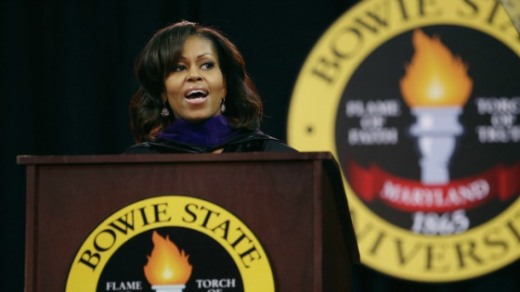
It’s commencement season. Yet amid conservative complaints about liberal dominance of the commencement industry, some speeches have reverberated with conservative ideas. That was no more evident than when Michelle Obama took the opportunity to reiterate more of her husband’s politics of black respectability at Bowie State University.

She told the audience at the historically black college’s graduation last week that the focus on education had been lost by a community with a history in which slaves had risked their lives to learn to read. She spoke of the struggles to integrate America’s schools. But those words were a mere setup to yet again demonizing and pathologizing today’s black youth. “Instead of walking miles every day to school,” she said, “they’re sitting on couches for hours playing video games, watching TV. Instead of dreaming of being a teacher or a lawyer or a business leader, they’re fantasizing about being a baller or a rapper.”

Reducing educational success to choices and blaming dropout rates on false dreams, such claims are a disservice to struggles for justice. Worse, the presumption is that one choice is good and rational, and the other pathological and irrational. The idea that dreaming of a career in hip-hop or athletics doesn’t prepare one to succeed in law or politics is problematic.

The first lady’s shaming message, praising the power of educational bootstraps, echoed her husband’s. At a 2009 speech before the NAACP, President Obama urged the African-American community to take better advantage of education’s equalizing potential. Irrespective of racism, inequality, or segregation, education was the ticket to freedom and prosperity. Urging students to stay in school and keep up their grades, he said, “No one has written your destiny for you. Your destiny is in your hands, and don’t you forget that.” He wanted students “aspiring to be scientists and engineers, doctors and teachers, not just ballers and rappers.”

If only it were that easy.

While the path to colleges is littered with school closures, the hegemony of the testing culture, and divestment from public education—pushing youth of color into the school-to-prison pipeline—the percentage of African-Americans attending colleges and universities is on the rise. That’s no thanks to President Obama, whose administration’s educational policy has done little to rectify persistent inequalities. The rising costs of higher education and the administration’s position on student loans have made it more difficult for African-American families, disproportionately hurt by the recession, to send their kids to college. Still, African-Americans are attending colleges and universities at record levels. Why not celebrate this reality?

Continue reading at Hocus Pocus From Potus and Flotus – The Conversation – The Chronicle of Higher Education.

Forgotten Fathers: Parenting and the Prison Industrial Complex | NewBlackMan (in Exile)

Forgotten Fathers: Parenting and the Prison Industrial Complex | NewBlackMan (in Exile)

Forgotten Fathers:

Parenting and the Prison Industrial Complex

by David J. Leonard | special to NewBlackMan

Happy father’s day to all the fathers and grandfathers, but especially to those in Attica, San Quentin, Angola, and countless other prisons throughout the United States. For many, this is a day of celebration, of happiness and reflection. It is a day where kids give their dads homemade gifts and extra-special hugs. While everyday as a parent brings smiles and laughter, it is day where it is hard not to feel special as a dad. Yet, it should also be a day of reflection, where we as a society think about those who are unable to celebrate as a family. I am speaking about those among us who as Angela Davis laments have disappeared from the public imagination: incarcerated fathers.

According to a report entitled “Children of Incarcerated Parents,” in 2007 America was home to 1.7 million children (under 18) whose parent was being held in state or federal prison – that is 2.3 percent of American children will likely be celebrating father’s day away from dad. Despite hegemonic clamoring about family values, the prison industrial complex continues to ravage American families. Since 1991, the number of children with a father in prison has increased from 881,500 to 1.5 million in 2007. Over this same time period, children of incarcerated mothers increased from 63,900 to 147,400. Roughly half of these children are younger than 9, with 32 percent being between the ages of 10 and 14.

The problem is even more pronounced when looking at Black and Latino fathers. The numbers are startling: 1 in 15 black children lives away from their parent because of incarceration. For Latinos that number is 1 in 41, compared to 1 in 110 for white children. For incarcerated African Americans (1 in 3 black men are currently in prison, jail, on probation or parole), father’s day isn’t simply a day of disconnect from their sons and daughters, grandsons and granddaughters, but one that highlights their separation from their own fathers and entire family.

The consequences of America’s war on drugs (a war principally waged against black and brown America), of America’s “New Jim Crow” (see Michelle Alexander’s work), are evident on this day. Too many fathers, particularly black and Latino fathers, will celebrate alone, away from their sons and daughters. Writing in response to the widespread debate about the state of black fatherhood, Michelle Alexander makes clear the links between the new Jim Crow and “missing black fathers” in America. “Here’s a hint for all those still scratching their heads about those missing black fathers: Look in prison,” writes Alexander. She continues,

The mass incarceration of people of color through the War on Drugs is a big part of the reason that a black child born today is less likely to be raised by both parents than a black child born during slavery. The absence of black fathers from families across America is not simply a function of laziness, immaturity, or too much time watching Sports Center. Hundreds of thousands of black men have disappeared into prisons and jails, locked away for drug crimes that are largely ignored when committed by whites.

The systematic efforts to break-apart families, destroy communities, and separate fathers and mothers from their children is a direct result of the incarceration of drug users. According to Alexander, as of 2005, 4 in 5 drug arrests were for possession by individuals with no history of violence; in the 1990s alone, a period that saw a massive expansion of America’s war on drug users, 80 percent of those sent to prison were done so for marijuana possession. Yet, again we see how this is not a war on drugs or even illicit drug use, but use within the black community even though whites are far more likely to use illegal drugs. In a number of states, between 80 and 90 percent of all drug convictions have been of African Americans.

The impact of the war on drugs transcends father’s day. The systematic effort to dismantle families results in isolation and disconnection from community, support systems, and loved ones 365 days per year. It has resulted in a brain drain and systematic removal of grandfathers and grandmothers, fathers and mothers, sons and daughters – entire communities. On average, children live 100 miles away from their incarcerated parents. A 2000 U.S. Department of Justice Report found that over half of America’s prisoners have not been visited by their children. An expansive and far-reaching criminal justice system touches so many of our lives.

The memory is still vivid. I was sitting in my office, preparing for parental leave of absence, when my phone rang. I could hear the sadness and fear in his voice. He had been convicted and was facing jail time. He was scared of losing his career, the life that he had worked so hard for up until that point, and a future of seeing his kids and grandkids grow up. Listening to my father’s voice was disheartening; the prospect of having to tell my children that grandpa wasn’t going to be there for our next visit was terrifying then for many months to come. Thankfully (and revealing the ways in which privilege operates within the criminal justice system), our family never had to see him go jail. I did, however, see the financial and personal difficulties that besiege so many families. Too many families are being split apart because of expanding and overzealous criminal justice system. Too many fathers and mothers have to tell their children that they have to go away. Too many children wake up each and every day with a parent locked up. Too many children have to go through a metal detector simply to deliver a father’s day wish today.

Last year, in  “Imagine What Father’s Day Is Like for All the Dads and Sons in Prison,” Stephen H. Phelps offered the following father’s day reminder: “Let us take advantage of this Father’s Day to turn our well-wishing toward the ends for which our hearts are shaped; toward compassion for every son and every father who is in prison. And especially for black and brown men in prison.” Reminding us all that “these men are your sons. We are all their fathers,” Phelps calls upon us to collectively remember those who are unable to share this day with their children, who because of the troubling war on drugs are unable to be the fathers they would like to be. So, on the 40th anniversary of the racially-based and ineffective war on drugs, lets work toward the greatest present of all to not only fathers, but mothers, children, and our society at large: its end.

via Forgotten Fathers: Parenting and the Prison Industrial Complex | NewBlackMan (in Exile).

Priorities? America’s Family Values « MomsRising Blog

Priorities? America’s Family Values

by David Leonard

The day remains one of the most vibrant memories of my life. After months of preparation and a day at the hospital, our first child was born. Floating on cloud 9, and focused on taking care of what needed to be done in anticipation of her coming home, I quickly turned my attention back to work. It was spring break at my university so those in those first few days I wasn’t pulled in different directions. That would end before she even turned 10 days old.

I never thought about taking a break from work. That would be unfair to my students, my colleagues, and to all the deadlines in front of me. That is at least what I was told. But really I had no idea I could take time off to spend. Yes, I knew about Family and Medical Leave Act, but I didn’t know I was eligible. I was the father, not the mother.

While my absence in those initial weeks didn’t cause difficulties in terms of what needed to get done –my mother-in-law was staying with us – it led me to feel isolated. I wasn’t part of every “firsts;” I was stuck at the borderlands of parenthood, wanting to be present for every moment yet I stuck at my workplace.

By the time my daughter was 6 months, my partner was back working, leaving me as the primary caregiver. As a university professor, I had the flexibility to care for her whenever I was not in class. When not taking walks, reading or playing, we spent many days together with her by my side as I wrote my first book or prepared lectures. My feelings of isolation were a thing of the past.

The experience wasn’t idyllic as I found myself increasingly criticized for spending so much time with my daughter and not focusing exclusively on my work responsibilities. Good father, bad professor; good father, bad man? My decision to her into the workplace was met with opposition. In one instance, after telling a colleague that I would not be able to attend a meeting the following day because of childcare responsibilities, I was encouraged to consider switching to halftime since I wasn’t able to do my job properly. Angered and frustrated, I remained focused on both my responsibilities as a parent and a professor. As with her birth, the institution didn’t make either of these jobs any easier. Family values in rhetoric only!

In 2006, our second child was born. I hadn’t planned to take any time off for her arrival. No one had suggested that or even noted its availability. Our plans, however, changed quickly as the unimaginable happened. She died after a short and courageous life. Our life was turned upside down. The plans; the preparation; the future had all been changed leaving me with a constant feeling of unease. What else might happen around every corner?

Because of the courage of my partner, we quickly got pregnant again. This time I was determined to spend as much time at home as possible. I was determined to be there for the first bath, the first coo, and any other first. And because of Family and Medical Leave Act I was able to be there each and every day; I was able to share each and every moment with my partner, being there for and with her.

Continue reading at Priorities? America’s Family Values « MomsRising Blog.