NewBlackMan: Book Review | The John Carlos Story: The Sports Moment That Changed the World


Book Review | The John Carlos Story: The Sports Moment That Changed the World

Daring Then, Daring Now: The John Carlos Story

Book Review by David J. Leonard | NewBlackMan

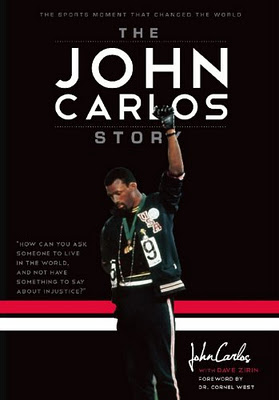
Having studied the 1968 Olympic protest, having conducted an interview with Harry Edwards on the revolt of the black athlete, and being someone dedicated to understanding the interface between sports, race and struggles for justice, I was of course excited about the publication of John Carlos’ autobiography, The John Carlos Story: The Sports Moment that Changed the World. Written with Dave Zirin, the book provides an inspiring discussion of the 1968 Olympics without reducing the amazing life of John Carlos to the 1968 Olympics. More than 1968 or the protests in Mexico City, it chronicles a life of resistance, of refusing to accept the injustices that encompass the African American experience.

John Carlos challenged American racism from an early age. Readers learn of a young man who “went around Harlem handing out food and clothes like Robin Hood and his merry men in Technicolor” (p. 21). Recognizing the level of poverty and injustice in Harlem, and refusing to stand idly by, a young Carlos would break into freight trains to steal food with the purpose of giving it to those who had been swallowed up by the system.

The experience of stealing groceries and good and giving the people something for nothing was positive. Just doing this kind of so-called work opened up my mind and got me to notice what was going on around me. I couldn’t turn my back when I saw evidence of discrimination in the community. I captured it in my mind every time I saw anyone in my neighborhood mistreated by the police (p. 27).

These experiences, like his having to give up on the dream of becoming an Olympic swimmer as a result of societal racism, not only politicized Carlos, but also instilled in him a passion and commitment to help others reach their dreams. It taught about the power and necessity of imagining and fighting for “freedom dreams.”

The John Carlos Story chronicles the ways he has lived a life guided by the philosophy articulated by Fredrick Douglas that “power concedes nothing without demand.” From his organizing a strike at his high school against “the nasty slop they called ‘food’” (p. 33) to his insistence that the manager at the housing protects where he lived address the problem of caterpillars in the courtyard, John Carlos demanded accountability and justice long before 1968.

His book illustrates the level of courage he has shown throughout his life. When the manager refused to address the caterpillar problem, which prevented his mother from joining others in the courtyard because of allergic reactions, Carlos once again lived by the creed: power concedes nothing without demand. John Carlos has lived a life of demanding justice and in the face of refusal demanding yet again. He describes his response in this case as follows:

Then I took the cap off the can and doused the first tree in front of me with gasoline. Then I reached for a box of long, thick wooden matches. After that first tree was soaked, I struck one of the stick matches against my zipper and threw it at the tree and watched. It was a sought: the fire just as that tree like it was a newspaper and turned it into a fireball of fried caterpillars (p. 41).

The compelling life that Carlos and Zirin document extends beyond his youth further reveals a life dedicated to justice. His refusal to accept the racism and the mistreatment experienced while living in Texas encapsulates how America’s racism and systematic efforts to deny both the humanity and citizenship of African Americans compelled Carlos’ activism as a young man and ultimately as an Olympian.

The protest at the 1968 Olympics should not be a surprise given the racial violence experienced by Carlos and his brothers and sisters throughout United States (and the world at large).

Continue reading @ NewBlackMan: Book Review | The John Carlos Story: The Sports Moment That Changed the World.


Dave Zirin: The Sporting Scene: Economics, Race, and the N.B.A. Lockout : The New Yorker


October 24, 2011

Economics, Race, and the N.B.A. Lockout

Posted by Dave Zirin


Last Tuesday evening, at the end of HBO’s “Real Sports,” Bryant Gumbel referred to David Stern, the commissioner of the N.B.A., as a “plantation overseer.” Coming at a point when the players have been locked out for four months, negotiations are at a standstill, and a substantial part of the season has already been cancelled, the remarks added to a simmering debate.

How can the horrors of the slave trade possibly be compared to a billion-dollar labor negotiation? It’s a fair question, but the metaphor, and the conflict it evokes, is as old as professional sports itself. In the nineteenth century, a white player named John Montgomery Ward was described as leading a “slave revolt” against Major League Baseball. In 1964, Muhammad Ali said that he would “no longer be a slave.” Five years later, the baseball player Curt Flood called himself “a well paid slave” because of his inability to exercise free agency (for which he went to court, and lost both the case and his career). Contemporary athletes such as Larry Johnson, Anthony Prior, Warren Sapp, and Adrian Peterson have used the formulation. It’s been deployed by players to describe a feeling of being condescended to—of being treated as boys instead of men—and of lacking control of their own livelihoods.

In the N.B.A., where every owner but one (Michael Jordan) is white, and eighty-six per cent of the players are black, racial tensions have been unspoken but tangible—as illustrated by a scene two weeks ago. David Stern was sitting across the negotiating table from a constellation of the league’s stars. He then became, per his usual style, openly contemptuous of the players “inability to understand” the financial challenges faced by ownership, according to ESPN’s Ric Bucher. He rolled his eyes. He took deep breaths. He then pointed his finger repeatedly toward the face of the Miami Heat’s Dwyane Wade. Wade, who is twenty-nine, is one of the most popular faces in the N.B.A. among fans. He interrupted Stern. “You’re not pointing your finger at me,” Wade said, according to Bucher. “I’m not your child.”

Most immediately, Gumbel’s comments looked at David Stern’s management style through a racial lens. That is, in a sense, tragic, since Stern’s résumé has all the trappings of a racial progressive. He’s served on the board of the N.A.A.C.P. He’s led a league that has long had the best record in terms of hiring people of color as coaches and executives. Even in ownership, the N.B.A. is the only major sport in which a person of African descent sits in the owner’s box. But none of that has protected him from the latest accusations. These dynamics didn’t develop overnight, and for that he bears most of the blame.

Over the last decade, Stern has built reservoirs of bad will. After an infamous 2004 brawl between members of the Indiana Pacers and fans of the Detroit Pistons, Stern said that he had a responsibility to “the ticket-buying fan” to clean up the league. He instituted a dress code. He created a list of verboten establishments where players couldn’t socialize when on the road. He set age limits on when players could enter the league. He met with the Republican strategist Matthew Dowd to discuss how to give the league “red state appeal.” When he had the N.B.A.’s official magazine, “Hoop,” airbrush out Allen Iverson’s tattoos, it was seen as an attack on the “hip-hop generation” of players. Yet Stern did little to reach out or correct the record.

For N.B.A. fans, the most maddening part about this should be that the suspicion of Stern means that no one on the players’ side trusts either him or the financial figures he has been pointing to in negotiations. The league is coming off of the most profitable season in its history, but Stern insists that as many as twenty-three of its thirty teams are losing money. Players don’t believe him, especially as his solution to “the crisis of team profitability” is to take back money that is going to them. Stern refuses to consider a solution that would involve his owners sharing television revenue, as N.F.L. teams do.

Continue reading @ The Sporting Scene: Economics, Race, and the N.B.A. Lockout : The New Yorker.

NewBlackMan: They Ain’t Wealthy, They Are Rich: Economic Lessons from the NBA Lockout

Shaq is rich; the white man that signs his check is wealthy. Here you go Shaq, go buy yourself a bouncing car. Bling-Bling . . . . I ain’t talking bout Oprah, I’m talking about Bill Gates. OK!. If Bill Gates woke up tomorrow with Oprah’s money, he would jump out a …window. I’m not talking about rich, I’m talking about wealthy—Chris Rock

They Ain’t Wealthy, They Are Rich: Economic Lessons from the NBA Lockout

by David J. Leonard | NewBlackMan

In headline after headline, in commentary after commentary, the NBA lockout has been described as a battle between “millionaires” and “billionaires.” Reductionist in many ways, the effort to construct the lockout as a struggle between two different yet similar parties (the owners are not part 99% although some of the players surely are) reflects a problematic conflation of two distinct groups. In “Why We Can’t Dismiss The NBA Labor Dispute As ‘Millionaires Versus Billionaires,’” Scott Keyes warns against the tendency to link and otherwise obliterate substantive differences between players and owners: “Conflating the two groups as similarly-placed economic royalists, neither of whom deserve sympathy from an American public grappling with a depressed economy, is understandable. But to create an equivalency between millionaire players and billionaire owners obscures a scarier picture regarding the players’ long-term economic prospects.” Discussing the very different long term economic prospects between owners and players, Keyes points to several larger issues at work: the differences between workers and owners, the differences between a salary and an investment, and the very different economic futures of each group.

Yet, one of the more striking aspects of the media coverage and public discussions of the NBA lockout is a continued inability to distinguish between income and wealth. This isn’t surprising given shows Cribs and media focus on player salaries. The danger, however, is quite evident. In a society where, according to a recent study from Brandeis University, black and white wealth inequality has dramatically increased in the 23 years from 1984 to 2007, the failures to distinguish between the wealth of players and owners has a larger context. Accordingly,

The gap between Black and white households ballooned during the 23-year study period, as white families went from a median of about $22,000 in wealth to $100,000 – a gain of $78,000. In the same period, Black household wealth inched up from a base of $2,000 per family to only $5,000. The sweat and toil of an entire generation had netted Black families only $3,000 additional dollars, while white families emerged from the period with a net worth of 100 grand that can be used to send a couple of kids to college, make investments, help out other family members, or contribute to the larger (white) community.

In other words, despite the accumulated income (some wealth) by a handful of African American athletes and entertainers, and a growing black middle-class, black-white wealth disparities have increased and that was before the economic downturn. The NBA lockout offers a window into the larger issues of wealth disparity and power differentials and the ways in which race-based wealth disparities operate in myriad of American institutions. The efforts by the owners to further the disparity in income and wealth, while very different given the salaries of scale, illustrates the level of disparity that defines class and racial inequality in the twenty-first century.

Continue reading at NewBlackMan: They Ain’t Wealthy, They Are Rich: Economic Lessons from the NBA Lockout.

NewBlackMan: “Our Justice System at Its Worst”: Date Set for Troy Davis Execution

“Our Justice System at Its Worst”:

Date Set for Troy Davis Execution

by David J. Leonard | NewBlackMan (#TooMuchDoubt)

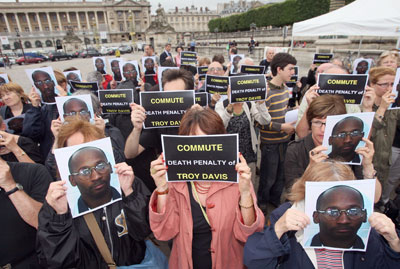
This week, Georgia announced its plans to carry out the execution of Troy Davis. While there remains time to thwart this miscarrying of justice, the planned execution should give pause to us all.

In absence of forensic evidence or a murder weapon, an all-white jury convicted Davis of the 1989 murder of a police officer in Savannah. The basis of the conviction was the witness testimony of nine individuals (7 eyewitnesses and 2 “jailhouse snitches”), many of who have subsequently spoken about police pressure. In fact, since his conviction, all but two of the prosecution’s non-police witnesses have recanted or contradicted their own testimonies, leaving the conviction in doubt. At the same time, 9 individuals have signed affidavits implicating another individual who happens to be one of the two witnesses who have not reversed on original testimony. Notwithstanding these significant doubts raised during the appeals process, one that has never allowed for his defense team to fully explore the recanting witness testimony, Davis’ conviction has remained, resulting in the issuing of his death warrant yesterday.

As part of its announced plan to stop the execution of Davis, the NAACP described the injustice in the following way: “This is our justice system at its very worst, and we are alive to witness it. There is just too much doubt.” Calling for people to take action to save Troy Davis’ life, his case points to larger racial issues that demand action as well.

His conviction and the decision to proceed with his execution should give pause given the research on race and witness identification. According to the Innocence Project, 75% of wrongful convictions overturned by DNA were the result of witness misidentification. “While eyewitness testimony can be persuasive evidence before a judge or jury, 30 years of strong social science research has proven that eyewitness identification is often unreliable” reports the Innocence Project. “Research shows that the human mind is not like a tape recorder; we neither record events exactly as we see them, nor recall them like a tape that has been rewound. Instead, witness memory is like any other evidence at a crime scene; it must be preserved carefully and retrieved methodically, or it can be contaminated.”

One of the sources of contamination is clearly race and the myriad of assumptions that result from an institutionalized system of stereotyping. In “Cross-Racial Identification Errors in Criminal Cases,” Sheri Lynn Johnson highlights the unreliable nature of “eye-witness” testimony, a fact that is exacerbated in cross-racial situations. Evidence from actual cases and in research studies elucidate the ways in which race and the larger social meanings attached to blackness play a significant role within the process of witness identification. In a study conducted with white students at University of Illinois and black students at Howard University, researchers showed them pictures of 10 white and 10 black individuals for a second and half; then, they were are asked to recall the pictures from a series of other photos. According to Elizabeth F. Loftus, in Eyewitness Testimony:

[T] he subjects were clearly better able to identify members of their own race. This study was later duplicated with the addition of Asian students. Again [African Americans] had greater difficulty recognizing faces of whites and Asians. Interestingly, however, whites and Asians had relatively little problem in identifying members of each other’s race – though both had trouble identifying [African Americans]. (from review of book)

The psychological obstacles facing witnesses along with the ways in which race further complicates the process is well documented. Yet, we continue to rely on witness testimony within the criminal justice system. The power of the white racial frame illustrates the reasonable doubt inherent in eyewitness testimony. In a society where black is akin to criminal, so much so that within the dominant imagination there exist a distinct category, the “criminalblackman” (Russell, 1998, p. 3), it is crucial to reflect on what is at stake with Troy Davis: his life and so many others.

The planned execution of Troy Davis also points to a larger question of the racial application of the death penalty within the United States. According to David Dow, 35 years into the return of the death penalty “It remains as racist and as random as ever.” Referencing the often-cited Baldus Study, which “found that black defendants were 1.7 times more likely to receive the death penalty than white defendants and that murderers of white victims were 4.3 times more likely to be sentenced to death than those who killed blacks,” Dow highlights the racist application of the death penalty. Cases involving an alleged black perpetrator and a white victim are far more likely to result in the death penalty. Although, “nationwide, blacks and whites are victims of homicide in roughly equal numbers . . . 80 percent of those executed had murdered white people.”

PLEASE CONTINUE READING @ NewBlackMan: “Our Justice System at Its Worst”: Date Set for Troy Davis Execution.