NewBlackMan: Is the NBA Lockout About Race?


Is the NBA Lockout About Race?

by David J. Leonard | NewBlackMan

thought I would write a follow-up to my piece, “Bill Simmons and the Bell Curve: The ‘limited intellectual capital’ of the NBA’s Players” which has elicited a significant reaction.   It should be clear from the outset, I am not interested in conversations about individuals, intention, or motivation.  To paraphrase the always-brilliant Jay Smooth, the conversations should focus around what has been said, what has been done, and what all of this means in a larger context rather than the individual actors.  The discussion needs to be about how ideology, narrative, and frames operate within these larger discussions. 

One of the common responses to Bill Simmons’ commentary and more specifically the criticism directed at me for reflecting on the racial meaning in those comments has been that Simmons was talking about all NBA players, not just those who are black.  Given the racial demographics of the league and the racial signifiers associated with basketball, it is hard to accept the idea that “NBA player” isn’t a mere code for blackness.  In other words, blackness and basketball become inextricably connected within the dominant imagination, akin to Kathryn Russell-Brown’s idea of the criminal blackman.  Just as the “criminal Blackman” exists as contained identity within the dominant white imagination, the blackballer functions in similar ways. 
The process of both essentializing and bifurcating the black baller is evident in the very distinct ways that the white racial frame conceives of both white and black players, playing upon ideas of intelligence and athleticism.  Whereas the blackballer is imagined as athletic, naturally gifted, and physically superior, white basketball players are celebrated for their intelligence, work ethic, and team orientation.  In Am I Black Enough for You, Todd Boyd identifies a dialectical relationship between racialization and styles of play where whiteness represents a “textbook or formal” style basketball, which operates in opposition “street or vernacular” styles of hooping that are connected to blackness within the collective consciousness.   In both styles of play, notions of intelligence, mental toughness, and mental agility are centrally in play. 
A second and widely circulated denunciation against those critical voices has been our lack of fairness or the double standards of this portion of the discourse.  Whereas I honed in on Simmons’ comments, little has been made about those of Jason Whitlock (Bryant Gumbel has been the at the center of media commentary).  Lets be clear: the comments of Jason Whitlock, irrespective of intent, are worthy of criticism in that his recent commentary plays upon and reinforces dominant narratives and frames about race and blackness.  Looking at his comments, alongside with those of Simmons, further illustrates the ways in which ideologies are circulated, and how commentaries such of these cannot be understood outside of these larger contexts.


A belief in the superiority of white intelligence has been commonplace within American history.  This remains the case today. In one earlier study (during 1990s; see here for another source) about the persistence of racial stereotypes, the author found the following:

More than half the survey respondents rated African Americans as less intelligent than whites. Fifty-seven percent of non-African Americans rated African Americans as less intelligent than whites and thirty percent of African Americans themselves rated African Americans as less intelligent than whites. Sixty-two percent of the entire sample rated African Americans as lazier than whites and more than three out of four survey respondents said that African Americans are more inclined than whites to prefer welfare over work.

In a 2010 study about race and politics, researchers at the University of Washington found that stereotypes about blacks as it relates to intelligence, work ethic, and trust-worthiness remain prominent. Another recent study about race, politics, and stereotypes found that while there has been slight progress in terms of the rejection of longstanding prejudices, they remain constant within the national discourse. 

Continue reading (there is more) @ NewBlackMan: Is the NBA Lockout About Race?.

Bryant Gumbel, the NBA Lockout and David Stern as “Plantation Overseer”

In what was a refreshing and inspiring end to the always-great Real Sports, Bryant Gumbel took David Stern to task for his arrogance, “ego-centric approach” and eagerness “to be viewed as some kind of modern plantation overseer, treating NBA men, as if they were his boys.”  You can see the full transcript below.  I applaud Gumbel for speaking truth to power and disrupting the narrative that has demonized players and pushed the blame in their direction. Not surprisingly, his comments have evoked criticism and scorn: Example #1, Example #2, Example #3)

Even less surprising commentators have chastised Gumbel for inserting race into the discussions, as if race wasn’t central to the lockout, the media coverage, and its overall meaning.   Keep up the good work Bryant, keep challenging the sports media, which so often functions as communications director for the NBA and David Stern.  The response to Gumbel, and the ubiquitous efforts to blame the lockout and the labor situation on the players through racialized language (see here for example – h/t @resisting_spec), illustrates the ways in which race and hegemonic ideas of blackness operates in this context.

Full Statement from Gumbel:

If the NBA lockout is going to be resolved anytime soon, it seems likely to be done in spite of David Stern, not because of him. I say that because the NBA’s infamously ego-centric commissioner seems more hell-bent lately on demeaning the players than resolving his league’s labor impasse.

How else to explain Stern’s rants in recent days? To any and everyone who would listen, he has alternately knocked union leader Billy Hunter, said the players were getting inaccurate information, and started sounding Chicken Little claims about what games might be lost, if players didn’t soon see things his way.

Stern’s version of what’s been going on behind closed doors has of course been disputed. But his efforts were typical of a commissioner that has always seemed eager to be viewed as some kind of modern plantation overseer, treating NBA men, as if they were his boys.

It’s part of Stern’s M.O. Like his past self-serving edicts on dress code or the questioning of officials, his moves were intended to do little more than show how he’s the one keeping the hired hands in place. Some will of course cringe at that characterization, but Stern’s disdain for the players is as palpable and pathetic as his motives are transparent. Yes the NBA’s business model is broken. But to fix it, maybe the league’s commissioner should concern himself most with a solution, and stop being part of the problem.

NewBlackMan: Not About a Salary, but a Racial Reality: The NBA Lockout in Technicolor

Not About a Salary, but a Racial Reality: The NBA Lockout in Technicolor

by David J. Leonard | NewBlackMan

With the NBA lockout reaching a new low (or a return low) with David Stern’s announcement of the cancellation of the first two weeks, the class of pundits have taken to the airwaves to lament the developments, to asses blame, and offer suggestions of where to go from here. Not surprisingly, much of the commentaries have blamed players for poor tactical decisions, for wasting any potential they may have had over the summer, and for otherwise being too passive. Take Harvey Araton, from The New York Times, who while arguing that the players will need to take risks in order to secure leverage, speculates about a potential missed opportunity:

If it sounds unrealistic to suggest that the modern player might have considered striking first — or at least threatening one before last spring’s playoffs — that is only because the tactic has become virtually anathema, which is a mighty curious weapon for a union to concede.

While on the phone, Fleisher looked up the language in the expired collective bargaining agreement on Pages 264-265 that prohibited players from impeding N.B.A. operations. But supposing the players had gone ahead and walked out on the eve of the playoffs after they’d all been paid their regular-season hauls?

Fleisher guessed they would have opened themselves and their individual contracts up to a court action. Or maybe the owners — petrified at the thought of their profit season being flushed — might have agreed to a no-lockout pledge for the start of this season. Who knows? But sometimes risk begets reward.

While abstract at a certain level, the argument makes sense. Had the players been more aggressive, had they taken steps earlier, had they capitalized on past leverage, the situation might be different. Yet, we don’t live in an abstract world. The realities on the ground precluded such steps (see here for my past discussion). If the efforts to blame players, to demonize them as greedy, selfish, and out-of-touch during a LOCKOUT is any indication how the public might have reacted to a player strike, especially one starting at the playoffs, the strategy suggested here is pure silliness.

Moreover, it fails to understand the ways in which race operates in the context of sports and within broader society. The public outcry against LeBron James for exercising his rights of free agency, the condemnation of Deron Williams or Carmelo Anthony for deciding that they wanted to play elsewhere, and the overall vitriol directed at players illustrates both the impossibility of any player leverage and the ways in which race undermines any structural power the players may enjoy. The owners possess the power of the racial narrative that both guides public opinion and fan reaction.

We can make similar links to the larger history of African American labor struggles, where black workers have struggled to secure support from the public at large because of longstanding ideas of the lack of fitness/desirability of African Americans in the labor force. In other words, fans, just as the public in past labor struggles, see the black body as inherently undeserving and thus any demands for fairness, equality, and justice are seen as lacking merit. On all counts, the commentaries fail to see the ways and which blackness and anti-black racism constraints the tools available to the players.

Even those commentaries that ostensibly exonerate the players in highlighting David Stern’s strategy of throwing the players under the proverbial racial bus (his race card) with the hopes that the public will ultimately turn against the players (mostly there already) erases race from the discussion. For example, in “Stern ducks, lets NBA players take hit,” Adrian Wojnarowski highlights the difficulty facing NBA players and how that reality guides the intransigent position from the firm of Stern and owners. “So, there was the biggest star in the sport waddling onto the sidewalk on 63rd Street in Manhattan on Monday night without the kind of big-stage, big-event scene that the commissioner always loves for himself in the good times,” he writes. “He knows the drill now: Step out of the way, and let the angry mobs run past him and the owners. Let them chase his players down the street, around the corner and all the way to the lockout’s end and beyond.”

Continue reading @ NewBlackMan: Not About a Salary, but a Racial Reality: The NBA Lockout in Technicolor.

Honorée Fanonne Jeffers: What if Touré were White?

What if Touré were White?

Honorée Fanonne Jeffers

Touré on the ESPN website, entitled “What if Michael Vick were white?”  Above the actual article was adisturbing sight: Michael Vick in “white face” with light hair and light eyes. (This article also appears in the latest ESPN magazine.)

I know next to nothing about sports, and I don’t find sports interesting, either, so I almost didn’t read the article.  (To read an analysis of Touré’s piece by someone who does know about sports, check out this brilliant post by David J. Leonard.) I knew that I would encounter certain “insider” terms about sports in a, well, sports magazine.  I only read on because of the provocative title. But luckily, I need to know absolutely nothing about sports to understand Touré’s inflammatory and downright rude article, because it wasn’t about sports. It was about the pseudo-science of analyzing “race.”

Only in this article, Touré wasn’t analyzing the constructed concept of “race;” instead, he was making sweeping generalizations about Black culture, and reinforcing coded cultural and class stereotypes. Throughout my reading this article on Michael Vick, instead of asking myself the question I was su       pposed to—what if Vick were white—I found myself asking instead, what if Touré were white?

Now, before I go any further, let me say that I’m no fan of Michael Vick. I think what he did to those poor animals was horrible. And I’m also past tired of Black (and some White) folks trying to give Michael Vick a bleeding heart pass for inhumane treatment to God’s creatures and whining about he caught a bad break because he was African American. I don’t care what race he was; I think he should have done way more time than he already did.

Yes, I said it. Snatch my Black card, and I don’t care. I can always get me another one down at the Target.

But let me say that the sort of strange racial rhetoric on the other side of this debate, about the “nature” of Black men and Black culture is infuriating as well. And seriously tacky. In Touré’s defense, this rhetoric was going on long before he waded into this fray with his singular, accented moniker and “throwback jam” Enlightenment philosophy.

However, Touré’s article takes this rhetoric to the next, unsavory, near-skull measuring level. Again, this article is not about sports, though Touré begins with bloviated, quasi-lyrical language, using such terms like “in the pocket” and  (I guess) establishing his Black bonafides with the use of the Black vernacular, as when he writes:  “I’m not saying that a black QB who stands in the pocket ain’t playing black. [Emphasis mine.]

Okay, stop.

What the heck does “playing black” mean? I’m not even a sports fan and I know that’s not one of those complicated technical terms. And if a White writer said some sort of essentialist crap like somebody “plays black” that we’d be all over him. Why doesn’t Touré just start talking about antebellum slave breeding practices that produced better athletes while he’s at it? Like we haven’t already heard that one before.

Then, Touré goes on to imply that is Michael Vick were white and middle-class, he wouldn’t have been dogfighting in the first place.

Continue reading at What if Touré were white

NewBlackMan: America’s Most Wanted? The Locked Out NBA Baller

Saturday, August 13, 2011

America’s Most Wanted? The Locked Out NBA Baller
Saturday Edition

America’s Most Wanted? The Locked Out NBA Baller

by David J. Leonard | NewBlackMan

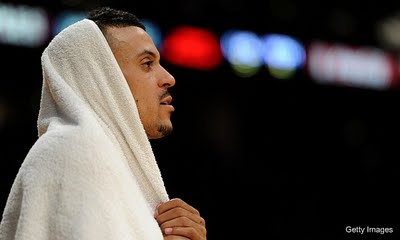
While the NBA players remained locked out by the owners, they continue to be subjected to what Alice Walker describes as “a prison of image, whereby stereotypes function not as errors, but rather forms of social control.” The media reports resulting from two separate altercations invoking Matt Barnes and Michael Beasley, and efforts to connect them to the NBA lockout, the culture of the NBA, and blackness demonstrates the power and threats inherent in these imprisoning images.

Trying to wax sociological, Chris Haynes, in “Overseas Not Problem, Pickup Games Are NBAers will continue to get into trouble if they keep playing streetball, ”uses Beasley and Barnes to point to the bigger dangers of the NBA lockout: the NBA player. “The NBA just like any other professional league, is also comprised of young, immature, volatile, emotional players who need structure in their lives 365 days out of the year. Unable to workout and have contact with their individual teams, players may be left searching for a good pickup game to stay in shape.” In other words, the NBA lockout will lead these immature and volatile to be free on the streets (playing street ball), just waiting to attack the nearest fan or competitor.

Celebrating the “grounded players such as Steve Nash, Derek Fisher, Tim Duncan and Dirk Nowitzki” (the good ones) Haynes is concerned about the behavior of the OTHER (the bad ones) NBA star during the lockout. He goes on to argue that the danger stems not only from the lack of structure experienced during the lockout, but the backgrounds of the players themselves:

Several players come from poverty-stricken backgrounds and still have some form of street mentality embedded in them. In the heat of the moment, competing against amateurs who are disrespecting and derogating athletes in their face, is a bad recipe for something potentially to pop off. Beasley and Barnes are lucky, it could have escalated to firearms.

The efforts to link “poverty” to criminality is problematic at many levels. At one level, it demonstrates the power of stereotypes and racial narratives relative to black bodies given the backgrounds of both Barnes and Beasley. Barnes, who was born in Santa Clara, California, and grew up in Sacramento, is the son of Ann and Henry Barnes. His mother, who died of cancer is 2007, was an elementary school teacher that worked with mentally challenged kids. His biography (like so many in the NBA – over half of NBA players grew up in Suburban neighborhoods) doesn’t mesh with the stereotypical discussion of inner-city ballers that Haynes works through in this piece. Likewise, Beasley, who was home-schooled and raised by his mother, Fatima Smith, exists on a different plane.

At another level, the media discourse evident here reflects a larger history of white racial framing and white supremacy. Playing on a myriad of racial narratives and tropes, Haynes uses the Beasley and Barnes incident, as well as the assumptions about streetball, the rhetoric here reflects a larger history of race in America.

For Elizabeth Alexander, the nature of racism within the United States is defined by practices wherein black bodies are systematically displayed “for public consumption,” both in the form of “public rapes, beatings, and lynchings” and “the gladiatorial arenas of basketball and boxing” (1994, p 92). Jonathan Markovitz similarly locates the criminalization of the black body within the narratives of the sports media: “The bodies of African American athletes from a variety of sports have been at the center of a number of mass media spectacles in recent years, most notably involving Mike Tyson and O.J. Simpson, but NBA players have been particularly likely to occupy center stage in American racial discourse.”

Amid the NBA lockout, the narrative space available for NBA players is increasingly limited to the projects of demonization and criminalization that are central to white supremacy. The coverage afforded to these instances, the efforts to spotlight their missed-steps as evidence of a larger problem facing the NBA, the narrative prison that links them to larger frames regarding black criminality, and the rhetorical devices offered demonstrates the process of criminalization central to the history of black America.

TO CONTINUE READING GO NewBlackMan: America’s Most Wanted? The Locked Out NBA Baller.

NewBlackMan: Brandon Marshall and the Challenge to Mental Health Treatment Inequality

Vulnerable:

Brandon Marshall and the Challenge to Mental Health Treatment Inequality

by David J. Leonard | NewBlackMan

On Sunday, amid all the hoopla about the start of NFL training camp, player movement, and the start of the NFL season, Brandon Marshall quietly told the world a secret, announcing that he was living with a Borderline Personality Disorder.

Right now today, I am vulnerable, I making myself vulnerable, and I want it to be clear that this is the opposite of damage control. The only reason I am standing here today is to use my story to help others who may suffer from what I suffer from, from what I had to deal with. I can’t explain to you and paint a vivid enough picture for you guys where I been in my life, probably since the end of my rookie year.

Noting that neither the cars nor the fame, neither the success on the field nor the joys experienced off the field resulted in happiness, Marshall highlighted the despair that he has experienced during his life:

I haven’t enjoyed not one part of it and it’s hard for me to understand why . . . . One of the things I added to my prayer was for God to show me my purpose here. When I got out of the hospital, I called my videographer and I said, Rob, grab your camera and just come to my house and just start shooting. I said I’m very depressed right now, I probably won’t talk, I probably won’t even leave my theater room, but you just shoot and don’t stop shooting. I said, I don’t know where we’re going with this, I don’t know what’s going to come out of this, but something good is going to happen.

Marshall is not the first high-profile African American athlete to publicly document the struggles with mental illness. Several years ago, Ricky Williams spoke about his illness (Social Anxiety Disorder) “to up the awareness and erase the stigma.” Likewise, Ron Artest, who has publicly acknowledged his own disease, has gone beyond chronicling his own story, testifying before congress while raising money (through auctioning off his championship ring) for mental health awareness among youth.

Continue reading at  NewBlackMan: Brandon Marshall and the Challenge to Mental Health Treatment Inequality.

NewBlackMan: “No Dad at Home:” James Harrison, Colin Cowherd and the Case Against the Black Family

“No Dad at Home:”

James Harrison, Colin Cowherd and the Case Against the Black Family

by David J. Leonard | NewBlackMan

In a recently published article in Men’s Journal, James Harrison questions the fairness and the administrative philosophy adopted by commissioner Roger Goodell. Referring to Goodell as a “crook,” “puppet,” “dictator” and a “punk” (among others things), Harrison problematizes the ways in which race operates within the NFL. “Clay Matthews, who’s all hype — he had a couple of three-sack games in the first four weeks and was never heard from again — I’m quite sure I saw him put his helmet on Michael Vick and never paid a dime,” notes Harrison. “But if I hit Peyton Manning or Tom Brady high, they’d have fucked around and kicked me out of the league.” And: “I slammed Vince Young on his head and paid five grand, but just touched Drew Brees and that was 20. You think black players don’t see this shit and lose all respect for Goodell?”

In a lengthy piece, entitled “Confessions of a Hitman,” Harrison discusses a myriad of issues. Yet, his comments about the commissioner, and his references to racial inequality in the punishment of players, have not surprisingly prompted the most widespread media commentary and condemnation. For example, Gregg Doyel, with “Goodell is a strict disciplinarian, but he’s no racist,” scoffed at the claim the Goodell is a racist or even that he treats black players differently/unfairly (he and others may want to read the work of Herbert Simmons and Vernon Andrews – here is a second piece by Andrews).

Goodell runs his league the way strong parents run their family: With rules, with parameters, with discipline. No shortcuts. No excuses. Tough love all the way, and if the players don’t like it, well, it happens. Does a 16-year-old like it when he sneaks out for a night of drinking, gets busted, then gets grounded for three months? No, the teenager doesn’t like it. Shocking

Building upon this argument during a discussion about Doyel’s piece, ESPN’s Colin Cowherd took to the air to recycle longstanding arguments about black families, single-mothers, absentee fathers, and the purported cultural shortcomings of black America.

Here is something that is interesting, if you look at basic metrics or numbers in this country. 71% of African Americans no Dad at home; no disciplinarian. Fathers are often louder voice, the disciplinarian. Many of those kids don’t grow up with a dad, raised by mom, sister, aunts, nieces, uncles whatever.

They go to college where they are stars. And basically even their college coach, as we saw with Ohio State, pretty much lets the stars run the program. The NFL is one of the first places where many star players finally see discipline. Finally have an authoritative male figure – buck stops here, I will make all the calls, you will not get an opinion.

This was not the first time Cowherd talked about black families in relationship to sports, having questioned John Wall’s leadership abilities because of his limited relationship to his father (his father was incarcerated during Wall’s childhood, dying of liver disease when Wall was age 9).

Let me tell you something: I’m a big believer, when it comes to quarterbacks and point guards. Who’s your dad? Who’s your dad? Because I like confrontational players, I don’t like passive aggressive. Strong families equal strong leaders. Talent? Overrated. Leadership? Underrated. And you can say, well, Colin, can you just go out and say anything crazy and get people to e-mail. That’s not the point. You wouldn’t e-mail if I was an idiot, because you wouldn’t listen to the show. You listen to the show because we make good points.

I simply have a different opinion than you do on John Wall. I like the character of Derek Fisher, the rebounding and distribution ability of Rajon Rondo, that’s what I like. That’s what I want from my point guards. You celebrate the assists more than the buckets…..I know he’s great. So don’t confuse [me saying] John Wall’s no good. No, John Wall’s an A+ talent. I don’t think he’s ever gonna be an A+ win-championships point guard.

In both instances, the efforts to recycle the Moynihan report, to define father as natural disciplinarian and mother’s nurturing, to link cultural values to family structures, and to otherwise play upon longstanding racial stereotypes, is striking. However, I would like to reflect on his recent comments in a substantive way.

First and foremost, the idea that 71% of black children grow up without fathers is at one level the result of a misunderstanding of facts and at another level the mere erasure of facts. It would seem that Mr. Cowherd is invoking the often-cited statistics that 72% of African American children were born to unwed mothers, which is significantly higher than the national average of 40 %. Yet, this statistic is misleading and misused as part of a historically-defined white racial project.

Continue reading at NewBlackMan: “No Dad at Home:” James Harrison, Colin Cowherd and the Case Against the Black Family.