You aint funny or cutting edge: A letter to Jason Horton

Dear Jason  (@Jason_Horton), AKA “the world’s only white male comedian”; AKA the man who played the slave master rapist in ‘Harriet Tubman Sex Tape.’

How does it feel to be part of one the most vile videos I have seen in a long time.  Spare me your explanations about comedy and satire.  You participation (your role) and the video itself are all about as funny as Paula Deen and Rush Limbaugh.  Your Los Angeles address and hipster jeans don’t mean anything to me.  I cannot see into your heart, but your “work” tells me something. I see a video that perpetuates racism, sexism, and violence.  It traffics in dehumanizing images, finding pleasure in other’s pain. I see you and your partners in moral crime (Simmons and others who made this video deserve plenty of criticism and condemnation – go here and here and take a read and then come back to reflect on your own responsibilities) as merely recycling  ideas that have for centuries justified black suffering, sexual violence directed at black women, and enslavement.

I know the satire argument is coming, but it’s not funny, it’s not satire (what are you satirizing? toward what end?) and if you think that is funny, what does that say.  What does it say that you were willing to be a piece  that feels like a remake of Birth of a Nation.  This slavery porn pathologizes black bodies, renders them as objects of ridicule and violence.

Jason, you once noted “I also grew up in the punk rock/hardcore rebellious culture. I really have a similar mentality when it comes to comedy. I think comedy should be dangerous.” What is dangerous about reinforcing many centuries of white supremacy?  What is dangerous in perpetuating stereotypes about oversexed black women seducing their white masters?  What is dangerous in profiting and relishing off black death?  Stereotypes?

You seem very invested in positioning yourself as cutting edge, as new, and as hip?  Congratulations, you just participated in a video that would make D.W. Griffith proud.  You just acted in video that seems to have taken cues from some of America’s most racist forms of popular culture.  Cutting edge is not 19th century minstrelsy.  Is that what you call hip? Is that what cutting edge looks like to you?  In your eyes, would Thomas Dixon be a cutting edge writer; would bull connor be a cutting edge police man; George Wallace an edgy politician; would Henry Ford be a cutting edge business man?

I imagine you think this video is funny – what is funny about slavery, about rape, about the thousands of black men and women, beaten, brutalized, and enslaved at the hands of people who look you and me.  I predict that you think it’s just a “joke,” but maybe that’s because the “joke” isn’t about you, isn’t about your family and community.

The mere idea that anyone could find humor here is the ultimate expression of privilege – male privilege, white privilege.  Is it easy to reenact rape, to mock black suffering and death, from a distance?  How can you not feel the anguish and pain resulting from your participation and that pain is not just in history but evident today?

Can you name 5 things about Tubman (or even slavery); maybe if you spent less time making infantile YouTube videos and more time reading, you would have known better.  But your lack of knowledge aint my concern. Your participation in this video is reprehensible; your participation is a sign of disrespect and ignorance about Harriet Tubman; you have spit on her life and legacy, her struggle for freedom and justice.

In case you get some time, I encourage you to read about Tubman, about slavery, and about the history of rape and lynchings.  Trying something else cutting edge – intelligence, knowledge.  Try studying and you might learn about the history of black resistance in the face of white supremacy in all its forms. As I am not sure if you will open a book, at least read this brief summary of Tubman’s life from @prisonculture

Araminta Ross (Harriet Tubman) became a “slave for hire” at the age of 5. She did domestic work, field work, cared for children…She once said that one of her mistresses would savagely whip her almost every day, first thing in the AM. When she was teenager, she stood before an overseer who was in pursuit of another slave. He took a lead weight & crashed it on her head. She was deeply wounded. She said that the blow “broke her skull.” She was carried back bleeding. She had no bed. They lay her on the floor. She was sent back to her parents who thought she would die. She survived. She went on to become Harriet Tubman. She freed slaves daringly & without fear. This is the person who @UncleRUSH laughed.

That is the person you mocked; that is the person you disparaged; that is the person whose community you enacted violence on today; that is the person you pretended to rape.  Read it again. Learn about the “Moses of her people”

You have said very little since the release of your historic porn. But I can hear the defense of this video and its participants.

Ignorance is not a defense.  And “I am sorry if I hurt your feelings” is not an apology.   The ability to be ignorant, to be unaware of the history and consequences of racial bigotry, and misogyny, to simply do as one pleases, is a quintessential definition of privilege.  The ability to disparage, to demonize, to ridicule, and to engage in racially hurtful practices from the comfort of one’s YouTube channel, from one’s segregated neighborhood, from one’s hipster enclave reflects both privilege and power. If you refuse to see, think, or feel outside your own experiences you are merely cashing in on those privileges.  At whose expense?

The ability to blame others for being oversensitive, for playing the race card, or for making much ado about nothing are privileges codified structurally and culturally.  Jokes about slavery, about sexual violence, about rape, about a history of white supremacy, about Harriett Tubman, are never a neutral form of entertainment, but loaded sites for the production of damaging stereotypes and violent images.

How about you take some responsibility and condemn yourself for being part of this video; now that would be cutting edge?

—-

Post Script – In addition to the articles above, I encourage any to read Kimberly Foster’s Twitter timeline, this piece by Jamilah King, and this from K Lynn Dreher

Please also read this important contextual piece at Feminist Wire.

Apologies for few typos/errors in original post and getting Mr Horton’s first name wrong.  Should be all corrected now

What’s yours is mine, and what’s mine is mine: The White Nature of Meritocracy

A recent post from Insiderhighered.com, entitled “Meritocracy or Bias?,” prompted widespread debate on social media regarding race, affirmative action, and definitions of meritocracy.

The study here does not reveal a fluid or shifting understanding of meritocracy.  Yes, in one context white respondents were “asked to assign the importance they thought various criteria should have in the admissions system.”  Not surprisingly, this group cited test scores and grades as the centerpiece of any admissions’ decisions.   Given racial stereotypes and the broader discourse regarding affirmative action, is it surprising that merit was defined through standards PRESUMED to be advantageous to white applicants?  Is it surprising that hard work and “earning” admission to a college of university erases both history and contemporary inequality in such a manner that whiteness is central to dominant definitions of merit and deservedness?

In the other context, white respondents “received a different prompt, one that noted that Asian Americans make up more than twice as many undergraduates proportionally in the UC system as they do in the population of the state.” When told about potential Asian applicants, the definition of merit shifted the focus away from test scores and GPA.  Instead of those traditional metrics, white respondents now saw leadership and other intangible qualities as important.

The findings are revealing on so many levels.  The mere mention of Asian American applicants seemingly scarred the white respondents.  One can deduce that “Asian American” conjured up a narrative of academically successful applicants whose test scores and grades would lead them to rise to the top (unless merit was defined in other ways).  It should also be noted how Asian Americans is seen through the narrative of model minority discourse.

The author of the study, Frank Samson, describes the findings as such:

Sociologists have found that whites refer to ‘qualifications’ and a meritocratic distribution of opportunities and rewards, and the purported failure of blacks to live up to this meritocratic standard, to bolster the belief that racial inequality in the United States has some legitimacy. However, the results here suggest that the importance of meritocratic criteria for whites varies depending upon certain circumstances. To wit, white Californians do not hold a principled commitment to a fixed standard of merit.

At face value, there appears to be a dynamic shift in what constitutes merit, what constitutes the desired standards colleges and universities should use for admission decisions.  Yet, in both contexts, the desirability of and centrality of whiteness remains clear.  Whiteness is what is meritorious and everything else is secondary.  The rules and the standards must reflect and reaffirm the spots reserved for white students.  “Why is this journalist and the researcher portraying whites’ takes on meritocracy as fluid when the evidence presented actually suggests they are as rigid as can be,” notes Dr. Carmen R. Lugo-Lugo, associate professor of Culture, Gender, and Race at Washington State University. “Whites believe in meritocracy as long as it keeps them and their children on top. Nothing fluid about that, as fluidity suggests some kind of shift in mentality and/or behavior.”

Indeed, there is no change to their definition or understanding of meritocracy.  It is not a shift in what are the desired qualities or qualifications perspective students should possess but an effort to preserve white entitlement. If rules need to be changed to preserve white admissions then that takes place. It seems that there is continuity in terms of definition of merit and that begins and ends with whiteness.  In other words, this isn’t a “flip flop” as argued, but the manifestation of racism, white privilege, and the racial standards that are engrained within American culture.  It is about focused effort to maintain a system that preserves and protects white entitlement; it is about protecting spots presumed to be for “whites.”  The predetermined rightful place of whites within higher education remains constant.  The paths to achieve this reality changes but the centrality of white supremacy is steady.

The efforts to protect white privilege, to enshrine white spots in higher education, and to otherwise center whiteness as the basis of merit is nothing new.  The examples are endless throughout history from voting rights to rights of citizenship (due process; innocent until proven guilty whites; guilty until proven innocent for people of color).  And the rules and laws simply shift according to the needs and desires of whiteness.  In 1915, a team of Filipino clerks defeated their white American bosses in volleyball.  Refusing to acknowledge the merit of their victory, the white bosses denounce their play as “unsportsmanlike” and “deceptive,” they simply changed the rules to protect white merit.  No longer able to bump the ball 52 times before sending it over the net (which they reportedly did during this match), Filipino teams were allowed no more than 3 bumps (their white counterparts, unlimited).  Just as with this study, the definition or understanding of merit didn’t change, the rules to protect white merit and privilege adjusted as necessary.

In 2003, MIT’s Marianne Bertrand and Sendhil Mullainathan, found that applicants with “white sounding names” were 50 percent more likely to receive a callback from a potential employer.  Although the resumes were identical between black and white applicants, those with “black sounding names” found calls infrequent.  Put another way whiteness or the perception of whiteness was worth 8 years of work experience.  To those employers, white was right.  To the respondents in these studies, white is also right.  What is right, deserving, and meritorious about whiteness may change contextually; yet the desire to preserve “white only” admission slots is clear. Fluidity, no; entrenched racism and the protection of white privilege, without a doubt.

The study offers a clear message, with its consequences evident in the ongoing assault on affirmative action: What’s yours is mine, and what’s mine is mine. And that is the white definition of meritocracy.

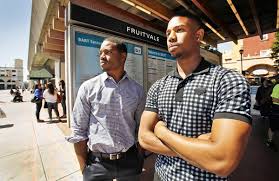
Reality ‘Written in Lightening’: On ‘Fruitvale Station’

(Al Seib/Los Angeles Times)
by David J. Leonard
Originally published| NewBlackMan (in Exile)

Walking out of the theater in West Los Angeles, I felt a lot of emotions.  Even before Ryan Coogler’s Fruitvale Station started, I felt the film at a visceral level: I was sad, anxious, angry, and disheartened as I sat down. Emotionality is central to the film.

As brilliant as the film is at tapping into the emotionality of Oscar Grant’s killing, it is not simply a film of anguish or one that builds upon the outrage and sadness compelled by murders #every28hours.  It is a work of art; a tapestry of images, narratives, and movements.  It is a story of depth about a layered life put together through sight and sound, image and voice.

There is a lot to be said about the film at an intellectual, artistic, and cinematic level.  For example, Coogler’s ability to “make Oakland a character” is crucial to the film; it is done with great precision and depth.  The shots of street signs, the Bay, BART, and several Oakland landmarks are critical to the film’s situating of Grant’s life and death within a physical landscape.  To understand Oscar Grant and to reflect on his death, requires an ability to see and hear, feel and understand, Oakland in post civil rights, post 9/11 America.  His life and death is a story of Oakland; it is also a story of neighborhoods and communities across the nation.

With its use of the camera, from the close-ups of Tatiana scrubbing crabs to the various moments that brought Grant’s humanity to life, Fruitvale Station forces viewers to not only confront Grant’s death and his killing in 2009, but his life: his relationship with his girlfriend, Sophina (Melonie Diaz); his adoration for his mother Wanda Johnson (Octavia Spencer) and sister; his beautiful interactions with his daughter; and the many obstacles he faced in an unforgiving America.  Wesley Morris offers an important assessment of the film when he writes:

Fruitvale Station speaks to that yawning discrepancy. What feels slight, shaggy, and ordinary about it is also rather remarkable. To present Grant this way — as a son who loves his mother, as a father who loves his daughter, as the sort of person who comforts a dying dog and pleads with a shop owner to permit a pregnant woman to use his restroom — is to remove the stigma. He’s a lower-middle-class kid who got mixed up with crime. But most of the narrative belongs to a charming, charismatic, devoted young man, someone striving to better himself. It’s not only that this Grant is a person. It’s that, to a fault, he’s made to be more than black male pathology.

Rahiel Tesfamariam similarly emphasizes the film’s cinematic and narrative success in humanizing Grant – in challenging the systemic flattening of black bodies.  Fruitvale Station gives voice to Grant and the injustice evident in his death and in doing so challenges America’s racial landscape.

We also see this vulnerability play out in his dealings with the matriarchs in his family… These women are his anchors in life. Sophina keeps him honest, holds him accountable and brings out his sensual side. Through their relationship, we see his desire to be a protector and provider. His mother Wanda grounds him in prayer and nurtures him through wise words and good food. Her “tough love” approach often haunts him in his actions and decision-making. Then, there’s Grandma Bonnie who keeps him connected to tradition and the family history that proceeds him.

This backdrop is so important to the film, and to a larger landscape of anti-black racism; yet as I watched and cried, I found myself asking myself: does the persistence of segregation in Hollywood constrain the impact of such an important film?  Does the nature of distribution limit the reach of films centering African American voices and experiences into “red state America”?

Given the ubiquity of the criminalized black body, and given the widespread practice of blaming Grant or Trayvon Martin for their own deaths, it is disheartening to know that those who continue to peddle and profit in/from anti-black racism will unlikely watch Fruitvale Station.

It is infuriating that those who blame inequality on “single mothers” and “children born out-of-wedlock” will never be forced to digest the beautiful relationship that Tatiana had with her father Oscar, who would be part of that 72% statistic cited without any thought over and over again.

The anger I felt is about the killing of Oscar Grant – and Trayvon Martin, Jordan Davis, Ayana Jones-Stanley, Rekia Boyd, Amadou Diallo; yet it was about a theater with only a handful of people; it is about knowledge of multiplexes across the country screening zombie movies and another about a snail rather than films that have the potential to transform a generation.  It is about knowledge that Madea, the Help, or the Butler will more likely be screened than the stories of Oscar Grant or Ruby.

Frustration, sadness, and anger.

Almost 100 years after the release of D.W. Griffith’s Birth of a Nation, a film steeped in white supremacy and anti-black violence, Fruitvale Station brings a level of black humanity that has remain on the periphery of the Hollywood imagination for a century.  Almost 100 years after the release of a film that celebrated the rise of the Klan as the necessary force to thwart black savagery, Fruitvale Station stepped into a cinematic and larger racial landscape to offer a powerful counter narrative to the anchors of contemporary racism.  Yet, 100 years after Birth of a Nation was celebrated as “history written in lightening,” the prospect of Fruitvale Station receiving similar treatment feels to the right of impossible.

As with the struggle for justice itself, the actual hearing and seeing of Grant, Martin, Diallo, and so many others remains a distant possibility.  As with the activists who have used their cell phones to document the specter of police violence and anti-black/brown racism, Coogler uses his camera to further force a nation to confront these realities.  Fruitvale Station shines a spotlight on this empathy deficit and the denied humanity.  And like the killing of Grant, this is the source of my frustration, sadness, and anger.

But be clear, Fruitvale Station is reality written in lightening; a piercing ray of truth telling that is painful.  It is a disheartening, infuriating, and devastating reality; one that everyone should confront before another train arrives at Fruitvale Station.

***

Profiling Trayvon…Again

“Angry Trayvon App”

****

Profiling Trayvon…Again

Originally Published at NewBlackMan (in Exile)

Watching the George Zimmerman trial has been a daily reminder of the ways that race and the criminal (in)justice system collide. The trial has been a daily display of the different standards, scripts, and narratives afforded to both victims and the accused, and how race sits at the center of these “two Americas.”  Media coverage of the trial has presented judgments  on whose life matters, whose future matters, whose pain matters, whose suffering matters, whose experiences matter, and who deserves, is entitled to, and will receive sympathy, mourning, and justice.
Just as every person within America is profiled as guilty or innocent, as desirable or undesirable, violence is profiled as well.  Gun violence is profiled racially. Victims are profiled racially.  Perpetrators of violence are profiled; the families and friends are profiled as well; communities are not spared from this process. Ultimately, the narratives embraced are dissimilar across communities whereupon race creates a dividing line that marks them as separate and unequal.  This is racism at its core.
“Deep in the white American psyche” rests the controlling belief that sees “the impossibility of Black innocence” (Mann 2013).  Inside this same dominant worldview is that impossibility of white guilt.
The perpetual criminalization of Trayvon Martin is telling; the efforts to blame him for his own death; whether from the defense questioning of Sabrina Fulton or the mentions of trace amounts of THC in his system at the time of his death, are evident in the ubiquity of depicting Trayvon as a “thug,” a “suspect” and a “criminal” (a CNN “expert” even justified Zimmerman’s profanity-laced 911 call because he thought he was following a criminal).
All of this is operates from and perpetuates the presumed guilt of Trayvon Martin and black bodies in general.  Zimmerman, on the other hand, is presumed innocent and a good person who is now being victimized.
On Fox News recently, Greg Jarrett and Kimberly Guilfoyle lamented the costs and anguish experienced by Zimmerman, citing his weight gain as evidence of his victimization.  “You eat when you’re under stress and pressure and stuff like that,” Guilfoyle reminded the audience, “So, you know, he’s already been punished to some extent. We’ll wait and see whether a Jury punishes him further.” “This is an individual that was trying to do some civic duty by being on the community watch,” Jarrett noted, “that was the purpose of why he was there that night.” In other words, Zimmerman was a victim; victimized in the past, on this fateful night, and through the process.  Sympathizes should rest with him.
While the verdict has not been read, the trial itself, the media coverage of the trial,  the focus on the Newtown shootings as opposed to gun violence in Chicago, as well as the demands for background checks and not jobs, and the focus on mental health and not schools, are testaments to the ways race sits at the center of discourses of gun violence, and the criminal justice system.
Black death and white death are conceived as separate and unequal within the dominant white imagination; yet the stories about life and death in black and white are contingent upon one another. White life is privileged over anything else.
The scripts we see with regards to Trayvon Martin and George Zimmerman, or  Newtown, and Chicago, are the stories of guilt and innocence; they are the stories of blacks and whites—evidence of the persistence of racism and the illusion of post-racial America. At the core of dominant discussions of guns and violence, like those of crime and punishment, is a presumption of black guilt and white innocence.  White America clings to the profiles of guilt and innocence as a religion.
To look at the stories told of Adam Lanza and James Holmes is to look at the difference in the profiling of and narratives associated with Trayvon Martin and Jordan Davis, another unarmed black teen shot to death in Florida. W.E.B Dubois once asked when writing about America’s race question, “how does it feel to be a problem?” Contemporary discussions of gun violence, from inner-cities to the suburbs, highlight the continued relevance of his words within America.

While the judge limited the ability of the prosecution to bring race into focus and to talk about racial profiling, among other things, race remains at the center of the trial and the criminal justice system—at the heart of life and death. The demands for colorblindness amid the realities of a racist America means that this trial, like those before, are playing out according to the hegemonic script: black criminalization and white innocence.  It is my hope for a new ending where justice and mourning no longer remain a dream deferred.

It’s Gotta Be the Ink: Crime, Athletes and Tattoos

 
It’s Gotta Be the Ink:  Crime, Athletes and Tattoos
 
Sports media is often a place ripe with racial, class, and gendered meanings; it often is a site where stereotypes and profiling are articulated; where bodies, particularly bodies of color, are subject to scrutiny and examination, ridicule and demonization.  Sports media, especially when the coverage moves beyond the game, is often dominated by generalizations and grandiose arguments that spill over outside of the arena and playing field.  This has been evident with two recent columns about John Wall and Aaron Hernandez, both of which extrapolate meaning and pathology from tattoos – or better said the meaning in an inked body of color.
 
In a recent column, Jason Reid cautioned the Wizards (he provides clarification here) against signing a contract extension with Wall because of his decision to get and unveil his tattoos:
 
Posing shirtless recently for an Instagram photo, Wall revealed several tattoos. Wall’s interest in body art is surprising, considering he previously said he did not have tattoos because of concerns over his image for marketing reasons. Many NBA players do have tattoos, and Wall isn’t breaking new ground in sharing his ink with fans through social media.
 
But not every player flip-flops on a topic in such a public way. Factor in that Wall is expected to receive a huge payday from the Wizards next month, and the timing of his tattoo revelation raises questions about his decision making. For a franchise with a history of backing the wrong players, that’s food for thought. . .
Reid makes clear that Wall’s decision to get tattoos leads him to question his mindset, his character, and his priorities since he previously stated that he wasn’t getting any tattoos because of a potential reaction from fans and the organization.  Yet, now he has them, causing Reid to wonder about Wall’s focus on the game and the fans.  It’s gotta be the ink.
 
Reid’s effort to read meaning into Wall’s tattooed body is nothing compared to Jason Whitlock’s recent column, which is disturbing even by Whitlock’s standards.  Amid the many troubling points of “analysis” that nostalgically pine for popular culture and a sports world of yesteryear, Whitlock uses the arrest of Aaron Hernandez as an instance to pathologize and demonize today’s athletes, and accordingly goes in on tattoos:
Athlete covered in tattoos is linked to several violent acts, including “accidentally” shooting a man in the face. Modern athletes carry guns. They do drugs. They mimic rappers and gangster pop-culture icons.
 
Athletes want street cred, and they costume themselves in whatever is necessary to get it. Nike, Reebok, Adidas, etc., were the first to recognize the importance of authentic street cred when it came selling product to American youth.
Sadly Whitlock was not done:
When he stood in chains before a judge at his arraignment, in a white T-shirt and his arms decorated in ink, Hernandez did not look out of place. Guilty or innocent, he looked like someone who had prepared for this moment. He didn’t look like an athlete. He looked like an ex-con…
 
We can no longer distinguish bad from good. We no longer even aspire to be good; it has considerably less value. That’s what Aaron Hernandez represents, to me. Popular culture has so eroded the symbolic core principles at the root of America’s love affair with sports that many modern athletes believe their allegiance to gangster culture takes precedence over their allegiance to the sports culture that made them rich and famous.
There is so much wrong here that I am not sure where to start but let me unpack a few arguments.  (1) He seems to argue that America’s crime problem (despite declining crime rates) is the result of its faulty values. Popular culture is the teacher to blame. The celebration of Jay-Z and Tony Soprano (and I am not fooled by the inclusion of Tony Soprano to obfuscate from the racial arguments) has created a culture of criminality, as evidenced by Aaron Hernandez.
 
 
Whitlock writes that Hernandez, “stayed true to his boyz from the ‘hood. He mimicked the mindset of the pop-culture icons we celebrate today.” While acknowledging the costs and consequences of “a 40-year drug war, mass incarceration,” Hernandez is a product of “a steady stream of Mafia movies, three decades of gangster rap and two decades of reality TV have wrought: athletes who covet the rebellious and marketable gangster persona”—a  little nostalgia to go with Whitlock’s simplicity and reductionist linear narrative.
 
In amazing level of erasure of history, of violence, Whitlock, who clearly plays a sociologist, psychologist and media studies scholar on both TV and the Internet, pontificates how to thwart crime and violence: revamp the television guide and top-40.   Yes, it’s got to be the television.  Rather than address structural realities, it is time for politicians, activists, and communities to address the real menace: popular culture.  If only he was kidding.
 
(2) I wonder if he or others who like to blame rap and popular culture for everything invoke these arguments in other cases or just those involving people of color.  I must have missed an examination of the listening habits of Adam Lanza or James Holmes?  I wonder what sort of influence hip-hop and Allen Iverson had on the Boston bombers, Catholic priests, or Wall Street executives.  Clearly, it is time for Whitlock and others to listen to Michael Franti’s “It’s a crime to be broke in America.”
They say they blame it on a song
When someone kills a cop
What music did they listen to
When they bombed Iraq?
Give me one example so I can take a sample
No need to play it backwards
If you wanna hear the devil
Cause music’s not the problem
It didn’t cause the bombin’
But maybe they should listen
To the songs of people starving…
More than reminding me of the scapegoating of music which truly masks the criminalization and demonization of bodies of color (nobody has made issue of George Zimmerman’s tattoos), I recall a response to David Whitley’s piece about Colin Kaepernick because sadly I can just remix this “Dear Mr. Whitlock” because same message different day.
 

On the Real: Virtual Exploitation and College Sports Games

Video games have been part of my research for many years; they have been part of my life for much longer.  Yet, the games that I always find hard to purchase or even play are those involving collegiate sports.  The games themselves are the product and perpetuation of the exploitation of student-athletes.  They are not unique in this regard but they symbolize so much that is wrong with college athletics.

The popularity of sports video games rests with the replication of “the real.”  Since those OG (Original Games) like Intellivision or Tecmo Bowl, the sports video game industry has been a race toward creating a virtual reality indistinguishable from the real reality.  This has proven to be an issue or a source of tension for N.C.A.A.  sports games, as it has justified its lack of compensation to current and former student-athletes by claiming the unrealistic nature of the games themselves.  According to Steve Eder and Greg Bishoff,

The issue of how close the games could mirror real life continued, as it became easier for game players to download rosters from the Internet that included the actual names of players. The N.C.A.A. did not sanction those rosters, and neither did E.A. But in April 2005, Myles Brand, then the president of the N.C.A.A., wrote to one of his executives that the organization should persuade university officials to “provide names and likenesses” for games, which would lead to a higher rights fee.

Not everyone within N.C.A.A. leadership appears to share these prevailing opinions.  This, also from The New York Times, makes that clear”

This whole area of name and likeness and the N.C.A.A. is a disaster leading to a catastrophe as far as I can tell,” the Nebraska chancellor Harvey Perlman, who served on the N.C.A.A.’s board of directors, wrote soon after the O’Bannon lawsuit was filed. “I’m still trying to figure out by what authority the N.C.A.A. licenses these rights to the game makers and others.

The decision from EA and the N.C.A.A. to sell realism while denying rightful compensation is just more hypocrisy; the N.C.A.A. should probably renamed N.H.A.A: the National Hypocritical Athletic Association.  In the context of immense profits for schools and poverty experienced by student-athletes, it is hard to even think about buying such a game.  In fact, the glorification of college athletics, and the erasure of the pain, the injuries, the hours of practice and class time, the financial difficulties, and of REALITY in fact contribute to an environment of exploitation.

Every time, I see a commercial for N.C.A.A. Football 14, or see its cover in the store, I find myself thinking about in  “The Price of Poverty in Big Time College Sport,” Ramogi Huma and Ellen J. Staurowsky:

  1. College athletes on full scholarship do not receive a “free ride”. For the 2009-2010 academic year, the average annual scholarship shortfall (out of pocket expenses) for Football Bowl Series (FBS) “full” scholarship athletes was $3,222.
  2. The compensation FBS athletes who are on “full scholarship” receive for living expenses (room and board, other expenses) situates the vast majority at or below the poverty level.
  3. The percentage of FBS schools whose “full” athletic scholarships leave their players in poverty is 85% for those athletes who live on campus; 86% for athletes who live off campus.
  4. The average FBS “full” scholarship athlete earns less than the federal poverty line by $1874 on campus and $1794 off campus.
  5. If allowed access to the fair market like the pros, the average FBS football and basketball player would be worth approximately $121,048 and $265,027 respectively (not counting individual commercial endorsement deals).
  6. Football players with the top 10 highest estimated fair market values are worth between $345k-$514k on 2009-10. The top spot was held by University of Texas football players. While 100% of these players received scholarships that left them living below the federal poverty line and with an average scholarship shortfall of $2841 in 2010-11, their coaches were paid an average of over $3.5 million each in 2010 excluding bonuses.
  7. Basketball players with the top 10 highest estimated fair market values are worth between $620k-$1 million in 2009-10. The top spot was held by Duke basketball players. While 80% of these players received scholarships that left them living below the federal poverty and with an average scholarship shortfall of $3098 in 2010-11, their coaches were paid an average of over $2.5 million in 2010 excluding bonuses.
  8. The poorest football and basketball players (generated combined FB and BB revenues of $30 million or more in 2009-10, yet live in the poorest bottom 1/3 of all of the players in the study live between $3,000-$5,000 below the poverty line in the report for further details.

The financial predicament facing student-athletes (and those who have left school, graduated or used their eligibility) stands in stark contrast to the gold-lined pockets of college coaches, the platinum realities of colleges and universities, or their diamond studded realities of the sports media.  The millions and billions that fall into their hands, while student-athletes struggle to make ends meet, in part through the profits and allure of video games, is sustained through myth of amateurism.  ‘

This fuels the exploitative relationship and the lack of compensation.  Student athletes are required to spend their wages at the “company store.” Akin to sharecroppers who not only worked the land for virtually no compensation, but what little compensation received had to be spent at the company store (usually owned by the land owner).  From food to tools, sharecroppers were forced to use their wages at these stores, often leading to debt and additional subservience.  Collegiate athletics is similar in that student-athletes MUST use their wage to pay for tuition, books, and room and board within the campus community.  According to McCormick and McCormick, “By this last arrangement, then, these athletes, unlike any other working people, are not free to spend their limited wages where they choose, but must spend them on college tuition, books, and other institutionally related expenses, regardless of their real needs or those of their families.”  Much of their wages cannot even be used to buy these video games. Hypocrisy

The N.C.A.A.’s decision to part ways with E.A. has little to do with the well-being of student-athletes; it is about protecting itself from lawsuits and insulating itself from demands for just compensation.  At a moral and educational level, nothing has changed. This decision, which is in line with past reforms, hasn’t transformed my thoughts about either the N.C.A.A. or the virtual fantasies known as sports video games.

Rather than fork over 50 dollars for a game, can you imagine if people started supporting student-athletes or an organization like the National College Players Association.  Now, that is a reality I can get with.

So you want to have a race conversation; how about investing in Ethnic Studies

Over the last few weeks, there has been a lot written about race; following the Fisher decision, the gutting of the Voting Rights Act, and more recently the acquittal of George Zimmerman, there have ample discussions online and within the media.   More than likely, there have been even more debates in public/private spaces; social media has had ample debates.

Not surprisingly, calls for more dialogues and encouraging words to continue the “race conversation” have been commonly articulated.  Although not a panacea, given issues of power, systemic racism, segregation and privilege, these calls are striking reminder of the importance of the work that is being done by teachers and community organizers; professors and others working at the grassroots committed to education, learning, and dialogue, all of whom spend hours each week strategizing approaches to foster critical engagement and thought about these essential questions of the day. President Obama weighed in last week, noting:

There has been talk about should we convene a conversation on race.  I haven’t seen that be particularly productive when politicians try to organize conversations.  They end up being stilted and politicized, and folks are locked into the positions they already have.  On the other hand, in families and churches and workplaces, there’s the possibility that people are a little bit more honest, and at least you ask yourself your own questions about, am I wringing as much bias out of myself as I can?

What is striking here is that schools, whether K-12 or colleges and universities, are not listed alongside of families and churches.  The call for dialogues within these segregated spaces, and the erasure of the research, scholarship and work already been done, represents a missed opportunity from President Obama and in the potential for dialogue.

The celebration of dialogues and the call for conversations is striking that amid efforts to close schools, to divest in education, to eliminate any emphasis on critical thinking through testing culture, and the overall assault on Ethnic Studies, African American Studies, Queer Studies, Women’s Studies, Chicano Studies, Asian American Studies and Native American Studies. Those demonized as “race baiters,” who are working in the name of justice and equality, are already doing this work.

There are ample people focused on creating the constructive space to foster these conversations; there are ample places dedicated to developing the tools to effectively dialogue toward transgression and transformation  The support for them is another story.   If “a more perfect union” is actually a goal, maybe schools and politicians, community leaders and communities themselves should start by supporting the very people working to foster dialogue and create change.  And this would need to include Critical Whiteness Studies, a necessity made clear by Dr. Stephany Spaulding,

Without Critical Whiteness Studies, we will continue living in a society that blindly privileges particular ways of organizing institutional practices and structures, not realizing that these ways are rooted in the histories and cultural beliefs of specific people.  It will leave me binging on chocolate, writing blogs and wishing I could tolerate the taste of alcohol every time some student vehemently argues, “But it really was the way he was dressed that caused him to look suspicious

If there is really a desire to actually have a conversation about racism, about gun violence, poverty, rape culture, inequality, and the criminal justice at the national level, at the state or local level, it would be nice to see investment in these spaces.  The failure to not only support, but in effect undermined and attack those committed to this work demonstrates the true agenda – investment reveals priorities — and ain’t that dialogue and it certainly isn’t change. The lack of support tells me everything I need to know about a desire to truly have a conversation about race.  I hope I am wrong.  This moment demonstrates yet again the important work that so many people are doing and why it is crucial to support this work; but I am not holding my breath.

I haven’t been optimistic for a while, which led me to write this piece last year. The last week (month, six months, year) has demonstrated why White America needs Black Studies.  The level of denial, the efforts to silence, and the need for “context” reveals the necessity for greater education as it relates to race in America society.  As important as speeches, television pieces, and columns are in complicating the discourse, education systems need to change.   American education has to do more to give voice to the experiences of communities of color, to push back at stereotypes and implicit bias, and to otherwise provides the tools and skills necessary to not only have conversations but change institutions toward that more perfect union.  Change is not simply the result of time; change requires work.

Recent months have seen a wave of campus racism at America’s colleges and universities, including Fordham University, University of Wisconsin-Madison, Cornell University, Northwestern University, and the Ohio State University.  While racism is as commonplace at America’s “liberal” training grounds as binge drinking, I found myself wondering about occupying America’s universities.  I found myself wondering how Black studies and ethnic studies have the potential to change America’s racial path.   How Black studies and understanding the ongoing history of racism is essential to a quest for a “more perfect union.”

Imagine if every student took at least one Black studies course per year during college alongside of Chicano Studies, Asian American Studies and Native American Studies.  What if students, what if white students, starting in kindergarten and through graduate school, American’s future leaders, teachers, and voters learned a 4th R – racism – alongside ‘reading, ‘riting and ‘rithmetic?  Surely institutional racism would remain an obstacle, but Whites who inhabit those institutions, from the classroom to the Capital, would likely be changed.

Learning about minstrelsy and the history of racist imagery would surely impact the decision from White students to don blackface for the sake of fun, parties and Halloween.  Learning about the history of slavery and lynchings would hopefully encourage thought from entire communities the next time a noose appeared on campus, the next time someone scrawled lynch on a chalkboard or dorm room door.  There would be no more excuses and claims of ignorance about these histories.

Can we imagine a world where White students didn’t commonly use the “N-word” behind closed doors because they understood the history of racial violence?  Would the hurling of racist jokes and epithets lessened as all students began to think about the consequences and daily harm?  Would the exposure to alternative perspectives, to unseen history, and to conversations with students of color, change those students? I would hope so.

Through knowledge, critical thinking and dialogue, colleges can transform themselves–and their students.  According to Howard J. Ehrlich, director of The Prejudice Institute, between 850,000 and one million students (roughly 25 percent of students of color and five percent of White students) experience racially and ethnically-based violence (name calling, verbal aggression, harassing phone calls and “other forms of psychological intimidation”) each year.  What if each of the students who hurled the slurs at Cornell or graffitied “Long live Zimmerman” at the Ohio State University taken a Black studies course surely there worldview would have been different.  Surely, those White students who sat idly by, who watched and said nothing, would have challenge their peers had they any real knowledge of race and racism.

Yet, the need for a world of Black Studies as multi-year required isn’t simply to teach White students about prejudice, but the erased experiences and voices of Black people.  Knowledge about Black culture, history, and identity would come not from Basketball Wives or The Help but in James Baldwin and Tayari Jones, Daughters of the Dust and Killer of Sheep.  We would no longer hear about Martin Luther King’s dream of colorblindness, but instead his dream of justice, reparations, and equality of outcome. The civil rights movement would be a history told not through King and one great speech, but people like Bayard Rustin and Ella Baker, heroes and sheroes who refused to accept American Apartheid.  This is my dream, a dream where White students learn alongside of students of color about the history of racism, about privilege, and inequality; about the contributions and humanity of communities of color; about histories of resistance from “Aint I a woman?” to “Let freedom ring.”

While a freshman at the University of Oregon, I took my first African American history class.  This class and so many others changed my life.  Beyond learning about African American history, beyond reading the likes of DuBois, Frederick Douglas and Carter G. Woodson, beyond hearing for the first time names like Turner, Garvey, Delany, and Hamer, I learned to think for myself, asking why wasn’t I learning this history and what does it mean that the history, literature, and culture I learned during my formative years was a story of whites.

A couple years later, while at University of California, Santa Barbara, I enrolled in a Chicana feminism class. Being the only White male in the class, I felt apprehensive and unsure as to my place in the class.  With the encouragement of the professor, I remained in the class.  During a small group discussion about race and privilege, I shared my anxiety within the class, explaining how I felt like an “outsider.”  A classmate quickly responded, noting “Now you know how we feel in every class.”  But in fact, I did not and couldn’t know since I felt uncomfortable, as an outsider, and as representative of “my community” twice a week for 75 minutes.  When class was over, I returned to the sea of Whiteness, privileged in my invisibility and empowered by a world that normalized Whiteness.  I can only wonder how the world might look if more students had this type of experience. It is a world I think is worth fighting for.