In Defense of Dirty Laundry | Vitae

In Defense of Dirty Laundry

By David J. Leonard

January 15, 2014

We lament, vent about, and dissect student interactions all the time. From hallway conversations to conference sessions, from publications to dinner parties, shop talk is commonplace. And it’s generally accepted.

But now, of course, that talk is moving to a new space: Facebook. To some observers, this is a thing to be bemoaned. In a post on The Conversation, Chad Abushanab spells out this view: Facebook, he argues, is not an appropriate place “to air your classroom’s dirty laundry.”

“What makes this approach problematic,” he writes, “is that you are essentially having a conversation about the decisions of a student in your professional care in a public forum without inviting that student to participate.”

Sounds reasonable enough, right? But there are two problems with this line of thinking.

The first is that the technology isn’t the issue; the way we make use of it is. Facebook can be used for good or evil—as a source of power or a source of harm. Irrespective of the technology used, shouldn’t we question the nature of the conversations we have, rather than the tools we use to have them?

Which brings me to the second problem with Abushanab’s denunciation: Why reduce all faculty conversations on Facebook to “airing dirty laundry,” “putting it out there,” and “venting”? Sure, that stuff happens. But there’s more than narcissistic grousing going on here. These social-media spaces exist in response to the very real isolation and individualism that permeates academia. And these online conversations can be helpful, cathartic, and empowering.

To dismiss them as nothing more than cattiness erases the pedagogical importance of discussions around classroom dynamics. Are teaching forums merely spaces for venting? Should we dismiss the deluge of journal articles and books dedicated to real-life classroom scenarios as inappropriate? No, these communities are about self-care, about preservation, and about growth. They are about education and the desire of so many teachers to continue to improve inside and outside the classroom.

Abushanab suggests that it would be more advisable for me to raise student issues with a colleague who may be teaching that same student, rather than chatting with a larger group that has no direct knowledge of the situation. But that presumes that face-to-face conversations and discussions among campus colleagues are possible.

In a world of small and squeezed-together departments, officeless adjuncts, 4-4 loads, “road scholars” teaching on multiple campuses, and growing service and scholarship demands, weekly meetings to discuss classroom dynamics aren’t necessarily possible. The weekly lunch at the faculty club—where professors supposedly gather to process class happenings—seems like something out of the Hollywood imagination, if it ever existed.

Beyond the question of feasibility, there’s another question: Would you actually rather talk about this stuff with your campus colleagues than with your social-media peers?

Within my social-media community I see all sorts of descriptions of student behavior. There are posts about students who miss class, yet come to office hours to ask, “Did I miss anything important?” There’s a status update bemoaning yet another incident of plagiarism. There’s a post lamenting an essay that doesn’t distinguish between the Civil War and the civil-rights movement.

Venting and commiserating aside, though, many more posts seek advice and help: “I have students that are using their computers in class and instead of paying attention, they are on Facebook. What should I do?” This is the type of question for which it may make more sense to seek support and advice from colleagues at campuses across the country, from colleagues who teach at different types of schools and within different disciplines, than from those who share your own classrooms, students, and academic culture.

More importantly, Facebook and other social-media platforms provide a space where academics can discuss issues that might otherwise be dismissed by colleagues. How many faculty of color have turned to Facebook following a conversation with a white colleague that ended with “I think you are reading too much into the fact that students refuse to address you by Dr. or Professor”?

How many female professors have used Twitter to discuss sexual harassment or sexism within the classroom or on their evaluations? Might an audience of friends and social-media peers respond differently than male colleagues on campus, whose privilege and misogyny may preclude them from even hearing these issues? In other words, every faculty member doesn’t have an equal ability to share and process the inequality she or he may encounter inside and outside the classroom.

Continue reading at  In Defense of Dirty Laundry | Vitae.

Racism: The Most Violent Weapon in Human History – Hip-Hop and Politics

Racism: The Most Violent Weapon in Human History

by JLove Calderon and David Leonard

February 24, 2014

Originally posted at Davey D’s Hip Hop and Politics

Stop denying that race doesn’t matter.

To claim that killings of Jordan Davis, Trayvon Martin, Renisha McBride, Darius Simmons, Garrick Hopkins, Carl Hopkins, and countless others have nothing to do with race erases generations of white-on-black violence.

And before you trot out some example from history of an African American who killed a white person, or cite some FBI statistics (deflection is a form of denial), hear us:

The history of violence directed at African Americans is grounded in a history of systemic racism; efforts to protect slavery, irrational fear, segregation, Jim Crow, stereotypes and white privilege are all part of this history. It is what binds together Emmett Till and Jordan Davis, what links together the countless incidents of lynching throughout America’s history with killings of Trayvon Martin and Renisha McBride who were seen as “not belonging.”

The history of the United States is one where whites have killed with impunity; the murder of African Americans has been carried under a culture that continues to sanction this violence. Our society has refused to hold white killers accountable within the criminal justice system. On the flip side, African Americans have historically and continually experience the opposite: the unequal brunt force of the criminal justice system. Unlike their white counterparts, who have been let off the hook over and over again, blacks have been policed, locked up, lynched, and executed for s**t they didn’t do. Just as those involved with countless lynchings and Emmett Till’s killers never faced consequences for killing black people, Michael Dunn and George Zimmerman have been left off the hook.

Race matters because of continued circulation of racial stereotypes. From Dunn’s views about “thug music” or Zimmerman’s profiling of Martin, or the belief from Theodore Wafer that Renisha McBride’s an intruder has everything to do with race. How many different jokes about blacks and crime do you hear each day, either from popular culture or from friends? How often do you confront media reports, video games, films, TV, or conversations that depict African Americans as dangerous, as “thugs,” as threatening criminals?

One cannot understand Michael Dunn, or George Zimmerman or countless others within a colorblind fantasy.  We must talk about racism, stereotypes and the history of criminalizing black bodies.  Research proves that whites, from college students to police officers, are more likely to misidentify a gun when in a black hand.  According to B. Keith Payne, “Race stereotypes can lead people to claim to see a weapon where there is none. Split-second decisions magnify the bias by limiting people’s ability to control responses.”  Racism thwarts many in white America from seeing how racism kills.

According Project Implicit,  “An analysis of more than 900,000 completed Implicit Association Tests (IAT) at the Project Implicit website suggested that more than 70% of test takers associated White people with good and Black people with bad…”   It is easy to dismiss race and racism but the daily consequences of American racism are real; the trauma and pain, the ongoing history of racial violence, and a culture that is more likely to see black criminality than black innocence.  Racism kills and so does denial.

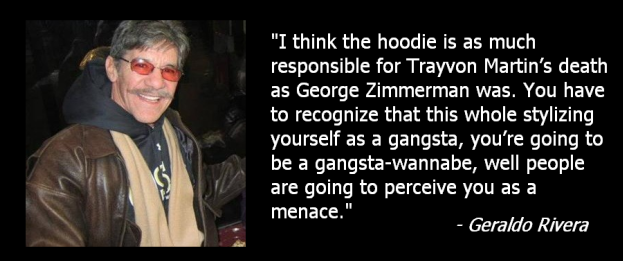
Geraldo Rivera Blames TrayvonRace matters even in death.  How else can we explain the lack of concern society shows for the anguish of black parents who have lost a child?  The mantra of not speaking ill of the dead is rarely applied to black youth.  For all too many, that means routinely seeing the victims as criminals, as unworthy of sympathy and assumptions of innocence. Instead of being seen as victims, as someone’s son or daughter, someone’s friend that lost their life, they are turned into criminals deserving of death.  Writing about Emmett Till and Trayvon Martin, Eric Mann highlights the longstanding history of blaming black youth for their own murders:  [D]eep in the white American psyche” rests the controlling belief and script that sees “the impossibility of Black innocence.” Efforts to convict black youth for their own murders is engrained in the American fabric, enshrined in the history books, and centuries old in the script of white supremacy.  Racism continues to turn the victims of racism into criminals who either deserved to die or did something that resulted in their own death.

Whether citing school suspensions, problems with the law, drug use, clothing choices, being drunk, loud music, whistling, not listening to authority or simply their attitude, the presumption of black guilt, black criminality, and black pathology is reason for black death.  Don’t look at the killers or a history of white supremacy since the “victim” is in fact responsible for his/her death.  The message is clear: Don’t mourn for them; don’t seek justice for them since it is they (and their parents, their “culture”, and their community) that is responsible, not the killers, not the laws, not the gun culture, not the racism, and not America. . . .

Continue reading at Racism: The Most Violent Weapon in Human History – Hip-Hop and Politics.

!Chicana Power!: Contested Histories of Feminism in the Chicano Movement by Maylei Blackwell (A Review #AMST 525)

Some forty years after the “height” of the Chicana/o movement, there still hadn’t been a full accounting of the contributions and involvement of Chicanas.  This changed in 2011 with the publication of Dr. Maylei Blackwell’s !Chicana Power!: Contested Histories of Feminism in the Chicano Movement (University of Texas Press).  Challenging readers to think beyond the binary, Blackwell (see here for interview) documents the day-to-day contributions, the activism, the theoretical work, and the struggles faced by Chicanas inside and outside the movement.  Offering a book that privileges the voices of Chicana activists, that chronicles the work carried out by Las Hijas and countless other organizations, Blackwell documents that many ways that Chicanas spotlighted, intervened, challenged, refashioned, and built upon the “conflict between American ideals and our social reality” (Imani Perry); she also makes clear the efforts to expose and curtail the conflict between the ideologies and rhetoric espoused within some spaces of the movement and the social reality.”

In her review of the book, Yolanda Padilla’s captures the essence of !Chicana Power! in her review of the book:

Maylei Blackwell’s !Chicana Power!, the first book-length study of Chicanas in the Chicano movement, uses oral history and archival research to tell the compelling story of Las Hijas de Cuauhtémoc, a group that emerged in the late 1960s in response to “the repudiation of women’s leadership and the marginalization of women’s issues in the Chicano student movement” (2). Blackwell’s focus is two-fold. First, she recounts the active ways that Las Hijas responded to the often severe discrimination they faced from male activists; these included concrete actions (publishing one of the first Chicana feminist newspapers, organizing a national meeting of Chicanas, and community involvement) and the development of an early analysis of the interrelated nature of gender, racial, sexual, and class power. Second, Blackwell interweaves her own analysis of how the story of Las Hijas “transforms the ways we understand these historical narratives and the political nature of the knowledge practices that produce them” (3). Thus, the politics of knowledge production is as central to the book as Las Hijas themselves. Informed by Foucault and Michel-Rolph Trouillot, Blackwell underscores the stakes involved in interrogating exclusionary historical narratives, arguing that they do not “merely represent historical realities but help to produce those realities by enforcing the boundaries of legitimate political memory and the subjectivities they authorize” (11).

One of the book’s many strengths is Blackwell’s decision to foreground the voices of the organization’s former members, allowing their firsthand accounts to communicate how their struggles over gender and sexuality within the movement ultimately gave rise to the “multifaceted vision of liberation” they created, which, as Blackwell argues, resulted in the production of “a new Chicana political identity” (1). The book also provides an excellent analysis of the role played by sexual politics in the movement and details the painful divisions that marred the extraordinary 1971 national meeting of Chicanas (Conferencia de Mujeres por la Raza), shedding light on the “political fault lines of early Chicana feminism” (161). Finally, Blackwell develops a number of theoretical concepts, chief among which is her notion of “retrofitted memory,” her name for the historicizing strategies Las Hijas used to counter the erasure of Chicana political subjectivities from the movement. !Chicana Power! is a significant contribution to the ongoing process of historicizing Chicana feminist consciousness and furthers the work of scholars such as Emma Pérez, who have problematized traditional historio-graphical practices in Chicana/o studies contexts.

The book is not invested in simply filling the historical cupboards that have neglected to tell the stories of Chicana activists, those who challenged racism, sexism, homophobia, and the structures of violence, segregation, inequality, and white male hegemony in multiple locations.  Dr. Blackwell pushes readers beyond this binary. She argues that Chicana feminism wasn’t merely a response to the sexism of Chicano nationalism or the racism of the women’s movement.   Highlighting the many iterations of feminism, and the “adoption of different strategies to be heard” (p. 66) Maylei Blackwell brings many stories, many strains of history, and many spaces of resistance together in an effort to not only reimagine this historical moment but to challenge the ways that we construct narratives within the historical imagination.

She demands that readers of history account for the multiple points of entries, the multiple spaces of consciousness, and the conditions that led to action.  For example, whereas history books, which have long privileged white feminist national organizations, have imagined Chicana feminism as emanating from the writings, organizational influence, and teachings of white feminists, Maylei Blackwell highlights the longstanding history of feminism within Chicana movement that can be seen in the home, in indigenous institutions (p. 47), and in spaces that are autonomous to white feminist influence.

Moreover, she argues that to understand the Chicana feminist ethos of the 1960s and 1970s requires not simply looking at the contested politics of the Chicano movement and the entrenched misogyny and patriarchy, but white supremacy, classism, and the daily realities facing Chicana women. “Women activists learned to name the structures of exclusion and inequality they faced and how to negotiate complex relationships of power within and outside their community,” notes Blackwell (p. 61). “Familial bonds, female friendships, and relationships with political comrades were the sites through which they gained new forms of consciousness, named inequitable power relations, and strived to create new forms of solidarity, as well as a different organizational culture.” In other words, their experiences as students, as activists, as members of multiple communities, as daughters, friends, and partners all shaped their consciousness, political ethos, and repertoire of available tactics.  This was not defined by experiencing sexism in one location as often argued.

In pushing for a “retrofitted historic memory,” in documenting “multiple feminist insurgencies” (p. 21), in thinking about how conferences and print work contributed to imagined and realized communities, and in reflecting on Chicana subjectivities through a transnational framework, Maylei Blackwell offers a book that challenges our collective understanding of this historic moment; yet, it is equally invested in challenging how we make history and who is privileged through hegemonic history-making.  Pushing back at those who simply see history as the piecing together of the archives, Blackwell demands that we reflect on this process, inserting her important voice into both the history and the history making.

!Chicana Power!  thus challenges the over reliance on text centered, chronological and archival based histories (p. 36), which invariably elevates male participation, organizational importance, and the spectacular moments that contribute to social transformation.  Reimagining definitions of leadership, activism, and social movements (p. 37), Blackwell also reimagines how we write and document history:

When I began this research in 1991, I embarked on a question to turn up the volume on the stories of gender and sexuality that have been dubbed out of the Chicano historical record.  Through this journey I have found that being an oral historian is like being a DJ. As one digs through the old crates of records (historical archives) to find missing stories, the songs (narratives groups, if you will) must be selected and their elements remixed to produce new meanings.  Oral historians spin the historical record by sampling new voices and cutting and mixing the established sounds to allow listeners to hear something different, even in grooves they thought they knew” (p. 38).

Also an embodying an interdisciplinary approach that samples that necessary theories, that borrows from the useful registers of a myriad of disciplines, which builds on different traditions and understandings of the world, this book seeks to answer a series of important questions, to chronicle the spaces and means of resistance exhibited by Chicana activists.  In this regard, !Chicana Power! offers a powerful theoretical intervention.  The methods employed by hegemonically produced histories and dominant social movement theory exclude women of color in part because of the failure “to see multiple strands of intervention and contribution.” That is, this work is not simply an effort to “add-and-stir” but one invested in rethinking our historic epistemologies and how this erases women of color. An important book for those seeking to understanding the Chicana/o movement, to complicating our 1960s-1970s memory, !Chicana Power! is a treasure for its theorizing, for its methodological intervention, and for its efforts to provide future scholars and history makers with the tools to fulfill “the historian’s political project: to write a history that decolonizes otherness” (Emma. Perez, p. 15).


Questions

  1. In what ways did “Chicano cultural nationalism create a contradictory position for women” (98)?
  2. How is this work both a critical intervention against cultural nationalism and also a historic project of reclamation?
  3. How does this book’s methodological approach/history making compare to our previous discussed texts
  4. In what ways is this book in dialogue with hegemonic understandings of social movements; how does it argue that if we are to reclaim and make visible these untold stories we must “decolonize” the ways we understand and chronicle history?
  5. Reaction to DJ metaphor?
  6. How does the book challenge definition of leadership?
  7. How does it intervene within binary of Chicano movement versus feminist movement?
  8. How does it challenge the narrative that often positions activism and grassroots organizing in opposition to intellectual work, to theoretical and discursive struggles?
  9. What legacies can we see from the historiography chronicled here?
  10. How does this image defy and replicate dominant expectations of Chicana femininity?
  11. Whereas this book is not invested in documenting struggles against the state, Empty Nets is very much invested in chronicling the struggles against the state (within meeting rooms, through court cases, lobbying).  Does this reflect the different historic projects or the varied social location of the Chicana/o and Indigenous communities?
  12. How are both these books local, but national historiographies?
  13. How can we understand social movement as existing within structures of state and outside state; often times social movements are imagined as apart from political structure – limitations?

From the Jaws of Victory by Matt Garcia (A Review – #AMST 525)

In the tradition of Charles Payne, Barbara Ransby, and Chana Kai Lee, Matt Garcia chronicles the history of the United Farm Workers (UFW) from an organizing perspective.  Quoting Jerry Brown, Garcia highlights the importance, the principles, and the requisite grind the includes organizing: Fred “Ross never lectured about organizing.  He believed that one could only learn to organize by doing.  He would point out there was nothing romantic organizing, and this it required mainly common sense, meticulous planning, hard work, and a great deal of self discipline” (63).  Whereas much of the public memory of Chavez and the UFW has focused on marches, hunger strikes, and confrontations, Garcia brings to life a history of “slow and respectful work.”

From the Jaws of Victory: The Triumph and Tragedy of Cesar Chavez and the Farm Worker Movement highlights the use of three principal tactics within the UFW: the strike, the march, and the boycott.   While each served a distinct purpose, exerting different levels of pressure on the agricultural industry, Garcia pushes readers to see the significance of the boycott not only within the United States but also across the globe.  In many ways, From the Jaws of Victory is a story of the grape boycott.

Although documenting the efforts to organize the farm workers themselves, Garcia spends many pages of From the Jaws of Victory highlighting the many ways that UFW organized the consumer boycott.  As a child I still recall, the “don’t buy grapes campaign,” which in many ways impacted by own politicization, identity, and understanding of justice.

To work alongside of those withholding their labor, the UFW organized consumers to withhold their dollars, to punish grape growers for their failure to provide adequate compensation and working conditions.   While Chavez was “reluctant to embrace the boycott … given the difficulty of maintaining such a campaign well beyond the primary site of struggle” (46), the boycott proved important in generating public participation.  Despite apprehension, the UFW, with the assistance college students and other nonpaid volunteers, tried to cut off the demand for grapes.  Educating consumers, pressuring markets, and disrupting supply chains, the UFW took the boycott to Los Angeles and New York, to Toronto and London.

Garcia chronicles the depth of this organizing and the extensive networks required to disrupt the supply chain at a global level.  They created boycott houses; they lobbied other unions to refuse to transport grapes; and they shamed any who aided and abetted the global sale of grapes.  Here the book emphasizes how the UFW utilized the media, and deploys particular frames to galvanize support, offering a dynamic and engaging look at the UFW as a social movement, as a space of organizing.

A wonderful expose of organizing, agitation, and the challenges of a global economy, From the Jaws of Victory pushes the conversations beyond the UFW, beyond Delano, beyond Delores Huerta and beyond Chavez, who is “saintly” status is complicated and problematized in significant ways.  While critical, Garcia highlights the contradictions and shortcomings of Chavez and others within the movement.  Yet, his focus is on the organizing and on the organizational tensions that is both a strength and source of weakness for the movement.

In this respect, Garcia chronicles the work Marshall Ganz, Elaine Ellison, and Jessica Govea, each of whom organized throughout in different parts of world as part of a global grape boycott.  He recalls a meeting between Leon Weinstein, a Toronto grocer and UFW organizers Manny Rivera, Jerry Brown, and Juanita Brown:

Weinstein prided himself as a fair-minded entrepreneur with the power to disarm those who questioned his business practices.  Jerry Brown recalled, ‘He [told] us how he would not have grapes in his home, how he supports the farm workers’ cause, but he is the president of a large chain, and the consumers have to have free choice, so he cannot publicly support the boycott.’ Weinstein also made a peace offering of Cuban cigars to Ribera, who accepted the gift and came ready to reciprocate.  ‘He hand[ed] Leon a farm worker calendar,’ Brown remember, ‘every month of which ha[d] a picture of the travails in the fields – you know, hungry, children, child labor, tired workers.’  ‘I’m going to give you… our calendar,’ Rivera told Weinstein, ‘and I hope you’ll put it on the wall, so that every day you look at it, you’ll be reminded of the suffering you’re causing our people by carrying grapes in your store” (88).

Such details, and compelling narratives are at the core of From the Jaws of Victory.

While the boycott proved to be important in terms of education, in terms of increasing leverage and visibility for the union, and ultimately securing a contract, the focus rests with the boycott, which “required organizers to move away from the cradle of the movement to live in far-flung cities with few connections to Delano” (62).  These demands and the emphasis on producing boycott from supermarkets and others who would potentially sell grapes, alongside of the racial and class dynamics of the organizing class, contributed to disunity at times.  Yes, class and race mattered, but the interface with tactics, was the true story.

One of the prominent themes of From the Jaws of Victory is the tension – ideological, tactical, organizational, and political – that results from the yearning to become a union and a social movement.  The goal of becoming a union, negotiating contracts and representing farm workers – and the desire to build a movement dedicated to social justice and empowering workers was at times competing; at other times, these goals were irreconcilable. Garcia highlights these debates and the difficulty resulting from the “institutionalization of social justice.” According to Garcia, the failure of Chavez and UFW is not surprising given the history of social justice:

In the end, Chavez’s greatest failure may not have been his flirtations with communal living, creating a new religion, or attempting to control the minds of his followers through a bevy of devices borrowed from self-made prophets.  Rather his failures were quite familiar to social movements that harbored a dream of institutionalizing social justice: Chavez failure to adapt his strategy to fit the demands of a dynamic situation.  The ability to move the locus of power from the strike to the boycott in the earlier days was not matched in the late 1970s by an equal ability to move from the boycott to a fight for victories in ALRB election and arbitration and, if necessary, California courtrooms (287)

Garcia not only elucidates the struggles that resulted in waning power and influence of Chavez and UFW but provides a larger lesson regarding the pitfalls, possibilities, and potential problems when trying to “merge a social movement with the requirements of becoming a state recognized union” (284).  These shortcomings are not just for the record books but felt by “the health and security of the farm workers” (295).   The legacy is not simply to be debated among academics or memorialized within Hollywood but can be seen and felt in the continued struggle for farm workers’ rights.

Garcia pushes the conversation beyond Chavez, beyond the sensationalism, and beyond Hollywood representations, to look at the complexities and contradictions, a history of organizing and dreams incomplete, which given the persistent injustice remains as important as ever.

 Questions

  1. Why so much tension between developing a union and a social movement
  2. How does the demands of a union versus a social movement impact identity, tactics, and politics
  3. What was role of community in development of UFW; how was this a strength and also a source of weakness
  4. How did race and class play into the development of UFW
  5. Is the solidification of agriculture business/rise of corporate farms an unintended consequence of unionization
  6. In what ways did UFW embrace a transnational strategy alongside of one based in local politics, histories, and community formations?
  7. Why was organizing farm workers so difficult
  8. How did the intellectual work lay a foundation for organizing and activism
  9. Why do you think there has been some resistance to the narrative offered in From the Jaws of Victory
  10. Why limited coalitions and connections to other industries such as meatpacking?
  11. Was the embrace of potential sexism from those being organized a smart strategy or short-sided (93)?
  12. Has the multiracial nature of struggle and the importance of “allies” been over emphasized or erased from historiography
  13. How is framing important in understanding history of UFW?  What role does the representation of Chavez play in contemporary framing

Black Against Empire by Joshua Bloom and Waldo E Martin: (A Review) #AMST525

To say that much of America lacks an understanding of black history would be an understatement.  Neither taught in schools nor adequately represented within public discourse, the history of black America remains largely invisible into the twenty first century.  This is especially the case when thinking about the history of resistance and social movements – for all too many, they are hidden from the historic transcript.  That is, the challenges to white supremacy, from slave revolts to the Dream Defenders, from anti-lynching crusades of the early twentieth century to the Black Panther Party, are omitted and misrepresented, turned into an illegible footnote to the larger struggle against white supremacy.

Joshua Bloom and Waldon Martin enter into this historic vacuum with Black against Empire: The History and Politics of the Black Panther Party (UC Press, 2013).  Countering the broader erasure, its exploration of the Black Panther Party offers an important intervention against the surfaced treatment of the Black Freedom Struggle and specific counternarrative to the historic lies surrounding the Panthers.   Although there have been several books to date – a number of collections and memoirs – that have worked to set the record straight regarding the Panthers, Bloom and Martin offer a groundbreaking intervention that thoroughly documents the complex and rich history of the Black Panther Party.

Like so many movements, organizations, and individuals, the Panthers have been erased from the historiography.  More significantly, those inclusions are often defined by stereotypes (cue Forest Gump), flattened representations (cue The Butler), and the perpetuation of lies about the Panthers.  Whether reduced to “gun-totting thugs” or imagined as a static organization, whether seen as a “media creation” or an insignificant footnote that had little impact, the myths and misinformation surrounding the Panthers has remained in place for more than forty years.

A core theme for the book is the dynamic nature of the Panthers.  There is no single history of the Panthers but many histories.  There is the history of the self-defense organization that seized upon the tradition of guns and freedom in an effort to challenge persistent and unchecked state violence.  That is, in the face of police violence, police brutality, and the failure of the state to uphold and protect the rights of African Americans, particularly those segregated inside America’s ghettos, the Panthers filled that void. This isn’t the only history of the Panthers; there is the story of survival programs – health care, schools, breakfast programs – in Los Angeles, Oakland, New York, and countless other cities.  There is the history of the Panthers transnationally – their direct organization throughout the globe and also their influence in China, Sweden, Cuba and many other places.  There are the histories of organizations, from the Young Lords to the Brown Berets, who not only found inspiration in the aesthetics and the BPP platform, but with a shared ideology.  There is the history of the relationship between the Panthers and the New Left, between the Panthers and wealthy white “allies.”  There are many stories that highlight the complexity of the Panthers and the historicity of their ideology, tactics, shortcomings, and trajectory.  And there are the histories of Huey Newton and Ericka Huggins, Bobby Seale and Elaine Brown, Aaron Dixon and Kathleen Cleaver, Bobby Hutton, Eldridge Cleaver, Fred Hampton, Mark Clark, Assata Shakur, and many more.

The book also spotlights these many histories, providing readers with a chronological and detailed understanding of the multiple histories, the dynamic shifts, and the fluid nature of the Panthers; yet it also brings to life the many locations, the many individuals, and the many movements that encompass the Panthers.  While Black against Empire is the story of an organization it is much more a story of a movement.

A second and crucial theme to the book is it’s understanding of the Panthers within a larger history of social upheaval.

The Black Panther Party was also specific to its times.  The times did not make the Black Panther Party, but the specific practices of the Black Panthers became influential precisely because of the political context.  Without the successes of the insurgent Civil Rights Movement, and without its limitations, the Black Power ferment from which the Black Panther Party emerged would have not existed.  Without widespread exclusion of black people from political representation, good jobs, government employment, quality education, and the middle class, most black people would have opposed the Panthers’ politics.  Without the Vietnam War draft and the crisis of legitimacy ion the Democratic Party, few nonblack allies would have mobilized resistance to state repression of the Party.  Without powerful anti-imperialist allies abroad, the Panthers would have been deprived of both resources and credibility (p. 13).

They further note understanding the history of this movement isn’t simply knowing the Panthers:  “It’s not simply what the Panthers did” (14) – it’s how they did it, where and when they did it, under what conditions they did it, and how they responded to the shifting landscape. To understand the Panthers is to comprehend the landscape of late 1960s and early 1970s . . . to understand this era requires looking at the Panthers.

The book is very invested (& rightly so) in spotlighting the dialectics between the Panthers and the shifting social, political, racial, cultural, and economic landscapes. It sees the Panthers as an important challenge against U.S. Empire.  Like the Panthers, the book documents the interconnections of Empire (see image above from Emory Douglas as illustrative here), making clear the many ways that people and communities throughout globe felt the reach of state violence.

While chronicling the history of the BPP, it argues that one cannot understand this organization (or these histories) without looking at: the influence of decolonization movements and Third World liberation ideologies, the anti-War Movement, the shifting political landscape resulting from the election of Richard Nixon, the existence of the Hollywood left, and deindustrialization; one cannot think about the ideological arguments and the “Freedom Dreams” put forth by the Panthers without looking at Fanon, Che, Mao, Malcolm, and countless others.   Although it misses some important opportunities to show the ways that say Fanon’s discussion of violence or the idea of domestic colonialism impacted the organizational approach/tactics embraced by the BPP, it masterfully shows the ways that the Panthers built on the traditions of Malcolm and Robert Williams, Fanon and Mao not just its day-to-day activities but with its theorizing about the state, intercommunalism, and self determination.  Policing the police or breakfast programs weren’t simply strategies, tactics, or part of the Panthers larger intervention against a racist capitalist state but theorization about the state and its challenge to American Empire.

While the book does leave out intellectual and theoretical contributions of say Fanon, instead simply noting his influence, the book does an excellent job highlighting the historic ingredients that give rise to the Panthers, even while not the shifting nature of the Panthers amid a fluid environment.

Despite its 400 plus pages, there are absences and omissions: it falls short in its discussion of the influences of the Black Feminist Movement, painting the Panthers shifting gender ideology as somewhat organic.  Along these same lines, its erasure of the likes of Vicki Garvin, Ella Baker and countless other women who encompass the black radical tradition, points to further points of intervention.

As I read I also found myself wondering about the legacy of the Panthers.  To think about the Panthers today is not simply reflect on historic recovery but also their ongoing contributions: policing the police, free breakfast programs and an emphasis on self-determination.  A legacy of their challenge to empire is also evidenced in the increased power of the state, visible in the allegiance to discourses law and order and the rise of the prison industrial complex.  While not a point of focus, the detailed history brings to life the legacies and the persistent violence that operate from empire.

See more on the book

Question

  1. How was framing (pg 160) central to the emergence of the Panthers?  Why is this so often erased from the discussion of Black Radical social movements
  2. In what ways were the BPP a product of the moment?
  3. How can we talk about social movements that spotlights the importance of the larger context while not erasing the ways that organizations and individuals made history
  4. Why were coalitions so crucial for the Panthers; in what ways do coalitions reveal the contradictory space which the Panthers had to occupy
  5. How were the Panthers as much a political intervention as a social movement
  6. Why did Panthers’ politics focus on creation of parallel institutions; why was this so important not simply in terms of organizing but in terms of theorizing and but in terms of a revolutionary mindset
  7. Why were the survival programs the biggest threat to hegemony?
  8. In what ways did the state neutralize the BPP and what does this reveal about social movements?

Women and the the Radical Tradition: A review of Want to Start a Revolution?

This week’s book for American Studies 525, a course on social movements, is Want to Start a Revolution? Radical Women in the Black Freedom Struggle, edited by Dayo Gore, Jeanne Theoharis and Komozi Woodard (New York University Press – 2009).  Pushing back against historic erasure and a tendency to merely mention “various women as key participants and note the damage of sexism” (8) – “dominance through mentioning” – this book documents the political, philosophical, intellectual, organizing and activist contributions of several radical women.  Moving beyond a discourse of “firsts” (249), it spotlights visionary women who challenged movements to “imagine a different kind of politics,” to create alternative paths to freedom, and to expand the struggle.

Along with its efforts to chronicle the contributions of “radical women in the Black Freedom Struggle,” to highlight their impact as leaders, organizers, theorists, strategists, intellectual forces, and in a myriad of other ways, the collection pushes the conversation regarding social movements in a broader sense.  Writing against “single-game” analysis and those that focus on individual movements/leaders or the rise and fall of organizations/ movements, the collection speaks to continuity between movements.  From Vicki Garvin to Shirley Graham Du Bois, from Rosa Parks to Flo Kennedy, the history of radical women of color is a story that transcends boundaries.  Whether talking about Garvin’s “journey from old left to black liberation and Third Word solidarity” or Shirley Chisholm’s presence in multiple types of movements, or Flo Kennedy, Ella Baker, Yuri Kochiyama, and Rosa Parks’ presence and influence across various organizations, this collection “resists marking these women as activists defined exclusively within any singular movement,” making “visible the ways these black women radicals redefined movement politics” (4-5). The breadth of many decades of activism and organizing, intellectual and creative works, is illustrative of the range of influences.  To talk about radical women is to talk multiple points of influence, multiple organizations, and multiple movements.

The book’s cover, which shows Rosa Parks holding a picture of Malcolm X speaks to the orientation of the book: a refusal to see the contributions and influences of radical women within the Black Freedom Struggle in a single snapshot.  The history is too dynamic. The influences extend beyond a struggle against a single injustice but instead are seen in the intellectual and theoretical impact and the confluence and bridges that existed between communities, organizations and movements.

These women, and the ideologies, organizing tools, and influences that brought into these movements can be seen across multiple spaces and organizations; their influence was not limited to a single issue, organization or movement.  Here lies one of the most powerful aspects of the book: the influence of a feminist black radicalism across generations and movements, which are often imagined as distinct and at times in opposition.   Dayo Gore, Jeanne Theoharis and Komozi Woodard make this clear in their introduction, arguing:

Black women radicals continued this fight for equality into the 1960s and 1970s.  Unwilling to keep silent about gender issues within all-black organizations, many of these women highlighted gender oppression as part of their political analysis.  They opened up conversations about gendered structures and assumptions in the organizations in which they worked…. Black women radicals fought to make feminist politics an intrinsic part of the black left and Black Power mobilizations, just as they pushed white feminist to address racism and economic exploitation as crucial to women’s liberation (p. 15).

Writing about Flo Kennedy, Sherie Randolph notes, “Kennedy was simultaneously a Black Feminist and a black nationalist who built alliances between the mostly white feminist and Black Power movements during the postwar period” (225).  Kennedy, like Parks, Garvin, Fannie Lou Hamer, Denise Oliver, and countless other Black women radicals were immerse inside many movements.  Their imprint can be seen in their day-to-day impact of various organizations and struggles, and also in their intellectual and theoretical influence within these same spaces. Again from the introduction:

Each woman proved a long-distance runner and embraced a range of strategies.  Each woman traversed a host of movements and invested in innovative coalition building and each woman articulated an intersectional analysis that made connections between multiple movements for social justice: black freedom, women’s equality, anticolonialism, and the redistribution of wealth.  Taken together, they show the day-to-day work necessary to sustain a radical movement, women’s intellectual contributions to the advancement of the struggle, and the broad vision of black liberation that was forged in the post war era” (4).

For example, Shirley Graham DuBois intellectual work and “freedom dreams” brought issues of colonization and the Diasporic struggle into focus within both the Communist and Black radical movements, pushing each to also interrogate gender privilege and patriarchy.  To deny the intellectual theorizing and the imprint on the radical theorizing and thinking is to further the erasure of women from this history.  This collection refuses to follow this tradition.

While the book offered many important interventions, the collection and the individual chapters are organized around three thematic interventions: (1) throughout the book, there is a clear emphasis on how the radical women discussed worked from an intersectional approach.  This approach, which was brought into the organizations and movements, and their theorizing around the interplay of race-gender-sexuality-class-nation, is crucial to understanding this history.  For example, Erik McDuffie highlights the ways that Ella Baker, Marvel Cooke and Esther Cooper Jackson challenged the tendency among white communist women to imagine “’woman’ as a universal ahistorical category.”  To talk about labor and class required talking about race and gender, racism and sexism within a capitalist culture.  “Like Baker and Cookie, Cooper Jackson singled out the Bronx slave market to make the case that African American women encountered unique forms of exploitation and intersections of race, gender, and class positioned black and white women differently vis-à-vis one another” (33).  Understandings of intersectionality, long before academic discourses reflected on the “intersectional turn,” guided the activist work, which included day-to-day organizing and the production of intellectual/artistic works.

(2) A second point of intervention rests with the book’s refusal of the binary that posits “respectable and radical” in opposition.  Speaking to the ways that these women “adhered to and destabilized notions of stability,” spotlights a complex and dynamic history.  At times using the middle-class sensibilities and the class-based privileges, they also “reshaped dominant notions of respectability as a vehicle to promote radical change” (12).  Often donning a style coat and hat (12), Juanita Jackson Mitchell used her “social competency and confidence in her social role… to speak to multiple audiences, crossing racial, religious and class lines to convey political messages that were important, relevant, accessible, and inspirational (50).

A third intervention resists the tendency to seeing “women’s work in the movement” as being “solely behind the scenes, local activists.” Speaking to their national influence, and the influences as leaders, the collection moves beyond the story of “slow and respectful work” as it relates to the contributions of radical women within the Black Freedom Struggle.

On one end of the spectrum, this included charismatic leadership.  Women like Lillie Jackson, Shirley Chisholm and Denise Oliver took public leadership roles, pushing aside barriers of sexism in their organizations. … On the other end of the spectrum, many women (and men) believed in participatory democracy and resisted public leadership and national roles.  Activists like Yuri Kochiyama and Rosa Parks understood that no movement could be built without people creating an infrastructure, without the day-to-day work to enable the dramatic public action.  These movement organizers rejected notions of the charismatic individual and instead heavily in building democratic organizing structures and completing the behind-the-scenes work the struggle entailed.  Still others, like Toni Cade Bambara and Erika Huggins, created alternative structures and institutions to nourish themselves and others in order to provide political spaces free from racism, classism, sexism, and homophobia (13).

The radical women highlighted in the book were organizers but they were also leaders, theorists, and activists both visible and in the background; “their radicalism was hidden in plain sight” (3).  Shirley Chisholm often described herself as “unbought and unbossed” – this description applies to the women spotlighted in this book, each who in different ways changed the contours of post-War radicalism.  The collection speaks to their many important contributions, giving voice to their histories and their powerful words.  The book, like the videos below, speaks to the many “freedom dreamers” who in the face of racism and sexism, refused to accept, demanding the world anew.


Discussion Questions

  1. What do Dayo Gore, Jeanne Theoharis and Komozi Woodard mean when they argued that “their radicalism was hidden in plain sight” (3)
  2. Michael Apple argues that 2nd wave of historiography has often engaged in “dominance through mentioning” – what does he mean here and what impact does it have on our understanding of social movements?
  3. Why is the book pushing us to move beyond “first” and documenting the untold stories?
  4. What, according to collection, are the dangers of seeing women purely as organizers, or as bridge leaders?
  5. In what ways does the book document the influences of a larger history of black radicalism on the southern civil rights movement, feminist movements, Black Power  movements, and the White Left?
  6.  Robin Kelley argues, “The collapse of an organization does not necessarily signify the destruction of a movement or the eradication of traditions of radicalism” – what examples does the book supply to illustrate Kelley’s point; why do you think that this sort of historic framework further obscures presence and influence of radical women
  7. Has the focus on the influence and importance of World War II on the civil rights movement contributed to these generated narratives?
  8. In what ways does the book document a history of diversity, breadth, and longevity of movements?
  9. Why is the “long distance runner” metaphor so prominent within this book; why is this an important intervention?

10. In what ways does this book speak to the transnational nature of post-War movements?  What role did radical Black women play in articulating these understandings?

11. Horne and Stevens describe Graham Du Bois as having a “series … of many lives” – why is this sort of historic memory so uncommon within historiography and why is this such an important intervention?

12. Several chapters challenge the flattening if black radical women within the historic imagination – why have movements, historic narratives, and the broader culture invoked black women as symbols – Rosa Parks, Assata Shakur, Angela Davis, Coretta Scott King?  What does this visibility and invisibility speak to?

13. From Septima Clark’s work as a teacher to Garvin’s work as “mother hen” (84) to Huggins’ involvement with “survival programs” and Johnnie’s Tillmon’s welfare rights organizing to Chisholm’s role as a politician, much of this work gets positioned outside a history of radicalism – why? What does this tell us about definition of radicalism and violence?