Jeremy Lin and the NBA’s Race Problem – Entertainment & Culture – EBONY

Jeremy Lin and the NBA’s Race Problem

David Leonard

We interrupt this regularly scheduled Jeremy Lin update to bring your breaking news about Jeremy Lin: he is taking his talents to South Texas. The unfolding drama that amazingly pushed Dwight Howard’s fate to out of the limelight has finally come to end, although without fireworks.

Some have taken the opportunity to blame Carmelo Anthony or JR Smith for Lin’s departure. Carmelo Anthony, when asked about The Lin Situation over the weekend, offered the following: “At this point there’s a lot going on. I stay away from that part right now. I would love to see him back, but I think he has to do what’s best for him right now…It’s not up to me. It’s up to the [Knicks] organization to say they want to match that ridiculous contract that’s out there.”

And then the media spun “ridiculous” as if Carmelo was arguing that Lin’s offer was undeserved. When I read these comments, it didn’t feel like a sign of disrespect, or one where Anthony was saying that Lin didn’t warranted the contract, but rather that it was (L)insane, amazing, and out-of-the ordinary. Like saying “that dunk was ridiculous” or “that performance was sick.” Six months ago, did you think Lin would command 25 million dollars? Did you foresee earning as much as Russell Westbrook or millions more than Steve Nash.

Ridiculous!

When not blaming Melo and Smith, fans and commentators have directed their attention at the Knicks and owner James Dolan. To place all the focus on the Knicks decision is to deny Lin his choice and his agency. According to Frank Isola, “Dolan felt betrayed by Lin for going back to Houston to rework the contract. After all, the Knicks acquired Lin in December after he was released by both Golden State and Houston.” Some have linked this sense of betrayal to Lin’s Asianness, as if Dolan only felt “betrayed” because HE gave Lin – the “overlooked Asian American baller” a chance otherwise unavailable to him.

From start until now, Linsanity has been wrapped in racial narratives that pitted him against Black players. Is it a surprise that as some within the organization reportedly felt he was getting a big head or being ungrateful? Linansity emerged because he could be imagined as the anti-Black NBA star. Yet with reports of him not wanting to play at 85%, his flashy clothing at the ESPYS, and his demands to get paid more, he no longer fits this bill.

And compared to LeBron James, Deron Williams, Dwight Howard, Carmelo Anthony, and Ray Allen, Lin has gotten a pass. Yes, some have criticized him, questioning his worth and his value, questioning his loyalty. But this doesn’t stack up with the derision and contempt directed at Black NBA players. Many in the media have come to Lin’s defense. Dan Devine made a point to explain that “This wasn’t an act of treason,” but rather this is ” how free agency works.”

Yet the loudest media voices weren’t speaking up for Howard or Williams when they expressed their desire to head to NY, or when fans took to Twitter and into the streets to metaphorically and literally burn Ray Allen’s Celtics jersey. Nor did they come to the defense of James when Dan Gilbert described James’ decision as a “shocking act of disloyalty from our home grown ‘chosen one’ sends the exact opposite lesson of what we would want our children to learn.”

If we believe reports that the Knicks decision wasn’t driven by money or even for basketball reasons, but instead Dolan’s ego or his feeling that Lin should have been more grateful since “how often does an Asian American kid go from Harvard to MSG,” it is fair to say race matters. But this is the NBA, where race matters, and where Black players face the daggers of American media racism daily. The constant backlash against these stars, particularly Black ones, who determine their own fate is clear: professional basketball players are lucky enough to earn millions of dollars for playing a game, and the least they can be is grateful, appreciative and loyal.

As Charles Moriano brilliantly stated, the media constantly tells NBA players “get-back-in-your-place-you-spoiled-ungrateful-fill-in-the-racial-code-word-blank.” For Jeremy Lin, the “code words” may be different, but the foundation of race is unquestionable.

via Jeremy Lin and the NBA’s Race Problem – Entertainment & Culture – EBONY.

NewBlackMan (in Exile): Kevin Durant and the Myth of Michael Jordan’s America

Kevin Durant and the Myth of Michael Jordan’s America

by David J. Leonard | NewBlackMan

With game #3 in the NBA finals set for tonight, and the series in question, one thing not in question is that the league has finally found its Michael Jordan for the twenty-first century. While others have fallen short for a number of reasons, it seems that Kevin Durant is on the precipice of following in Air Jordan’s footsteps.

Although the NBA lockout marked the end of this search, given the league’s focus on team rivalries over superstars, it now clear that Kevin Durant has taken the mantle. Irrespective of who ultimately wins the series, Kevin Durant has already been declared the winner of America’s next best commodifiable baller. His reign is not so much about basketball but the narrative, the embedded racial meaning, his appeal in “red state America,” and the representational possibilities available with Durant. Clearly LeBron James’ basketball resume is on the same level; in fact, with multiple MVP awards, endless skill, and an ability to dominate each and every game at both ends of the floor, LB6 has game that is once in generation. The same cannot be said for KD35, whose skills are unimpeachable yet his power and resonance rests with the story and ideological confirmation he provides the league and countless fans.

Since MJ’s retirement, the league, its marketing partners, and fans alike have pinned for someone to fill his AIR Jordans. Each anointed as the next Michael Jordan, Penny Hardaway, Grant Hill, Vince Carter, and Harold Miner (“Baby Jordan”) all failed to deliver because of injuries, limited production, or a combination of both. Each in their own right was imagined as a player who could fill the shoes, whose talents, charisma, and athleticism would propel the NBA during its post-Jordan era. None of them met these expectations resulting in an NBA in continued search for a twenty-first century basketball God.

Kobe Bryant and LeBron James each took the mantle of the next Jordan to places none of the other NMJ (next Michael Jordan) had reached. Kobe, because of his talents, the ways in which he patterned his game and demeanor after Jordan, his quest for rings, and most importantly his competitiveness, all elevated the comparisons, leading many to argue that he was the NMJ. Yet because of Eagle County, Colorado, because of his conflicts with Shaquille O’Neal and the ultimate demise of the Lakers Dynasty, and because he is said to have demanded to get out of Los Angeles, Kobe has fallen short in other’s quest to find the next Michael Jordan. Like Kobe, LeBron James has delivered on the court, dazzling fans with his passing skills, his athleticism, and his ability to make his teammates better. Worse than struggling to secure a title, LeBron James fell short in the MJ sweepstakes when he decided to take his talents to South Beach. Simply exercising his rights of free agency meant that James was no longer eligible for Jordan status within the national imagination.

While possessing the skills, charisma, and baller potential, the two most promising players to lead the NBA, to build upon the global popularity established by Jordan, have fallen short not because of any basketball deficiency, but their inability (or our inability) to fill some mythical shoes. The quest to find the Next Michael Jordan, thus, has nothing to do with basketball but rather is part of an effort to find a player who reinforces popular narratives about the American Dream, the protestant work ethnic, and post-racialness.

Continue reading @ NewBlackMan (in Exile): Kevin Durant and the Myth of Michael Jordan’s America.

NewBlackMan in Exile: Brittney Griner, Women Athletes and the Erotic Gaze

Brittney Griner,
Women Athletes and the Erotic Gaze


by David J. Leonard | NewBlackMan (in Exile)

With the 40th anniversary of the Title IX, and the recent announcement that for the first time in history American female athletes will outnumber their male teammates at the Olympics, it would be easy to claim victory in the fight against sexism within the world of sports. Dave Zirin, in a recent column about Title IX and Serena Williams, reflected on the importance of this legislation:

There is arguably no piece of progressive legislation that’s touched more people’s lives than Title IX, which allowed young women equal opportunity in education and sports. According to the Women’s Sports Foundation, one in thirty-five high school girls played sports forty years ago; one in three do today. Before Title IX, fewer than 16,000 women participated in college sports; today that number exceeds 200,000. All stereotypes about women being too “emotional” to handle sports were answered when the gyms were unlocked, and they arrived in droves. It is a reform that has improved the quality of life for tens of millions of women around the country.

While certainly a landmark piece of legislation that literally and symbolically transformed sporting landscapes throughout the United States more so in the suburbs, Zirin also elucidates the persistence of sexism within sports culture, evident in inequity in pay, coaching disparities, differential treatment from the press, and the intransigent power of stereotypes. Recognizing an incomplete transformation and the need for persistent agitation as to fully realize justice and equality, Zirin depicts sports as a place where dreams remained deferred.

The reasons for Zirin’s muted or skeptical celebration have been on full display this evening with the treatment of Brittney Griner by “sports fans” on Twitter. Illustrating the ways that race, gender, and sexuality constrain and contain, the ways that racism, sexism, and homophobia exists as prism/prison of sporting consumption, and the ways that new media operates as a technology of surveillance and demonization, the treatment of Griner highlights the dreams yet fulfilled in Title IX. What should have been a celebration of her greatness and that of other female athletes is yet another moment of rampant sexism, homophobia and racism. Here are but a few of the tweets that echoed within the twitter world during the ESPYS:


·      And the best male athlete goes to… Britney Griner


·      Britney Griner should have won best male athlete…


·      If Britney Griner‘s straight then I’m an Angels fan.


·      Watchin the #espys……ummmmm Britney Griner sounds like a man……wow!!


·      The Heat win “BestTeam” category really? They should sign Britney Griner then they’d really be a scary team


·      Britney Griner is a man


·      The ESPYs made me cry tonight. Not because of Eric LeGrand or Pat Summit. But because of Britney Griner. That woman frightens me endlessly.


·      Britney griner screaming like a dude lol


·      Britney Griner has to be a dude


·      Britney Griner is a Dude her voice deeper than mine


·      Britney griner looks and sounds like a dude #BestMaleAthlete


·      I would rather have Britney Griner win best male athlete than Lebron. Because she’s WAY more of a man than he will ever be


·      Britney griner… Do your balls grow hair? #nodoubt


·      Cup check in britney griner please


·      I wonder if Britney griner is packing more downstairs than the #bieledong@BeingBielema


·      No one on this planet can tell me that Britney Griner is not a homosexual male. I won’t believe it. #ESPYS


·      Britney Griner’s voice scares me


·      Britney Griner…you just won best FEMALE college athlete, at least go to the ESPY’S dressed like a GIRL! Smh.


·      Are we sure that Britney Griner is really a girl??


·      If Britney Griner wins female athlete of the year at the Espys tonight I’m gonna throw a fit. She’s not even a female


Clearly, the 2012 ESPYS were another moment to mock and ridicule and to otherwise dehumanize Britney Griner. Demonizing her as “unattractive,” questioning her worthiness or the appropriateness of her receiving an award for “best female athlete,” and imaging her as a scary and disgusting Other, the Tweets are yet another reminder of how sports culture remains a space hostile to women, especially those who don’t fulfill male sexual fantasies.  In an effort to fully contextualize these tweets, I thought I would repost piece I wrote for Slam earlier in the year.


Continue reading NewBlackMan in Exile: Brittney Griner, Women Athletes and the Erotic Gaze.

Adidas and the Truth About ‘Slavery Sneakers’ – News & Views – EBONY

Adidas and the Truth About ‘Slavery Sneakers’

David Leonard

Adidas’ planned release of its “JS Roundhouse Mids” shoes has been put on hold, but the rightful outrage continues.

The sight of “slave shoes”—sneakers with shackles and chains—prompted widespread indignation and outrage. “The attempt to commercialize and make popular more than 200 years of human degradation, where Blacks were considered three-fifths human by our Constitution is offensive, appalling and insensitive. Removing the chains from our ankles and placing them on our shoes is no progress,” writes Jesse Jackson. “For Adidas to promote the athleticism and contributions of a variety of African-American sports legends … and then allow such a degrading symbol of African-American history to pass through its corporate channels and move toward actual production and advertisement, is insensitive and corporately irresponsible.”

The shoes are yet another reminder of the efforts to sanitize and erase slavery from public consciousness. Whether in the efforts to whitewash history through denying or minimizing the history of slavery, or turning slavery into sources of profit and pleasure, the shoes speak to an effort to reimagine slavery within White America. Whereas the history of slavery is one of violence, bloodshed, and survival in the face of brutality, these shoes disrespect the memories and atrocities at the heart of this country. In turning its symbols – shackles and chains – into something of trendy desire and pleasure, these shoes and its designers not only spit on this history but seek to cash in on the pain and suffering of many people.

The marketing of the shoes also disturbingly capitalize on incidences of shoe violence and media sensationalism. According to the Philadelphia Inquirer, “On Adidas’ Facebook page, the company calls the shoe ‘so hot you [will need to] lock your kicks to your ankles.’” Like those pundits, politicians, and media who sold fear by citing kids being murdered for their shoes, Adidas sees an opportunity in exaggerated stories of death. By telling its consumers that “yes others will desperately want your shoes but not to worry, they are on lockdown,” the company is selling consumers a footwear version of LoJack. As with the politicians and media pundits before them, Adidas is continuing a tradition of peddling and proofing off of racial fears and stereotypes.

As the history of shoe production has been one of exploitation, abuse and “slave-like” conditions, there is sickening irony in these shoes. Do the shackles and chains attached to the shoes mirror those that have been found on children’s feet? Does it symbolically reflect the sweatshop conditions endured by those who produce shoes and apparel throughout the globe?

Continue reading @ Adidas and the Truth About ‘Slavery Sneakers’ – News & Views – EBONY.

REBIRTH OF GEEK: The NBA’s Nerd Swag Reigns – Entertainment & Culture – EBONY

REBIRTH OF GEEK:

The NBA’s Nerd Swag Reigns

David Leonard

With Kevin Durant and the Oklahoma City Thunder making a serious run for the title this year, interestingly talk has once again turned to his stylistic choices. With debate shows like Around the Horn and First Take, not too mention various content starved sports writers, pining for anything to debate, much has been made about Durant’s clothing choices. Watching Durant, along with Russell Westbrook, LeBron James, and Dwyane Wade at live post-game press conferences has become the NBA’s version of the red carpet. Part shock and awe, part celebration of the players’ purported back turning on hip-hop styles, and part curiosity, no piece of clothing has been left unremarked upon, making me wonder if Joan Rivers has a future on ESPN.

Noting how players wear “gingham and plaid and velvet, bow ties and sweater vests, suspenders, and thick black glasses they don’t need,” Wesley Morris celebrates their stylistic stances against racial stereotypes. It ain’t just an outfit, it’s an effort to stomp out racial bigotry: “Their colors conflict. Their patterns clash. Clothes that once stood as an open invitation to bullies looking for something to hang on the back of a bathroom door are what James now wears to rap alongside Lil Wayne. Clothes that once signified whiteness, squareness, suburbanness, sissyness, in the minds of some NBA players no longer do.”

Similarly, Sean Gregory identifies his clothing choices as a window into his broader appeal and demeanor: “In Durant, African-Americans are blessed with an ideal front man: a seemingly humble superstar” evidence by his “refusal to play the part of ego-driven hoops celeb” as well as clearly his propensity to wear glasses rather than chains, a backpack rather than headphones, and sweater in lie a hoodie. If you didn’t know that plaid and mismatched colors was a sign of humility and a lack of ego, now you know.

Commenting about the popularity of non-prescription glasses from NBA stars, Dave Hyde furthered the links between “nerds” and the sort of “style” embraced by several NBA stars: “That’s just it. No one’s sure what the statement these frameless glasses are other than, well, Urkel-R-Us. . . . .But wear the non-glass glasses? You don’t need to understand fashion to recognize a nerdy idea when it hits you right between the eyes.”

The efforts to celebrate “nerd style” are wrapped up in larger questions of identity. For several commentators, it is punctuates an expanded definition of Blackness (in the tradition of Touré’s post-Blackness theories) available in contemporary America. Under this logic our changing world allows for Allen Iverson and Kevin Durant, Kanye West and Little Wayne, Brittney Griner and Nicki Manaj, Michelle Obama and Cory Booker to exist under a larger umbrella of blackness. According to Touré, “I see [Black irony] in NBA star Kevin Durant’s penchant for nerd chic, wearing glasses and a schoolboy backpack and thereby taking the air out of the Black male imperative to be masculine, tough, and cool.”

Continue reading @ REBIRTH OF GEEK: The NBA’s Nerd Swag Reigns – Entertainment & Culture – EBONY.
CHANGING LANES: What if NASCAR was Black? – News & Views – EBONY

CHANGING LANES: What if NASCAR was Black?

By David Leonard

Can you imagine if NASCAR was Black?

In 2010, scholar Tim Wise and rapper-activist Jasiri X called upon their readers and listeners to imagine “If the Tea Party was Black”—how might their perception, reach and behavior be received if the race of the people involved changed?

Two years later, I think we should play this game again, but with NASCAR. Like the Tea Party, NASCAR is overwhelmingly White (there have been 5 Black drivers in its 64 year history), male, and tied to a particular set of reactionary politics. Can you imagine if NASCAR was Black?

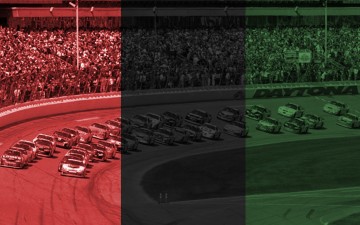
Can you imagine the reaction to fans in “Black Power” shirts lining racetracks, as red, black and green flags and Black Panther Party imagery blanked NASCAR events? Whereas the Confederate flag—a symbol of secession and White supremacy—are commonplace at NASCAR events, symbols of Black pride would surely bring about major criticism and attacks.

What if it was an African-American driver who purposely crashed into another driver’s car, sending him airborne as Carl Edwards did to Brad Keselowski in 2010? Can you imagine if Barry Bonds, Metta World Peace, or Terrell Owens was a race car driver and how the public might respond at the sight of intentional crashes, trash talking, fist fights, and helmet throwing? Would it be “boys will be boys” or “that’s just NASCAR”? Or would the talk to turn to criminality, thugs, and “gangstas?” One has to wonder if hip-hop would take the blame, even though nobody blames country music for this type of behavior from White NASCAR drivers.

Take a recent incident involving Kyle Busch and Ron Hornaday during a Camping World Truck Series race. After bumping each other, Busch proceeded to rear-end Hornaday’s truck into the wall, ostensibly wrecking his car. While Busch received a 1-race suspension and a 50,000 fine, can you imagine the outrage, moral posturing and punishments had the driver not been White?

Although a recent study highlighted the connection between NASCAR viewing and “aggressive driving,” with no such study on the impact of watching hard fouls, one has to wonder what people are actually scared about. If an elbow from Metta World Peace and a hard foul from Udonis Haslem prompts national outrage that focus on how the foul could have killed someone or that if someone did on the street would have been in jail, a Black NASCAR driver would lead to similar statements about “cars being weapons” and “out-of-control” drivers who are obviously crazy and therefore unsafe and off the track.

If the U.S. military gave $136 Million to a Black NASCAR driver as it did to Dale Earnhardt Jr., would people see it as advertisement or maybe a handout, welfare, or affirmative action?

Can you imagine if NASCAR fans that were overwhelmingly (if not entirely) Black booed the First Lady of the United States, what might the reaction be? Whereas White fans can boo Michelle Obama and Jill Biden during an appearance at Homestead-Miami Speedway, which it is hard to imagine Laura Bush and Lynne Cheney receiving similar treatment at a Black NASCAR event; certainly such disrespect would elicit national outrage and condemnation. Can you imagine the reaction from Sean Hannity and Rush Limbaugh, who actually thought the incident to be justifiable given the Obamas’ “uppity-ism?”

That sort of disrespect wouldn’t fly if NASCAR were Black, nor would a group of drivers refusing to meet with the president. Just this year, several White NASCAR drivers passed on an invitation to the White House, citing scheduling conflicts. We don’t have to guess what might happen given the experiences of Craig Hodges, who in 1992 while visiting the Bush White House not only wore a dashiki, but also “handed the President a letter that asked him to do more to end injustice toward the African-American community.” He was soundly denounced in the media and shortly thereafter he was out of the league.

Continue reading @ CHANGING LANES: What if NASCAR was Black? – News & Views – EBONY.

Metta World Peace and the Stigma of Criminalized Bodies Pt. 2 | Urban Cusp


Metta World Peace and the Stigma of Criminalized Bodies Pt. 2

By David J. Leonard

The elbow seen around the world and the media fallout continues to bother me. Over the last five weeks, I have found myself debating others online, yelling angrily at the television and otherwise struggling to make sense of Metta World Peace’s elbow of James Harden. As I noted in part 1, my concern stems from a media narrative that too often invokes the language and frames reserved for “criminal justice” matters (the courts). It also reflects a narrative that refuses to let MWP live in the moment, to be defined by his actions in our present. Instead, he is defined now (and as he has been since 2004) by his actions and the meaning of those actions within our racialized society. Having paid his debt to the NBA, and society, he continues to be dogged by the past, an unfair constraint of America’s criminalizing culture.

The efforts to criminalize MWP, to depict him as pathological and dangerous, as a constant threat to those on the court is illustrated in language usage but also in the constant references to his past. The constant reference to the Palace Brawl and to past suspensions without any acknowledgement of the specifics of each instance (and the differences), the timeframe involved, or the changes MWP has shown is telling. For example, many commentators continue to reference his “past,” his “history” and the fact that he has been suspended “13 times in his NBA career for a total of 111 games.”

However, few provide any specifics, as if they don’t matter. Three of those suspensions (4 games) were for exceeding the maximum allowable flagrant foul points, with another coming from his leaving the bench during an altercation that he was not involved with. Even his first suspension in the league (4 games – “With the Pacers, four games for confronting and making physical contact with Miami Heat coach Pat Riley, for taunting the Miami bench, for committing a flagrant foul-2 on Caron Butler (pushing him into the stands) and making an obscene gesture toward fans”) or two of his more recent suspensions, both of which were clearly impacted by his involvement with the Palace Brawl, points to the problems of imagining MWP as some “habitual” offender.

None of this is to excuse MWP for the elbow or even past actions (including a plea of “nolo contender” in a case where involving infliction of injury his wife, clearly his most troubling offense yet one that received much less media outrage that the elbow or the Palace). Rather, I call for specifics and reflection as a way to caution against the continued merging of the criminal justice system and public culture, between the criminal court and the basketball court. The normalization of the language of the criminal justice system and the criminalizing of “bad” bodies gives life to America’s prison culture, to America’s new Jim Crow.

This leads me to why the media coverage regarding the elbow gives me pause – why it troubles me more than the elbow itself. The intrusion of the language of the criminal justice system, the ubiquitous references to Metta’s past, and inability of others to allow MWP to move forward without the past shackling, defining, and controlling him reflects a larger injustice: the stigmas, life-sentence, and 2nd-class citizenship “afforded” to criminalized communities. “A criminal record today authorizes precisely the forms of discrimination we supposedly left behind,” writes Michelle Alexander in The New Jim Crow: Mass Incarceration in the Age of Colorblindness:

Continue reading @ Metta World Peace and the Stigma of Criminalized Bodies Pt. 2 | Urban Cusp.