NewBlackMan: Brandon Marshall and the Challenge to Mental Health Treatment Inequality

Vulnerable:

Brandon Marshall and the Challenge to Mental Health Treatment Inequality

by David J. Leonard | NewBlackMan

On Sunday, amid all the hoopla about the start of NFL training camp, player movement, and the start of the NFL season, Brandon Marshall quietly told the world a secret, announcing that he was living with a Borderline Personality Disorder.

Right now today, I am vulnerable, I making myself vulnerable, and I want it to be clear that this is the opposite of damage control. The only reason I am standing here today is to use my story to help others who may suffer from what I suffer from, from what I had to deal with. I can’t explain to you and paint a vivid enough picture for you guys where I been in my life, probably since the end of my rookie year.

Noting that neither the cars nor the fame, neither the success on the field nor the joys experienced off the field resulted in happiness, Marshall highlighted the despair that he has experienced during his life:

I haven’t enjoyed not one part of it and it’s hard for me to understand why . . . . One of the things I added to my prayer was for God to show me my purpose here. When I got out of the hospital, I called my videographer and I said, Rob, grab your camera and just come to my house and just start shooting. I said I’m very depressed right now, I probably won’t talk, I probably won’t even leave my theater room, but you just shoot and don’t stop shooting. I said, I don’t know where we’re going with this, I don’t know what’s going to come out of this, but something good is going to happen.

Marshall is not the first high-profile African American athlete to publicly document the struggles with mental illness. Several years ago, Ricky Williams spoke about his illness (Social Anxiety Disorder) “to up the awareness and erase the stigma.” Likewise, Ron Artest, who has publicly acknowledged his own disease, has gone beyond chronicling his own story, testifying before congress while raising money (through auctioning off his championship ring) for mental health awareness among youth.

Continue reading at  NewBlackMan: Brandon Marshall and the Challenge to Mental Health Treatment Inequality.

NewBlackMan: “No Dad at Home:” James Harrison, Colin Cowherd and the Case Against the Black Family

“No Dad at Home:”

James Harrison, Colin Cowherd and the Case Against the Black Family

by David J. Leonard | NewBlackMan

In a recently published article in Men’s Journal, James Harrison questions the fairness and the administrative philosophy adopted by commissioner Roger Goodell. Referring to Goodell as a “crook,” “puppet,” “dictator” and a “punk” (among others things), Harrison problematizes the ways in which race operates within the NFL. “Clay Matthews, who’s all hype — he had a couple of three-sack games in the first four weeks and was never heard from again — I’m quite sure I saw him put his helmet on Michael Vick and never paid a dime,” notes Harrison. “But if I hit Peyton Manning or Tom Brady high, they’d have fucked around and kicked me out of the league.” And: “I slammed Vince Young on his head and paid five grand, but just touched Drew Brees and that was 20. You think black players don’t see this shit and lose all respect for Goodell?”

In a lengthy piece, entitled “Confessions of a Hitman,” Harrison discusses a myriad of issues. Yet, his comments about the commissioner, and his references to racial inequality in the punishment of players, have not surprisingly prompted the most widespread media commentary and condemnation. For example, Gregg Doyel, with “Goodell is a strict disciplinarian, but he’s no racist,” scoffed at the claim the Goodell is a racist or even that he treats black players differently/unfairly (he and others may want to read the work of Herbert Simmons and Vernon Andrews – here is a second piece by Andrews).

Goodell runs his league the way strong parents run their family: With rules, with parameters, with discipline. No shortcuts. No excuses. Tough love all the way, and if the players don’t like it, well, it happens. Does a 16-year-old like it when he sneaks out for a night of drinking, gets busted, then gets grounded for three months? No, the teenager doesn’t like it. Shocking

Building upon this argument during a discussion about Doyel’s piece, ESPN’s Colin Cowherd took to the air to recycle longstanding arguments about black families, single-mothers, absentee fathers, and the purported cultural shortcomings of black America.

Here is something that is interesting, if you look at basic metrics or numbers in this country. 71% of African Americans no Dad at home; no disciplinarian. Fathers are often louder voice, the disciplinarian. Many of those kids don’t grow up with a dad, raised by mom, sister, aunts, nieces, uncles whatever.

They go to college where they are stars. And basically even their college coach, as we saw with Ohio State, pretty much lets the stars run the program. The NFL is one of the first places where many star players finally see discipline. Finally have an authoritative male figure – buck stops here, I will make all the calls, you will not get an opinion.

This was not the first time Cowherd talked about black families in relationship to sports, having questioned John Wall’s leadership abilities because of his limited relationship to his father (his father was incarcerated during Wall’s childhood, dying of liver disease when Wall was age 9).

Let me tell you something: I’m a big believer, when it comes to quarterbacks and point guards. Who’s your dad? Who’s your dad? Because I like confrontational players, I don’t like passive aggressive. Strong families equal strong leaders. Talent? Overrated. Leadership? Underrated. And you can say, well, Colin, can you just go out and say anything crazy and get people to e-mail. That’s not the point. You wouldn’t e-mail if I was an idiot, because you wouldn’t listen to the show. You listen to the show because we make good points.

I simply have a different opinion than you do on John Wall. I like the character of Derek Fisher, the rebounding and distribution ability of Rajon Rondo, that’s what I like. That’s what I want from my point guards. You celebrate the assists more than the buckets…..I know he’s great. So don’t confuse [me saying] John Wall’s no good. No, John Wall’s an A+ talent. I don’t think he’s ever gonna be an A+ win-championships point guard.

In both instances, the efforts to recycle the Moynihan report, to define father as natural disciplinarian and mother’s nurturing, to link cultural values to family structures, and to otherwise play upon longstanding racial stereotypes, is striking. However, I would like to reflect on his recent comments in a substantive way.

First and foremost, the idea that 71% of black children grow up without fathers is at one level the result of a misunderstanding of facts and at another level the mere erasure of facts. It would seem that Mr. Cowherd is invoking the often-cited statistics that 72% of African American children were born to unwed mothers, which is significantly higher than the national average of 40 %. Yet, this statistic is misleading and misused as part of a historically-defined white racial project.

Continue reading at NewBlackMan: “No Dad at Home:” James Harrison, Colin Cowherd and the Case Against the Black Family.

NewBlackMan: Locked Out and Demonized: Challenges Facing the NBA’s Black Players

This has

Led to that

Locked Out and Demonized:

Challenges Facing the NBA’s Black Players

by David J. Leonard | special to NewBlackman

Deron Williams made it official, signing a contract with Besiktas, a top tier team in Turkey. While not the first NBA player to sign a contract as a result of the lockout, he is clearly the most high profile (superstar) to do so thus far. Others may follow suit, with Kobe Bryant, Dwight Howard, Kevin Durant, Rudy Gay and Stephen Curry all noting interest in the prospects of playing overseas. Having already written on the larger implications here, in terms of both the lockout and the globalization of basketball, what is striking is how Williams’ decision to sign overseas and the possibilities from other superstars has provoked a backlash from fans and media commentators alike.

Not surprisingly the patriotism and loyalty of players has been questioned, as his been their commitment to the American fans. Similarly, players have been criticized for being greedy, whose sole motivation is to “get paid” (the fact that players were locked out by the owners often gets OBSCURED – ignored – within these discussions). Yet, what has been most striking is the systematic questioning about these players willingness to play overseas. Recycling longstanding arguments about athletes as pampered, over indulged, and spoiled, a charge that has commonplace against black athletes, these commentators both question the willingness of these players to play in non-NBA conditions all while questioning their mental toughness.

For example, Berry Tramel, in “NBA players’ threat to go overseas is weak,” seems to question the seriousness of threat, asking if, “The players want us to believe they’ll sign on to play in venues and under conditions wholly inferior to the NBA standard? In case no one has noticed, the NBA is lavish living. First-class travel. First-class accommodations. First-class officiating. First-class training staffs.” Similarly, David Whitley, with “NBA stars would get rude awakening playing overseas” further emphasizes how the NBA lifestyle that players are accustomed to, would not be available to them in Europe or China. “It would also give players a taste of how 90 percent of the hoop world lives. It isn’t finger-lickin’ good. There aren’t a lot of charter flights, much less extra-wide leather seats or five-star meals.” In “NBA lockout causing European exodus?”

Umar Ali, while acknowledging the possibility of NBA players going overseas, focused on the horrid conditions there and the spoiled nature of the players themselves.

Though the accommodations pale in comparison to what the average player receives while playing in the NBA – five-star hotel rooms, luxury vehicle transports and catered food compared to second rate rooms on the road, cramped buses and whatever is provided for sustenance – there is still enough to sway players to consider making the transition.

Ali seems to be alone with the majority of the commentaries depicting today’s players as high maintenance divas who would not accept the conditions overseas. Skip Bayless, on “First and Ten,” scoffed at the prospect of the NBA stars playing in China or Europe longer than a week “because they will not like it. They will not like the conditions; they will not like the travel; they will not like the food, the TV they aren’t able to watch.” His “debate” adversary, Dan Graziano, not surprisingly agreed, adding “The lifestyle these guys lead over here . . . if they think that will follow them to Europe or Asia . . . it will be a very short period of time before they realize they were mistaken.”

Continue reading at  NewBlackMan: Locked Out and Demonized: Challenges Facing the NBA’s Black Players.

NewBlackMan: Death Isn’t a Slave’s Freedom: The Historic Erasure of Curt Flood’s Life

Death Isn’t a Slave’s Freedom: The Historic Erasure of Curt Flood’s Life

by David J. Leonard

| special to NewBlackMan

Nikki Giovanni once write that “death is a slave’s freedom” aptly surmising elements of Curt Flood’s life and his struggle against America’s white baseball establishment. Denounced for his efforts to challenge baseball’s slave-like conditions and crucified for his efforts to connect baseball to slavery, to American racism, Flood experienced neither vindication nor compensation in part until his death, at which time Flood tasted freedom in a certain way – freedom from the death threats, abuse, ridicule, and American racism.

Yet after watching HBO’s recent documentary The Curious Case of Curt Flood, I am less sure that “death is a slave’s freedom” in that Flood was unable to escape demonization and ridicule, as the film turned his life into a spectacle of sorts. In an effort to illustrate how the human cost faced by Flood and his family, to highlight the difficult path to redemption, the film spends an overwhelming amount of time on Flood’s personal tragedy. Evidence in the divorce from his initial wife shortly after he fought to live in an Alamo neighborhood and the financial, emotional, and physical impact on Flood during and after his suit against Major League Baseball, Curt Flood’s life is a testament to the costs of resistance and struggle.

Yet, the film goes too far in this respect, turning Flood’s life into a spectacle, a train wreck that the audience is suppose to stare and marvel at for the duration of the film. Focusing on alcoholism, fraudulent paintings and the personal demons that haunted Flood, The Curious Case of Curt Flood highlights the narrative grip that confines Flood in our contemporary moment. In “The Way It Is: HBO’s The Curious Case Of Curt Flood,” Nasir Muhammad & Stephane Dunn elucidate the film’s flaws in this regard, seemingly questioning its narrative focus on the tragedies experienced by Flood and his ultimate redemption, turning an important history into a “E’ Hollywood” story. They quote Stan Hochman, whose critiques of the film illustrate the powerful ways that death is not a slave’s freedom:

The courageous athlete who dared to challenge an unfair system is depicted as an alcoholic, a womanizer, a woeful husband, a dreadful father, a lousy businessman and a fraud who never really painted those portraits he churned out that enhanced his image as an artist . . . .In the history of warts-and-all biographies, this one slithers near the top of the list.Curt Flood was a freedom fighter. That didn’t begin with his challenge to Major League’s Baseball Reserve clause or his rhetorical links to a larger history of slavery

To continue reading head to NewBlackMan: Death Isn’t a Slave’s Freedom: The Historic Erasure of Curt Flood’s Life.

Yao Ming’s Exit: Globalization and All Its Possibilities

  MY LATEST BLOG POST FOR NEW BLACK MAN


Yao Ming’s Exit: Globalization and All Its Possibilities  | Special to NewBlackMan
   Yao Ming is reportedly retiring from the NBA.  A player of immense talent and potential, his career for some will be a disappointment.  While debating his on-the-court successes, whether or not he is a hall-of-famer, and the large basketball significance are interesting, I think his retirement should elicit thought and reflection about the globalization of the NBA.  His importance to the game, in global sports marketing, and in terms of larger social forces transcend the game and that has always been the case.  In 2003, when Yao’s statistics were pedestrian at best, I wrote in Colorlines about the larger significance of his arrival to the NBA.
   The star power of Yao Ming is not the result of his extraordinary stats for the Houston Rockets. He averages a respectable 13 points and 8.2 rebounds per game. The flurry of magazine covers, billboards, and television commercials featuring Yao reflect the desires of American and Chinese companies to cash in on Yao’s popularity. Beyond the efforts to sell basketball to more than 2 billion Chinese nationals, the NBA hopes to capitalize on the sudden explosion in ticket sales to the Asian American market. Asian Americans buying group packages for Rockets games represent 11 percent of the buying public, 10 percent more than last year. In cities across America, Yao attracts fans to the Rockets’ away games to such an extent that a number of stadiums, in places like Detroit, Boston, and Oakland, have offered special “Asian American nights.” When the Rockets played the Golden State Warriors this spring, the Oakland arena announced parts of the game in Mandarin. Rockets’ coach Rudy Tomjanovich frequently boasts of Yao ‘s importance in bridging cultural and political gaps. In other words, Yao is presumably schooling America about Chinese culture and history.
    Since 2003, Yao Ming’s economic, social, and cultural importance has increased tenfold.  According to a 2007 study, 89 percent of Chinese between the ages of 15 and 54 were “aware of the NBA,” with 70 percent of youth between the ages of 15 and 24 describing themselves as fans.  More recent numbers show a game increasing in popularity, despite Yao’s diminished presence.  On average, NBA games (despite being aired early in the morning) deliver 558,100 viewers; NBA.com/China generates roughly 12 million hits per day. A two billion dollar market, China has proven to be immensely important to the NBA’s global expansion and its overall financial success.

Metta World Peace: Leave the Baller formerly known as Ron-Ron alone

Metta World Peace

Described as crazy, as a publicity stunt from a man seeking attention, as evidence of his weirdness, and countless other not-to-mentioned racist and derogatory comments, the Internet was set ablaze after Ron Artest announced his plans to change his name to Metta World Peace.

Commentators also used the instance to rehash Artest’s past, postulating that the name change reflected a deliberate attempt to continue to change his image.  For example, Andy Kamenetzky, offered the following as explanation for his name change:

In any event, the identity change falls in line with recent steps Ron has taken while bettering himself as a person and revamping his formerly tarnished image:

– Opening up about his time in therapy, while becoming an outspoken advocate for the mental health issues. (A matter we discussed at great length earlier this season.)

– Winning the 2011 J.Walter Kennedy Citizenship award for outstanding service and dedication to the community.

– Launching a new reality TV show, “Last Second Shot,” in which he’ll mentor parolees.

Thus, why not change his name to “Metta World Peace?” (“Metta,” by the way, is defined as the Buddhist virtue of kindness.”)

The one concern I might have for Ron is perhaps appearing like he’s on the verge of jumping the shark. It’s one thing to thank your psychiatrist before conducting a freewheeling, heartfelt press conference for the ages. It’s another to adopt a very unusual moniker. Too many moves at once, however well-intentioned, could come off as cartoonish.

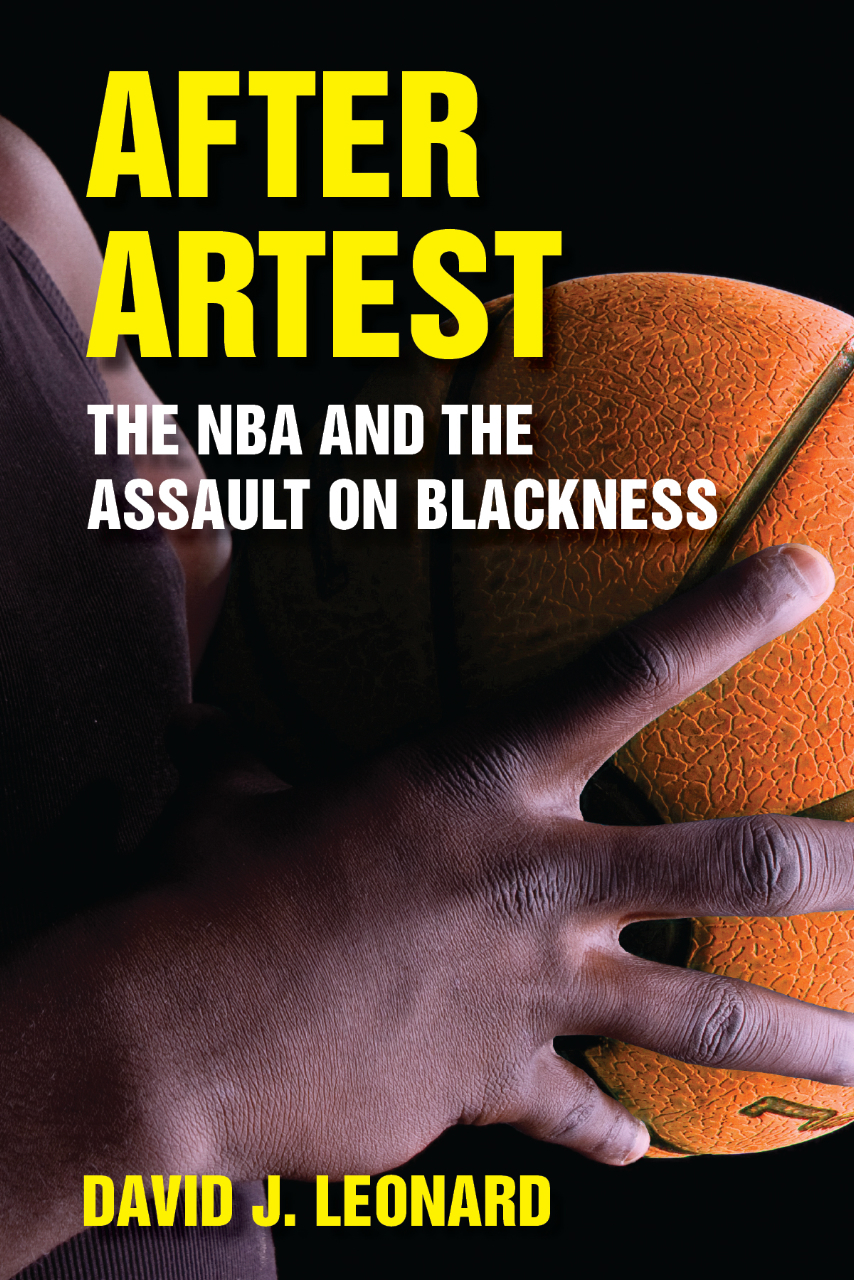
The fact that his decision to change has led to ample ridicule and criticism, leaving one to wonder how this was an attempt to reform his image, is revealing.  Unable or unwilling to accept the name change on his terms, analysts and the many people who offered comments on various pages took the opportunity to once again deconstruct, analyze, psychologically prod Artest.  In my forthcoming book – After Artest (SUNY Press) – I argue that Artest (and the NBA’s black bodies) were unable to transcend and move beyond the prism of the Palace Brawl.  That is, the 2004 Palace Brawl overdetermined the media discourse surrounding and public consumption of the NBA; and both the Palace Brawl and the representations of the NBA were overdetermined by the blackness associated with the league.  The spectacle surrounding his name change, the demonization, the ridicule, and the efforts to psychologically analyze Artest demonstrates how both blackness and the Palace Brawl overdetermine this reaction.   The level of animosity and judgment is not only evidence to the impossible path to redemption, but also how we as a society might grow a bit if we simply thought about what Metta (Ron Artest) is trying to tell us.  According to Acharya Buddharakkhita, Metta means the following:

The Pali word metta is a multi-significant term meaning loving-kindness, friendliness, goodwill, benevolence, fellowship, amity, concord, inoffensiveness and non-violence. The Pali commentators define metta as the strong wish for the welfare and happiness of others (parahita-parasukha-kamana). Essentially metta is an altruistic attitude of love and friendliness as distinguished from mere amiability based on self-interest.

If people could simply hear and practice what is in his name, I can only imagine what the sporting world would look like (not too mention the comment) as well as every other institution within our society.