NewBlackMan: No Heir Jordan: The NBA Lockout and the End of an Era

NewBlackMan: No Heir Jordan: The NBA Lockout and the End of an Era

No Heir Jordan: The NBA Lockout and the End of an Era

by David Leonard | NewBlackMan

The NBA lockout is over. With the players and the owners having reached an agreement, basketball will return beginning Christmas Day. Ushering in substantial structural changes to the league, which will likely restrict player movement and constrain middle-class player salaries, the NBA lockout will also go down in history as an end to the search for the next Michael Jordan. Since MJ’s retirement, the league, its marketing partners, and fans alike have pinned for someone to fill his AIR Jordans. Each anointed as the next Michael Jordan, Penny Hardaway, Grant Hill, Vince Carter and Harold Miner (“Baby Jordan”) all failed to deliver because of injuries, limited production, or a combination of both. Each in their own right was imagined as a player who could fill the shoes, whose talents, charisma, and athleticism would propel the NBA during its post-Jordan era. None of them met these expectations resulting in an NBA in continued search for a twenty-first century basketball God.

Kobe Bryant and LeBron James each took the mantle of the next Jordan to places none of the other NMJ (next Michael Jordan) had reached. Kobe, because of his talents, the ways in which he patterned his game and demeanor after Jordan, his quest for rings, and most importantly his competitiveness, all elevated the comparisons, leading many to argue that he was the NMJ. Yet because of Eagle County, Colorado, because of his conflicts with Shaquille O’Neal and the ultimate demise of the Lakers Dynasty, and because he is said to have demanded to get out of Los Angeles, Kobe has fallen short in other’s quest to find the next Michael Jordan. Like Kobe, LeBron James has delivered on the court, dazzling fans with his passing skills, his athleticism, and his ability to make his teammates better. Worse than struggling to secure a title, LeBron James fall short in the MJ sweepstakes when he decided to take his talents to South Beach.

While possessing the skills, charisma, and baller potential, the two most promising players to lead the NBA, to build upon the global popularity established by Jordan, have fallen short not because of their basketball talents but their inability (or our inability) to fill mythical shoes. The quest to find the Next Michael Jordan, thus, has nothing to do with basketball but rather is part of an effort to find a player who reinforces popular narratives about the American Dream, the protestant work ethnic, and post-racialness.

Jordan, only seen in public in his basketball uniform or a $3,000-dollar suit, Jordan embodied the politics of racial respectability on and off the court. He “allow[ed] us to believe what we wish to believe: that in this country, have-nots can still become haves; that the American dream is still working” (Ken Naughton quoted in Andrews 2000, p. 175).

continue reading @ NewBlackMan: No Heir Jordan: The NBA Lockout and the End of an Era.

Emancipate the NBA: Struggling for Justice in the NBA (New piece from @NewBlackMan)

Emancipate the NBA: Struggling for Justice in the NBA
by David J. Leonard | NewBlackMan


I have been trying to write this column for several days.  I have thought and thought, and spent several hours writing, resulting in nothing.  I am just too angry.  My anger about the NBA LOCKOUT has nothing to do with the players.  I am actually proud of their courage and their refusal to kowtow in the face of pressure to accept an unfair proposal.  I am happy they told David Stern to file his ultimatum under “U” for unacceptable.  In fact, when I heard the news on Monday that the players indeed rejected the proposal, I found myself giving a little fist pump.  The prospect of a lost NBA season is disheartening at one level, yet I am encouraged by their refusal to accept an unjust economic arrangement.

Despite a public narrative that continually focuses on money as the only issue of contention, the LOCKOUT isn’t simply about how to split NBA pie.  It isn’t about greedy, out-of-touch players that already make millions for playing a game (this idea is so disrespectful to not only their talents but their hard work and dedication).

Players have already given up billions of dollars when they apparently agreed to a 50/50 split (or thereabouts).   Yet that wasn’t enough for the owners.  Their proposal would dramatically restrict player movement, ostensibly ending much of free agency.  The LOCKOUT in many ways is an effort to roll back free agency, to overturn the legacies of Curt Flood and to create a system where owners don’t have to compete for the services of all players (Ric Bucher made this point eloquently).

The proposed structural changes would dramatically alter the landscape of the NBA, severely limiting the options and free agency potential of NBA players.  In 2010-2011, where the players received 57% of basketball related income, the salary cap was $58.044 million; that year teams paid a tax at $70.307 million.  If the owners have their way, these numbers would fall to $50,915,789 for the cap and $61,672,807 for the luxury tax.  So what does this mean?  It means, that only 10 teams would be under the salary cap (these calculations include potential rookie salaries).  It means that 14 teams would be paying a luxury tax, which would be higher in the new system.  It means that the many teams that have empty roster spots would have little or no money to spend on free agents.  Faced with a luxury tax and only able to use a reduced exception that allows teams to exceed the salary cap, the new system is an assault on free agency and “free-market capitalism.”  It allows teams to ostensibly eliminate player leverage in getting the most possible money.

Imagine if this system existed in other industries.  Imagine if every company in your respective field was restricted in how much money they could spend on salaries.  Imagine if these companies were taxed if they spent over a certain threshold.  How would it impact your ability to garner employment?  How would it impact your ability to move from one company to the next?  How would it impact your ability to increase your salary because two competitors were forced to compete for your services?  What the owners and David Stern are trying to do, through the reduction of the BRI, through the changes in the mid-level of exception, and the tax structure is to limit the power and choice of the players.  It will invariably depress wages, bolster profits for owners, kill the NBA’s middle-class, and otherwise limit player power.

The owners’ proposal will likely HURT many teams and the quality of their basketball.  Look at the Boston Celtics: they have 7 players under contract for the 2011-2012 year, meaning they would need 5 more players just to get the 12-person minimum (teams often carry 15 players).  Based on estimates of a 50/50 BRI split, the Celtics would be roughly $15 million dollars over the cap, meaning that in order to fill out their roster they would be limited to minimum veteran salaries and one exception (unless they sign players previously under contract in 2010-2011).  They would be forced to pay a tax for every dollar they spend.  How do you think that will impact player movement?  How will it impact jobs?  What team will be willing and able to sign players beyond 12-man roster?  As much as it pains me to say this (as someone born and raised in Los Angeles), the proposal would be horrid for a team like the Celtics.

The NBA LOCKOUT is not about fans, despite claims that it is about helping the small-market teams and their fans.  As I have said before, I don’t buy the parity argument.  I buy it even less as it imagines the LOCKOUT as a struggle to protect small market teams from future player exodus. Focusing on LeBron James, Deron Williams, and Carmelo Anthony, all of whom left their teams for “greener” pastures in big markets, this argument focuses on the lack of fairness to the fans in these respective cities.  They cite the potential exits of Chris Paul and Dwight Howard as further evidence that the NBA needs structural change.  I am angered that anyone accepts this seriously flawed argument.  Whether thinking about the success of the Mavs or Spurs, or the failures of the Clippers, Knicks and the Warriors, market size does not guarantee success or failure.  It isn’t about the fans or fixing a broken system, but enhancing owner profits and further creating a league where players are     treated as “the help.”  It is about owners asserting their power to control the players.

Continue reading @NewBlackMan

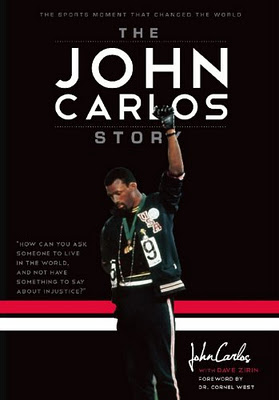
NewBlackMan: Book Review | The John Carlos Story: The Sports Moment That Changed the World


Book Review | The John Carlos Story: The Sports Moment That Changed the World

Daring Then, Daring Now: The John Carlos Story

Book Review by David J. Leonard | NewBlackMan

Having studied the 1968 Olympic protest, having conducted an interview with Harry Edwards on the revolt of the black athlete, and being someone dedicated to understanding the interface between sports, race and struggles for justice, I was of course excited about the publication of John Carlos’ autobiography, The John Carlos Story: The Sports Moment that Changed the World. Written with Dave Zirin, the book provides an inspiring discussion of the 1968 Olympics without reducing the amazing life of John Carlos to the 1968 Olympics. More than 1968 or the protests in Mexico City, it chronicles a life of resistance, of refusing to accept the injustices that encompass the African American experience.

John Carlos challenged American racism from an early age. Readers learn of a young man who “went around Harlem handing out food and clothes like Robin Hood and his merry men in Technicolor” (p. 21). Recognizing the level of poverty and injustice in Harlem, and refusing to stand idly by, a young Carlos would break into freight trains to steal food with the purpose of giving it to those who had been swallowed up by the system.

The experience of stealing groceries and good and giving the people something for nothing was positive. Just doing this kind of so-called work opened up my mind and got me to notice what was going on around me. I couldn’t turn my back when I saw evidence of discrimination in the community. I captured it in my mind every time I saw anyone in my neighborhood mistreated by the police (p. 27).

These experiences, like his having to give up on the dream of becoming an Olympic swimmer as a result of societal racism, not only politicized Carlos, but also instilled in him a passion and commitment to help others reach their dreams. It taught about the power and necessity of imagining and fighting for “freedom dreams.”

The John Carlos Story chronicles the ways he has lived a life guided by the philosophy articulated by Fredrick Douglas that “power concedes nothing without demand.” From his organizing a strike at his high school against “the nasty slop they called ‘food’” (p. 33) to his insistence that the manager at the housing protects where he lived address the problem of caterpillars in the courtyard, John Carlos demanded accountability and justice long before 1968.

His book illustrates the level of courage he has shown throughout his life. When the manager refused to address the caterpillar problem, which prevented his mother from joining others in the courtyard because of allergic reactions, Carlos once again lived by the creed: power concedes nothing without demand. John Carlos has lived a life of demanding justice and in the face of refusal demanding yet again. He describes his response in this case as follows:

Then I took the cap off the can and doused the first tree in front of me with gasoline. Then I reached for a box of long, thick wooden matches. After that first tree was soaked, I struck one of the stick matches against my zipper and threw it at the tree and watched. It was a sought: the fire just as that tree like it was a newspaper and turned it into a fireball of fried caterpillars (p. 41).

The compelling life that Carlos and Zirin document extends beyond his youth further reveals a life dedicated to justice. His refusal to accept the racism and the mistreatment experienced while living in Texas encapsulates how America’s racism and systematic efforts to deny both the humanity and citizenship of African Americans compelled Carlos’ activism as a young man and ultimately as an Olympian.

The protest at the 1968 Olympics should not be a surprise given the racial violence experienced by Carlos and his brothers and sisters throughout United States (and the world at large).

Continue reading @ NewBlackMan: Book Review | The John Carlos Story: The Sports Moment That Changed the World.

NewBlackMan: Putting the “Run Away Slaves” Ahead of the Plantation: Parity, Race and the NBA Lockout


“Basketball and Chain” by Hank Willis Thomas

***

Putting the “Run Away Slaves” Ahead of the Plantation:

Parity, Race and the NBA Lockout

by David J. Leonard | NewBlackMan

In wake of LeBron James’ decision to take his talents, along with those of Chris Bosh, to South Beach to join forces with Dwayne Wade, the NBA punditry has been lamenting the demise of the NBA. This only became worse with the subsequent trades of Deron Williams and Carmelo Anthony to New Jersey and New York respectfully. Described as a league “out of control in terms of the normal sports business model” where player power “kills the local enthusiasm for the customer and fan base,” where superstars leave smaller markets with no hope of securing a championship, where manipulating players and agents have created a game dominated by “players whose egos are bigger than the game,” much has been made about player movement.

Commentators have lamented how players are yet again destroying the game from the inside, thinking of themselves ahead of its financial security and cultural importance. In “NBA no longer fan-tastic,” Rick Reilly laments the changing landscape facing the NBA. Unlike any other sport, the NBA is now a league where “very rich 20-somethings running the league from the backs of limos,” are “colluding so that the best players gang up on the worst. To hell with the Denvers, the Clevelands, the Torontos. If you aren’t a city with a direct flight to Paris, we’re leaving. Go rot.” In other words, this line of criticism have warned that “the inmates are running the asylum,” so much so that the league “is little more than a small cartel of powerful teams, driven by the insecurities and selfishness of the players who stack them.”

While such rhetoric erases history (of trades – players of the golden generation have certainly demanded trades; the same can be said for other sports as well) and works from a faulty premise that parity is good for the economics of the NBA (the very different television monies for the NBA and NFL proves the faultiness of this logic), the idea that the league needs more parity remains a prominent justification for the NBA lockout. “The owners believe that the league should be more competitive and that teams should have an opportunity to make a profit,” notes David Stern. Similarly, Adam Silver, deputy commissioner, argues, “Our view is that the current system is broken in that 30 teams are not in a position to compete for championships.”

Such rhetoric and Stern’s ubiquitous statements about the NBA needing a dramatic restructuring builds upon argument that the NBA’s future is tied to its ability to thwart players like LeBron James, Carmelo Anthony, Deron Williams, and potentially Dwight Howard, Chris Paul, and others from taking their talents anywhere.

Continue reading @ NewBlackMan: Putting the “Run Away Slaves” Ahead of the Plantation: Parity, Race and the NBA Lockout.

NewBlackMan: Is the NBA Lockout About Race?


Is the NBA Lockout About Race?

by David J. Leonard | NewBlackMan

thought I would write a follow-up to my piece, “Bill Simmons and the Bell Curve: The ‘limited intellectual capital’ of the NBA’s Players” which has elicited a significant reaction.   It should be clear from the outset, I am not interested in conversations about individuals, intention, or motivation.  To paraphrase the always-brilliant Jay Smooth, the conversations should focus around what has been said, what has been done, and what all of this means in a larger context rather than the individual actors.  The discussion needs to be about how ideology, narrative, and frames operate within these larger discussions. 

One of the common responses to Bill Simmons’ commentary and more specifically the criticism directed at me for reflecting on the racial meaning in those comments has been that Simmons was talking about all NBA players, not just those who are black.  Given the racial demographics of the league and the racial signifiers associated with basketball, it is hard to accept the idea that “NBA player” isn’t a mere code for blackness.  In other words, blackness and basketball become inextricably connected within the dominant imagination, akin to Kathryn Russell-Brown’s idea of the criminal blackman.  Just as the “criminal Blackman” exists as contained identity within the dominant white imagination, the blackballer functions in similar ways. 
The process of both essentializing and bifurcating the black baller is evident in the very distinct ways that the white racial frame conceives of both white and black players, playing upon ideas of intelligence and athleticism.  Whereas the blackballer is imagined as athletic, naturally gifted, and physically superior, white basketball players are celebrated for their intelligence, work ethic, and team orientation.  In Am I Black Enough for You, Todd Boyd identifies a dialectical relationship between racialization and styles of play where whiteness represents a “textbook or formal” style basketball, which operates in opposition “street or vernacular” styles of hooping that are connected to blackness within the collective consciousness.   In both styles of play, notions of intelligence, mental toughness, and mental agility are centrally in play. 
A second and widely circulated denunciation against those critical voices has been our lack of fairness or the double standards of this portion of the discourse.  Whereas I honed in on Simmons’ comments, little has been made about those of Jason Whitlock (Bryant Gumbel has been the at the center of media commentary).  Lets be clear: the comments of Jason Whitlock, irrespective of intent, are worthy of criticism in that his recent commentary plays upon and reinforces dominant narratives and frames about race and blackness.  Looking at his comments, alongside with those of Simmons, further illustrates the ways in which ideologies are circulated, and how commentaries such of these cannot be understood outside of these larger contexts.


A belief in the superiority of white intelligence has been commonplace within American history.  This remains the case today. In one earlier study (during 1990s; see here for another source) about the persistence of racial stereotypes, the author found the following:

More than half the survey respondents rated African Americans as less intelligent than whites. Fifty-seven percent of non-African Americans rated African Americans as less intelligent than whites and thirty percent of African Americans themselves rated African Americans as less intelligent than whites. Sixty-two percent of the entire sample rated African Americans as lazier than whites and more than three out of four survey respondents said that African Americans are more inclined than whites to prefer welfare over work.

In a 2010 study about race and politics, researchers at the University of Washington found that stereotypes about blacks as it relates to intelligence, work ethic, and trust-worthiness remain prominent. Another recent study about race, politics, and stereotypes found that while there has been slight progress in terms of the rejection of longstanding prejudices, they remain constant within the national discourse. 

Continue reading (there is more) @ NewBlackMan: Is the NBA Lockout About Race?.

My newest piece @NewBlackMan: Bill Simmons and the Bell Curve: The “limited intellectual capital” of the NBA’s Players

Bill Simmons and the Bell Curve:

The “limited intellectual capital” of the NBA’s Players

by David J. Leonard | NewBlackMan

Like many sports writers, Bill Simmons has used his columns this week to condemn NBA players, ostensibly blaming them for the cancellation of games. On Friday, he offered the following that put the onus on the players:

Should someone who’s earned over $300 million (including endorsements) and has deferred paychecks coming really be telling guys who have made 1/100th as much as him to fight the fight and stand strong and not care about getting paid? And what are Garnett’s credentials, exactly? During one of the single biggest meetings (last week, on Tuesday), Hunter had Kobe Bryant, Paul Pierce and Garnett (combined years spent in college: three) negotiate directly with Stern in some sort of misguided “Look how resolved we are, you’re not gonna intimidate us!” ploy that backfired so badly that one of their teams’ owners was summoned into the meeting specifically to calm his player down and undo some of the damage. (I’ll let you guess the player. It’s not hard.) And this helped the situation … how? And we thought this was going to work … why?

Congratulations, players — you showed solidarity! You showed you wouldn’t back down! You made things worse, and you wasted a day, but dammit, you didn’t back down! Just make sure you tell that to every team employee who gets fired over these next few weeks, as well as to all the restaurant and bar owners near NBA arenas who are taking a massive financial hit through the holidays. I’m sure they will be proud of you.

Beyond trotting out the “angry black man” trope, which seems to be commonplace within the NBA punditry, and blaming the players for the forthcoming unemployment facing many employees within of the NBA, Simmons hinges his evidence about the incompetence of the players by citing the amount of formal college education of Piece, Bryant and Garnett. In other words, people are losing jobs and fans are losing games because the NBA is at the mercy of its stupid/uneducated black players. And, Simmons wasn’t done here, offering additional clarity about his comments in “Behind the Pipes: Into the Arms of the NHL.” Explaining why he started going to hockey games, Simmons once again returns to the lockout or better said the player caused cancellation of games. In this column (sandwiched in between his general arrogance, dismissive rhetoric, and overly simplistic analysis that presumes sports exists in his theoretical mind and not reality), he writes

Where’s the big-picture leadership here? What’s the right number of franchises? Where should those franchises play? What’s worse, losing three franchises or losing an entire season of basketball? What’s really important here? I don’t trust the players’ side to make the right choices, because they are saddled with limited intellectual capital. (Sorry, it’s true.) The owners’ side can’t say the same; they should be ashamed. Same for the agents. And collectively, they should all be mortified that a 16-hour negotiating session, this late in the game, was cause for any celebration or optimism. In my mind, it was more of a cry for help.

Unusually Simmons offer some blame for the owners. As the intelligent ones, they have an obligation to fix the situation. Although they have the intelligence they allow the players, who lack intelligence, to have input in the situation. To Simmons, this is the source of the NBA’s problem.

The racial paternalism here is as striking as are his efforts to resuscitate the bell curve. What we are left with is an argument that the NBA faces a lockout because those who possess the requisite intelligence, who posses the proper fitness, have failed to control their inferior players. Michael Eric Dyson described such rhetoric as central to the history of American white supremacy: “Skepticism about black intelligence and suspicion about black humanity have gone hand in hand throughout the history of this country in feeding the perception that black people don’t quite measure up.” Writing about black male athletes and processes of representation, Ben Carrington invokes Frantz Fanon, who wrote about the incompatibility of blackness and intelligence within the white imagination. Carrington notes Fanon’s exploration of the ways in which blackness was conceptualized and envisioned through white supremacy:

When Fanon gives his white patients a word association test, it is significant to note how often his respondents mention either sports, or prominent black athletes of the period. Fanon informs us that the word, ‘Negro brought forth biology, penis, strong, athletic, potent, boxer, Joe Louis, Jesse Owens, Senegalese troops, savage, animal, devil, sin’. For Fanon, the black male was the repository of white fears, fantasies and desires, and of all of these constructions, there was one figure above all others that held a central place within the colonial imaginary: ‘There is one expression that through time has become singularly eroticized: the black athlete’.

In reading Simmons, it is clear that the black athlete remains both eroticized and demonized, a repository for white fears, fantasies, and desires, as well as a rhetorical space to articulate white fantasies, desires, and ideas about whiteness. It is no wonder that Simmons recycles the bell curve, explaining the lockout as simply a violation of nature or what happens when the intellectually inferior get to have input in a world where adults should make those important decisions.

Post script:

This is not a question of intent or even individuals, but the ways in which larger narratives and the white racial frame (stereotypes about
intelligence, athleticism) plays out within public discourse.  This is a discussion of the words, the ideology, and the history within them and how
they impact OUR collective discussions.  It is one of stereotypes and the assumptions that are embedded within our language.  It is the ways in which
race and a history of racism imprisons our assumptions and the ways that it impacts our collective imagination.  This is NOT a commentary on Simmons as a person or him at all but the words themselves, which have a larger social context, that carry with them assumptions and history.  Those assumptions, those ideas, and the ideologies guides my discussion and the ways in which those assumptions cloud both the discourse and policy inside and outside of the NBA

via NewBlackMan: Bill Simmons and the Bell Curve: The “limited intellectual capital” of the NBA’s Players.


NewBlackMan: Ain’t Much Black in the Fall Classic: Racial Diversity and Baseball


Ain’t Much Black in the Fall Classic: Racial Diversity and Baseball

by David J. Leonard | NewBlackMan

The World Series is set to start on Wednesday between the St. Louis Cardinals and the Texas Rangers. Much will be made of the pageantry, the Cinderella story surrounding the Cardinals, who only made into the playoffs on the final day of the seasons, the Rangers’ attempt to finally win a title, and of course the redemption story of Josh Hamilton (whiteness has its power). Yet, there are more stories to be hold, one being what this World Series tell us about diversity and baseball, and more importantly what the racial and national demographics of the “American past time” tell us about large social forces.

While the National Championship series highlighted an overwhelming number of African American baseball players (8), the World Series won’t showcase a similar level of diversity; as the Cardinals possess 4 African Americans on its roster (Edwin Jackson, Arthur Rhodes, John Jay, and Adron Chambers), Rangers will only suit up a single African American player (Darren Oliver). Representing 10%, this still exceeds the league-wide number, which stands at 8.5%. Mac Engel describes the state of baseball’s diversity in “Baseball continues to see fewer black players:”

For a variety of reasons, from societal to financial, the sport can’t seem to reverse the trend of fewer African-Americans playing baseball.

The University of Central Florida’s Institute for Diversity and Ethics in Sports reported this year that the number of blacks in baseball is down to 8.5 percent. The percentage of Latinos is 27 percent. The percentage for African-Americans in MLB is at its lowest level since 2007. When the institute began to track the figure in 1990, 17 percent of all MLB players were African-American. Beginning in 1997, the number has steadily decreased for a variety of reasons.

The consequences of closed parks, globalization, specialization of sports, prohibitive costs, a failing school systems, and expanded prison system has been the steady erosion of baseball. The last thirty years have seen the re-segregation of baseball, an ironic twist given its importance within the larger history of sports integration. From 1990-2000, blacks presence in professional baseball decline from 18% of the league’s players to 13%; in the ten years since, the number has continued to decline, with prospects even worse for the future. While the lack of black baseball roles models and the presumed incapability between an authentic black identity and baseball certainly part of the story, segregation and the systematic divestment, dismantling and destruction of the institutional spaces that produced past generations of black ball players is key to understanding the waning black place within “America’s Past Time.”

The declining presence of African American baseball players, almost 65 years after Jackie Robinson reintegrated professional baseball, transcends the numbers, with the shrinking influence and importance, evidence by the lack of African American star power. It is also evident in the absence of younger African American talent. Two of the players are older than me (Arthur Rhodes and Darren Oliver) revealing beyond the numbers how the systematic destruction of the infrastructure that produced both the great African American stars of yesteryear and the role players has left a barren future for African Americans in baseball

The World Series will equally highlight the impact of globalization, with a total of 17 players coming from outside the United States (8 from the Dominican Republic, 3 hailing from Venezuela, 2 coming from Japan and Mexico). Two Cardinal players hail from Puerto Rico, which has historically produced a large number of Major League players. Similar to their African American brothers, recent history has seen a precipitous decline amongst the professional ranks, which in part reflect the limited development and focus on cultivating talent. Despite its neocolonial status (or maybe because of it), players from Puerto Rico are subjected to the MLB draft, impacting Puerto Rican presence within the game (teams won’t want to invest in players that they might not be to sign). In “Puerto Rico’s Pipeline Has Been Running Low,” Ken Belson reflects on the changing place of Puerto Ricans within Major League Baseball

The pipeline of prospects from the island, once rich with potential Hall of Fame talent, has narrowed as major league teams focus on cheaper and more plentiful prospects from Cuba, the Dominican Republic and Venezuela.

In 2009, only 3.5 percent of position players in Major League Baseball came from Puerto Rico, a 24-year low. Meanwhile, the percentage of Cuban and Venezuelan position players has nearly doubled in the last decade.

While the mere mention of the declining numbers of African Americans and Puerto Rican players, or the efforts to highlight the global influences on the game often sets off resistance to the mere introduction of race and politics in the game (see here for a vivid example), we can learn much about larger issues of injustice, social change, economic inequality, and global politics by examining the rosters of this year’s World Series competitors.

Continue reading @ NewBlackMan: Ain’t Much Black in the Fall Classic: Racial Diversity and Baseball.