Dave Zirin: The Sporting Scene: Economics, Race, and the N.B.A. Lockout : The New Yorker


October 24, 2011

Economics, Race, and the N.B.A. Lockout

Posted by Dave Zirin


Last Tuesday evening, at the end of HBO’s “Real Sports,” Bryant Gumbel referred to David Stern, the commissioner of the N.B.A., as a “plantation overseer.” Coming at a point when the players have been locked out for four months, negotiations are at a standstill, and a substantial part of the season has already been cancelled, the remarks added to a simmering debate.

How can the horrors of the slave trade possibly be compared to a billion-dollar labor negotiation? It’s a fair question, but the metaphor, and the conflict it evokes, is as old as professional sports itself. In the nineteenth century, a white player named John Montgomery Ward was described as leading a “slave revolt” against Major League Baseball. In 1964, Muhammad Ali said that he would “no longer be a slave.” Five years later, the baseball player Curt Flood called himself “a well paid slave” because of his inability to exercise free agency (for which he went to court, and lost both the case and his career). Contemporary athletes such as Larry Johnson, Anthony Prior, Warren Sapp, and Adrian Peterson have used the formulation. It’s been deployed by players to describe a feeling of being condescended to—of being treated as boys instead of men—and of lacking control of their own livelihoods.

In the N.B.A., where every owner but one (Michael Jordan) is white, and eighty-six per cent of the players are black, racial tensions have been unspoken but tangible—as illustrated by a scene two weeks ago. David Stern was sitting across the negotiating table from a constellation of the league’s stars. He then became, per his usual style, openly contemptuous of the players “inability to understand” the financial challenges faced by ownership, according to ESPN’s Ric Bucher. He rolled his eyes. He took deep breaths. He then pointed his finger repeatedly toward the face of the Miami Heat’s Dwyane Wade. Wade, who is twenty-nine, is one of the most popular faces in the N.B.A. among fans. He interrupted Stern. “You’re not pointing your finger at me,” Wade said, according to Bucher. “I’m not your child.”

Most immediately, Gumbel’s comments looked at David Stern’s management style through a racial lens. That is, in a sense, tragic, since Stern’s résumé has all the trappings of a racial progressive. He’s served on the board of the N.A.A.C.P. He’s led a league that has long had the best record in terms of hiring people of color as coaches and executives. Even in ownership, the N.B.A. is the only major sport in which a person of African descent sits in the owner’s box. But none of that has protected him from the latest accusations. These dynamics didn’t develop overnight, and for that he bears most of the blame.

Over the last decade, Stern has built reservoirs of bad will. After an infamous 2004 brawl between members of the Indiana Pacers and fans of the Detroit Pistons, Stern said that he had a responsibility to “the ticket-buying fan” to clean up the league. He instituted a dress code. He created a list of verboten establishments where players couldn’t socialize when on the road. He set age limits on when players could enter the league. He met with the Republican strategist Matthew Dowd to discuss how to give the league “red state appeal.” When he had the N.B.A.’s official magazine, “Hoop,” airbrush out Allen Iverson’s tattoos, it was seen as an attack on the “hip-hop generation” of players. Yet Stern did little to reach out or correct the record.

For N.B.A. fans, the most maddening part about this should be that the suspicion of Stern means that no one on the players’ side trusts either him or the financial figures he has been pointing to in negotiations. The league is coming off of the most profitable season in its history, but Stern insists that as many as twenty-three of its thirty teams are losing money. Players don’t believe him, especially as his solution to “the crisis of team profitability” is to take back money that is going to them. Stern refuses to consider a solution that would involve his owners sharing television revenue, as N.F.L. teams do.

Continue reading @ The Sporting Scene: Economics, Race, and the N.B.A. Lockout : The New Yorker.

Malcolm Gladwell on Bruce Ratner and the Barclays Center – Grantland

Ten years ago, a New York real estate developer named Bruce Ratner fell in love with a building site at the corner of Atlantic and Flatbush Avenues in Brooklyn. It was 22 acres, big by New York standards, and within walking distance of four of the most charming, recently gentrified neighborhoods in Brooklyn — Park Slope, Boerum Hill, Clinton Hill, and Fort Greene. A third of the site was above a railway yard, where the commuter trains from Long Island empty into Brooklyn, and that corner also happened to be where the 2, 3, 4, 5, D, N, R, B, Q, A, and C subway lines all magically converge. From Atlantic Yards — as it came to be known — almost all of midtown and downtown Manhattan, not to mention a huge swath of Long Island, was no more than a 20-minute train ride away. Ratner had found one of the choicest pieces of undeveloped real estate in the Northeast.

But there was a problem. Only the portion of the site above the rail yard was vacant. The rest was occupied by an assortment of tenements, warehouses, and brownstones. To buy out each of those landlords and evict every one of their tenants would take years and millions of dollars, if it were possible at all. Ratner needed New York State to use its powers of “eminent domain” to condemn the existing buildings for him. But how could he do that? The most generous reading of what is possible under eminent domain came from the Supreme Court’s ruling in the Kelo v. New London case. There the court held that it was permissible to seize private property in the name of economic development. But Kelo involved a chronically depressed city clearing out a few houses so that Pfizer could expand a research and development facility. Brooklyn wasn’t New London. And Ratner wasn’t Pfizer: All he wanted was to build luxury apartment buildings. In any case, the Court’s opinion in Kelo was treacherous ground. Think about it: What the Court said was that the government can take your property from you and give it to someone else simply if it believes that someone else will make better use of it. The backlash to Kelo was such that many state legislatures passed laws making their condemnation procedures tougher, not easier. Ratner wanted no part of that controversy. He wanted an airtight condemnation, and for that it was far safer to rely on the traditional definition of eminent domain, which said that the state could only seize private property for a “public use.” And what does that mean? The best definition is from a famous opinion written by former Justice Sandra Day O’Connor:

Our cases have generally identified three categories of takings that comply with the public use requirement. … Two are relatively straightforward and uncontroversial. First, the sovereign may transfer private property to public ownership — such as for a road, a hospital, or a military base. See, e.g., Old Dominion Land Co. v. United States, 269 U. S. 55 (1925); Rindge Co. v. County of Los Angeles, 262 U. S. 700 (1923). Second, the sovereign may transfer private property to private parties, often common carriers, who make the property available for the public’s use — such as with a railroad, a public utility, or a stadium.

A stadium. The italics are mine — or rather, they are Ratner’s. At a certain point, as he gazed longingly at the corner of Atlantic and Flatbush, a light bulb went off inside his head. And he bought the New Jersey Nets.

Earlier this year, NBA commissioner David Stern was interviewed by Bloomberg News. Stern was expounding on his favorite theme — that the business of basketball was in economic peril and that the players needed to take a pay cut — when he was asked about the New Jersey Nets. Ratner had just sold the franchise to a wealthy Russian businessman after arranging to move the team to Brooklyn. “Is it a contradiction to say that the current model does not work,” Stern was asked, “and yet franchises are being bought for huge sums by billionaires like Mikhail Prokhorov?”

“Stop there,” Stern replied. “… the previous ownership lost several hundred million dollars on that transaction.”

This is the argument that Stern has made again and again since the labor negotiations began. On Halloween, he and the owners will dress up like Oliver Twist and parade up and down Park Avenue, caps in hand, while their limousines idle discreetly on a side street. And at this point, even players seem like they believe him. If and when the lockout ends, they will almost certainly agree to take a smaller share of league revenues.

Continue reading at Grantland

NewBlackMan: Could Dr. King Watch Big Time College Sports?

Could Dr. King Watch Big Time College Sports? Race Beyond Shame

by David Leonard and C. Richard King | NewBlackMan

In “Shame of College Sports,” legendary American historian Taylor Branch turns his college sports in this month’s The Atlantic. Focusing on the profits generated through college sports, the lack of power available to student-athletes, and the absurdity to claims of amateurism and student-athletes, Branch exposes the exploitation and hypocrisy that is as much part of the NCAA experience as March Madness and Bowl Games. Almost hoping to disarm critics who often scoff at ‘slavery analogies,’ Brand avoids that comparison instead embracing one that centers on colonialism.

Slavery analogies should be used carefully. College athletes are not slaves. Yet to survey the scene—corporations and universities enriching themselves on the backs of uncompensated young men, whose status as “student-athletes” deprives them of the right to due process guaranteed by the Constitution—is to catch an unmistakable whiff of the plantation. Perhaps a more apt metaphor is colonialism: college sports, as overseen by the NCAA, is a system imposed by well-meaning paternalists and rationalized with hoary sentiments about caring for the well-being of the colonized. But it is, nonetheless, unjust. The NCAA, in its zealous defense of bogus principles, sometimes destroys the dreams of innocent young athletes.

Providing readers with an amazing history, including the origins of the term student-athlete (as part of a systematic effort to avoid paying workers’ compensation claims for injured football players) and illustrating the methods used by NCAA and its partner schools to maintain the illusion of amateur sports all while raking in the dough, Branch surprisingly avoids the issue of race. The colonial analogy notwithstanding, there is virtually no discussion of the racial implications in this system, the larger history of the NCAA in relationship to race, and the ways in which white racial frames help to justify an acceptance of such a system.

Branch seems to point to the racial implications here in a section entitled, ““The Plantation Mentality,” where he quotes Sonny Vaccaro:

“Ninety percent of the NCAA revenue is produced by 1 percent of the athletes,” Sonny Vaccaro says. “Go to the skill positions”—the stars. “Ninety percent African Americans.” The NCAA made its money off those kids, and so did he. They were not all bad people, the NCAA officials, but they were blind, Vaccaro believes. “Their organization is a fraud.”

The reference to the “Plantation mentality” and the explicit acknowledgement that the bulk of profits are generated within sports that in recent years have been dominated by African American athletes generates surprisingly little discussion of the radicalized political economy of college athletics today. Over a decade ago, D. Stanley Eitzen observed

These rules reek with injustice. Athletes can make money for others, but not for themselves. Their coaches have agents, as many students engaged in other extracurricular activities, but the athletes cannot. Athletes are forbidden to engage in advertising, but their coaches are permitted to endorse products for generous compensation. Corporate advertisements are displayed in the arenas where they play, but with no payoff to the athletes. The shoes and equipment worn by the athletes bear very visible corporate logos, for which the schools are compensated handsomely. The athletes make public appearances for their schools and their photographs are used to publicize the athletic department and sell tickets, but they cannot benefit. The schools sell memorabilia and paraphernalia that incorporate the athletes’ likenesses, yet only the schools pocket the royalties. The athletes cannot receive gifts, but coaches and other athletic department personnel receive the free use of automobiles, country club memberships, housing subsidies, etc.

To our minds, then, Branch clearly misses an opportunity to reflect on the ways in which the system is built around generating profits through the labor of young African American men. Those profits – the billions of dollars earned through television contracts, merchandizing, video game deals, concessions, booster donations, ticket sales – find there way into the hands of overwhelming white constituency, coaches and athletic directors, in support of a largely white establishment.

Continue reading @ NewBlackMan: Could Dr. King Watch Big Time College Sports?.

Red Clay Scholar: Swagger Jacker: Musings on the White Michael Vick


Swagger Jacker: Musings on the White Michael Vick

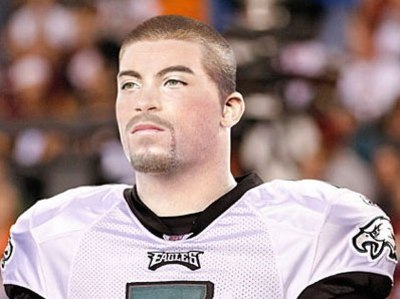
I can’t lie. The first thing I did when I saw a whiteface Michael Vick was laugh.

It is a (very) off color (pun intended) attempt to open up conversations about race and sports. C’mon, America. We wanna talk about race? Of course not! That’s so 2008.

Pause.

I’ve tackled the idea of whiteface in a previous post that contextualized it as a 20th century African American rebuttal to the minstrelsy tradition situated in 19th century white supremacist discourse. But ESPN: the Magazine (and much of writer Toure’s article that it supposedly complemented) got us messed up. Aside from the pathological and straight up dumbfounding ways that both Toure and the picture essentialize black masculinity there was some serious swagger jacking involved. ESPN: the Magazine ain’t the first one to use whiteface. George Schuyler would be pissed.

For the literary aloof, George Schuyler was a master satirist and conservative kicking folks’ racial politics in the throat during the Harlem Renaissance or lack thereof. Schuyler is perhaps most recognized for his essay “The Negro Art Hokum” which dismisses the idea of black American art as essentialist and nonexistent. But it is Schuyler’s satiric novel Black No More, released in 1931, that situates him as a predecessor of progressive racial thought, weaving a delightfully absurd narrative that promotes a similarly absurd solution to America’s race problem. Make everyone white.

Continue reading at Red Clay Scholar: Swagger Jacker: Musings on the White Michael Vick.

Honorée Fanonne Jeffers: What if Touré were White?

What if Touré were White?

Honorée Fanonne Jeffers

Touré on the ESPN website, entitled “What if Michael Vick were white?”  Above the actual article was adisturbing sight: Michael Vick in “white face” with light hair and light eyes. (This article also appears in the latest ESPN magazine.)

I know next to nothing about sports, and I don’t find sports interesting, either, so I almost didn’t read the article.  (To read an analysis of Touré’s piece by someone who does know about sports, check out this brilliant post by David J. Leonard.) I knew that I would encounter certain “insider” terms about sports in a, well, sports magazine.  I only read on because of the provocative title. But luckily, I need to know absolutely nothing about sports to understand Touré’s inflammatory and downright rude article, because it wasn’t about sports. It was about the pseudo-science of analyzing “race.”

Only in this article, Touré wasn’t analyzing the constructed concept of “race;” instead, he was making sweeping generalizations about Black culture, and reinforcing coded cultural and class stereotypes. Throughout my reading this article on Michael Vick, instead of asking myself the question I was su       pposed to—what if Vick were white—I found myself asking instead, what if Touré were white?

Now, before I go any further, let me say that I’m no fan of Michael Vick. I think what he did to those poor animals was horrible. And I’m also past tired of Black (and some White) folks trying to give Michael Vick a bleeding heart pass for inhumane treatment to God’s creatures and whining about he caught a bad break because he was African American. I don’t care what race he was; I think he should have done way more time than he already did.

Yes, I said it. Snatch my Black card, and I don’t care. I can always get me another one down at the Target.

But let me say that the sort of strange racial rhetoric on the other side of this debate, about the “nature” of Black men and Black culture is infuriating as well. And seriously tacky. In Touré’s defense, this rhetoric was going on long before he waded into this fray with his singular, accented moniker and “throwback jam” Enlightenment philosophy.

However, Touré’s article takes this rhetoric to the next, unsavory, near-skull measuring level. Again, this article is not about sports, though Touré begins with bloviated, quasi-lyrical language, using such terms like “in the pocket” and  (I guess) establishing his Black bonafides with the use of the Black vernacular, as when he writes:  “I’m not saying that a black QB who stands in the pocket ain’t playing black. [Emphasis mine.]

Okay, stop.

What the heck does “playing black” mean? I’m not even a sports fan and I know that’s not one of those complicated technical terms. And if a White writer said some sort of essentialist crap like somebody “plays black” that we’d be all over him. Why doesn’t Touré just start talking about antebellum slave breeding practices that produced better athletes while he’s at it? Like we haven’t already heard that one before.

Then, Touré goes on to imply that is Michael Vick were white and middle-class, he wouldn’t have been dogfighting in the first place.

Continue reading at What if Touré were white

Dave Zirin: DON’T Give the Miami Hurricanes the Death Penalty: Give it to the NCAA | The Nation


DON’T Give the Miami Hurricanes the Death Penalty: Give it to the NCAA

Dave Zirin

August 18, 2011

Thursday morning’s cover of USA Today blared the two words on everyone’s lips: “the death penalty.” No, this isn’t because Texas Governor Rick Perry – who just loves executin’ innocent and guilty alike – is now running for President. It’s the fate that most people believe awaits the storied football team at the University of Miami. The death penalty means that the NCAA will for an indeterminate time shut down the entire Hurricanes program. It’s a brutal, financially crippling fate that many believe Miami has more than earned, following a Yahoo Sports expose by Charles Robinson which detailed eight years of amateur violations that would make Dennis Rodman blush. A mini-Madoff financial criminal named Nevin Shapiro, currently serving 20 years behind bars, offered prostitutes, payola, jewelry, yacht parties and every possible South Beach excess for the Hurricane players. While corrupting the athletic program, he was simultaneously being feted by school President, former Clinton cabinet member Donna Shalala and Hurricanes athletic director Paul Dee. They even let him on two occasions lead the team out of the tunnel on game day.

This bombshell has the moral majority of sports journalists in full froth, rushing to the barricades to defend amateur sports. We have people like Sporting News columnist David Whitley, to use merely one example, writing, “The only way to make Miami behave is a long timeout. No more football, smoke and parties for a couple of years. Nothing else has a chance of ending the culture of corruption that is The U.” He even calls Miami “the Ben Tre of college football”, writing, “American forces wiped out the village to get rid of the Viet Cong, prompting a timeless explanation from the U.S. commander: ‘It became necessary to destroy the town to save it.’ The only way to save Miami is to destroy it, stripper pole and all.” But like the war in Vietnam, not to mention the actual death penalty, the call for the NCAA to shut down the program is dead wrong. As with capital punishment, eliminating the Hurricanes is an exercise in hypocrisy that does nothing but ensure these scandals will happen again and again.

What this scandal should produce, instead of the isolation and destruction of one program, is a serious reflection on the gutter economy that is college athletics. Players cannot be paid openly and legally so instead we get the amoral wampum of “amateur sports.” Reading the Yahoo Sports story, it’s difficult to not be chilled by the casual misogyny detailed as strippers, “escorts” and hookers were purchased and handed to players like party favors. You wonder why over 80% of NFL players get divorced after retirement. It’s because as teenagers, they are mentored by parasites like Nevin Shapiro who show them that women are the exchange value for their lucrative labor. This kind of gutter economy also has an ugly echo in old slave plantations, as the prized sports specimens in the antebellum South were handed women by the masters in return for their athletic prowess. Or as David Steele wrote earlier this week, ”Of course, America’s tender little feelings will be bruised if this is equated to slavery, or a plantation economy, or a plantation mentality. Fine. Maybe it can live with a metaphor like sharecropping. You do all the work, we take all the profits, we compensate you with the bare necessities of life, and tough break if you don’t like it.”

The metaphor works because once you wave away the smoke and hot air, this is about jock sniffing criminals and corrupted college Presidents taking advantage of primarily poor African Americans from the South, who see everyone getting paid but them. One anonymous University of Miami player told Yahoo Sports about University running back Tyrone Moss, who took $1,000 from Shapiro. “The guy had a kid while he was in college, a little Tyrone Jr.,” the player said. “He comes in poor as [expletive] from Pompano and he’s got a little kid to feed. I could barely feed myself. I can’t imagine having to feed a kid, too. Of course he’s going to take it when someone offers him $1,000. Who wouldn’t in that situation?”

via/continue reading at DON’T Give the Miami Hurricanes the Death Penalty: Give it to the NCAA | The Nation.

David Steele: College athletes used, abused by NCAA system – NCAA Football – Sporting News

College athletes used, abused by NCAA system

David Steele

Are you happy, Nevin Shapiro? You, University of Miami athletic department? You, NCAA? You, College Football Nation?You’ve made Luther Campbell look like a paragon of virtue in comparison.Much of the allegations of impropriety happened while Paul Dee was the AD at Miami.

You all had various obligations and responsibilities to the welfare and progress of the members of the Miami football and basketball teams. All of you abandoned them.

Those young men – actually, boys in some cases, since the actions described in that damning Yahoo! report Tuesday were sometimes initiated with high school recruits – should have been able to use you for guidance to help them move to the next stage of their lives. Instead, you all used them. You bought, sold and traded those human beings, calculated the costs and benefits of your expenditures and raked in the profits.

In short, you all displayed scruples and values that are somewhere beneath those of the guy who wrote and performed “Me So Horny.’’

Uncle Luke did get a previous version of “The U’’ in trouble, for sure, with allegations of bounties and cash payouts. But, as he pointed out Wednesday in his own blog for the Miami New Times, he was not a booster for the school when he did it, didn’t have direct access to the halls of power as he did it. His connection was lower on the ladder. On the bottom rung, as far as the sport is concerned.

Laugh if you want at his claim that he “dedicated part of his life to helping kids in Miami’s inner city neighborhoods get a college education.’’ He sure gave more of a damn about the welfare of those players than Shapiro did. Or, for that matter, anyone else connected to the Miami program. Or anyone else in college football, or anyone else who follows the sport.

Shapiro bared his tainted soul in a series of jailhouse interviews for Yahoo, detailing how he indulged his deepest jock-sniffing desires for nearly a decade by throwing money at Miami players, utterly unconcerned about whether school officials knew. Oh, and how he funded it by robbing investors in a $930 million Ponzi scheme.

via College athletes used, abused by NCAA system – NCAA Football – Sporting News.