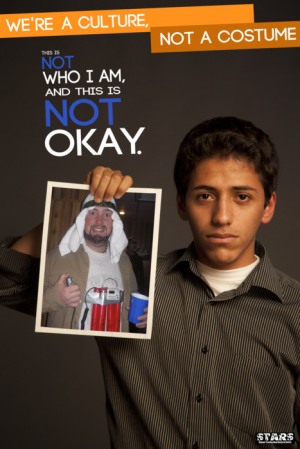
“We’re a culture, not a costume.” STARS, a student org at Ohio University « Eternal Sunshine of the Spotless Mind


“We’re a culture, not a costume” is campaign by STARS, a student organization at Ohio University.  Their efforts to highlight the issue of racial costumes and parties is truly amazing


This mission of the group is as follows: “to educate and facilitate discussion about racism and to promote racial harmony and to create a safe, non-threatening environment to allow participants to feel comfortable to express their feelings.”

via “We’re a culture, not a costume.” STARS, a student org at Ohio University « Eternal Sunshine of the Spotless Mind.

Bakari Kitwana and Urban Cusp on Kanye West @Occupy Wall Street

From http://newblackman.blogspot.com/

As the nation and global community turns its attention to the rise of the Occupy Wall Street movement, celebrity involvement has been a growing hot topic. Last week, controversy erupted over Kanye West’s presence at the protest site, Zuccotti Park in New York City, at the invitation of Russell Simmons. One article of particular interest, Why Kanye West Doesn’t Belong at Occupy Wall Street, was written by GOOD Senior Editor Cord Jefferson. Highlighting the selling price of his outfit and his image as the “Louis Vuitton Don,” the writer concluded by saying that “what OWS doesn’t need is everyone who’d like to be seen as a populist jumping on Rboard for a photo opportunity before leaving to go buy $500 jeans. Lip service and deceit is what got us into this mess in the first place.”
Watch this videotaped discussion to hear Urban Cusp’s Editorial Director Rahiel Tesfamariam reflect on the author’s points with Bakari Kitwana, who has a forthcoming new book entitled Hip-Hop Activism in the Obama Era. Kitwana has been seen and heard on CNN, Fox News, C-Span, PBS and NPR. He is the CEO of RapSessions.org and Senior Media Fellow at the Harvard Law-based think think, the Jamestown Project. Kitwana is also the former editor of The Source, co-founder of the National Hip-Hop Political Convention and author of the best-selling The Hip Hop Generation: Young Blacks and the Crisis in African American Culture.

New post from @NewBlackMan- Campus PD: Criminalizing Higher Education?


Campus PD: Criminalizing Higher Education?
by David J. Leonard | NewBlackMan

In what was obviously a slow night television night, I found myself searching for something to watch.  After perusing up and down the onscreen schedule, I came across Campus PD (I was somewhat familiar with show having read about their filming in Pullman, WA, where I live), a show that “takes viewers along for the ride with officers on duty to capture firsthand all the mayhem and excitement they take on night after night when student fun spirals out of control.” The show is described in the following way:

From policing parties and security issues, to keeping the peace at sports events and arresting possible suspects, ride with the “Campus PD” as they tackle the ongoing challenge of keeping students safe. Depicting university life from the perspective of the law enforcement professionals who police them, this ground-breaking new series presents a real-life account of these modern-day campus heroes. As they gear up for a shift, these courageous cops know they’re in for a few surprises!

The series heads to five college towns across the country including Tallahassee, FL, San Marcos, TX, Cincinnati, OH, Chico, CA, and Greenville, NC. It takes viewers deep inside the internal lives of the law enforcement professionals policing a town of fun-loving college kids. It isn’t easy, but these dedicated officers love their jobs, and wouldn’t have it any other way.


The emphasis on “fun,” “keeping student’s safe” “fun-loving college kids,” parties, and “binge drinking COEDS” is instructive, demonstrating how a show about criminal misconduct goes to great extents to decriminalize its primarily white, middle-class, “participants” and in doing so criminalizes the Other once again.


The show might as well be called “Warning PD.”  In the three episodes I watched on television, and countless clips online (which don’t necessarily show the encounters from start to finish leaving it hard to see the final resolution), I have only seen a handful of actual arrests.  For the most part, the show brings to life several excessively permissive campus police forces, who tolerate abuse, disrespect, and a culture of chaos.  In many instances, college students are given countless warnings, and only after failing to comply with instructions, are they forced to deal with the repercussions of their actions with a ticket or an arrest.


Another common theme within these initial episodes I watched from start to finish was a belief from the students they were unjustly being persecuted by the police.  Students would often note that, “they were not doing” anything wrong, or that they were simply engaged in “harmless fun” only to be harassed by campus police.  Given the ways in which harassment, racial profiling, and pre-text stops so often define the experiences of youth of color, it is a troubling re-imagination of policing in America.  Worse yet, Campus PD does a good job in showing why many college students view police as unfairly harassing them.


In two different episodes (as in the book Dorm Room Dealers), students respond to the presence of police by telling them to go “police” and investigate some real criminals.  That is, they were wasting their time with the happenings of college students since they were harmless, as opposed to those who “lived over there.”  In both instances, “over there” was clearly the neighborhood inhabited by poor people of color.  This assumption (one that is reinforced by the show) that the “real criminals” exist elsewhere reflects the power of American racial and class logic.


According to a study from the Journal of Alcohol and Drug Education, 95 percent of respondents imagined an African American when asked about drug users.  In other words, blackness operates interchangeably with criminality, especially in relationship to the urban poor.  Better said, “to be a man of color of a certain economic class and milieu is equivalent in the public eye to being a criminal.” (John Edgar Wideman, p. 195)


The consequences of the permissive policing and a culture that imagines college students engaged in criminal activity as just having fun (as opposed to the “real criminals”), is evident in the lack of attention directed at the criminal misconduct taking place at America’s colleges and universities.


According to a 2007 study reported in USA Today, over half of America’s college student regularly abuse alcohol and drugs.

The study found that college students have higher rates of alcohol or drug addiction than the general public: 22.9% of students meet the medical definition for alcohol or drug abuse or dependence — a compulsive use of a substance despite negative consequences — compared with 8.5% of all people 12 and older.


Increasingly, along with the traditionally seen drug and alcohol abuse, college students are abusing prescription drugs like Adderall, termed “smart drugs” by many college students.  “For many middle and upper-middle class young people in New York,” notes Lala Straussner. “Adderall is much more acceptable than using methamphetamine (more common on West Coast) or crack cocaine, although the brain doesn’t know the difference.” Yet, the ubiquity and acceptance of “smart drugs” is simply the perceived function or the consequences of these drugs but the ways in which crack and meth are both racialized and connected to distinct class identities.  Prescription drugs, on the other hand, are linked to those in college, who are said to have a future, illustrating criminality and criminals are identities are constructed as elsewhere and not within college communities.


While shows like Campus PD illustrate the ubiquity of instances of public intoxication, cases of drunk-driving, and physical assaults, other issues plague college communities.  As such, it does little to elucidate the problem of sexual violence (20-25% of women in college will experience rape or an attempted rape), prescription drug abuse, and even drug dealing.  The erasure of these systemic problems reflects a culture that imagines college as a space of parties, fun, and adolescent behavior rather than criminal activity.


This type of narrative is evident in the recent drug busts at San Diego Sate University and Columbia University.  In 2008, after a several month investigation, authorities arrested 75 students (96 people in total), confiscating drugs worth a total of approximately $100,000 worth of drugs.  Among the 20 students arrested for distribution and sales was a criminal justice major, who when arrested was in possession of two guns and 500 grams of cocaine.   San Diego County Dist. Atty. Bonnie Dumanis made clear that their investigation demonstrated “how accessible and pervasive illegal drugs continue to be on our college campuses and how common it is for students to be selling to other students.” This was certainly true with Columbia University, where 5 students were arrested as part of “Operation Ivy League,” “a five-month undercover sting, during which police purchased $11,000 worth of drugs from the students out of Columbia fraternity houses and dorms.”


While the media rendered this incidence and that at SDSU as a shocking spectacle, it is clear that the situation at these schools is a national phenomenon.   This should actually be surprising given how drug markets are as segregated as the rest of America.  According to A. Rafik Mohamed and Erik D. Fritsvold, authors of Dorm Room Dealers, who spent 6-years examining drug distribution at a Southern California Private school, not only do students sell to other students, but do in a reckless manner, which in their mind highlight a sense of entitlement based on the students’ middle-class white identities.  Phillip Smith describes their findings in “Dorm Room Dealers: A Peek into the Drug World of the White and Upwardly Mobile”:

Mohamed and Fritsvold show repeatedly the reckless abandon with which their subjects went about their business: Dope deals over the phone with uncoded messages, driving around high with pounds of pot in the car, doing drug transactions visible from the street, selling to strangers, smuggling hundreds of pills across the Mexican border. These campus dealers lacked even the basics of drug dealer security measures, yet they flew under the radar of the drug warriors.

Even when the rare encounter with police occurred, these well-connected students skated. In one instance, a dealer got too wasted and attacked someone’s car. He persuaded a police officer to take him home in handcuffs to get cash to pay for the damages. The cop ignored the scales, the pot, the evidence of drug dealing, and happily took a hundred dollar bill for his efforts. In another instance, a beach front dealer was the victim of an armed robbery. He had no qualms about calling the police, who once again couldn’t see the evidence of dealing staring them in the face and who managed to catch the robbers. The dealer wisely didn’t claim the pounds of pot police recovered and didn’t face any consequences.


A former Columbia student highlights a similar culture there, adding more evidence to the arguments offered in Dorm Room Dealers.

But, in fact, the prestigious institution on Manhattan’s Upper West Side has long been “ripe” for drug trafficking, a knowledgeable 2009 Columbia graduate told The Daily Beast. “I think the permissive environment of Public Safety”—as Columbia’s campus police force is known—“makes it a no-brainer proposition,” said this former student, who described himself as a recreational drug user who dabbled in selling. “I always felt safe.”


The culture and climate of Columbia in terms of public concern and policing, as opposed to the levels of surveillance found a few miles away in Harlem, tells an important story about how race and class operate in contemporary America.  Campus PD offers a similarly distorted glimpse a crime as well.


Media accounts of these two recent drug operations and shows like Campus PD have done little to shine a spotlight on the double standards that exist between the primarily white middle-class student population and poor youth of color when it comes to policing and incarceration.  With the situation at Columbia, one student has plead guilty thus far; although charged with the most serious crimes, he was sentenced to 6-months in prison in July.  In a city where 46,500 people were arrested for marijuana possession in 2009, with 87% of these people being black and Latino, the inequality is quite clear.


San Diego saw a similar outcome, with many of those arrested pleading guilty only to face probation and entrance into a drug diversion programs, leading some people to question why police are spending so much time and energy conducting investigations against college students that do not result in incarcerations.   When considering the media coverage, popular representations of college campuses, levels of policing and unzealous prosecution, it is no wonder that while African Americans constitute 13% of all monthly drug users, they represent 38% of these arrested for drug possession, 55% of convictions and 74% of prison sentences; it is as argued by Michelle Alexander, the new Jim Crow, ostensibly cordoning off America’s college and universities from policing and prosecution.  The criminalization of black and brown youth and the decriminalization of white America, particularly its middle-class college-bound constituency, have material consequences.


Evident in a show like Campus PD and the various examples provided here is the ways in which  “what it means to be criminal in our collective consciousness to what it means to be black.”  In other words, “the term black criminal is nearly redundant . . . . To be a black man is to be thought of as a criminal, and to be a black criminal is to be despicable – a social pariah” (Alexander 2010, p. 193).   No wonder so many students yell at cops to go focus on the “real criminals”; that is the message they have learned all too well.

***
Originally posted at NewBlackMan

Mark Anthony Neal @NewBlackMan: “I Arrived the Day Fred Hampton Died”: If Jay Z Met Fred Hampton


“I Arrived the Day Fred Hampton Died”: If Jay Z Met Fred Hampton

by Mark Anthony Neal | NewBlackMan

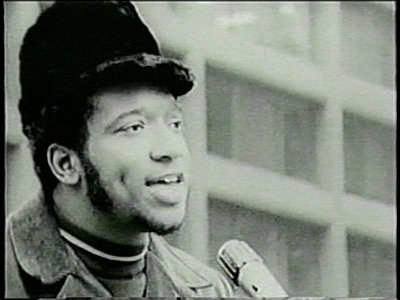
In the early morning of December 4, 1969, before dawn, the Chicago Police Department in conjunction with the Federal Bureau of Investigation—The FBI—riddled the residence of Black Panther Party leaders Fred Hampton and Mark Clark, killing them both. Hampton, who was sleeping in the back of the house with his pregnant girlfriend was unable to defend himself (he had been drugged by an informant), leading poet and Third World Press founder Haki Madhubuti (then Don L. Lee) to describe the incident as a “One Sided Shootout.” On that same day, Shawn Corey Carter—the maverick hip-hop mogul and artist—was born in the Bedford-Stuyvesant section of Brooklyn, NY. I can’t help but wonder what might have happened if these two—icons for two distinct generation of Black youth—might have ever had the chance to meet.

For those familiar with the legacy of Fred Hampton, simply known as Chairman Fred for many, Jay Z might seem the very antithesis of what Hampton represented. At the time of his assassination, Hampton was being prepared for national leadership within The Black Panther Party, which was decimated by incarceration (Huey P. Newton and Bobby Seale) and exile (Eldridge Cleaver). Hampton was 21-years-old, five years younger than Martin Luther King, Jr. was when he led the Montgomery Bus Boycott and the same age of Malcolm Little when he was when he began the prison sentence that transformed him into Malcolm X. Hampton was no ordinary young Black man.

Specifically the Black Panther Party was targeted by FBI director J. Edgar Hoover’s counter-intelligence program, known by the acronym COINTELPRO. The year before Hampton’s death, Hoover publically announced that the Black Panther Party was the “greatest threat to the internal security of the country.” Part of the FBI’s strategy was to kill off the local leadership of the Black Panther Party, before it could ascend to national leadership. In that vein Hoover targeted the Black Panther Party’s breakfast program, because it was one of the most tangible ways the organization impacted their communities.

According to historian Craig Ciccione, author of the forthcoming If I Die Before I Wake: The Assassination of Fred Hampton, “The threat was on the local level because on the local level the organizing was most effective.” Ciccone suggests that killing off local leadership could be achieved on a much quieter level—he notes that virtually none of the Panthers killed in the late 1960s were part of the national leadership.

Of those local leaders, Fred Hampton was perhaps the most significant—The FBI created a file on Hampton when he was just an 18-year-old high school student, who would shortly become leader of the Illinois Chapter of the Black Panther Party. Fred Hampton was a compelling figure because of his skills as an organizer—he was instrumental in the creation of the Rainbow Coalition (a term later appropriated by Jesse Jackson) which included the Black Panther Party, young White activist known as The Young Patriots and The Young Lords, a national organization of Puerto Rican activists co-founded by Felipe Luciano, who was also a member of the original Last Poets.

Combined with his accomplished skills as an orator and his willingness to organize beyond the Black community, Hampton was the prototype for the next generation of Black activist, a possibility that was literally killed in the early hours of December 4, 1969.

One of the tragedies of Fred Hampton’s death is that his presence would not be felt in the Marcy Houses that Jay Z came of age in, or in any of the like communities across this country were young Black Americans lacked examples of political agency and activism that were in sync with their lives at the dawn of 1980s. The period, best known as the Reagan era, was marked by the child murders in Atlanta, the explosion of crack cocaine in Black communities, the emergence of AIDS and the collapse of the kinds of social and cultural infrastructures that helped Black Americans survive segregation and racial violence throughout the 20th Century.

Hip-Hop initially filled that void and though early hip-hop was little more than the “party and bullshit” that seems so normative today, it ability to allow young Black Americans a voice and alternative ways to view the world may have been it most potent political achievement. For example, Chuck D would have been Chuck D regardless of Hip-Hop, but how many young Blacks became politically engaged because Chuck D had Hip-Hop. Indeed as Jay Z details throughout his memoir Decoded (written with Dream Hampton), the possibilities that Hip-hop offered were compelling enough to take him from the street life.

The easy part of this story is to suggest that Jay Z, as emblematic of a Black generational ethos, has squandered Hip-Hop’s political potential on the spoils of crass materialism, middle-management wealth and a politics of pragmatism (as embodied by his man Obama). The feel good move is to imagine a 61-year-old Hampton and a 41-year-old Carter sitting down in conversation with Sonia Sanchez to discuss the legacy of the Black Panther Party on Hip-Hop and Carter’s funding of the Fred Hampton and Shirley Chisholm Institute for Black Leadership Development (which by the way Mr. Carter, need not be a dream). Unfortunately the history of Black political engagement is not as simple as one of those Staples “easy” buttons.

Continue reading at NewBlackMan: “I Arrived the Day Fred Hampton Died”: If Jay Z Met Fred Hampton.

Mark Anthony Neal @NewBlackMan: “Where Dey At?”: Bounce and the ‘Sanctified Swing’ in Post-Katrina New Orleans


“Where Dey At?”:

Bounce and the ‘Sanctified Swing’ in Post-Katrina New Orleans

by Mark Anthony Neal | NewBlackMan

In the immediate aftermath of Hurricane Katrina and the failure of the levees in New Orleans, there were many high profiles efforts to raise awareness about the cultural legacy of New Orleans. Many of those efforts centered on the exaltation of New Orleans Jazz, with many events aimed at providing shelter and support for Jazz musicians dispersed by the tragedy. New Orleans Jazz seemed the most important resource to be protected in the months after Katrina, more so than the people who made the city such a vital and important, ever evolving cultural outpost. Lost in the focus on New Orleans Jazz—arguably one of the nation’s most important cultural exports—are other forms of musical expression that were and continue to be crucial to the survival and spirituality of New Orleans and its citizens, including those who have yet to return.

Though Jazz was a critical component of Black political discourse and intellectual development throughout the 20th century—jazz musicians like John Coltrane, Billie Holiday, Max Roach and Abbey Lincoln are some of the most resonate examples of creative intellectuals—New Orleans Jazz is often depicted as being tethered to some imagined past, in which race relations and the power dynamics embedded in them were far more simplistic.

Indeed recent films like The Princess and the Frog and The Curious Case of Benjamin Buttons the television series Treme (despite it’s progressive political critiques) contribute to a nostalgic view that New Orleans Jazz as a dated, static musical form that offers an “authentic” alternative to more commercially viable forms of popular music like rap and R&B music. Much of this has to do with the relationship between New Orleans Jazz and the leisure and tourist industries that were so vital to the city’s economy. In this context, mainstreams desires to save New Orleans Jazz and to protect its musicians are less about strengthening the links between Jazz and Black cultural resistance—a resistance that historically fermented in New Orleans—but maintaining the economic vitality of what Johari Jabir calls the “theater of tourism” in which Black bodies are rarely thought of as citizens but laborers, servants and performers.

In the introduction to the book, In the Wake of Hurricane Katrina: New Paradigms and Social Visions, scholar Clyde Woods places New Orleans Jazz in a much broader context, as part of what Woods has famously described as a “Blues tradition of investigation.” As Woods notes in his essay, “Katrina’s World: Blues, Bourbon and the Return to the Source,” historically the city of New Orleans and the region was “latticed with resistance networks that linked enslaved and free blacks with maroon colonies established in the city’s cypress forests swamps.”

These traditions of resistance would manifest themselves after Emancipation and beyond in the form of “societies and benevolent associations; churches, second lines, pleasure and social clubs; brass bands, the Mardi Gras Indians” and of course New Orleans Jazz. Two practices also linked to resistance in New Orleans are Bounce music and what Jabir refers to as the “sanctified swing,” embodied in the genres of Rap music and Gospel respectively.

Continue reading @ NewBlackMan: “Where Dey At?”: Bounce and the ‘Sanctified Swing’ in Post-Katrina New Orleans.

Red Clay Scholar: Swagger Jacker: Musings on the White Michael Vick


Swagger Jacker: Musings on the White Michael Vick

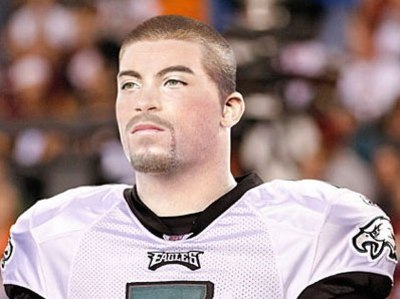
I can’t lie. The first thing I did when I saw a whiteface Michael Vick was laugh.

It is a (very) off color (pun intended) attempt to open up conversations about race and sports. C’mon, America. We wanna talk about race? Of course not! That’s so 2008.

Pause.

I’ve tackled the idea of whiteface in a previous post that contextualized it as a 20th century African American rebuttal to the minstrelsy tradition situated in 19th century white supremacist discourse. But ESPN: the Magazine (and much of writer Toure’s article that it supposedly complemented) got us messed up. Aside from the pathological and straight up dumbfounding ways that both Toure and the picture essentialize black masculinity there was some serious swagger jacking involved. ESPN: the Magazine ain’t the first one to use whiteface. George Schuyler would be pissed.

For the literary aloof, George Schuyler was a master satirist and conservative kicking folks’ racial politics in the throat during the Harlem Renaissance or lack thereof. Schuyler is perhaps most recognized for his essay “The Negro Art Hokum” which dismisses the idea of black American art as essentialist and nonexistent. But it is Schuyler’s satiric novel Black No More, released in 1931, that situates him as a predecessor of progressive racial thought, weaving a delightfully absurd narrative that promotes a similarly absurd solution to America’s race problem. Make everyone white.

Continue reading at Red Clay Scholar: Swagger Jacker: Musings on the White Michael Vick.

Honorée Fanonne Jeffers: What if Touré were White?

What if Touré were White?

Honorée Fanonne Jeffers

Touré on the ESPN website, entitled “What if Michael Vick were white?”  Above the actual article was adisturbing sight: Michael Vick in “white face” with light hair and light eyes. (This article also appears in the latest ESPN magazine.)

I know next to nothing about sports, and I don’t find sports interesting, either, so I almost didn’t read the article.  (To read an analysis of Touré’s piece by someone who does know about sports, check out this brilliant post by David J. Leonard.) I knew that I would encounter certain “insider” terms about sports in a, well, sports magazine.  I only read on because of the provocative title. But luckily, I need to know absolutely nothing about sports to understand Touré’s inflammatory and downright rude article, because it wasn’t about sports. It was about the pseudo-science of analyzing “race.”

Only in this article, Touré wasn’t analyzing the constructed concept of “race;” instead, he was making sweeping generalizations about Black culture, and reinforcing coded cultural and class stereotypes. Throughout my reading this article on Michael Vick, instead of asking myself the question I was su       pposed to—what if Vick were white—I found myself asking instead, what if Touré were white?

Now, before I go any further, let me say that I’m no fan of Michael Vick. I think what he did to those poor animals was horrible. And I’m also past tired of Black (and some White) folks trying to give Michael Vick a bleeding heart pass for inhumane treatment to God’s creatures and whining about he caught a bad break because he was African American. I don’t care what race he was; I think he should have done way more time than he already did.

Yes, I said it. Snatch my Black card, and I don’t care. I can always get me another one down at the Target.

But let me say that the sort of strange racial rhetoric on the other side of this debate, about the “nature” of Black men and Black culture is infuriating as well. And seriously tacky. In Touré’s defense, this rhetoric was going on long before he waded into this fray with his singular, accented moniker and “throwback jam” Enlightenment philosophy.

However, Touré’s article takes this rhetoric to the next, unsavory, near-skull measuring level. Again, this article is not about sports, though Touré begins with bloviated, quasi-lyrical language, using such terms like “in the pocket” and  (I guess) establishing his Black bonafides with the use of the Black vernacular, as when he writes:  “I’m not saying that a black QB who stands in the pocket ain’t playing black. [Emphasis mine.]

Okay, stop.

What the heck does “playing black” mean? I’m not even a sports fan and I know that’s not one of those complicated technical terms. And if a White writer said some sort of essentialist crap like somebody “plays black” that we’d be all over him. Why doesn’t Touré just start talking about antebellum slave breeding practices that produced better athletes while he’s at it? Like we haven’t already heard that one before.

Then, Touré goes on to imply that is Michael Vick were white and middle-class, he wouldn’t have been dogfighting in the first place.

Continue reading at What if Touré were white