Spectra: Straight Allies, White Anti-Racists, Male Feminists (and Other Labels That Mean Nothing to Me)

This is a really amazing piece because it reminds us about the limitations of labels, it reminds us about the importance of actions, especially the everyday actions, and it reminds us that community is essential.  Really thoughtful piece.  Spectra writes,

Maybe I’m old fashioned, but I’d rather experience people–and their politics–through unlikely, awkward, strained, challenging, beautiful relationships built over time. That way, when we do clash or differ, we love each other enough to express the full range of our raw emotions – cry, yell, storm out – and always return to build the deeper, more intimate connections we need to take on the world together, truly united.

When someone fights for me, I want them to do so because they care about me as an individual – or as someone who reminds them of someone else that they care about – not just as some abstract theoretical concept. I’d rather that the “white allies”, the “straight allies”, the “male feminists” of the world do the work to build authentic relationships based on real love and respect, not just politically correct lexicon and rhetoric.

So, despite starting off as an activist who was really excited about the concept of “allies”, as I’ve gotten older, I’ve found less use for words and definitions in social justice; labels like feminists, anti-sexists, radicals, allies etc simply don’t mean much to me anymore. Though I certainly see these ideas/concepts as a way of connecting with others initially, ultimately, relationships that last aren’t sustained by what you are to each other, but how you treat each other.

Falling back on words and phrases that are intended to convey some sort of ideological purity won’t ever trump the transformation you’ll experience within yourself (and others) if you truly put yourself out there — if you dare to be vulnerable, admit wrongs, take responsibility for your blind spots, hold your damn self accountable, an not for show, but for real.

So, screw the definitions; let’s experience the ideas and world views through the relationships we build with people. Let’s commit to living in principle, and remain mindful of the core values that help us navigate our lives in the gray. Let’s embrace ambiguity, and its potential for unearthing surprise and disappointment in equal measure, because only through the natural bombardment that arises when we converse with strangers, can we learn more about the world, and about each other.

Read the entire piece at Spectra: Straight Allies, White Anti-Racists, Male Feminists (and Other Labels That Mean Nothing to Me).

Racial gap in pot busts extends to SF – SFGate

Racial gap in pot busts extends to SF

Justin Berton

(06-04) 20:58 PDT SAN FRANCISCO — In San Francisco, a city that prides itself on a progressive attitude toward marijuana, authorities have been arresting fewer and fewer people for pot possession. But African Americans are arrested at far higher rates than whites, according to a report released Tuesday.

The report by the American Civil Liberties Union, which analyzed federal arrest data, found that black people in San Francisco were 4.3 times more likely than white people to be arrested on the charge in 2010. The disparity was twice the state rate and slightly higher than the national rate.

The divide in marijuana arrests – which the ACLU attributed to a “staggering racial bias” – persisted even though black and white people have been found to use pot with similar frequency, the report concluded. It questioned the high cost of marijuana enforcement at a time when Americans are increasingly favoring legalization of the drug.

San Francisco Police Department officials did not respond Tuesday to requests for comment on the report.

The numbers varied across the Bay Area: In Marin County African Americans were 4.1 times more likely to be arrested than whites in 2010. In contrast, in Alameda County they were 1.3 times as likely to face arrest for marijuana possession as white people.

Experts on policing and drug enforcement offered a number of theories on the disparity in San Francisco, including that police officers target enforcement in neighborhoods that have high African American populations and high levels of crime, like Bayview-Hunters Point.

As the core African American population diminishes in San Francisco and concentrates in the city’s southeast districts, some experts said, the group can be disproportionately affected by such enforcement.

Continue reading at  Racial gap in pot busts extends to SF – SFGate.


Peeking Behind the Kitchen Door: The Struggle for Food Justice in America’s Restaurant Industry

 Peeking Behind the Kitchen Door

by David J. Leonard

Last month, Michelle Obama visited a Springfield, Mo., Walmart to celebrate and highlight its efforts to help Americans eat healthier. Mrs. Obama announced, “For years, the conventional wisdom said healthy products just didn’t sell… Thanks to Walmart and so many other great American businesses, we’re proving that conventional wisdom wrong.” If only this neoliberal logic delivered as promised. As with Michael Bloomberg’s cola crusade, the narrow focus on food choices, individual behavior (“Get Fit”), and healthy lifestyles obscures the structural inequalities that contribute to health inequity.

While Walmart MAY have led to great access to organic foods or fresh fruits and vegetables in some communities, it also contributes to the very conditions that make “healthy living” difficult. Stacy Mitchell notes the deleterious impact of Walmart and other members of the food industry’s 1 percent:

The real effect of Walmart’s takeover of our food system has been to intensify the rural and urban poverty that drives unhealthy food choices. Poverty has a strong negative effect on diet… Walmart has made it harder for farmers and food workers to earn a living. Its rapid rise as a grocer triggered a wave of mergers among food companies, which, by combining forces, hoped to become big enough to supply Walmart without getting crushed in the process.

The fight over injustice is not limited to these mega companies. The destructive impact the food industry has on the health and well-being of people across this country (and beyond) extends beyond the fields and super markets. It is most certainly evident in the treatment of restaurant workers,

In a new book entitled Beyond the Kitchen Door, Saru Jayaraman highlights the harmful impact of the restaurant industry on the health, economic security, and lives of those who cook, serve, and provide for US. Jayarman paints a picture of a restaurant world defined by exploitation, mistreatment, and abuse. It is a world not simply of delicious foods and celebrity chefs, but of workers, moms and dads, scraping by just to make ends meet.

Saru Jayarman pulls the curtain back on restaurant work, highlighting the struggles endured on the dining room floor. Far from the glamorous world of Top Chef or the joys of being a foodie, restaurant work is both hard and poorly compensated. As of 2013, federal minimum wage for tipped workers is $2.13 an hour. When tips don’t net the mandated $7.25 (current federal minimum wage), restaurants are supposed to make up the difference. Not shockingly, this doesn’t happen in many cases. According to the book (pg. 70), 13 percent of restaurant workers report managers stealing their tips. Others note how restaurant supervisors require them to report larger tip counts to create the illusion of an earned minimum wage. Jayarman tells the story of Claudia, a server at a pancake restaurant in Texas. Enduring racism from customers, she also did not receive sufficient tips on many occasions (one has to wonder how racism, sexism, and homophobia impact tips). The combination of her tip count and her wage left her income under the federally mandated amount. Instead of making up the difference, a manager told her, “If you don’t make enough tips to make up the difference, you have to report that you made the money anyway.” In other words, her poverty wages were often way below poverty level.

In another instance, one of Claudia’s tables walked out on their bill of $98 dollars. “She told me that it was my fault, and that I’d have to pay the bill. I had made $80 dollars in tops that night,” noted Claudia. “So after tipping out the bussers and the dishwater, the manager took all my tips and told me I still owed the restaurant $18. I had worked from 10:00 p.m. until 9:00 a.m. — though I clocked out at 7 a.m. — and instead of paying me anything, they were telling me I had to pay them.” It is no wonder that 80 percent of food service workers do not earn a livable wage (pg. 3); of the few that do earn a living wage, a large portion are white men who work at upscale restaurants (pg. 117). This is the American Dream; this is American poverty; this is restaurant work. These men and women are the 47 percent, the “takers,” who despite serving the 1 percent, alongside the rest of us, get little in return but grief, mistreatment, and disrespect.

Continue reading at Dr. David J. Leonard: Peeking Behind the Kitchen Door: The Struggle for Food Justice in America’s Restaurant Industry.

Not Worthy of National Attention: The NOLA Mother’s Day Mass Shootings by David J. Leonard | NewBlackMan (in Exile)


Not Worthy of National Attention: The NOLA Mother’s Day Mass Shootings by David J. Leonard | NewBlackMan (in Exile)

Not Worthy of National Attention: The NOLA Mother’s Day Mass Shootings

by David J. Leonard | NewBlackMan (in Exile)

Amid the celebration of moms across the nation (amid the passage of policies that directly and indirectly hurt so many moms), America was once again reminded that all moms and all people are not celebrated equally; all lives are not worthy of similar mourning and attention. In New Orleans, 19 people, including 2 children, were shot at a Mother’s Day Celebration.

Hamilton Nolan reflected on the narrative that has already emerged (can you imagine how many stories about mothers celebrating with their children would have been on the air had this occurred in West Los Angeles or Manhattan, NY), offering a powerful comparison to the Boston marathon bombing:

A couple of disaffected young men in search of meaning drift into radical Islam and become violent. A couple of disaffected young men in search of meaning drift into street crime and become violent. A crowd of innocent people attending the Boston marathon are maimed by flying shrapnel from homemade bombs. A crowd of innocent people attending a Mother’s Day celebration in New Orleans are maimed by flying bullets. Two public events. Two terrible tragedies. One act of violence becomes a huge news story, transfixing the media’s attention for months and drawing outraged proclamations from politicians and pundits. Another act of violence is dismissed as the normal way of the world and quickly forgotten.

The juxtaposition of Boston and New Orleans is striking given the extent of death, given the violence that occurred within ritualized spaces, and given how each is a communal gathering space. Of course one doesn’t have to travel down South to New Orleans or West to Chicago to see the hypocrisy in the separate and unequal narratives. The lack of national attention afforded to violence in Roxbury, Mass; the lack of interventions in the form of jobs, reform to the criminal justice system, investment in education, and economic development is a testament to the very different ways violence registers in the national imagination. Roxbury doesn’t enliven narratives of humanity but instead those dehumanizing representations.

Yet, don’t we need to extend the comparison to Newtown, Aurora, and Milwaukee? Remixing the above: A couple of disaffected young men in search of meaning drift into spree shootings and become violent. Flying bullets wound crowds of innocent people attending a movie, going to school, or praying at their local temple. How is the reaction to Newtown and New Orleans, to Boston and Milwaukie, and to Aurora and Chicago an indicator of who we expect to commit violence, where we expect to be safe, who we see as a victim, and where we see violence as normalized and where it is exceptional?

One comment in the thread made the link between Boston, Newtown (Aurora), and New Orleans in a profound way:

The difference is, of course, that the media and the public focus on Things That Could Happen to Middle Class White People. Bombs placed at a marathon or a plane hitting a building or a gunman mowing down people in Newtown, Connecticut or Aurora, Colorado are things that happened to middle class white people and show the other white people that it could happen to them. Crime is somehow not supposed to happen to middle class white people; it’s supposed to happen to black people.

Whereas violence is supposed to happen in Chicago, Detroit, and New Orleans, because of “culture of poverty,” because of single parents, because of dystopia and nihilism, because of warped values, gangs, and purported pathologies, the Boston Marathon, an Aurora movie theater, or a Newtown school are re-imagined as safe. These are places and spaces immune from those issues.

The normalization of violence in inner cities is why the suburbs exist; it is why police work to keep violence from entering into those suburban safety zones; it is why police guard the borders, making sure the wrong people don’t cross into the idyllic homeland of the American Dream. It is why white middle-class America avoids “those” communities or activities presumed to be dangerous (or go during the right time with the right people); it is why the white middle-class America reacts when those spaces that are presumed to be safe are simply not.

The movie theater, the school, and the marathon are symbols of Americana and therefore desirable, pure, and the embodiment of goodness. As such, the violence that happens in these “otherwise safe” enterprises and places occurs because of the entry of “dangerous” and threatening people. Outsiders enter into otherwise safe and idealized spaces.

Continue reading at Not Worthy of National Attention: The NOLA Mother’s Day Mass Shootings by David J. Leonard | NewBlackMan (in Exile).

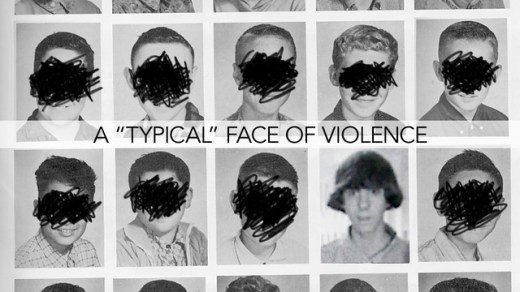
The Unbearable Invisibility of White Masculinity: Innocence In the Age of White Male Mass Shootings

The Unbearable Invisibility of White Masculinity: Innocence In the Age of White Male Mass Shootings

I have been profiled my entire life as innocent. When disruptive in class, I was told that I was eccentric, that I needed to work on my focus. Growing up, I looked for fights and conflicts yet I never fit the profile of a juvenile delinquent. The chip on my shoulder never signified a thug; I was just a kid with a bad temper who needed to mature and grow out of it.

When I was pulled over in Emeryville, CA for speeding for several miles and asked multiple times by the police officer if there was a reason for my speeding, I told him the truth. “Officer, my ice cream is melting.”

No stop and frisk. No pretext stop. No humiliating search. No fear of how to hold my hands. No ticket. I, like Adam Lanza and James Holmes, the two most notorious mass shooters of the past year, am white male privilege personified. We are humanized and given voice and innocence over and over again.

***

The most recent shooting in Newtown highlights whiteness and the ways it has been rendered invisible after every mass shooting. Described as a “nerd,” who “still wears a pocket protector,” Adam Lanza has been reimagined as a character straight out of The Revenge of the Nerds series and not a cold-blood killer. He carried a brief case, not a gun; he read The Catcher in the Rye and Of Mice and Men, not Guns and Ammo; he wore button down polos, not fatigues. His life was not extraordinary but was that of an average kid. From the reading list to the sartorial choices we have been sold a Normal Rockwell painting. The Associated Press painted a picture of Adam that imaged him as a character ripped out of a Brady Bunch script: “He was an honors student who lived in a prosperous neighborhood with his mother, a well-liked woman who enjoyed hosting dice games and decorating the house for the holidays.”

While identified as “reclusive,” and “shy,” as “quiet and reserved,” as “weird” and a “loner” outcast, Lanza has been consistently described as an average kid who had problems and difficulties. At worst, he was odd and painfully shy. “He didn’t have any friends, but he was a nice kid if you got to know him,” said Kyle Kromberg. “He didn’t fit in with the other kids. He was very, very shy.” Yet, the constant quest to figure out what caused him to snap, to speculate about the effects of his parents’ divorce or medications, all refashions Lanza as a good kid, a victim of sorts. He just snapped so there must have been a reason. Yes, he was strange, but do good (white, suburban, upper-middle class) kids shoot up an elementary school? Thus, reports the New York Post: “Bloodthirsty child killer Adam Lanza might have snapped, and carried out his unspeakable atrocities after learning that his mom wanted him thrown in the loony bin, according to published reports today.”

Is James Holmes a Nerd?

Here’s something that almost all the mass killers of the last fifteen years or so have in common: they’ve been called “nerds.”… Read…

The narrative following Adam Lanza and Newtown might as well recycled the media coverage surrounding James Holmes and the Aurora, Colorado shooting. Described as “smart” and quiet, as “nice,” and “easy-going,” the narrative sought to not only humanize James Holmes, but also imagine him as good at his core. It worked to tell a story of a normal kid, whose life turned toward evil for some yet-to-be-explained reason.

Sympathetic and identifiable, Holmes was depicted as Beaver Cleaver for most of his life. Anthony Mai, a longtime family friend, told the Los Angeles Times: “I saw him as a normal guy, an everyday guy, doing everyday things.” Like many others in the community, he is “very shy, well-mannered young man who was heavily involved in their local Presbyterian church.” The AP similarly depicted Holmes as a cross between Norman Rockwell, Jason, and Opie. Mind you the extent of its evidence comes from someone who had a beer with him at a local bar. “We just talked about football. He had a backpack and geeky glasses and seemed like a real intelligent guy and I figured he was one of the college students.” Can you imagine having your identity reduced to a single meeting at a bar? Sure, he was quirky, and a bit of a “loner” but he was a “reserved” and “respectful” “kid.”

Because these are told as stories of individuals with specific reasons for killing others, there is no reason to talk about race, class, or gender; there is no reason to talk about society, nor is there any reason to think that Aurora, Newtown, or Columbine are becoming Chicago or Detroit.

Continue reading at The Unbearable Invisibility of White Masculinity: Innocence In the Age of White Male Mass Shootings.

NewBlackMan (in Exile): Women of Color and the Political Economy of Sympathy

Women of Color and the Political Economy of Sympathy

by Stephanie Troutman and David J. Leonard |

NewBlackMan (in Exile)

“Given the racist and patriarchal patterns of the state, it is difficult to envision the state as the holder of solutions to the problem of violence against women of color. However, as the anti-violence movement has been institutionalized and professionalized, the state plays an increasingly dominant role in how we conceptualize and create strategies to minimize violence against women—Angela Davis.

Words sadly ring true given the daily realities of state violence, and the limited care and concern for the daily realities of violence in our country. What is wrong with us/U.S.? The endless examples (in a long, sad history of violent acts) act of violence against a woman of color to NOT make headlines is beyond devastating. It is pedagogical in pointing to the material consequences of the intersections of race and gender.

This has been all too clear with reports about the horrific circumstances of Glenda Moore, a Black mother who lost her two young sons during Hurricane Sandy. According to The Daily News Moore was “holding onto them, and the waves just kept coming and crashing and they were under,” the mother’s sister told the Daily News at her home. “It went over their heads … She had them in her arms, and a wave came and swept them out of her arms.” In the midst of the storm, Moore knocked on doors searching for help to no avail. As Moore’s sister recounted to The Daily News “They answered the door and said, ‘I don’t know you. I’m not going to help you,’”…”My sister’s like 5-foot-3, 130 pounds. She looks like a little girl. She’s going to come to you and you’re going to slam the door in her face and say, ‘I don’t know you, I can’t help you’?’”

Although there seems to be reticence and an unwillingness to talk about racism and sexism – implicit biases – in this case, the limited (yes there has been some media attention) concern and national mourning for the death of these children, and the pain endured by Moore is telling. While people came together to raise over $313,000 dollars for a tormented school bus monitor, the Moore family is fighting just to raise enough money to bury their children (as of today, there is just short of $11,000 dollars). It is yet another reminder that not all pain, not all suffering is created equal.

While the reports surrounding Sharmeeka Moffitt, who accused several men of attacking her because she wore an Obama t-shirt, proved unsubstantiated, her experiences point to how racism and misogyny is operationalized within contemporary culture. Yet another reminder of the violence besieging the United States and the media’s silence (and complicity) on the violence experienced by women of color; the fact that Sharmeka Moffitt’s name did not initially warrant front-page news, a lead story on the national news, or national conversation is telling. The fact that people required more evidence in this stance is revealing. The fact that people dismissed the initial reports by noting “We don’t know what happened;” “we don’t know the specifics;” “we don’t know if it is a hate crime” is not without consequence.

Continue reading @ NewBlackMan (in Exile): Women of Color and the Political Economy of Sympathy.

NewBlackMan (in Exile): Blaming Hip-Hop for Hate Rock?

Blaming Hip-Hop for Hate Rock?

David J. Leonard & C. Richard King | NewBlackMan (in Exile)

Little says more about the state of racism and the centrality of the white racial frame in the USA today than the rapidity with which pundits transformed a conversation about white power, racialized violence, and hate rock into a critique of hip-hop. Indeed, a number of discussions of the spree killing at the Sikh temple outside of Milwaukee, echoing broader political currents, reference the evils of hip-hop as both a defense and a scapegoat.

Perhaps not surprisingly, in The New Republic, John McWhorter rehearsed this well worn conversation to turn the killings into another referendum on hip-hop. “It has been fashionable,” he asserts, “to speculate on whether the White Power music he [Wade Michael Page] listened to helped stoke him into the senseless murders he committed…such speculations,” he suggests are both “incoherent” and “pointless—and they are marked, above all, by a cloying air of self-congratulation.” To “prove” his point, he invoked the tried and tested “hip-hop” comparison as if it represented mainstream rap, failing to note, of course, that he is specifically talking about a small subset of hip-hop music):

A comparison with another musical genre helps put the debate into relief. Indeed, in assessing White Power music’s influence on Page, it helps to acknowledge that rap music—savored by people of all colors, ranging in age from “youth” to middle-aged—has its own tendency to celebrate the indefensible. Some practitioners casually boast about hurting women—whether attacking a partner during intercourse (Cam’ron, “Boy, Boy”), or kicking a woman in the stomach to make her abort (Joe Budden, “Confessions II”) and, of course, all varieties of maiming and murder.

However, nasty as all of this is, and whatever one might say about its implications for the street culture that produced it, it’s all symptom rather than cause. Those who listen to rap—including myself—are not passively consuming its message, but actively seeking it as a release. Indeed, last I heard, the enlightened take on rap lyrics is that their violence must be taken not as counsel but as poetry, poses of strength from disenfranchised people—“Black Noise” as Brown’s Tricia Rose calls it. Other academics, priding themselves on their connection with the music, crown the makers of violent rap as “Prophets of the Hood” (Imani Perry, Princeton) or “Hoodlums” (William Van Deburg, University of Wisconsin), the latter meant as an arch compliment to men celebrated for speaking truth to power.

And there is more than a little bit of truth to this treatment of rap’s violent strain. It is, indeed, an attitude that functions as a response to the frustrations of everyday life. In that light, rapademics have been fond of noting that old-time “toasts” among black people had their violent strains as well. Despite the prevalent anxieties in the 1990s about the social consequences of rap music, evidence that the music causes actual violence never actually surfaced.

These arguments are as tired as they are simplistic; the failure to see any difference between rap music and hate rock is absurd on every level. Yet, they keep getting published. Yet another failure to account for white supremacy. Importantly, invoking the purported ills associated hip hop simultaneously recycles dangerous stereotypes about blacks and lets whites off the hook. Indeed, it encourages white readers to misrecognize the force of white racism and dissociate themselves from deeper structural arrangements, while essentially giving a pass to the violence, antipathy, and dehumanization at the core of white power music specifically, and white power thinking more generally. It is as if McWhorter would like to conclude: there are haters everywhere, stop picking on isolated whites who do bad things and pay attention to the ubiquitous threat of black pathology.

Continue reading @ NewBlackMan (in Exile): Blaming Hip-Hop for Hate Rock?.