NewBlackMan: “Our Justice System at Its Worst”: Date Set for Troy Davis Execution

“Our Justice System at Its Worst”:

Date Set for Troy Davis Execution

by David J. Leonard | NewBlackMan (#TooMuchDoubt)

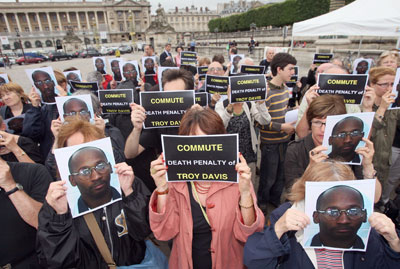
This week, Georgia announced its plans to carry out the execution of Troy Davis. While there remains time to thwart this miscarrying of justice, the planned execution should give pause to us all.

In absence of forensic evidence or a murder weapon, an all-white jury convicted Davis of the 1989 murder of a police officer in Savannah. The basis of the conviction was the witness testimony of nine individuals (7 eyewitnesses and 2 “jailhouse snitches”), many of who have subsequently spoken about police pressure. In fact, since his conviction, all but two of the prosecution’s non-police witnesses have recanted or contradicted their own testimonies, leaving the conviction in doubt. At the same time, 9 individuals have signed affidavits implicating another individual who happens to be one of the two witnesses who have not reversed on original testimony. Notwithstanding these significant doubts raised during the appeals process, one that has never allowed for his defense team to fully explore the recanting witness testimony, Davis’ conviction has remained, resulting in the issuing of his death warrant yesterday.

As part of its announced plan to stop the execution of Davis, the NAACP described the injustice in the following way: “This is our justice system at its very worst, and we are alive to witness it. There is just too much doubt.” Calling for people to take action to save Troy Davis’ life, his case points to larger racial issues that demand action as well.

His conviction and the decision to proceed with his execution should give pause given the research on race and witness identification. According to the Innocence Project, 75% of wrongful convictions overturned by DNA were the result of witness misidentification. “While eyewitness testimony can be persuasive evidence before a judge or jury, 30 years of strong social science research has proven that eyewitness identification is often unreliable” reports the Innocence Project. “Research shows that the human mind is not like a tape recorder; we neither record events exactly as we see them, nor recall them like a tape that has been rewound. Instead, witness memory is like any other evidence at a crime scene; it must be preserved carefully and retrieved methodically, or it can be contaminated.”

One of the sources of contamination is clearly race and the myriad of assumptions that result from an institutionalized system of stereotyping. In “Cross-Racial Identification Errors in Criminal Cases,” Sheri Lynn Johnson highlights the unreliable nature of “eye-witness” testimony, a fact that is exacerbated in cross-racial situations. Evidence from actual cases and in research studies elucidate the ways in which race and the larger social meanings attached to blackness play a significant role within the process of witness identification. In a study conducted with white students at University of Illinois and black students at Howard University, researchers showed them pictures of 10 white and 10 black individuals for a second and half; then, they were are asked to recall the pictures from a series of other photos. According to Elizabeth F. Loftus, in Eyewitness Testimony:

[T] he subjects were clearly better able to identify members of their own race. This study was later duplicated with the addition of Asian students. Again [African Americans] had greater difficulty recognizing faces of whites and Asians. Interestingly, however, whites and Asians had relatively little problem in identifying members of each other’s race – though both had trouble identifying [African Americans]. (from review of book)

The psychological obstacles facing witnesses along with the ways in which race further complicates the process is well documented. Yet, we continue to rely on witness testimony within the criminal justice system. The power of the white racial frame illustrates the reasonable doubt inherent in eyewitness testimony. In a society where black is akin to criminal, so much so that within the dominant imagination there exist a distinct category, the “criminalblackman” (Russell, 1998, p. 3), it is crucial to reflect on what is at stake with Troy Davis: his life and so many others.

The planned execution of Troy Davis also points to a larger question of the racial application of the death penalty within the United States. According to David Dow, 35 years into the return of the death penalty “It remains as racist and as random as ever.” Referencing the often-cited Baldus Study, which “found that black defendants were 1.7 times more likely to receive the death penalty than white defendants and that murderers of white victims were 4.3 times more likely to be sentenced to death than those who killed blacks,” Dow highlights the racist application of the death penalty. Cases involving an alleged black perpetrator and a white victim are far more likely to result in the death penalty. Although, “nationwide, blacks and whites are victims of homicide in roughly equal numbers . . . 80 percent of those executed had murdered white people.”

PLEASE CONTINUE READING @ NewBlackMan: “Our Justice System at Its Worst”: Date Set for Troy Davis Execution.

New post from @NewBlackMan- Campus PD: Criminalizing Higher Education?


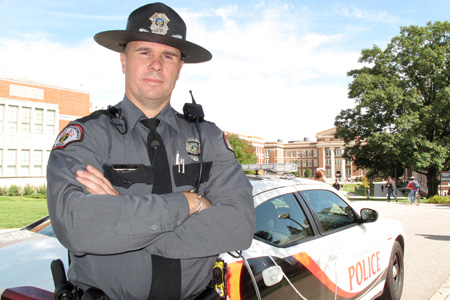
Campus PD: Criminalizing Higher Education?
by David J. Leonard | NewBlackMan

In what was obviously a slow night television night, I found myself searching for something to watch.  After perusing up and down the onscreen schedule, I came across Campus PD (I was somewhat familiar with show having read about their filming in Pullman, WA, where I live), a show that “takes viewers along for the ride with officers on duty to capture firsthand all the mayhem and excitement they take on night after night when student fun spirals out of control.” The show is described in the following way:

From policing parties and security issues, to keeping the peace at sports events and arresting possible suspects, ride with the “Campus PD” as they tackle the ongoing challenge of keeping students safe. Depicting university life from the perspective of the law enforcement professionals who police them, this ground-breaking new series presents a real-life account of these modern-day campus heroes. As they gear up for a shift, these courageous cops know they’re in for a few surprises!

The series heads to five college towns across the country including Tallahassee, FL, San Marcos, TX, Cincinnati, OH, Chico, CA, and Greenville, NC. It takes viewers deep inside the internal lives of the law enforcement professionals policing a town of fun-loving college kids. It isn’t easy, but these dedicated officers love their jobs, and wouldn’t have it any other way.


The emphasis on “fun,” “keeping student’s safe” “fun-loving college kids,” parties, and “binge drinking COEDS” is instructive, demonstrating how a show about criminal misconduct goes to great extents to decriminalize its primarily white, middle-class, “participants” and in doing so criminalizes the Other once again.


The show might as well be called “Warning PD.”  In the three episodes I watched on television, and countless clips online (which don’t necessarily show the encounters from start to finish leaving it hard to see the final resolution), I have only seen a handful of actual arrests.  For the most part, the show brings to life several excessively permissive campus police forces, who tolerate abuse, disrespect, and a culture of chaos.  In many instances, college students are given countless warnings, and only after failing to comply with instructions, are they forced to deal with the repercussions of their actions with a ticket or an arrest.


Another common theme within these initial episodes I watched from start to finish was a belief from the students they were unjustly being persecuted by the police.  Students would often note that, “they were not doing” anything wrong, or that they were simply engaged in “harmless fun” only to be harassed by campus police.  Given the ways in which harassment, racial profiling, and pre-text stops so often define the experiences of youth of color, it is a troubling re-imagination of policing in America.  Worse yet, Campus PD does a good job in showing why many college students view police as unfairly harassing them.


In two different episodes (as in the book Dorm Room Dealers), students respond to the presence of police by telling them to go “police” and investigate some real criminals.  That is, they were wasting their time with the happenings of college students since they were harmless, as opposed to those who “lived over there.”  In both instances, “over there” was clearly the neighborhood inhabited by poor people of color.  This assumption (one that is reinforced by the show) that the “real criminals” exist elsewhere reflects the power of American racial and class logic.


According to a study from the Journal of Alcohol and Drug Education, 95 percent of respondents imagined an African American when asked about drug users.  In other words, blackness operates interchangeably with criminality, especially in relationship to the urban poor.  Better said, “to be a man of color of a certain economic class and milieu is equivalent in the public eye to being a criminal.” (John Edgar Wideman, p. 195)


The consequences of the permissive policing and a culture that imagines college students engaged in criminal activity as just having fun (as opposed to the “real criminals”), is evident in the lack of attention directed at the criminal misconduct taking place at America’s colleges and universities.


According to a 2007 study reported in USA Today, over half of America’s college student regularly abuse alcohol and drugs.

The study found that college students have higher rates of alcohol or drug addiction than the general public: 22.9% of students meet the medical definition for alcohol or drug abuse or dependence — a compulsive use of a substance despite negative consequences — compared with 8.5% of all people 12 and older.


Increasingly, along with the traditionally seen drug and alcohol abuse, college students are abusing prescription drugs like Adderall, termed “smart drugs” by many college students.  “For many middle and upper-middle class young people in New York,” notes Lala Straussner. “Adderall is much more acceptable than using methamphetamine (more common on West Coast) or crack cocaine, although the brain doesn’t know the difference.” Yet, the ubiquity and acceptance of “smart drugs” is simply the perceived function or the consequences of these drugs but the ways in which crack and meth are both racialized and connected to distinct class identities.  Prescription drugs, on the other hand, are linked to those in college, who are said to have a future, illustrating criminality and criminals are identities are constructed as elsewhere and not within college communities.


While shows like Campus PD illustrate the ubiquity of instances of public intoxication, cases of drunk-driving, and physical assaults, other issues plague college communities.  As such, it does little to elucidate the problem of sexual violence (20-25% of women in college will experience rape or an attempted rape), prescription drug abuse, and even drug dealing.  The erasure of these systemic problems reflects a culture that imagines college as a space of parties, fun, and adolescent behavior rather than criminal activity.


This type of narrative is evident in the recent drug busts at San Diego Sate University and Columbia University.  In 2008, after a several month investigation, authorities arrested 75 students (96 people in total), confiscating drugs worth a total of approximately $100,000 worth of drugs.  Among the 20 students arrested for distribution and sales was a criminal justice major, who when arrested was in possession of two guns and 500 grams of cocaine.   San Diego County Dist. Atty. Bonnie Dumanis made clear that their investigation demonstrated “how accessible and pervasive illegal drugs continue to be on our college campuses and how common it is for students to be selling to other students.” This was certainly true with Columbia University, where 5 students were arrested as part of “Operation Ivy League,” “a five-month undercover sting, during which police purchased $11,000 worth of drugs from the students out of Columbia fraternity houses and dorms.”


While the media rendered this incidence and that at SDSU as a shocking spectacle, it is clear that the situation at these schools is a national phenomenon.   This should actually be surprising given how drug markets are as segregated as the rest of America.  According to A. Rafik Mohamed and Erik D. Fritsvold, authors of Dorm Room Dealers, who spent 6-years examining drug distribution at a Southern California Private school, not only do students sell to other students, but do in a reckless manner, which in their mind highlight a sense of entitlement based on the students’ middle-class white identities.  Phillip Smith describes their findings in “Dorm Room Dealers: A Peek into the Drug World of the White and Upwardly Mobile”:

Mohamed and Fritsvold show repeatedly the reckless abandon with which their subjects went about their business: Dope deals over the phone with uncoded messages, driving around high with pounds of pot in the car, doing drug transactions visible from the street, selling to strangers, smuggling hundreds of pills across the Mexican border. These campus dealers lacked even the basics of drug dealer security measures, yet they flew under the radar of the drug warriors.

Even when the rare encounter with police occurred, these well-connected students skated. In one instance, a dealer got too wasted and attacked someone’s car. He persuaded a police officer to take him home in handcuffs to get cash to pay for the damages. The cop ignored the scales, the pot, the evidence of drug dealing, and happily took a hundred dollar bill for his efforts. In another instance, a beach front dealer was the victim of an armed robbery. He had no qualms about calling the police, who once again couldn’t see the evidence of dealing staring them in the face and who managed to catch the robbers. The dealer wisely didn’t claim the pounds of pot police recovered and didn’t face any consequences.


A former Columbia student highlights a similar culture there, adding more evidence to the arguments offered in Dorm Room Dealers.

But, in fact, the prestigious institution on Manhattan’s Upper West Side has long been “ripe” for drug trafficking, a knowledgeable 2009 Columbia graduate told The Daily Beast. “I think the permissive environment of Public Safety”—as Columbia’s campus police force is known—“makes it a no-brainer proposition,” said this former student, who described himself as a recreational drug user who dabbled in selling. “I always felt safe.”


The culture and climate of Columbia in terms of public concern and policing, as opposed to the levels of surveillance found a few miles away in Harlem, tells an important story about how race and class operate in contemporary America.  Campus PD offers a similarly distorted glimpse a crime as well.


Media accounts of these two recent drug operations and shows like Campus PD have done little to shine a spotlight on the double standards that exist between the primarily white middle-class student population and poor youth of color when it comes to policing and incarceration.  With the situation at Columbia, one student has plead guilty thus far; although charged with the most serious crimes, he was sentenced to 6-months in prison in July.  In a city where 46,500 people were arrested for marijuana possession in 2009, with 87% of these people being black and Latino, the inequality is quite clear.


San Diego saw a similar outcome, with many of those arrested pleading guilty only to face probation and entrance into a drug diversion programs, leading some people to question why police are spending so much time and energy conducting investigations against college students that do not result in incarcerations.   When considering the media coverage, popular representations of college campuses, levels of policing and unzealous prosecution, it is no wonder that while African Americans constitute 13% of all monthly drug users, they represent 38% of these arrested for drug possession, 55% of convictions and 74% of prison sentences; it is as argued by Michelle Alexander, the new Jim Crow, ostensibly cordoning off America’s college and universities from policing and prosecution.  The criminalization of black and brown youth and the decriminalization of white America, particularly its middle-class college-bound constituency, have material consequences.


Evident in a show like Campus PD and the various examples provided here is the ways in which  “what it means to be criminal in our collective consciousness to what it means to be black.”  In other words, “the term black criminal is nearly redundant . . . . To be a black man is to be thought of as a criminal, and to be a black criminal is to be despicable – a social pariah” (Alexander 2010, p. 193).   No wonder so many students yell at cops to go focus on the “real criminals”; that is the message they have learned all too well.

***
Originally posted at NewBlackMan

New piece @NewBlackMan: The “Selling of Candace Parker” and the Diminishment of Women’s Sports

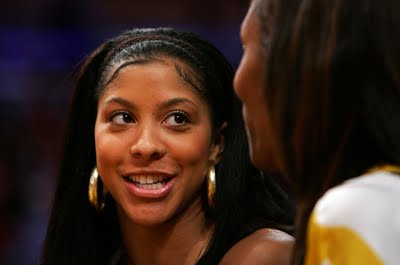
The “Selling of Candace Parker”and the Diminishment of Women’s Sports

by David J. Leonard | NewBlackMan

Breaking News: The WNBA is about to complete its 14th season. If you watched ESPN regularly, read a myriad of sports pages, or surfed the virtual sport world, the fact that the WNBA season was actually going on might be breaking news. In what could have been an exciting season—given the parity between teams and the influx of new talent, which could have resulted in increased cultural and sporting significance—the WNBA experienced yet another summer of alienation.

In a recently published piece in The Nation, entitled “Sex sells Sex, Not Women’s Sports,” Mary Jo Kane explains this marginalization, debunking the idea that sex is able to sell women’s sports. Rather, she notes that, “Sex sells sex, not women’s sports” leaving little doubt why women’s sports continues to struggle within the marketplace. “Millions of fans around the globe just witnessed such media images and narratives during coverage of the Women’s World Cup in Germany. Perhaps such coverage will start a trend whereby those who cover women’s sports will simply turn on the camera and let us see the reality—not the sexualized caricature—of today’s female athletes. If and when that happens, sportswomen will receive the respect and admiration they so richly deserve.” To reflect on these dynamics and the continued struggles of the WNBA to transcend (or even undermine) the sexist grips of American sports, I want to discuss an almost three-old year feature on Candace Parker.

In 2009, ESPN: The Magazine, as part of its women in sports issue, featured an article on Candace Parker. This one story encapsulates the persistent sexism that detracts from and inhibits the development of women’s sports within American culture. Reducing women athletes to sexual objects and potentially profitable spokeswomen, the article, entitled “The Selling of Candace Parker” does little to introduce and celebrate the contributions of women’s sports, but rather elucidates the systemic problems of American sports culture.

The emphasis on selling sex, rather than athletics and sport, is evident from moment one of the piece. “Candace Parker is beautiful. Breathtaking, really, with flawless skin, endless legs and a C cup she is proud of but never flaunts,” writes Alison Glock. “She is also the best at what she does, a record-setter, a rule-breaker, a redefiner.” Eliciting some criticism about the references to her body, and the reduction of her body to its sexualized parts, ESPN: The Magazine brushed off accusations of sexism, identifying the article as sensible given the demographics of the magazine. According to Gary Belsky, editor-in-chief, “It’s not the worst thing in the world in a men’s magazine to talk about things like that.”

The sexualization of Parker and the focus on her body, at the expense of a narrative highlighting her athletic talents, doesn’t end with this initial introduction of readers to her physical attributes. Glock continues this treatise on Parker’s body before moving to a discussion of her “feminine charm”:

She is a woman who plays like a man, one of the boys, if the boys had C cups and flawless skin. She’s nice, too. Sweet, even. Kind to animals and children, she is the sort of woman who worries about others more than about herself, a saint in high-tops.

It is this unprecedented combination of game, generosity and gorgeous that has Team Parker seeing miracles. They believe with all their collective heart that their 22-year-old, 6’4″ stunner with the easy smile and perfect, white teeth will soon be the most recognized woman in American sports.

In other words, Parker represents an ideal femininity – nurturing, sexy, and heterosexual (the article make this clear though various rhetorical phrases, references to her husband, basketball player Sheldon Williams, and of course its discussion/visual presentation of Parker’s pregnancy); she is the perfect woman who happens to play basketball. In this regard, ESPN is selling Parker as a sexy and attractive woman whose job is to play basketball, a professional choice that in no way comprises her role as mother, wife, and sexual object to be consumed by male fans.

Yet, Glock doesn’t seem to limit Parker’s immense potential as the Michael Jordan of women’s sports because of her “flawless skin” and breast size (despite multiple references to her bust size), rather arguing that Parker can transcend women’s sports, breaking down commercial barriers to become “a one namer” because she isn’t like so many of today’s (black) athletes, whose brash and hyper-masculine demeanor alienates fans. She is “nice,” humble, and likable. She “is the total package, an advertiser’s dream: attractive yet benign enough to reflect any fantasy projected upon her. Like Jordan before her, Parker is a cipher of sorts, nothing outsize or off-putting. Nothing edgy. Nothing Iverson. Aside from being an athletic freak, she’s normal. You could imagine her hanging out at your family barbecue. This matters; if Parker seems like a down-home gal, a possible friend, then it’s a short step to trust, and with trust comes a willingness to buy what Team Parker is selling.”

Continue reading at NewBlackMan: The “Selling of Candace Parker” and the Diminishment of Women’s Sports.

Mark Anthony Neal @NewBlackMan: “Where Dey At?”: Bounce and the ‘Sanctified Swing’ in Post-Katrina New Orleans


“Where Dey At?”:

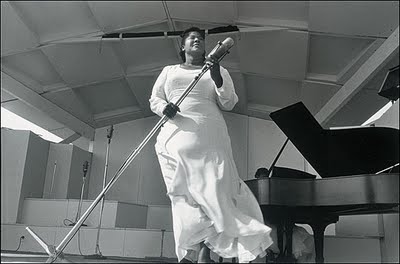
Bounce and the ‘Sanctified Swing’ in Post-Katrina New Orleans

by Mark Anthony Neal | NewBlackMan

In the immediate aftermath of Hurricane Katrina and the failure of the levees in New Orleans, there were many high profiles efforts to raise awareness about the cultural legacy of New Orleans. Many of those efforts centered on the exaltation of New Orleans Jazz, with many events aimed at providing shelter and support for Jazz musicians dispersed by the tragedy. New Orleans Jazz seemed the most important resource to be protected in the months after Katrina, more so than the people who made the city such a vital and important, ever evolving cultural outpost. Lost in the focus on New Orleans Jazz—arguably one of the nation’s most important cultural exports—are other forms of musical expression that were and continue to be crucial to the survival and spirituality of New Orleans and its citizens, including those who have yet to return.

Though Jazz was a critical component of Black political discourse and intellectual development throughout the 20th century—jazz musicians like John Coltrane, Billie Holiday, Max Roach and Abbey Lincoln are some of the most resonate examples of creative intellectuals—New Orleans Jazz is often depicted as being tethered to some imagined past, in which race relations and the power dynamics embedded in them were far more simplistic.

Indeed recent films like The Princess and the Frog and The Curious Case of Benjamin Buttons the television series Treme (despite it’s progressive political critiques) contribute to a nostalgic view that New Orleans Jazz as a dated, static musical form that offers an “authentic” alternative to more commercially viable forms of popular music like rap and R&B music. Much of this has to do with the relationship between New Orleans Jazz and the leisure and tourist industries that were so vital to the city’s economy. In this context, mainstreams desires to save New Orleans Jazz and to protect its musicians are less about strengthening the links between Jazz and Black cultural resistance—a resistance that historically fermented in New Orleans—but maintaining the economic vitality of what Johari Jabir calls the “theater of tourism” in which Black bodies are rarely thought of as citizens but laborers, servants and performers.

In the introduction to the book, In the Wake of Hurricane Katrina: New Paradigms and Social Visions, scholar Clyde Woods places New Orleans Jazz in a much broader context, as part of what Woods has famously described as a “Blues tradition of investigation.” As Woods notes in his essay, “Katrina’s World: Blues, Bourbon and the Return to the Source,” historically the city of New Orleans and the region was “latticed with resistance networks that linked enslaved and free blacks with maroon colonies established in the city’s cypress forests swamps.”

These traditions of resistance would manifest themselves after Emancipation and beyond in the form of “societies and benevolent associations; churches, second lines, pleasure and social clubs; brass bands, the Mardi Gras Indians” and of course New Orleans Jazz. Two practices also linked to resistance in New Orleans are Bounce music and what Jabir refers to as the “sanctified swing,” embodied in the genres of Rap music and Gospel respectively.

Continue reading @ NewBlackMan: “Where Dey At?”: Bounce and the ‘Sanctified Swing’ in Post-Katrina New Orleans.

Theresa Runstedtler @NewBlackMan: “It Doesn’t Get Any More Real Than Perry”?: The Right’s Stake in Real Americaness

“It Doesn’t Get Any More Real Than Perry”?: The Right’s Stake in Real Americaness

“It Doesn’t Get Any More Real Than Perry”?:

The Right’s Stake in Real Americaness

by Theresa Runstedtler | special to NewBlackMan

“People of all persuasions are sick, sick, SICK of mollycoddling, pandering and Edwardian (as in John Edwards) phoniness . . . . It doesn’t get any more real than Perry. The elite may call it ‘swagger’; I call it a real man with real convictions and the courage to stand up for them, which happen to comport with the majority of Americans. Or as they say in Texas, he is had and cattle. And the coupe de gras, he is a spiritually anchored and philosophically happy warrior.”

– Republican strategist Mary Matalin on presidential candidate Gov. Rick Perry (R-Texas)

Since when did the Right (and more specifically white Republican men from Texas) become the arbiters of what it means to be a “real American man”?

As a Canadian transplant, I’ve always found the theatrics of the U.S. political scene fascinating, where big money campaigns seem interminable and public spectacle usually trumps any in-depth discussion of policy. American politics is a virtual blood-sport with all its sound bite and bombastic fury. Texas Governor Rick Perry is just the latest Republican to enter the pissing contest that is the 2012 presidential campaign, ready to show the “real America” that he has the balls to lead the nation.

Of course, Perry is simply following in the well-worn footsteps of his predecessor George W. Bush, with his self-righteous swagger, Texas drawl, and rugged, frontier persona. He prefers cowboy boots to dress shoes and proudly recounts shooting a coyote with his .380 Ruger (it had a laser sight). He wears his Christianity on his sleeve, most recently playing the patriarchal prophet at his Houston prayer rally. Even though Bush’s people reportedly disdain Perry, he seems to have taken many of his moves right out of their campaign playbook.

While Bush had to manufacture a frontier persona to cover up his elite, northeastern roots (much like President Theodore Roosevelt back in the early 1900s), Perry actually has a real connection to rural Texas. As his campaign website triumphantly claims, “A fifth generation Texan, Governor Rick Perry has taken an extraordinary Texas journey, from a tenant farm in the rolling West Texas plains to the governor’s office of our nation’s second largest state.” Perry and his people would clearly like us to think that he made it to his current political station by pure, hard-scrabble individualism (with a little help from the Man upstairs), but even a cursory look at his record suggests otherwise.

As his website extols, “Rick Perry has led a life of public service, starting in the United States Air Force and continuing over two decades in elected office.” Thanks to a clever, rhetorical twist, his work for one of the largest wings of the federal government – the military – can be touted as admirable public service, in contrast to the other government services he so desperately wants to cut. As the wife of a former Marine, I also know that serving in the military makes one eligible for government-backed housing loans and educational funding, but Perry would argue that unlike other handouts these are appropriate entitlements for deserving people. Perhaps most ironic of all, he boasts two decades as an elected official, even as he calls for the shrinking of government. (I’m pretty sure that he won’t be handing back his tax-payer-provided pension or healthcare.)

Perry claims credit for “creating a Texas of unlimited opportunity and prosperity by improving education, securing the border and increasing economic development through classic conservative values.” However, his real record and the real-life conditions in his state tell a different story. Despite his vociferous condemnation of the federal stimulus bill, Perry has a long history of fighting for federal money to help fund state projects. Even members of his own party have decried his blatant “corporate cronyism.” He has used handouts from the Texas Enterprise Fund (TEF) to pad the pockets of his friends in big business, who in turn have helped to fill his campaign coffers. The free market’s hand is not so invisible in the Lone Star state.

Continue reading @ NewBlackMan: “It Doesn’t Get Any More Real Than Perry”?: The Right’s Stake in Real Americaness.

Red Clay Scholar: Swagger Jacker: Musings on the White Michael Vick


Swagger Jacker: Musings on the White Michael Vick

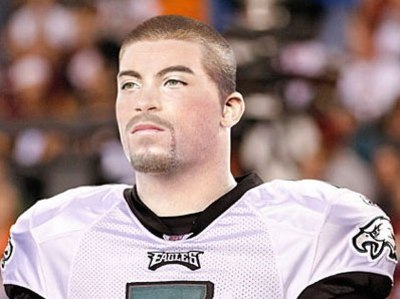
I can’t lie. The first thing I did when I saw a whiteface Michael Vick was laugh.

It is a (very) off color (pun intended) attempt to open up conversations about race and sports. C’mon, America. We wanna talk about race? Of course not! That’s so 2008.

Pause.

I’ve tackled the idea of whiteface in a previous post that contextualized it as a 20th century African American rebuttal to the minstrelsy tradition situated in 19th century white supremacist discourse. But ESPN: the Magazine (and much of writer Toure’s article that it supposedly complemented) got us messed up. Aside from the pathological and straight up dumbfounding ways that both Toure and the picture essentialize black masculinity there was some serious swagger jacking involved. ESPN: the Magazine ain’t the first one to use whiteface. George Schuyler would be pissed.

For the literary aloof, George Schuyler was a master satirist and conservative kicking folks’ racial politics in the throat during the Harlem Renaissance or lack thereof. Schuyler is perhaps most recognized for his essay “The Negro Art Hokum” which dismisses the idea of black American art as essentialist and nonexistent. But it is Schuyler’s satiric novel Black No More, released in 1931, that situates him as a predecessor of progressive racial thought, weaving a delightfully absurd narrative that promotes a similarly absurd solution to America’s race problem. Make everyone white.

Continue reading at Red Clay Scholar: Swagger Jacker: Musings on the White Michael Vick.

Honorée Fanonne Jeffers: What if Touré were White?

What if Touré were White?

Honorée Fanonne Jeffers

Touré on the ESPN website, entitled “What if Michael Vick were white?”  Above the actual article was adisturbing sight: Michael Vick in “white face” with light hair and light eyes. (This article also appears in the latest ESPN magazine.)

I know next to nothing about sports, and I don’t find sports interesting, either, so I almost didn’t read the article.  (To read an analysis of Touré’s piece by someone who does know about sports, check out this brilliant post by David J. Leonard.) I knew that I would encounter certain “insider” terms about sports in a, well, sports magazine.  I only read on because of the provocative title. But luckily, I need to know absolutely nothing about sports to understand Touré’s inflammatory and downright rude article, because it wasn’t about sports. It was about the pseudo-science of analyzing “race.”

Only in this article, Touré wasn’t analyzing the constructed concept of “race;” instead, he was making sweeping generalizations about Black culture, and reinforcing coded cultural and class stereotypes. Throughout my reading this article on Michael Vick, instead of asking myself the question I was su       pposed to—what if Vick were white—I found myself asking instead, what if Touré were white?

Now, before I go any further, let me say that I’m no fan of Michael Vick. I think what he did to those poor animals was horrible. And I’m also past tired of Black (and some White) folks trying to give Michael Vick a bleeding heart pass for inhumane treatment to God’s creatures and whining about he caught a bad break because he was African American. I don’t care what race he was; I think he should have done way more time than he already did.

Yes, I said it. Snatch my Black card, and I don’t care. I can always get me another one down at the Target.

But let me say that the sort of strange racial rhetoric on the other side of this debate, about the “nature” of Black men and Black culture is infuriating as well. And seriously tacky. In Touré’s defense, this rhetoric was going on long before he waded into this fray with his singular, accented moniker and “throwback jam” Enlightenment philosophy.

However, Touré’s article takes this rhetoric to the next, unsavory, near-skull measuring level. Again, this article is not about sports, though Touré begins with bloviated, quasi-lyrical language, using such terms like “in the pocket” and  (I guess) establishing his Black bonafides with the use of the Black vernacular, as when he writes:  “I’m not saying that a black QB who stands in the pocket ain’t playing black. [Emphasis mine.]

Okay, stop.

What the heck does “playing black” mean? I’m not even a sports fan and I know that’s not one of those complicated technical terms. And if a White writer said some sort of essentialist crap like somebody “plays black” that we’d be all over him. Why doesn’t Touré just start talking about antebellum slave breeding practices that produced better athletes while he’s at it? Like we haven’t already heard that one before.

Then, Touré goes on to imply that is Michael Vick were white and middle-class, he wouldn’t have been dogfighting in the first place.

Continue reading at What if Touré were white