During the spring semester, I am teaching a graduate course on social movements. Each week, I will post a review of that week’s book (I will also occasionally include a review of a recent documentary that connects to that week’s book)
****
Reading Akinyele Omowale Umoja’s brilliant We Will Shoot Back: Armed Resistance in the Mississippi Freedom Movement (NYU Press, 2013), in the midst of the national celebration of Martin Luther King Jr.’s birthday, was striking to say the least. Whereas the national narrative, from political speeches to ESPN commercials, imagines the civil right movement beginning and ending with King (and a sanitized and flattened history at that), while seemingly erasing the specter of white supremacist terrorist violence, Dr. Umoja chronicles the tireless organizing and agitation. He focuses on armed resistance, people who in the face of entrenched violence challenged white supremacist terror in Mississippi and beyond.
Dr. Umoja works from an expansive definition of armed resistance, which includes “individual and collective use of force for protection, protest, or other goals of insurgent political action and in defense of human rights… including armed self-defense, retaliatory violence, spontaneous rebellion, guerrilla warfare, armed vigilance/ enforcement and armed struggle” (7). The willingness or the threat to respond to violence with violence, to protect life, liberty and property “by any means necessary,” was central to the fight for freedom.
Pushing back at linear narratives and those that deny the importance of armed resistance, Dr. Omoja speaks to the dialectics between “unviolent” (Payne) tactics and those more militant strategies. The gun, like a mass meeting, the willingness to provide secured safe havens for Freedom Riders, like nonviolent training, were all crucial to building community, establishing trust, creating a sense of shared identity, and collectively generating “freedom dreams”; organizing was crucial irrespective of the tactic. We Will Shoot Back highlights the centrality of organizing and collectivity, pushing back at the individual/non-violent narrative to tell a multi-layered and crucial part of this history.
We Will Shoot Back documents that the history of armed resistance is a narrative of a complex system of roles, organizations, identity formation and action. Dr. Umoja notes:
Though not as visible as Evers, the Deacons, or the NAACP, the works of the enforcer squads, both that of Shields and that of the NAACP women was essential to the Movement. The enforcer groups ensured accountability and respect for the decisions of the Natchez Movement. If the boycott was almost 100 percent effective, recognition has to be given to the work of the enforcer groups. While this has escaped most accounts of the Mississippi Movement, the participants, in the Movement, particularly those active in Southwest Mississippi, recognize the significance of Rudy Shields and the enforcer groups he organized” (139).
This organization and the importance of armed resistance are documented in a myriad of places, taking a multitude of forms. The book chronicles the violence endured by the Hazelwood family, who after housing Freedom Riders experienced widespread economic reprisals and terrorist violence. Refusing to back-down in the face of violence, the ability of Luella Hazelwood or Willie Hazelwood to push forward with their work as activists and organizers cannot be understood outside of history of armed resistance. Luella spoke about how she did not even fear an arrest by the Belzoni police:
They never would hit nobody, when they pick them up like that. ‘Cause they had a war going on… ‘Cause these folks [Black people] was ready to fight some. They wasn’t like martin Luther King. Get him on this side and turn the other. Naw, we didn’t turn no jaws. No Lord.
We Will Shoot Back, thus, documents this history and others, including that of “Da Spirit” which made sure that Blacks were adhering to the boycott in Natchez. “Punishment by ‘Da Spirit’ ranged from public spankings to damage to home or vehicle to seizure of property” (169). It is a story of refusal, of challenging terror and fear, of accountability and justice.
While documenting the level of terror and violence that was part and parcel to Jim Crow and American Apartheid, and the level of violence employed in the name of white supremacy (compare historic understanding of shootings at Kent State to that of shootings at Jackson State College where “police fired hundreds of rounds into Alexander Hall, a form dormitory, killing two and wounding 12 others), We Will Shoot Back “documents the role that armed resistance played in overcoming fear and intimidation and engendering Black political, economic and social liberation” (1-2).
In this regard, one cannot understand the history of the Black Freedom Struggle outside of the simultaneous use of boycotts, other forms of direct action, self-defense, and organizing. Dr. Umoja makes clear that to understand King’s “Beloved Community” or Lawson’s tools of direct action requires looking at the history of armed resistance throughout the movement.
Armed resistance and nonviolence were not in opposition but worked together. Dr. Umoja highlights how these tactics and worldviews worked hand-in-hand? That one cannot understand Freedom Rides outside of a history of armed protection; that we cannot understand voter registration movements outside of the role of the gun in conquering fear in the face of white supremacist terror. “Armed resistance must be included with litigation, mass organizing, nonviolence demonstrations and protests, as well as other forms of insurgent challenge to force federal intervention and a change in white attitudes and behavior toward Black humanity,” writes Dr. Umoja. “Moreover armed resistance contributed to giving activities and communities the confidence to challenge White supremacist terror even when the federal government did not have the capacity or will to protect them. Without due attention to the role of armed resistance in Mississippi, either the agency of Blacks in the Civil Rights and Black Power Movements is denied or an inaccurate account of the Struggle is offered” (p. 258-259).
Reading the book alongside in the context of the King Holiday (and the 50th anniversary of the March on Washington) added layers to the book. Likewise, thinking about the book in relationship to the ongoing debate about guns added another layer. While some have sought to seize upon this history, and the broader story of armed resistance against white supremacy to justify unfettered access to guns, I am struck by the disconnect between the actual history. We Will Shoot Back speaks to armed resistance to antiblack racism, to state violence, and to systems of white supremacy. Within these mainstream discourses, the entrenched antiblack racism, the systemic state violence, the specter of police brutality and #every28hours, is nowhere to be found rendering these historic invocations problematic at best. Akinyele Omowale Umoja’s We Will Shoot Back gives us lots to think about with the past but the present and future as well.
Silence and Spectacle: How the Sports Media Sanctions Racist Mascots
By Guest Contributors C. Richard King and David J. Leonard
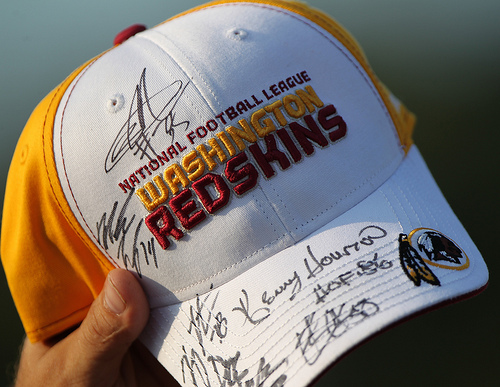
One would hope sport media outlets might take their civic duty to foster critical thinking, public engagement, and informed debated seriously. Their approach to the representations in Native Americans in sport suggest otherwise. Under the veil of fairness and balance, they opt to speak for, to be silent and to silence as preferred pathways.
When ESPN columnist Rick Reilly offered a defense of Native American mascots because the American Indians he knew did not have a problem with them. Flouting his whiteness and playing his privilege with little regard, he spoke for Native Americas. His word – his whiteness, his platform – made their words meaningful. His editors neither batted an eye nor cleared a space for Native Americans to express themselves.
In fact, Reilly misrepresented his key source, his father-in-law, who wrote a lengthy retort in Indian Country Today that noted he found the name of Washington D.C.’s National Football League team to be objectionable. Reilly still stood by his piece and neither he nor his publisher have offered a correction or an apology.
Fans of Washington, D.C.’s NFL team. Image by Keith Allison via Flickr Creative Commons.
Similarly, Daniel Snyder, the owner of the franchise, continually invokes American Indians to support the team name, imagery and traditions, as in his recent sentimental letter to the public, from one-time coach Lone Star Dietz (who claimed to be but was indeed not indigenous) as the inspiration of the honorific name to the Red Cloud School (a reservation school which does not support it).
Not surprisingly, someone who loves and profits from the invented Indian figure he owns does not have a problem with offering up insincere fictions in his defense. He doesn’t invoke the history of colonization and genocide, or the specific racial history of his own franchise. Predictably, someone who reaps the daily benefit of white supremacy sees little problem with the football team located in the nation’s capital having for its mascot a racist slur seeped in white supremacist colonial history.
Johnny Manziel is No Rosa Parks by David J. Leonard
by David J. Leonard | NewBlackMan (in Exile)
Johnny Manziel is no Rosa Parks – six words that no one should ever need to type. Yet thanks to Jen Floyd Engel, a FOX Sports columnist, I can now cross this off my bucket list: Johnny Manziel is no Rosa Parks.
Engel, who is clearly a member of the Johnny Football Reclamation project, has gone to great lengths to elevate his importance. With “Manziel case was tipping point,” Engel recast the one time football player by day, partier by night, as a collegiate freedom fighter. That is, his defiance, his refusal to play by the NCAA rules, and his “show me the money” approach to autographs is all part of a plan to bring down the NCAA. Problematic enough, Engel is not content with simply demanding change, that NCAA do it for Johnny.” Manziel is a game changer; a transformative hero within a larger history of struggle.
“Once upon a time in this country, there were ugly, racist, tyrannical rules dictating where a black person could sit on a bus. There were all kinds of these laws, actually, created and defended by the racists who benefited from them,” notes Engel. According to Engel, this chapter in America’s history of racism (notwithstanding subprime loans, stop and frisk, mass incarceration….) ended because an “everyday woman named Rosa Parks, who had grown tired of being tired” said no. She “was merely the tipping point for many Americans long since tired of these immoral laws.” Johnny Manziel, who was also tired, albeit of the NCAA making money off his labor, name, and signature. And according to Engel, he too will lead us to the promise land of reform.
The Parks comparison is so offensive and historically ignorant, I wouldn\’t know where to start (a national reading of Jeanne Theoharis recent book would be a good starting point). Rosa Parks trained, sacrificed, and participated in movement; Johnny is a movement for/about himself. A movement is not Johnny Football, his friend, and his sharpie.
Rather than joining a movement, partnering with a group like National College Players Association (dare I say a modern day sports equivalent of the Highlander Folk School or SCC), or voicing his support for the O’Bannon lawsuit, Manziel followed in the footstep of his capitalism forefathers: he got paid. And now he might get punished for that reported rule violation.
And for that, he is Rosa Parks. He is a tipping point. She writes, “On a much less historically significant scale, so it is with Johnny Football — and no, this is not intended in any way to compare the vast evil of Jim Crow to an incompetent NCAA investigation, or to slings from TV commentators.”
There is so much wrong with the comparison, from the hypocrisy of a writer who chastised Terrelle Pryor for rule’s violations to the historic ignorance about the civil rights movement. Dave Zirin articulates this with great precision and brilliance how misguided and historically myopic the comparison is between Manziel (not yet “an accidental activist”) and Rosa Parks, “the mother of the movement:”
By comparing the two, Engel does more than trivialize the bravery of Parks. She traffics in a myth about who Parks was and why she chose to fight the indignities of the Jim Crow South. In Engel’s telling—and this is the kindest possible interpretation—Manziel, like Parks, is the unconscious activist thrust by circumstance into firing the first shots at an unjust system.
Zirin and several others make clear the many problems of the column. However, as easy as it is to dismiss Engel, her reclamation of Johnny Football, and her denial of the racial implications here (“This has absolutely zero to do with race. What I believe to be true is, after years of watching black kids, white kids and mostly poor kids of all colors villainized for accepting a free sandwich or plane fare to go home and attend a funeral or, God forbid, wanting a cut of the billions of dollars they make for people not doing much in the way of heavy lifting, this was America’s tipping point”) has become commonplace. ESPN might as well start a network dedicated to all things Johnny. This column is a symptom of a larger set issues operating through Manziel.
Race has everything to do with Johnny Manziel. His whiteness matters. It matters when Engel recast this moment as a tipping point; it matters when commentators use this moment to spotlight the hypocrisy of the NCAA; it matters that “he’s just 20” and “he’s behaving like other college students” has become the commonplace defense of his daily transgressions. It matters as we come to grips with fact that he was celebrated as the greatest QB since Tim Tebow Johnny Unitas despite the fact that he lagged statistically behind Oregon’s Marvelous Marcus Mariota in 2012 (who wasn’t even invited to NY for Heisman festivities).
I couldn’t put this book down. It is a wonderful history that introduces readers to three amazing artist/activist women: Ann Petry, May-Lou Williams and Pearl Primus. She chronicles their artistry (with amazing detail), the vibrancy of a community, a culture of progressive opposition, and resistance movements within 1940s Harlem. Dr. Griffin’s prose transports readers into this moment, allowing one to picture, smell, and hear all that was happening in this moment – I found myself watching Petry dance, or listening to Williams, all while thinking about their collective challenges to white supremacy.
And while the book brings Primus’ dance, Petry’s word, and Williams’ music to life, she is equally successful in bringing the dynamism of 1940s Harlem, the post-war moment, the progressive struggles, and a burgeoning struggle for racial justice, for full citizenship, and recognition. into focus
Harlem Nocture highlights the daily challenges to white supremacy waged by these artists. She shows artistry as the outgrowth of the community, the politics of the moment, and collective experiences. Griffin writes, “New York beckoned, and they came. They gave it substance, word and music, dance and meaning. In turn, it gave them inspiration, a community, and an audience. It contributed to each one’s already strong sense of self. It gave them the world” (187). In this sense, Harlem Nocture is a story of 1940s and three amazing artists. But it is also explicitly a history of three black women whose artistry, experiences, and politics “fueled change” within the community and beyond. They “were agents, not spectators. They advocated for access to education, jobs, and adequate food and shelter. They were concerned with both racial and economic equality. They walked the streets of Harlem during the time that a young Baldwin walked those same streets” (9). This work offers a narrative of these inspiring artists, reminding readers of their “freedom dreams” and our own. Amazing history, amazing artists, and amazing book
Angry at the prosecution & police; the jurors and the Zimmerman supporters; angry at CNN (the defense) and so much more;
Angry at a system that at its core has no concern for black life;
Furious that we are not shocked – the depths of white supremacy run deep;
Full of rage at the silence from white America; at the unwillingness to account for racism, white supremacy and white privilege
Sick and tired of excuses, denials, distractions, and dismissals;
Outraged by the celebration – Fox News, the right wing, and the Zimmerman GANG;
Outraged by their smiles and laughs, their arrogance and entitlement;
Outraged by their lack of concern for Trayvon Martin, his friends and family, and the many people who are hurting, who are outraged, who are angry;
Enraged that those who care for life, who fight for justice, are filled with so much pain;
Sad, enraged, and devastated that almost 60 years later, from Till to Trayvon, aint much changed;
These memories of Till’s murder and the sham of a trial are a haunting reminder that aint a dang thing changed:
I was a senior at Los Angeles High School in California. It had a profound affect on me because I understood that it could have happened to any of us. It shook my confidence. It was as though terrorists had struck — but it was terrorists from our own country. It made me want to do everything I could to make sure this event would not happen ever again – Johnnie L. Cochran, Jr.
My memories are exact — and parallel those of many others my age — I felt vulnerable for the first time in my life — Till was a year younger — and recall believing that this could easily happen to me — for no reason at all. I lived in Pennsylvania at the time – Julian Bond
Emmett Till and I were about the same age. A week after he was murdered… I stood on the corner with a gang of boys, looking at pictures of him in the black newspapers and magazines. In one, he was laughing and happy. In the other, his head was swollen and bashed in, his eyes bulging out of their sockets and his mouth twisted and broken. His mother had done a bold thing. She refused to let him be buried until hundreds of thousands marched past his open casket in Chicago and looked down at his mutilated body. [I] felt a deep kinship to him when I learned he was born the same year and day I was. My father talked about it at night and dramatized the crime. I couldn’t get Emmett out of my mind… – Muhammed Ali
I was fifteen years old when I began to hate people. I hated the white men who murdered Emmett Till and I hated all the other whites who were responsible for the countless murders… But I also hated Negroes. I hated them for not standing up and doing something about the murders – Ann Moody
Almost 60 years later, this is America
When Zimmerman was acquitted today, it wasn’t because he’s a so-called white Hispanic. He’s not. It’s because he abides by the logic of white supremacy, and was supported by a defense team—and a swath of society—that supports the lingering idea that some black men must occasionally be killed with impunity in order to keep society-at-large safe – Aura Borgado
You see, tonight Trayvon Martin’s unremorseful killer was acquitted. Tonight, I fell silent with a dear friend when we heard the news. Our eyes closed. Our heads fell into our hands. There were no words. Tonight, I heard my mother’s voice crack and tremble under the weight of her grief as she expressed her shock and sadness at seeing an unapologetic black-child-stalker-and-killer walk free. And tonight I realized, more than ever, that as much as I love your potential, as much as I love the good that I know is in your heart, as much as I appreciate and see the beauty of your highest calling, the truth is that I feel like this relationship — our relationship — is becoming abusive and toxic on a level that nearly boggles the mind – Crystal Fleming
Zimmerman’s not guilty verdict will be contested for years to come. But he passed judgement on Trayvon that night summarily. Fucking punks,” Zimmerman told the police dispatcher that night. “These assholes. They always get away.” So true it’s painful. And so predictable it hurts – Gary Younge
I wish I had answers to soothe my worries, optimism to soothe my rage. I do know a change had better come. Because as James Baldwin said in the epigraph to one of my favorite collections of his essays, “God gave Noah the rainbow sign. No more water. The fire next time – Brittney Cooper
Perhaps history does not repeat itself exactly, but it is certainly prone to extended paraphrases. Long before the jury announced its decision, many people had seen what the outcome would be, had known that it would be a strange echo of the words Zimmerman uttered that rainy night in central Florida: they always get away – Jelani Cobb
A couple weeks back, Melissa Harris Perry and her guests discussed the power of images, focusing on the debate as to whether or not the public should see images of Newtown violence. While recognizing the pain and difficulty for the Newtown parents, each seemed to conclude the stakes were too high and that the public needed to see the images.
Michael Skolnick called upon Connecticut Gov. Dannel Malloy to release the pictures. The past reveals that the sight of images has the potential to change the course of history. Amid the gun debate, the sight of young (middle-class white) children brutalized may galvanize change. Skolnick, who later noted, “Newtown changed the conversation because they were white,” highlights the power of the photographs of whiteness.
I think that for Americans, we have to see these images. This is not about politics. This is about lifting the consciousness of our nation. We have to know, yes, these were angels that went to heaven, but this was a brutal, brutal attack on children whose hands were blown off, whose faces were blown off and torsos were blown off. This is not just about glamorizing or sensationalizing what happed in Newtown. This was horror.
Yet, so much of the conversation was about the universal power of seeing evil; that viewing the horrors of gun violence, brutality, or abuse compels outrage and action. In fact, Melissa Harris-Perry started the show by highlighting the power of images to sway public opinion; pictures shape the debate, elicit emotion, and inspire action:
So it’s a tough choice. And when it comes to choosing to show the image, the slain child, it’s a decision no parent should be faced with having to make. But it is a decision that Mamie Till-Mobley did make in the case when her son Emmett Till was killed in 1955. Instead of having a reserved, low-key, private family funeral, Mamie decided to open the casket. To make the funeral a public experience. To show how killers, lynchers, J.W. Milam and Roy Bryant brutalized and tortured her 14-year-old son to death. Her decision to show the world the battered body and unrecognizable face of her son Emmett served as a spark for the civil rights movement. Till’s example might lead all of us to ask Newtown parents to release those pictures. Be as brave as Mamie Till was.
To illustrate the power of image, Harris Perry and others noted how the sight of Emmett Till, beaten beyond recognition, compelled national attention and outrage, spurring the civil rights movement. In reality, it galvanized and inspired action, among African Americans. However, the sight of Till’s disfigured body didn’t produce systemic change; it didn’t lead to legislation from congress nor did it compel federal intervention. It didn’t lead to white America to look in the mirror or confront racism because it had seen its brutality. Even the acquittal of two men didn’t propel a national movement across communities demanding justice and change. Till’s death and his life, his humanity, wasn’t, to borrow from Mark Anthony Neal, “legible.” Black suffering was and continues to be “illegible” to much of white America.
Instead, Till’s death and the horrifying images impacted Black America. Much of white America continued to accept Southern apartheid. All images are not created equally; the white supremacist gaze clouded the moral, political, and cultural responses.
It is no wonder that as we look at the Till generation, as we look into the historic archives to bear witness to the impact of the lynching of Till had, we see examples of how the lynching of Till galvanized activism from within the black community. Muhammad Ali and Diane Nash, Langston Hughes and Gwendolyn Brooks, Audre Lorde and James Baldwin, Anne Moody and members Black Panther Party all spoke of the transformative impact of Till. Harvey Young describes the importance in “A New Fear Known to Me”:Emmett Till’s Influence and the Black Panther Party”
While spectacular murders of black people, both male and female, by white individuals and mobs had occurred for centuries within (and across) the United States, the Till case proved extraordinary thanks to Bradley’s concerted efforts not only to openly display her son’s bloated and misshapen corpse but also her maternal grief for the world to see. Although not recognizable as a person – much less a teenager, the face of Till, captured by a photographer and circulated via print media, promptly became a representation of the severity of racial hatred, prejudice, and violence that continued to exist in the nation. … It asserts that the killing not only encouraged a newfound self-awareness among black youth as “black” and, therefore, as being susceptible to violence, but also provided additional motivation toward the formation of political organizations like the Black Panther Party, which advocated a more aggressive pursuit of social reform than the NAACP and the Southern Christian Leadership Conference (SCLC). Till’s influence on “the Party” appears not only in the recollections of members, who were nearly the same age as Till when he was murdered, but also in the Party’s skillful use of images of injustice to raise civic awareness and mobilize a new movement for social reform, efforts to monitor the police, and establishment of community-based, social service programs which sought to create a hopeful future for new generations of black youth.
Death and its meanings is clouded and constrained by race, class, and nation; bloodshed and violence is narrated through America’s white racial frame.
The differential levels of mourning and outrage afforded to different bodies are visible throughout history. In fact, the civil rights movement used white supremacy and codified white privilege as part of its struggle to bring down the walls of Jim Crow segregation. The Freedom Rides and Freedom Summer relied on violence against white civil rights workers to compel national attention, governmental intervention, and widespread outrage. One organizer noted that, “the death of a white college student would bring on more attention to what was going on than a black college student getting it.” In other words, the reports of the beating, bombing, brutalization, or murder of African Americans didn’t elicit sufficient outrage and action; images of maimed black men and women, and those who lost their lives to white supremacist hands, did not compel mourning or calls to action. The sight of maimed white bodies, of whiteness, marked as innocence, as civility, as citizen, and as the future, provoked a differential emotional, political, and media reaction than did violence directed at black bodies. Writing about a SNCC Poster entitled “For Food . . . For Freedom,” which featured a blond haired white child, Leigh Raiford reflects on the powerful ways that SNCC used the accepted humanity of white bodies in their fight for justice:
The “for food . . . for freedom” poster also suggests SNCC’s increased awareness of the value assigned white bodies over black bodies in the estimation of U.S. liberals, a cognizance that prompted the recruitment of more than eight hundred predominantly white, predominantly northern college students for the massive voter registration efforts of Freedom Summer. James Forman and Bob Moses rightly anticipated the media attention and general sympathy that would come to bear as young white men and women experienced, if only for a few months of 1964, the same vulnerability that beleaguered African Americans in the face of white supremacist violence. The poster speaks to the precarious situation of whites dehumanized by the matrices of race and poverty.
Pictures exist in a social context; the sight of violence and death is always read through socially-produced scripts and gaze. Gun violence is profiled racially. Victims are profiled racially. Perpetrators of violence are profiled racially; communities are profiled racially. The visibility and invisibility of death perpetuates this profiling schema; it reflects the logics of racial profiling as well.
The notion that visibility of violence or death compels national outrage erases the real world context of Trayvon Martin, who has been turned into the perpetrator rather than the victim within some parts of white America (see Fox news). Look at Jordan Davis, Hadiya Pendleton, Chicago and New Orleans. What about Oscar Grant, and so many others who have died at the hands of “law enforcement” #every28hours?
When talking about photographs, we must recognize that every life is not treated equally; every person’s humanity is not seen so much so that every image will elicit action and change. As Rebecca Wanzo argues in The Suffering Will Not Be Televised: African American Women and Sentimental Political Storytelling, shaming or “sentimentality” is an “insufficient means of political change.” Substantive change, especially when we are talking about the suffering and bodies that aren’t “legible” to white America, requires more than exposure. A photograph that potentially forces white American into a moral crossroad does not guarantee reaction and action toward transformation. Consciousness isn’t a natural outcome of knowledge; it’s not all about the photo. Change results from organizing and agitation. That is the true lesson from history.
Post script
After watching the George Zimmerman trial all week, and listening to a defense team along with the media portray Zimmerman as sympathetic terms; after watching the trial and listening to the demonization of Martin, and the deafening silence as it relates to the case from much of white America, it is clear to be that a picture is sadly not always worth 1000 words. A picture’s worth is very much wrapped up in the scripts of race, gender, class, innocence, criminality,
In 1852, Frederick Douglass offered the following with the “”The Meaning of July Fourth for the Negro”
What, to the American slave, is your 4th of July? I answer; a day that reveals to him, more than all other days in the year, the gross injustice and cruelty to which he is the constant victim. To him, your celebration is a sham; your boasted liberty, an unholy license; your national greatness, swelling vanity; your sounds of rejoicing are empty and heartless; your denunciation of tyrants, brass fronted impudence; your shouts of liberty and equality, hollow mockery; your prayers and hymns, your sermons and thanksgivings, with all your religious parade and solemnity, are, to Him, mere bombast, fraud, deception, impiety, and hypocrisy — a thin veil to cover up crimes which would disgrace a nation of savages. There is not a nation on the earth guilty of practices more shocking and bloody than are the people of the United States, at this very hour.
Reading these words today, I am struck by the unfulfilled promises of America’s creed. The sham of a celebration of freedom and liberty in clear as we remember Oscar Grant, Dante Price, Amadou Diallo, Kimani Gray, Rekia Boyd, Travis Henderson, Sean Bell, Kendrac McDade, Ramarley Graham and so many others. The sham has been clear over the last week with the Zimmerman trial and the gutting of the VRA. Knowing that an African American man or woman will likely be shot by the police (#every28hours) during the course of this day, I cannot but think of the ongoing history of injustice and cruelty. Amid the celebrations of freedom is the silence and lack of mourning over lost lives from Chicago to New Orleans. As he speaks of “the gross injustice and cruelty to which he is the constant victim,” I wonder how 2013 fits given rampant unemployment among communities and the systemic destruction of America’s educational system. I see a militarized border and a state that will allow voter suppression, the denial of a woman’s right to choose and global violence without any regard for the humanity and rights of all people. 4th of July is drones and racial profiling; 4th of July is subprime mortgages and the PIC; 4th of July is race to the bottom and poverty. Douglas reminds us clearly, “There is not a nation on the earth guilty of practices more shocking and bloody than are the people of the United States, at this very hour.” In the 161 years since he spoke these words, they remain all too true and all too powerful
Fellow Citizens, I am not wanting in respect for the fathers of this republic. The signers of the Declaration of Independence were brave men. They were great men, too Ñ great enough to give frame to a great age. It does not often happen to a nation to raise, at one time, such a number of truly great men. The point from which I am compelled to view them is not, certainly, the most favorable; and yet I cannot contemplate their great deeds with less than admiration. They were statesmen, patriots and heroes, and for the good they did, and the principles they contended for, I will unite with you to honor their memory….
…Fellow-citizens, pardon me, allow me to ask, why am I called upon to speak here to-day? What have I, or those I represent, to do with your national independence? Are the great principles of political freedom and of natural justice, embodied in that Declaration of Independence, extended to us? and am I, therefore, called upon to bring our humble offering to the national altar, and to confess the benefits and express devout gratitude for the blessings resulting from your independence to us?
Would to God, both for your sakes and ours, that an affirmative answer could be truthfully returned to these questions! Then would my task be light, and my burden easy and delightful. For who is there so cold, that a nation’s sympathy could not warm him? Who so obdurate and dead to the claims of gratitude, that would not thankfully acknowledge such priceless benefits? Who so stolid and selfish, that would not give his voice to swell the hallelujahs of a nation’s jubilee, when the chains of servitude had been torn from his limbs? I am not that man. In a case like that, the dumb might eloquently speak, and the “lame man leap as an hart.”
But such is not the state of the case. I say it with a sad sense of the disparity between us. I am not included within the pale of glorious anniversary! Your high independence only reveals the immeasurable distance between us. The blessings in which you, this day, rejoice, are not enjoyed in common.ÑThe rich inheritance of justice, liberty, prosperity and independence, bequeathed by your fathers, is shared by you, not by me. The sunlight that brought light and healing to you, has brought stripes and death to me. This Fourth July is yours, not mine. You may rejoice, I must mourn. To drag a man in fetters into the grand illuminated temple of liberty, and call upon him to join you in joyous anthems, were inhuman mockery and sacrilegious irony. Do you mean, citizens, to mock me, by asking me to speak to-day? If so, there is a parallel to your conduct. And let me warn you that it is dangerous to copy the example of a nation whose crimes, towering up to heaven, were thrown down by the breath of the Almighty, burying that nation in irrevocable ruin! I can to-day take up the plaintive lament of a peeled and woe-smitten people!
“By the rivers of Babylon, there we sat down. Yea! we wept when we remembered Zion. We hanged our harps upon the willows in the midst thereof. For there, they that carried us away captive, required of us a song; and they who wasted us required of us mirth, saying, Sing us one of the songs of Zion. How can we sing the Lord’s song in a strange land? If I forget thee, 0 Jerusalem, let my right hand forget her cunning. If I do not remember thee, let my tongue cleave to the roof of my mouth.”
Fellow-citizens, above your national, tumultuous joy, I hear the mournful wail of millions! whose chains, heavy and grievous yesterday, are, to-day, rendered more intolerable by the jubilee shouts that reach them. If I do forget, if I do not faithfully remember those bleeding children of sorrow this day, “may my right hand forget her cunning, and may my tongue cleave to the roof of my mouth!” To forget them, to pass lightly over their wrongs, and to chime in with the popular theme, would be treason most scandalous and shocking, and would make me a reproach before God and the world. My subject, then, fellow-citizens, is American slavery. I shall see this day and its popular characteristics from the slave’s point of view. Standing there identified with the American bondman, making his wrongs mine, I do not hesitate to declare, with all my soul, that the character and conduct of this nation never looked blacker to me than on this 4th of July! Whether we turn to the declarations of the past, or to the professions of the present, the conduct of the nation seems equally hideous and revolting. America.is false to the past, false to the present, and solemnly binds herself to be false to the future. Standing with God and the crushed and bleeding slave on this occasion, I will, in the name of humanity which is outraged, in the name of liberty which is fettered, in the name of the constitution and the Bible which are disregarded and trampled upon, dare to call in question and to denounce, with all the emphasis I can command, everything that serves to perpetuate slavery Ñ the great sin and shame of America! “I will not equivocate; I will not excuse”; I will use the severest language I can command; and yet not one word shall escape me that any man, whose judgment is not blinded by prejudice, or who is not at heart a slaveholder, shall not confess to be right and just.
But I fancy I hear some one of my audience say, “It is just in this circumstance that you and your brother abolitionists fail to make a favorable impression on the public mind. Would you argue more, an denounce less; would you persuade more, and rebuke less; your cause would be much more likely to succeed.” But, I submit, where all is plain there is nothing to be argued. What point in the anti-slavery creed would you have me argue? On what branch of the subject do the people of this country need light? Must I undertake to prove that the slave is a man? That point is conceded already. Nobody doubts it. The slaveholders themselves acknowledge it in the enactment of laws for their government. They acknowledge it when they punish disobedience on the part of the slave. There are seventy-two crimes in the State of Virginia which, if committed by a black man (no matter how ignorant he be), subject him to the punishment of death; while only two of the same crimes will subject a white man to the like punishment. What is this but the acknowledgment that the slave is a moral, intellectual, and responsible being? The manhood of the slave is conceded. It is admitted in the fact that Southern statute books are covered with enactments forbidding, under severe fines and penalties, the teaching of the slave to read or to write. When you can point to any such laws in reference to the beasts of the field, then I may consent to argue the manhood of the slave. When the dogs in your streets, when the fowls of the air, when the cattle on your hills, when the fish of the sea, and the reptiles that crawl, shall be unable to distinguish the slave from a brute, then will I argue with you that the slave is a man!
For the present, it is enough to affirm the equal manhood of the Negro race. Is it not astonishing that, while we are ploughing, planting, and reaping, using all kinds of mechanical tools, erecting houses, constructing bridges, building ships, working in metals of brass, iron, copper, silver and gold; that, while we are reading, writing and ciphering, acting as clerks, merchants and secretaries, having among us lawyers, doctors, ministers, poets, authors, editors, orators and teachers; that, while we are engaged in all manner of enterprises common to other men, digging gold in California, capturing the whale in the Pacific, feeding sheep and cattle on the hill-side, living, moving, acting, thinking, planning, living in families as husbands, wives and children, and, above all, confessing and worshipping the Christian’s God, and looking hopefully for life and immortality beyond the grave, we are called upon to prove that we are men!
Would you have me argue that man is entitled to liberty? that he is the rightful owner of his own body? You have already declared it. Must I argue the wrongfulness of slavery? Is that a question for Republicans? Is it to be settled by the rules of logic and argumentation, as a matter beset with great difficulty, involving a doubtful application of the principle of justice, hard to be understood? How should I look to-day, in the presence of Amercans, dividing, and subdividing a discourse, to show that men have a natural right to freedom? speaking of it relatively and positively, negatively and affirmatively. To do so, would be to make myself ridiculous, and to offer an insult to your understanding. There is not a man beneath the canopy of heaven that does not know that slavery is wrong for him.
What, am I to argue that it is wrong to make men brutes, to rob them of their liberty, to work them without wages, to keep them ignorant of their relations to their fellow men, to beat them with sticks, to flay their flesh with the lash, to load their limbs with irons, to hunt them with dogs, to sell them at auction, to sunder their families, to knock out their teeth, to burn their flesh, to starve them into obedience and submission to their mastcrs? Must I argue that a system thus marked with blood, and stained with pollution, is wrong? No! I will not. I have better employment for my time and strength than such arguments would imply.
What, then, remains to be argued? Is it that slavery is not divine; that God did not establish it; that our doctors of divinity are mistaken? There is blasphemy in the thought. That which is inhuman, cannot be divine! Who can reason on such a proposition? They that can, may; I cannot. The time for such argument is passed.
At a time like this, scorching irony, not convincing argument, is needed. O! had I the ability, and could reach the nation’s ear, I would, to-day, pour out a fiery stream of biting ridicule, blasting reproach, withering sarcasm, and stern rebuke. For it is not light that is needed, but fire; it is not the gentle shower, but thunder. We need the storm, the whirlwind, and the earthquake. The feeling of the nation must be quickened; the conscience of the nation must be roused; the propriety of the nation must be startled; the hypocrisy of the nation must be exposed; and its crimes against God and man must be proclaimed and denounced.
What, to the American slave, is your 4th of July? I answer; a day that reveals to him, more than all other days in the year, the gross injustice and cruelty to which he is the constant victim. To him, your celebration is a sham; your boasted liberty, an unholy license; your national greatness, swelling vanity; your sounds of rejoicing are empty and heartless; your denunciation of tyrants, brass fronted impudence; your shouts of liberty and equality, hollow mockery; your prayers and hymns, your sermons and thanksgivings, with all your religious parade and solemnity, are, to Him, mere bombast, fraud, deception, impiety, and hypocrisy — a thin veil to cover up crimes which would disgrace a nation of savages.There is not a nation on the earth guilty of practices more shocking and bloody than are the people of the United States, at this very hour.
Go where you may, search where you will, roam through all the monarchies and despotisms of the Old World, travel through South America, search out every abuse, and when you have found the last, lay your facts by the side of the everyday practices of this nation, and you will say with me, that, for revolting barbarity and shameless hypocrisy, America reigns without a rival….
…Allow me to say, in conclusion, notwithstanding the dark picture I have this day presented, of the state of the nation, I do not despair of this country. There are forces in operation which must inevitably work the downfall of slavery. “The arm of the Lord is not shortened,” and the doom of slavery is certain. I, therefore, leave off where I began, with hope. While drawing encouragement from “the Declaration of Independence,” the great principles it contains, and the genius of American Institutions, my spirit is also cheered by the obvious tendencies of the age. Nations do not now stand in the same relation to each other that they did ages ago. No nation can now shut itself up from the surrounding world and trot round in the same old path of its fathers without interference. The time was when such could be done. Long established customs of hurtful character could formerly fence themselves in, and do their evil work with social impunity. Knowledge was then confined and enjoyed by the privileged few, and the multitude walked on in mental darkness. But a change has now come over the affairs of mankind. Walled cities and empires have become unfashionable. The arm of commerce has borne away the gates of the strong city. Intelligence is penetrating the darkest corners of the globe. It makes its pathway over and under the sea, as well as on the earth. Wind, steam, and lightning are its chartered agents. Oceans no longer divide, but link nations together. From Boston to London is now a holiday excursion. Space is comparatively annihilated. — Thoughts expressed on one side of the Atlantic are distinctly heard on the other.
The far off and almost fabulous Pacific rolls in grandeur at our feet. The Celestial Empire, the mystery of ages, is being solved. The fiat of the Almighty, “Let there be Light,” has not yet spent its force. No abuse, no outrage whether in taste, sport or avarice, can now hide itself from the all-pervading light. The iron shoe, and crippled foot of China must be seen in contrast with nature. Africa must rise and put on her yet unwoven garment. ‘Ethiopia, shall, stretch. out her hand unto Ood.” In the fervent aspirations of William Lloyd Garrison, I say, and let every heart join in saying it:
God speed the year of jubilee
The wide world o’er!
When from their galling chains set free,
Th’ oppress’d shall vilely bend the knee,
And wear the yoke of tyranny
Like brutes no more.
That year will come, and freedom’s reign,
To man his plundered rights again
Restore.
God speed the day when human blood
Shall cease to flow!
In every clime be understood,
The claims of human brotherhood,
And each return for evil, good,
Not blow for blow;
That day will come all feuds to end,
And change into a faithful friend
Each foe.
God speed the hour, the glorious hour,
When none on earth
Shall exercise a lordly power,
Nor in a tyrant’s presence cower;
But to all manhood’s stature tower,
By equal birth!
That hour will come, to each, to all,
And from his Prison-house, to thrall
Go forth.
Until that year, day, hour, arrive,
With head, and heart, and hand I’ll strive,
To break the rod, and rend the gyve,
The spoiler of his prey deprive —
So witness Heaven!
And never from my chosen post,
Whate’er the peril or the cost,
Be driven.



 Dr. David J Leonard