Preventing the Rise of Pothead U. – The Conversation – The Chronicle of Higher Education

Preventing the Rise of Pothead U.

January 2, 2013, 3:29 pm

By David J. Leonard


With the election season thankfully in our rear-view mirror, we can take stock of what the marijuana legalization initiatives (in both Washington and Colorado) mean. It should come as no surprise that college students have been rallying to end the prohibition of marijuana. I, for one, have often seen students pushing their decriminalization agenda on campus. What always struck me as I walked past these primarily white, middle-class crusaders is that marijuana is already effectively decriminalized on college campuses, as well as in suburbs and middle-class communities.

Decriminalization is a daily reality and has always been the applied law of the land in these environments. Sure, colleges and universities may claim to comply with federal drug laws, which, theoretically, should prevent the rise of Pothead U. Still, I can’t imagine the DEA swooping down anytime soon. A student conduct hearing and threat of drug education is not criminal enforcement.

Take a look at the numbers. Studies typically show that close to 50 percent of college students have used marijuana during the course of their young lives. According to a 2007 study, the number of students using marijuana daily more than doubled between 1993 and 2005. Furthermore, research has consistently shown that white students (and Latino students) use illegal drugs more frequently than African-American or Asian college students. Those trends also reflect drug-use patterns among young people not enrolled in college. It is not surprising that most of agitation for legalization of marijuana has been overwhelmingly white.

Of course, even the federal decriminalization of marijuana won’t eradicate all of the criminal misconduct among today’s college students. In recent years, drug use has also worsened with the proliferation of “performance-enhancing drugs” like Adderall. During the early part of the 21st century, sales increased by 3,100 percent; in recent surveys, anywhere from 5 percent to 35 percent of students admitted to popping these “study drugs.” Despite the fact that it violates federal drug laws, students regularly secure Adderall with little fear of punishment.

Continue reading at Preventing the Rise of Pothead U. – The Conversation – The Chronicle of Higher Education.

Kasandra Michelle Perkins: We Must Say Her Name | The Feminist Wire

Kasandra Michelle Perkins: We Must Say Her Name

December 3, 2012

By David J. Leonard


In the aftermath of the tragic murder of Kasandra Michelle Perkins, and the subsequent suicide of Jovan Belcher, much of the media and social media chatter have focused on Belcher. Indeed, Kasandra Michelle Perkins has been an afterthought in public conversations focused on questions regarding the Chiefs’ ability to play, concussions, masculinity, guns, and the culture of football in the aftermath of this tragedy. Over at the always brilliant Crunk Feminist Collective website, one member described the situation in sobering terms:

Headlines and news stories have focused on the tragedy from the lens of the perpetrator (including speculation of potential brain trauma, his involvement, as an undergraduate, in a Male Athletes Against Violence initiative, and his standing as an allstar athlete), in some ways dismissing or overshadowing the lens of the victim, who in headlines is simply referred to as “(his) girlfriend.”

Mike Lupica, at the NY Daily News, offered a similar criticism about our focus and misplaced priorities:

That is why the real tragedy here — the real victim — is a young woman named Kasandra Michelle Perkins, whom Belcher shot and killed before he ever parked his car at the Chiefs’ practice facility and put that gun to his head.

She was 22 and the mother of Belcher’s child, a child who is 3 months old, a child who will grow up in a world without parents. At about 10 minutes to 8, according to Kansas City police, Jovan Belcher put a gun on the mother of his child in a house on the 5400 block of Chrysler Ave. in Kansas City and started shooting and kept shooting. You want to mourn somebody? Start with her.

Kasandra Michelle Perkins

While disheartening and indefensible, I get the turn towards concussions, guns, and the masculinity of sporting cultures. The murder-suicide shines a spotlight on a number of issues that many have been grappling with for many years. It encapsulates people’s discomfort about a culture that condones on-the-field violence that may contribute to so much pain off-the-field. It highlights society’s moral failures whereupon profits are put in front of people. There will be a time for these conversations, but for now the spotlight needs to be on Kasandra Michelle Perkins.

Upon hearing about this tragic murder of Kasandra Michelle Perkins, I too turn my attention to these issues; I am guilty of this failure, having tweeted about concussions, suicide, and the culture of the NFL. These issues are real, but so is the tragic death of Kasandra Michelle Perkins.

Kasandra Michelle Perkins cannot be a footnote. She cannot be an afterthought.

Continue reading @ Kasandra Michelle Perkins: We Must Say Her Name | The Feminist Wire.

NewBlackMan (in Exile): Déjà vu: Jordan Davis and the Danger of American Racism

Déjà vu: Jordan Davis and the Danger of American Racism

by David J. Leonard | NewBlackMan (in Exile)

Sadly, as I look back at a piece I wrote about Trayvon Martin, I find myself wondering, if I could simply replace Trayvon with Jordan, Martin with Davis. I don’t say this to mean their lives were interchangeable nor do I want to erase their individuality or uniqueness. Yet, American racism brings them together; the daily realities of violence, stereotypes, demonization and differential values ascribed to different brings them together; they are brought by together by what Imani Perry identifies the “conflict between American ideals and our social reality.”

I grew up in segregated Los Angeles. While often celebrated for its diversity, Los Angeles is an immensely segregated community. Divided by freeways, inequalities, and policing, the Los Angeles I remember was defined by its segregation. For middle-class white kids such as myself I was in constant ignorance about the persistence of inequality and differential opportunities. I never thought a second about leaving my house to buy a bag of Skittles; I never contemplated how others – teachers, employers, and even the police – might interpret my saggin’ pants or my hoodie; I did not even give a second thought when I showed up to play basketball at my local park with my hair in braids. The ignorance about privilege and the power of whiteness defined my youth. Yet, the privileges of whiteness were not simply in my head but conferred each and every day. I was able to move throughout the city without fear from driving while white, and without fear of being suspicious, because in America “the assumption is that the natural state of black men is armed and dangerous.”

Continue reading @ NewBlackMan (in Exile): Déjà vu: Jordan Davis and the Danger of American Racism.

Fear of a Black Body | The Feminist Wire

Hank Willis Thomas

***

Fear of a Black Body

David J. Leonard

“Suspicious;” “he feared for his life;” “it looked like a weapon;” and “it was a dangerous situation.” Such explanations and sources of defenses have become commonplace #every36hours. As black men and women die at alarming rates, amid claims that racism or race is not at issue, those who want to explain away these deaths, disregarding the injustice and lost futures, continue to rationalize and blame, criminalizing black bodies even, perhaps especially, in death.

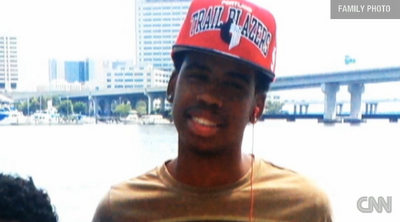
Jordan Davis spent his last night hanging out with a group of his friends. He, like many American youth, spent the evening laughing and chatting. Shortly after his family celebrated Thanksgiving, he breathed his last breath. Michael Dunn would shoot him to death. Claiming that “he felt threatened” and he “fired his handgun eight times … only after one of the four teenagers in a car threatened him and pointed a shotgun his way,” Dunn hinged his defense on fear and safety—his own.

Yet, according to Davis’ father, “There wasn’t a gun. They were just kids, 17-year-old kids. They have never been in trouble. The kids had no weapon, they had no drugs in the car.” While Davis lost his life, while his friends have been vilified and criminalized in the media, while his family grieves, Dunn is working overtime to construct himself as a victim. While this shooting is yet another that is happening #every36hours involving an African American victim, Dunn’s defense is denying that race matters.

Then there is Shelly Frey, who was killed in front of her two children after she ALLEGEDLY stuffed items into her purse. When confronted by a Wal-Mart security guard, Frey, “ran to a car — that had two small children in it — and mashed the accelerator as he attempted to open the door.” In response, he fired one deadly shot into the car, fatally wounding her. Yet, again, claims of fear and suspicion justify the aftermath. Thomas Gilliland, spokesperson for Harris County Sheriff’s Office, offered additional justification noting: “I think it knocked him off balance and, in fear of his life and being ran over, he discharged his weapon at that point.” He added, “He confronted the suspects at the exit of the store before they left. One female wouldn’t stop, struck the deputy with her purse, and ran off.”

And while some will note that the off-duty officer who was moonlighting at a security guard was African American to deny the racial implications, race always matters. In a country where black is suspicious, where the site of a black body compels fear, where stereotypes lead people to see things that aren’t actually happening, to note weapons that are never found, can we ever talk about fear, danger, and suspicion away from race. “The frightening thing, if you are a young African-American man, is that you know nothing makes some folks feel more ‘threatened’ than you,” writes Leonard Pitts. “Nor do you threaten by doing. You threaten by being. You threaten by existing. Such is the invidious result of four centuries of propaganda in which every form of malfeasance, bestiality and criminality is blamed on you.”

The consequences of racism are clear from Jordan Davis to Trayvon Martin and from Rekia Boyd to Shelly Frey. A report from the Malcolm X Grassroots Movement (MXGM) entitled, “Report on Extrajudicial Killings of 110 Black People,” highlights the epidemic of killings, by police, security guards, and others empowered to “protect and serve.” A great number of killings, the police and others have justified shootings with claims of self-defense, fear, suspicion, and alleged weaponry.

  • Stephon Watts, a boy with Asperger’s Syndrome was shot and killed after police claimed he “lashed out with a kitchen knife.”
  • Justin Sipp lost his life after an off-duty police officer “thought Sipp looked suspicious.” Following a routine “traffic stop for broken tail light” and argument,
  • Dante Price was shot 22 times by security guards who claim he tried to run them over with his car.

Sadly there are many more cases – Rekia Boyd, Canard Arnold, and Dakota Bright, just to name a few. To be sure, racism is at the center of each one.

Continue reading @ Fear of a Black Body | The Feminist Wire.

Revealing the Stigma Against Tattooed Athletes

Revealing the Stigma Against Tattooed Athletes

Dr. David J. Leonard

Dear Mr. Whitley:


I recently decided to take a break from public writing; I needed to catch my breath, to catch up on life, work, and recharge. Yet, after reading your most recent piece about Colin Kaepernick, I found myself unable to shake my anger; your words had gotten under my skin.


From the first sentence in your column — “San Francisco’s Colin Kaepernick is going to be a big-time NFL quarterback. That must make the guys in San Quentin happy” — to your description of people with tattoos as looking as though they are on parole, you make clear that you see a tattooed body as a criminal body. You question Colin Kaepernick because he looks “like a criminal.” This makes me wonder if you think he looks like a criminal because he has tattoos or because he has tattoos and he is black. To me, he looks like a chef, a college student, a soldier, or one of the many professors that I know who are covered with tattoos. He looks like many of the 20-30 percent of Americans who currently sport ink.


And so what if he looks like someone locked up in one of America’s many prisons? I know the extent of your knowledge of the criminal justice system begins with Cops and ends with Lockout, but did you know that the vast majority of America’s incarcerated are nonviolent drug offenders? Did you know or care that they are people — mothers and fathers; sons and daughters; brothers and sisters. Why is looking like someone who has gone to prison such a bad thing in your mind? Your comfort in imagining those locked up as violent criminals, as “tatted thugs,” gives me pause. I mean your entire argument is premised on fact that “criminals” have tattoos and therefore why would any person want to have a tattoo. Maybe you should do some research about the millions of incarcerated people, and those on probation and parole; hopefully that would lead you to be a little less callous. To lament Kaepernick’s inked arms by demonizing incarcerated people is reprehensible.


And forgive me if I don’t buy your claim that your point isn’t about race. Forgive me if I don’t buy the explanation that race isn’t an issue because you have two adopted African American daughters, or because your editor is black. Is it just a coincidence that you lament tattoos in sports by focusing on their place on African American bodies? I must have missed your exposés on Josh Hamilton and the death of America’s pastime. Your piece on Danica Patrick and NASCAR’s tattoo problem must have been left on the editing room floor. And yes, I realize that you note that Ben Roethlisberger and Alex Smith both have tattoos, yet they seem to get a pass because they aren’t visible. Are tattoos bad or do you have a problem when the ink is visible? You remind me of the person who denies they are homophobic, and claims, “I don’t have a problem with gay people,” but laments the sight of men holding hands or worse, kissing in public. Oh wait, you are that person.


Do you think Tim Duncan and Kevin Durant look like “criminals?” Have you questioned their leadership abilities? I think not. The “NFL quarterback is the ultimate position of influence and responsibility. He is the CEO of a high-profile organization, and you don’t want your CEO to look like he just got paroled.” Those are your words. Did you know that Barry Goldwater, Antonio Villaraigosa , Senator Jim Webb, Rep. Duncan Hunter, and John F. Kennedy, Jr. all had tattoos? Does this change your opinion of them? What about President Franklin D. Roosevelt, Winston Churchill (and his mom), President Theodore Roosevelt, King George V, and Thomas Edison? All tatted! This isn’t surprising, as among the elite tattoos have a long history. Throughout the early part of the twentieth century, aristocracy often got tattoos as evidence of their sophistication, cultured ethos, and worldly cosmopolitanism. Maybe before your next column about tattoos you should do a little reading about the subject you are writing about, rather than recycling stereotypes.


Your column mirrors so much of today’s lamenting discourse, which bemoans the changing racial demographics, the shifting cultural values, and the challenges to white male heterosexual power. It works through your own nostalgia, all of which seems wrapped up in your own racial assumptions. In sounding like Mittens O’Reilly and those afflicted with White Delusional Disorder (WDD), I can’t help but think this is all about your racial anxiety. Do you fear what will happen if the bastion of white masculinity — the quarterback position — is challenged not just by Cam Newton, but also by tatted Colin Kaepernick? “If you can’t draw the tattoo line at NFL quarterback, you can’t draw them anywhere.” Why is there an impulse to draw a line in the first place and how empowered you do draw such boundaries? How does this represent your desire to contain bodies? I can’t but see your column as part of a long line of efforts to police black bodies. Does the sight of Kaepernick’s ink body lead you think that he might be “bad boy black athlete” (Collins 2005, p. 153) and not “Tim Tebow.” We know that contemporary sports culture consistently represents black male athletes as “overly physical, out of control, prone to violence, driven by instinct, and hypersexual.” Are tattoos and blackness seen as inseparable? Or does ink mean something depending on the body it is attached to? While you seem OK in using tattoos as evidence of worthiness, as markers of being “unruly and disrespectful,” “inherently dangerous” and “in need of civilizing” (Ferber 2007, p. 20), I am not.

Continue reading @ Dr. David J. Leonard: Revealing the Stigma Against Tattooed Athletes.

NewBlackMan (in Exile): At the Borderlands of Mass Incarceration: A Review of Middle of Nowhere

At the Borderlands of Mass Incarceration: 
A Review of Middle of Nowhere
by David J. Leonard |
NewBlackMan (in Exile)

With all the talk within social media circles since Ava DuVernay won best director at the Sundance Film Festival, I cannot remember anticipating a film as much I anticipated Middle of Nowhere. While a testament to the film’s use of social media, my excitement reflected its storyline and its offering of a humanizing story. The New York Times aptly described the film as follows: a “poignant portrait of Ruby (Emayatzy Corinealdi), a nurse doing hard time in emotional limbo while her husband serves a prison sentence.” The Los Angeles Times summarizes the film’s story as somewhat classic with a story of marital crossroads, personal transformation, and self discovery: “the focus is on the couple’s relationship and, gradually, on a different kind of journey that Ruby is making, the classic one of self-actualization, of finding yourself when you feel emotionally in the middle of nowhere, a journey that allows for no shortcuts or easy answers.” While the film does play upon dominant themes, its embrace of tropes and themes specific to the history of African American film, and its intervention in the hegemony of dehumanizing narratives, especially those surrounding prisons, illustrates a film that is battling and challenging in a myriad of ways.

Middle of Nowhere gives voice to an all-too-familiar circumstance facing million of American families, particularly those of color. It chronicles the impact of mass incarceration on families, living on the outside, with relatives on the inside. According to a report entitled “Children of Incarcerated Parents,” in 2007 America was home to 1.7 million children (under 18) whose parent was being held in state or federal prison – that is 2.3 percent of American children will likely be celebrating father’s day away from dad. Despite hegemonic clamoring about family values, the prison industrial complex continues to ravage American families. Since 1991, the number of children with a father in prison has increased from 881,500 to 1.5 million in 2007. Over this same time period, children of incarcerated mothers increased from 63,900 to 147,400. Roughly half of these children are younger than 9, with 32 percent between the ages of 10 and 14. This reality is not just about children but about families forced to live at a crossroads between lack – of contact, lack of physical contact – and desire – to be free, to touch, to be with family. It is a reality that separates families and pushes members farther and farther apart. On average, children live 100 miles away from their incarcerated parents. This is the same of partners, and other family members, who are dislocated, punished and literally left out in the cold.

Chronicling the story of Ruby and Derek (Omari Hardwick) Middle of Nowhere shines a spotlight on trickle down incarceration, whereupon arrests and imprisonment travel downstream to the detriment of both families and communities. From Ruby’s conflict with her mother over her decision to wait for her husband to be released from prison to her choice to forgo medical school for a career in nursing because of their financial needs; from Derek’s inability to pay child support to his daughter’s mom, to the amount of time families must spend on buses just to remain connected to their loved ones; Middle of Nowhere brilliantly reveals the costs and consequences of mass incarceration. Derek is literally stuck in the middle of nowhere, detached geographically, physically, emotionally – he cannot see his daughter; his wife cannot kiss him. With no his release precarious at best and his future bleak given the lifetime sentences resulting from felony convictions, Derek is resigned to the middle of nowhere, existing without any paths toward freedom or even existence. It is not just Derek and his fellow incarcerated men and women housed in places like Victorville are confined to the middle of nowhere, hidden behind barbered wire fences, walls, and isolation, but their families as well.

Continue reading 2 NewBlackMan (in Exile): At the Borderlands of Mass Incarceration: A Review of Middle of Nowhere.

NewBlackMan (in Exile): Real Consequences: The War on Drugs, the New Jim Crow and the Story of Jonathan Hargett

Sean Proctor for The New York Times

Real Consequences:

The War on Drugs, the New Jim Crow and the Story of Jonathan Hargett

by David J. Leonard | NewBlackMan (in Exile)

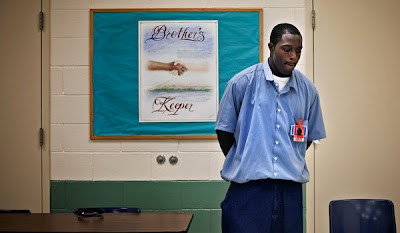
Most basketball fans have never heard of Jonathan Hargett. A basketball legend with immense potential, Hargett never fulfilled this promise. In a recent piece, The New York Times sought to explain this unfulfilled potential, chronicling his story as not just tragic but a cautionary tale.

Pete Thamel’s story is one that begins and ends with the basketball court. It replicates the popular narrative of the African American baller whose immense talents and endless potential were derailed by pathological behavior, a lack of discipline, and a system that did little to curtail these bad behaviors. In an effort to highlight this tragic story, Thamel imagines the tragedy through his greatness on the court, seemingly reducing Hargett’s story to one of talent left to rot in the fields.

Noting how Amar’e Stoudamire, Kevin Durant, and Carmelo Anthony have noted his greatness, Thamel uses their assessment to not only authenticate the wasted potential but to make clear the American Dream that could have been; yet, his life is more nightmare and according to “‘What Happened to Him?’” that isn’t because of a lack of talent or opportunity:

His signature move was his ability to freeze an opponent with a crossover dribble, then blow past him toward the basket, lobbing the ball off the backboard and catching it and dunking it with one hand. It became known simply as a Hargett.

“Especially when you’re talking about memories and things like that from high school basketball and A.A.U. basketball, he’s definitely one of the names that comes up,” Anthony said. “What happened to him?”

The answer is jarring and sadly predictable. Hargett, who turns 30 this weekend, is an inmate at the medium-security Indian Creek Correctional Center here, serving the final months of a nearly five-year sentence for drug possession with intent to sell.

Thamel’s answer is rife with simplicity and stereotypes. We are told over and over again that Hargett ended up in prison rather than the NBA simply because of his own demons and the failures of those around him to save him. Having lost his father, who died of pneumonia, Hargett grew up with his mom and 6 siblings.

Hargett’s mother, Nancy, worked multiple jobs to help support her six children. With his mother often working and no father figure around, Hargett began to form bad habits. Lancaster said that after Hargett’s ninth-grade year, he began showing up late to practice, and Lancaster noticed an entourage beginning to form around him.

In other words, the death of his father, the failures of his mother, and the influences of the street derailed Hargett’s greatness on the court. Lacking the necessary discipline, focus, and ability to see beyond the present, Hargett spent more time smoking marijuana than honing his craft. He eventually became addicted to marijuana, leading him on a path to prison rather than the NBA. For Thamel, Hargett’s own personal failures and demons are only part of the answer as to “why” or “what happened” to Hargett, as the other part of the story rests with the culture of sports.

A story about agents, handlers, and others who saw Hargett as a dollar sign, as an amazing talent who could line their pockets in the long run, Thamel (and others) treat Hargett as an expose about the pitfalls and dangers of contemporary sports. At its core, it really frames the narrative along these lines (in the words of Hargett himself): “The moral of this whole story is to help someone not to make the same mistakes.” In other words, the story that is offered here is one that imagines him as someone who made bad choices because of a lack of discipline and values (“culture of poverty”). Worse, his own failures are exacerbated by a system that never held him accountable. His fate wasn’t simply the result of his own failings but that of a system based in the exploitation and abuse of vulnerable young men like Hargett, whose talent insulates from the necessary discipline. These personal and institutional failings end with his incarceration.

Continue reading @ NewBlackMan (in Exile): Real Consequences: The War on Drugs, the New Jim Crow and the Story of Jonathan Hargett.