So You Want to Talk Solutions? White Denial and the Change Question (Part 1)

So You Want to Talk Solutions?

White Denial and the Change Question (Part 1)

David J. Leonard

One of the common responses to discussions about racism and other forms of injustice is the demand for solutions. The commonplace entry into public and private discussions about racism, the efforts to take over comment sections, to silence those who work to highlight inequality with responses like “what’s the solution” does not engender solutions but rather works to derail the conversation. Usually deployed alongside the descriptor of wining and complaining, this disingenuous demand (as opposed to a desire to figure out the path toward justice) for solutions illustrates the manner that white male privilege operates. In my many years of teaching and writing, the majority of those who felt entitled to have answers NOW and remedies yesterday were white men. The “shut up… stop complaining…give me solutions” reframe is the embodiment of privilege.

Recognizing our forms of denial and challenging our social and racial myopia is the solution. Refusing to accept the lies and distortions, the misinformation and stereotypes is a remedy. However, for those who are desperate for solutions, who feel disappointed with our collective failure to provide a road map toward justice you don’t have to look any further, I got you.

Reparations: Given the history of racist violence, evident in slavery, Native American genocide, Jim Crow, forced sterilization, racist immigration laws, the conquest of Southwest and other crimes against humanity, I think reparations are in order. “Sorry isn’t enough!” According to the National Coalition of Blacks for Reparations in America (NCBRA):

A necessary requirement of all forms of reparations is an acknowledgment by the government or corporation that it committed acts that violated the human rights of those making the claim for reparations. Some groups may want an explicit apology; however, neither the acknowledgement nor apology is sufficient – there must be material forms of reparations that accompany the acknowledgment or apology. Reparations can be in as many forms as necessary to equitably (fairly) address the many forms of injury caused by chattel slavery and its continuing vestiges. The material forms of reparations include cash payments, land, economic development, and repatriation resources particularly to those who are descendants of enslaved Africans.’

Financial restitution, especially given the amount of wealth generated through white supremacy, because of enslavement, genocide, and exploitation, is a necessary step of racial reconciliation. White financial and political success has been predicated on white racism. Malcolm X rightfully destroys the myth of meritocracy, bootstraps, and the white protestant work ethic as reasons for success:

If you are the son of a man who had a wealthy estate and you inherit your father’s estate, you have to pay off the debts that your father incurred before he died. The only reason that the present generation of white Americans are in a position of economic strength…is because their fathers worked our fathers for over 400 years with no pay…We were sold from plantation to plantation like you sell a horse, or a cow, or a chicken, or a bushel of wheat…All that money…is what gives the present generation of American whites the ability to walk around the earth with their chest out…like they have some kind of economic ingenuity. Your father isn’t here to pay. My father isn’t here to collect. But I’m here to collect and you’re here to pay. (From By Any Means Necessary, New York: Pathfinder Press, 1970, 123.)

Prison abolition: The history of America’s prison systems and the criminal justice system as a whole is wrought with racism. As Angela Davis remarks,

In order to imagine a world without prisons — or at least a social landscape no longer dominated by the prison — a new popular vocabulary will have to replace the current language, which articulates crime and punishment in such a way that we cannot think about a society without crime except as a society in which all the criminals are imprisoned. Thus, one of the first challenges is to be able to talk about the many ways in which punishment is linked to poverty, racism, sexism, homophobia, and other modes of dominance.

America’s addiction to incarceration requires dramatic intervention. No reform will suffice given the entrenched nature of the criminal (in)justice system within every institution, from the political to the educational, from the cultural to the economic. The systemic incarceration of people of color, of the poor, represents an assault on families, communities, and a betrayal of the principles of equality, fairness, and democracy.

via Dr. David J. Leonard: So You Want to Talk Solutions? White Denial and the Change Question (Part 1).

NewBlackMan (in Exile): Real Consequences: The War on Drugs, the New Jim Crow and the Story of Jonathan Hargett

Sean Proctor for The New York Times

Real Consequences:

The War on Drugs, the New Jim Crow and the Story of Jonathan Hargett

by David J. Leonard | NewBlackMan (in Exile)

Most basketball fans have never heard of Jonathan Hargett. A basketball legend with immense potential, Hargett never fulfilled this promise. In a recent piece, The New York Times sought to explain this unfulfilled potential, chronicling his story as not just tragic but a cautionary tale.

Pete Thamel’s story is one that begins and ends with the basketball court. It replicates the popular narrative of the African American baller whose immense talents and endless potential were derailed by pathological behavior, a lack of discipline, and a system that did little to curtail these bad behaviors. In an effort to highlight this tragic story, Thamel imagines the tragedy through his greatness on the court, seemingly reducing Hargett’s story to one of talent left to rot in the fields.

Noting how Amar’e Stoudamire, Kevin Durant, and Carmelo Anthony have noted his greatness, Thamel uses their assessment to not only authenticate the wasted potential but to make clear the American Dream that could have been; yet, his life is more nightmare and according to “‘What Happened to Him?’” that isn’t because of a lack of talent or opportunity:

His signature move was his ability to freeze an opponent with a crossover dribble, then blow past him toward the basket, lobbing the ball off the backboard and catching it and dunking it with one hand. It became known simply as a Hargett.

“Especially when you’re talking about memories and things like that from high school basketball and A.A.U. basketball, he’s definitely one of the names that comes up,” Anthony said. “What happened to him?”

The answer is jarring and sadly predictable. Hargett, who turns 30 this weekend, is an inmate at the medium-security Indian Creek Correctional Center here, serving the final months of a nearly five-year sentence for drug possession with intent to sell.

Thamel’s answer is rife with simplicity and stereotypes. We are told over and over again that Hargett ended up in prison rather than the NBA simply because of his own demons and the failures of those around him to save him. Having lost his father, who died of pneumonia, Hargett grew up with his mom and 6 siblings.

Hargett’s mother, Nancy, worked multiple jobs to help support her six children. With his mother often working and no father figure around, Hargett began to form bad habits. Lancaster said that after Hargett’s ninth-grade year, he began showing up late to practice, and Lancaster noticed an entourage beginning to form around him.

In other words, the death of his father, the failures of his mother, and the influences of the street derailed Hargett’s greatness on the court. Lacking the necessary discipline, focus, and ability to see beyond the present, Hargett spent more time smoking marijuana than honing his craft. He eventually became addicted to marijuana, leading him on a path to prison rather than the NBA. For Thamel, Hargett’s own personal failures and demons are only part of the answer as to “why” or “what happened” to Hargett, as the other part of the story rests with the culture of sports.

A story about agents, handlers, and others who saw Hargett as a dollar sign, as an amazing talent who could line their pockets in the long run, Thamel (and others) treat Hargett as an expose about the pitfalls and dangers of contemporary sports. At its core, it really frames the narrative along these lines (in the words of Hargett himself): “The moral of this whole story is to help someone not to make the same mistakes.” In other words, the story that is offered here is one that imagines him as someone who made bad choices because of a lack of discipline and values (“culture of poverty”). Worse, his own failures are exacerbated by a system that never held him accountable. His fate wasn’t simply the result of his own failings but that of a system based in the exploitation and abuse of vulnerable young men like Hargett, whose talent insulates from the necessary discipline. These personal and institutional failings end with his incarceration.

Continue reading @ NewBlackMan (in Exile): Real Consequences: The War on Drugs, the New Jim Crow and the Story of Jonathan Hargett.

NewBlackMan (in Exile): The Politics of Sex, The Principle of Pleasure

The Politics of Sex, The Principle of Pleasure

by David J. Leonard | NewBlackMan (in Exile)

In a society that routinely demonizes women, particularly women of color, because of sexuality, that rationalizes sexual violence through tropes and narratives of hyper sexuality, that sanctions and ignores sexual harassment, and that polices the clothing, the bodies, and sexualities of women, any discussion of sexuality is immensely political. In a country defined by a history of sexual violence, one where white masters routinely raped African American women and justified their violence with references to black female sexuality, the politics of pleasure are never simply a frivolous exercise.

We live in a society where men and women get messages about whose pleasure matters, who has ownership over another’s body, where women, particularly women of color, are reduced to some of one’s parts; the questions around sexuality and pleasure are immensely political.

How else do we explain the pornographic standard of male orgasms? How else do we explain popular culture emphasis on male-gaze, one that places women as objects to be consumed along a pathway to pleasure? How else do we explain what Heidi R. Lewis’ highlights in her brilliant article (“Li’l Wayne and the New Politics of Cunnilingus in Hip Hop”), where she documents the relationship between hip-hop and cunnilingus (which led to countless conversations). How else might we explain the narratives about giving a woman oral pleasures (“cranial maneuvers”) as “gross,” “dirty” “nasty” and otherwise “unnormal”?

Continue reading @ NewBlackMan (in Exile): The Politics of Sex, The Principle of Pleasure.

Racism Ain’t Natural: Skip Bayless, RG3, And White Fans | Racialicious – the intersection of race and pop culture

Washington quarterback Robert Griffith III. Courtesy: The Grio/ESPN.

Racism Ain’t Natural

By Guest Contributors David J. Leonard and C. Richard King

The Washington R*dskins (given the history and meaning of this term, we have decided to disidentify with its accepted name) sparked a minor controversy with their selection of two quarterbacks in this year’s NFL Draft. The franchise had given multiple draft picks to move up in the first round to select Robert Griffin III and then surprised many fans and pundits by picking Kirk Cousins, suggesting the latter was a developmental project, who would be groomed with an eye toward a future trade.

For a team hurting at almost every position, this move struck many as imprudent at best. Simply, the R*dskins decided to draft Griffin, a.k.a, “RG3,” last year’s Heisman Trophy winner, for being the best college football player in America. Despite their weakness at virtually every position, the selection of Cousins, who was less vaunted and certainly less heralded at Michigan State, raised eyebrows because some saw him as someone with tremendous upside and potential to start one day. This decision undercut Griffin as leader, as franchise player, and as the future from day one.

Enter ESPN pundits Skip Bayless and Stephen A. Smith, who have emerged as the sports version of the old CNN show Crossfire.Without a quarterback controversy to speak of, Bayless has created one. As our combustible elements, and avatars of the sports punditry industry, Bayless and Smith are often a bigger story than the athletes himself.

It is fair to say Smith is known for bringing a type of “blackness” to his commentary while Bayless paints himself as being “traditional” despite his unfair and unbalanced sports commentary. Bayless, long castigated for his unrelenting criticism of LeBron James and Terrell Owens as well as a fascination with media darling Tim Tebow, embodies the reactionary racial politics of today’s mainstream sports media.

Bayless, in signature over-the-top style, pushed the supposed controversy between the franchise quarterback and his probable back-up. Not content to limit his comments to talent, performance, or potential, Bayless reduced the debate to racial identification, transforming the quarterback controversy into a simplistic conversation about race:

Even though we’ve come a long long way, with black quarterbacks, and they have been consistently been taken high in the draft over the last 15 years, I’m not sure we’ve come all that far in protecting said black quarterback, publicly protecting. So now you’ve drafted another rookie who’s not a black quarterback, and it sets up wrong for RGIII on a racial component level. I’m sorry. It just does.

Smith responded by noting the racial demographics of Washington D.C. In his estimation, Griffin has little to worry about because he is playing in “Chocolate City.”

Continue reading @ Racism Ain’t Natural: Skip Bayless, RG3, And White Fans | Racialicious – the intersection of race and pop culture.

An Open Letter To Ruben Navarrette, Jr. from Alexandro Jose Gradilla and David J. Leonard

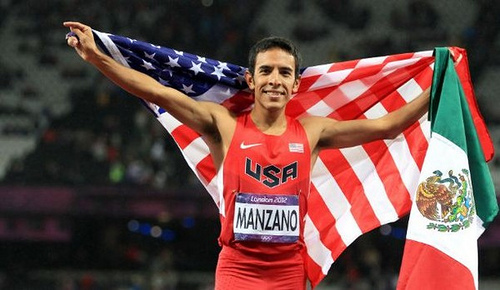
U.S. Olympic silver medalist Leo Manzano. Courtesy: examiner.com


Dear Mr. Navarrette,

We are writing to you in regards to your recent piece criticizing American Olympic silver medalist Leo Manzano for waving his native Mexican flag alongside the U.S. flag following his performance in the men’s 1500-meter finals.

Like many people, we were struck by not only its divisiveness–its desire to undermine the life and successes of Manzano to make a political point–but your dismissive tone to anyone who doesn’t agree with you. We were also struck by your efforts to pathologize those who don’t agree with you, to seemingly mock and ridicule those who see the world differently than you (“Most Mexican-Americans I know would need a whole team of therapists to sort out their views on culture, national identity, ethnic pride and their relationship with Mother Mexico”). We were also struck by the simplicity of your discussion of history, immigration, and sports, which you seem to think is outside the realm of politics.

Ruben, you write, “This country took you in during your hour of need. Now in your moment of glory, which country deserves your respect–the one that offered nothing to your parents and forced them to leave or the one that took you all in and gave you the opportunity to live out your dreams?”

Waiter, can we have a side of facts with this hyperbole and cliché?

Yes, Manzano arrived in the United States at the age of 4. In 1987, his father, Jesús, who was working in the United States without authorization, secured permanent residency. Soon thereafter, he would gain his green card, ultimately sending for his family.

Leo was born in central Mexico, a place “where education ceased by fourth grade, running water did not exist and electricity was practically unheard of.” While certainly a life of poverty, to say that his country offered him “nothing” is one of tremendous disrespect. Worse yet, you erase history; you erase the ways that the United States and globalization has impacted Mexico. In recent times the United States through its neo-liberal policies such as the Bracero Program (1942-1964), Border Industrialization Program, a.k.a “maquiladoras” (1964-1996) and finally the North American Free Trade Agreement (NAFTA), have slowly destroyed the traditional if not Jeffersonian agrarian society that provided self-sufficiency and subsistence.

continue reading @ An Open Letter To Ruben Navarrette, Jr. | Racialicious – the intersection of race and pop culture.

Dr. David J. Leonard: Innocence Lost in Colorado? For Whom?

Innocence Lost in Colorado? For Whom?

The violent killing of 12 people and wounding of 58 in Aurora, Colo., has, not surprisingly, prompted national attention. And while the concern and unease are understandable, I ask why this moment compels national conversations about life and death, about guns, about safety, about mental health, and about tragedy, when countless other horrific moments don’t elicit similar sadness and outage. Clearly, all of these emotions, the shock and the desire to understand how/why this happened stem from a belief that such violence is not supposed to happen “there,” that it is not supposed to impact suburban communities, that it is not supposed to involve shooters who look like James Holmes. Although the media imagines this act of domestic terrorism as “unthinkable” and “beyond explanation” — since Holmes is just a normal (white, middle-class) kid — it also portrays the violence as extraordinary, as fostering fear and anxiety where it didn’t exist before.

Ian Landau epitomizes this sense of innocence lost that pervades the media coverage with “Colorado Movie Theater Shooting Shatters Our Sense Of Safety”: “Traditionally in America movie theaters are a safe, family environment where everybody goes and settles down into the dark,” notes New York psychiatrist Alan Manevitz. “You can watch a scary movie because you know you’re safe in the movie theater and can enjoy the experience. The Aurora shooting has suddenly turned that upside down. That presumption of safety gets shattered and you feel the vulnerability at that moment.”

Beyond the erasure of cinematic violence and a larger history of racist images on screen, the imagination of lost innocence speaks to the powerful ways that race and class matters. For communities of color, innocence remains a dream deferred. In America, only certain kids are entitled to “innocence,” so much so that denied innocence and systemic exposure to violence is both normalized and accepted.

Normalizing the experiences of (white) middle-class suburbia, the media response has not only privileged this idealized space but has imagined it as a tragedy of immense proportions because of the shattered innocence that is predicated on an assumption of white privilege. “Is there anything more innocent than a child eating popcorn and sipping Coke with the lights of a movie screen reflecting off his face?,” writes Bert Weiss. “Is there any place I can feel my children are totally safe? Rather than being excited to share this movie together, now I’ll spend a considerable amount of time addressing what happened in that theater with my sons. Frankly, I wish someone could explain it to me. As a parent, I wish I could postpone the reality of conversations like this for just a little longer; keep my kids innocent for as long as possible.” Would Mr. Weiss describe a movie theater within America’s inner cities as “safe places”; would he paint such a rosy picture if his children ran the risk of being stop and frisked on their way to the movies? Within the national imagination, there remains a dividing line whereupon violence at certain premiers and at certain theaters is both expected and accepted.

Erasing the fears produced by racial profiling, stop-and-frisk policies, political brutality, extrajudicial killings and the violence that plagues communities throughout the United States, the heightened media and political concern points to the power of whiteness.

Continue reading @ Dr. David J. Leonard: Innocence Lost in Colorado? For Whom?.

‘Soul Food Junkies’ Offers a Window Into Black America’s Food Culture | Urban Cusp

‘Soul Food Junkies’ Offers a Window Into Black America’s Food Culture

By David J. Leonard

In 2007, Byron Hurt’s father lost his battle with pancreatic cancer. As with many children, Hurt wanted answers. His quest to understand his father’s death was further propelled by his daughter’s birth and his desire to live a long and fruitful life. This serves as the backdrop for his masterful film “Soul Food Junkies.” According to the film’s description:

“Baffled by his dad’s unwillingness to change his traditional soul food diet in the face of a health crisis, Hurt sets out to learn more about this rich culinary tradition and its relevance to black cultural identity. He discovers that the love affair that his dad and his community have with soul food is deep-rooted, complex, and in some tragic cases, deadly.”

In trying to understand and process this death, he turned his attention to his father’s love affair with soul food, a source of contention throughout his life. Hurt, the film’s head chef, sous chef, pastry chef, and maître de (director, producer, writer, and narrator) recalls how Sunday breakfast at his house was a time where the family would come together to share a meal. A time where as a young child he not only ate the foods his father ate but did so in the exact same way as his father. It was in this space that he ultimately confronted his past and future.

One morning, he decided to eat just his eggs and grits, leaving the salt pork and bacon alone. This decision was not simply a dietary choice but one implicated in family, tradition and identity. His refusal to eat everything made his father uncomfortable. Whether it be because he felt rejected or whether he thought his son was turning his back on black culture, he left an impression, illustrating the power and importance of (soul) food. As noted by Anthelme Brillat-Savarin in 1826, “tell me what you think you eat, and I will tell you who you think you are.” “Soul Food Junkies” shows truth here, but pushes the conversation to highlight the truth of this as well: “Tell me what you think you eat, and I will tell you where you live.”

The greatness of “Soul Food Junkies” is its ability to seamlessly navigate viewers through a myriad of issues. Hurt explores the power of soul food given its history, given its connection to the identity, community, family, and memory. He highlights the ways in which soul food has served as a glue or foundation for families, communities, and even the civil rights movement.

Yet, Hurt pushes the conversation beyond cultural or identity explanations for soul food, reflecting on context and the larger social forces that have effected the recipes and the production of food for centuries. In addition to the connection between slavery and soul food, Hurt documents the ways in which foodways have been impacted by Jim Crow and by post-1960s de facto segregation. For example, the realities of Jim Crow impacted the ways African Americans travelled for many decades. The development of the Green book – which provided how-to advice and insight about traveling within the Jim Crow south – the creation of “shoe box lunches” contributed to foodways in that era. Food was thus constrained by the realities of American apartheid.

“Soul Food Junkies” brings the importance of context into the contemporary. It expands the discussion beyond tradition and beyond soul food, to reflect on how fast food and processed food is threatening the health and wellness of the black community. It sadly documents how diabetes and high blood pressure have become part of the life cycle for black America; it too is emerging as a tradition of sorts. Yet, Hurt pushes back against those who simply scapegoat soul food. At one level, he challenges those who see fried chicken, ham hocks, mac and cheese, and red velvet cake as authentic African American cuisine, instead arguing that the history of American foodways is one of great diversity.

Continue reading @ ‘Soul Food Junkies’ Offers a Window Into Black America’s Food Culture | Urban Cusp.