NewBlackMan in Exile: Freeloading Muppets: Mitt, the Conservative Right and its Assault on Sesame Street

Freeloading Muppets:

Mitt, the Conservative Right and its assault on Sesame Street

by David J. Leonard

| NewBlackMan in Exile

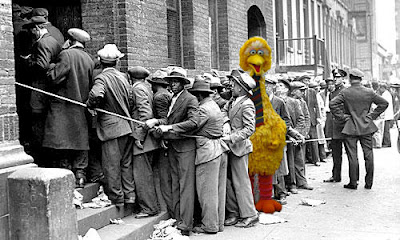
During last night’s presidential debate, which was lackluster to say the least, Mitt Romney finally unveiled some specifics as it relates to his slash the deficit, taxes, and spending economic plan – the “no reason to hope, the future will be grim” plan. He announced his desire to defund PBS, which according to Neil deGrasse Tyson, accounts for .012% of the federal budget. His war on Muppets prompted a deluge of social media posts ranging from images of an unemployed Big Bird to an angry Elmo seeking revenge.

While reflecting people’s anger and anxiety about the nature of the political process, his oft-handed remark is revealing. At one level, it demonstrates the Republican Party’s opposition to public support for institutions and organizations that advance a social good. It represents their contempt for the social contract. At another level, it embodies an ideological movement that promotes divestment from public education, health care, and countless other social programs. The recasting of Cookie Monster, Grover, and Snuffy as freeloading welfare recipients constitutes a continuation of the GOP’s structural adjustment program that started some thirty years ago. Whether or not Mitt Romney like’s Big Bird, or public teachers, firefighters, or health care workers is irrelevant.

The gutting of public higher education throughout the nation, the destruction of America’s parks and recreation facilities, and now the proposed foreclosure on Sesame Street is part of a larger movement to divested from public support and institutions, that which is utilized by the middle-class, working-class and America’s poor. It is yet another example of the true essence of the GOP AKA POP – Privatization Old Party.

Continue reading @ NewBlackMan in Exile: Freeloading Muppets: Mitt, the Conservative Right and its Assault on Sesame Street.

My newest piece @NewBlackMan: Elmo and the “Beloved Community”: The Conservative Right’s Assault on Sesame Street

Elmo and the “Beloved Community”:

The Conservative Right’s Assault on Sesame Street

by David J. Leonard | NewBlackMan

Over the summer, Ben Shapiro, while making an appearance on Fox News’ Hannity, “jokingly” announced his desire to “cap” the characters of Sesame Street. He followed this up with more “serious” criticisms, denouncing America’s favorite kid’s show because of its “soft bigotry of low expectations,” its promotion of “gender neutral language,” and its advocacy to “give boys dolls and girls fire trucks.” The other members of Hannity’s “great all-American” panel similarly spoke about the downgrading of America’s moral fabric, seemingly linking the messages of Sesame Street to the cultural wars. The Huffington Post describes his criticism of Sesame Street in the following way:

Chief amongst Shapiro’s alleged liberal offenders is Sesame Street, the Jim Henson-created educational show carried on PBS, the public network with few conservative fans or defenders.

Citing interviews with one of the show’s creators, early episodes of the show featuring hippies and racial reconciliation and, more recently, incidents such as 2009′s “Pox News” controversy, Shapiro writes that “Sesame Street tried to tackle divorce, tackled ‘peaceful conflict resolution’ in the aftermath of 9/11 and had Neil Patrick Harris on the show playing the subtly-named ‘fairy shoeperson.’”

Patrick Harris, to Shapiro’s chagrin, is gay. And, even scarier, Cookie Monster says cookies are only a sometimes food now; the venerable sweets machine has added fruits and vegetables to his diet, indicating a major liberal plot.

On Martin Bashir’s show on MSNBC, Shapiro similarly denounced children’s television for promoting “a self-esteem ethos, the idea that, to paraphrase Barney ‘everyone is special’; an unearned self-esteem.”

The attacks on Sesame Street (and by extension the liberal media and big government intrusion in family matters) are nothing new. A 1992 column in The Economist similarly denounced Sesame Street as a liberal assault on American values:

The problem comes when the sensible tolerance and respect of “Sesame Street” are mutated into something less appealing. First, it becomes a kind of hypertolerance (which argues, for example, that the canon of black female authors is as rich as that of white male authors); which is merely silly. Second, it becomes an intolerance of those who do not practice this hyper-tolerance (so that anyone who argues that a canon of authors who happen to be white and male is better than the one picked by sex and skin color is a racist sexist); which is pernicious. It is the intolerance that has come to be called “political correctness”—or PC (Sesame Street, the acceptable face 1992, A30).

The criticisms that “multiculturalism” or “tolerance” represents a vehicle for the “intolerance” for dominant values (white, Christian, middle-class) that have purportedly been central to America’s historic greatness are common to the broader culture. Equally troubling to those critics of Sesame Street is not only tax-payer support for a program that is neither intended for white-middle class audiences (Shapiro notes the history behind Sesame Street), but in their mind devalues whiteness for the sake of multiculturalism agenda.

To understand this criticism and to comprehend the right’s denunciation of Sesame Street mandates an examination of this larger history and the ways in which Sesame Street has built upon the civil rights movements and those concerned with justice, equality, and fairness. In 1979, The New York Times identified the primary focus of Sesame Street as the “4-year-old inner-city black youngster.” Jennifer Mandel, in “The Production of a Beloved Community: Sesame Street’s Answer to America’s Inequalities,” argues that while the original intended audience for the show was “disadvantaged urban youth” who suffered because of “the limited availability of preschool education” the appeal and impact of the show transcended any particular demographic. While addressing structural inequalities and countering the systemic failures in America’s educational television was part of the show’s mission, it more masterfully offered a utopic vision of America and the broader world.

continue reading at NewBlackMan: Elmo and the “Beloved Community”: The Conservative Right’s Assault on Sesame Street.